
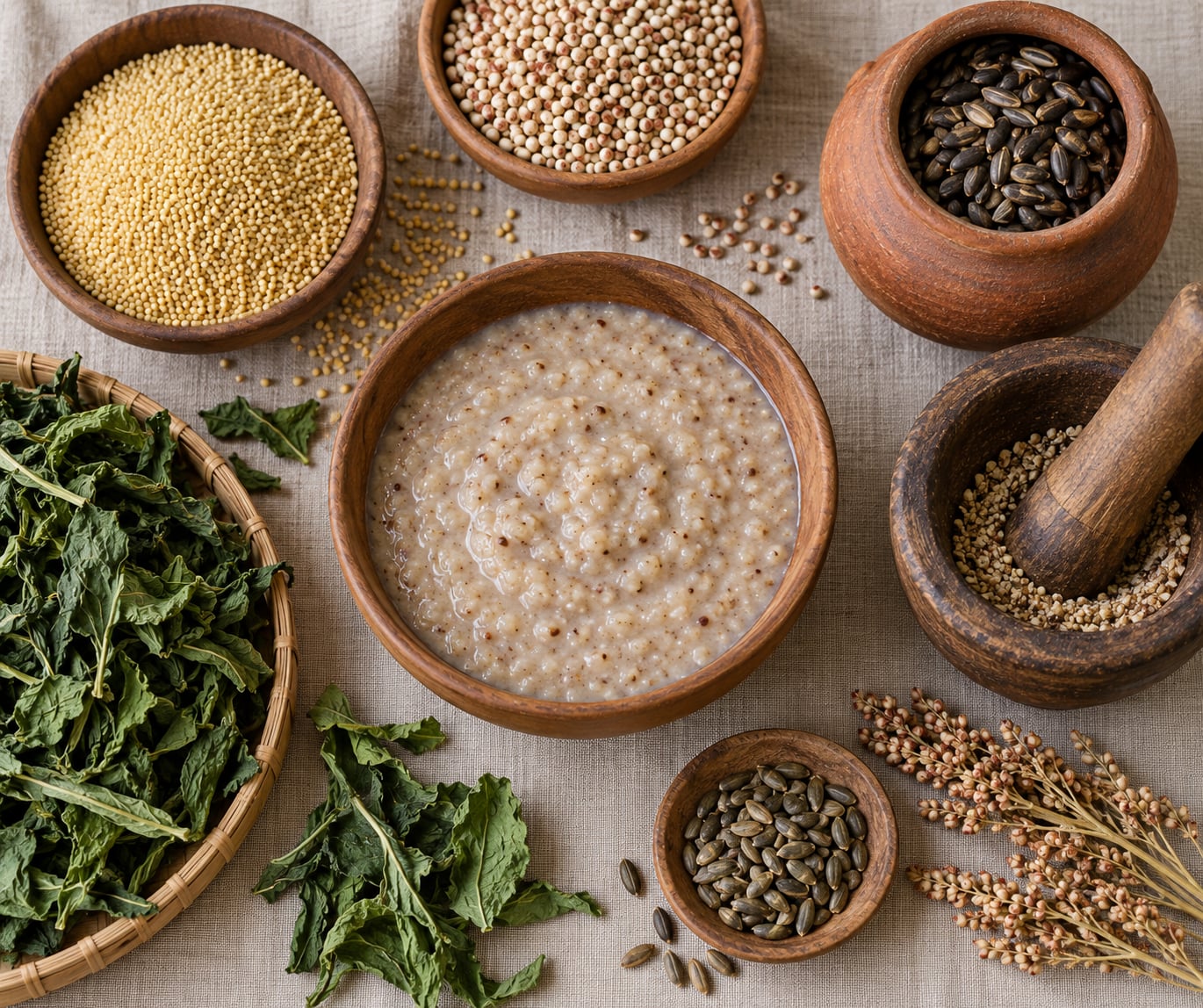
Traditional diets shaped modern nutrition science by supplying its first evidence: generations of observation about which foods kept people well, which preparation methods made staples more nourishing, and which patterns went alongside disease. That knowledge fed laboratory chemistry, shaped food composition tables, and eventually produced the dietary guidelines we use now.
The influence runs in three repeated cycles. Traditions offered observations, then created contrasts that acted like natural experiments, then forced corrections when reductionist nutrient models failed to explain whole patterns. Understanding how traditional diets influenced modern nutrition science matters mostly for researchers and health writers, because most of what nutrition science knows still comes from a narrow slice of populations.
Table of Contents
- 1How Traditional Diets Influenced Modern Nutrition Science
- 2What can nutrition science learn from traditional diets?
- 3How researchers record traditional food knowledge without treating it as laboratory evidence
- 4Which traditional foods and methods shaped early nutrition research?
- 5How did African food systems expand ideas about balanced diets?
- 6What did fermentation, preservation, and processing reveal?
- 7How have traditional diets changed research methods and public health?
- 8What benefits are supported by evidence, and what remains uncertain?
- 9What is the lasting influence on modern nutrition?
- 10Frequently Asked Questions
- 11Were all traditional African diets healthier than modern diets?
- 12Which traditional African foods are most important to preserve?
- 13How can traditional healing claims about foods be checked scientifically?
- 14Where can students begin researching African food and nutrition history?
- 15Can traditional diets replace advice from a doctor or registered dietitian?
- 16Conclusion
How Traditional Diets Influenced Modern Nutrition Science
Before laboratories could measure a nutrient, communities had already worked out which foods sustained heavy labour, which cured an ailment, and which spoiled quickly in a hot climate. Those records were practical rather than scientific, but they were observation at scale and over long spans of time.
Three mechanisms carried that knowledge forward. First, deficiency patterns. Diets that relied on one staple produced recognisable diseases, and researchers who could match those diseases to a missing food component had somewhere to start. Second, contrast. Populations that kept a traditional pattern and populations that shifted away from it offered researchers two versions of the same transition to compare. Third, correction. When isolated-nutrient models failed to reproduce the health of whole traditional patterns, the field had to rethink what a nutrient was.
What can nutrition science learn from traditional diets?
A traditional diet is the habitual pattern of foods, preparation methods and meal structure that a population developed over generations in a particular ecological setting. That usually means whole grains, legumes, tubers, leafy greens, fermented products and locally available animal foods, prepared by drying, fermenting, grinding and ash-roasting rather than industrial processing.
The word traditional covers an enormous range of practice, and treating it as one thing is the fastest way to get a topic wrong. A Maasai diet of milk and blood, a West African mixed dish of a staple with legumes and leafy greens, a Japanese pattern built on fish, soy and rice, and an Andean pattern of tubers with maize all fall under the label while sharing very little.
Two things need separating. Everyday food practice — what a staple is eaten with, how it is milled, when it is eaten — is a well-evidenced object of study and rarely a medical claim. A traditional remedy, a plant used to treat a specific illness, is a different category, and one that needs its own evaluation.
How researchers record traditional food knowledge without treating it as laboratory evidence
Fieldwork usually starts with interviews and kitchen observation, then moves to sampling for laboratory analysis. An ethnobotanical survey records which plants a community uses and for what; a dietary assessment records portion patterns and meal frequency; a compositional analysis measures what is actually in the food; a controlled human trial tests an effect. Each step changes the strength of the claim.
Interview evidence establishes that a practice exists and what it is for. It does not establish that the practice works. That distinction is where most public argument about traditional foods goes wrong, and researchers who state it plainly tend to get better cooperation from the communities they work with.
Which traditional foods and methods shaped early nutrition research?
Certain staples and techniques recur so widely across traditional food systems that they gave nutrition researchers their first real material to work with.
| Food or method | What it contributed | Research question it raised |
|---|---|---|
| Millet and sorghum | Drought-tolerant grains with a coarse outer layer, useful where wheat will not grow | Can a locally adapted staple supply a comparable share of daily energy? |
| Maize | High-yield staple; processing with alkali improves its amino acid profile and unlocks niacin availability | How much does processing change what a food actually delivers? |
| Legumes | Protein and minerals that complement grain-heavy meals | Does a mixed plate behave differently from isolated nutrients studied separately? |
| Leafy greens | High micronutrient density per unit of food, often scarce in urbanised diets | Why does micronutrient density fall when diets diversify toward processed foods? |
| Oil-rich seeds | Concentrated fats and fat-soluble compounds | How should plant fats be positioned relative to animal fats? |
| Fermented foods | Live cultures, lowered acidity, and reduced antinutrients | Can fermentable foods shape the gut microbiome? |
| Soups and stews | Combine several foods in one dish and slow eating down | Does meal structure change intake and satiety signals? |
| Soaking, sprouting, milling | Reduce phytate and improve digestibility | Which traditional processing steps are worth reproducing industrially? |
How did African food systems expand ideas about balanced diets?
Mixed-plate traditions in much of Africa put a staple grain or tuber, a legume, a leafy green, an oil, and sometimes an animal protein in the same meal rather than in separate dishes. Nutrition researchers studying these patterns had to describe a plate instead of a nutrient, which was an awkward fit for early laboratory work built around single-food analysis.
The contribution showed up later as complementary protein thinking and as the development of dietary diversity scores, which count distinct food groups rather than totals. Meal structure mattered too. A stew eaten slowly with shared sides is a different eating event from separated components eaten in any order, and satiety research later gave that difference a mechanism.
Research on heritage diets in Tanzania illustrates the value of this granularity. Work published in Nutrition Research Reviews on the Maasai, Chagga, Pare and Hadzabe maps named foods and preparation techniques per community rather than treating African diet as one thing, and links those traditions to immunomodulatory and cardiometabolic outcomes.
What did fermentation, preservation, and processing reveal?
Soaking, sprouting, fermenting, drying, smoking, salting, milling, boiling and long-cooking are all food safety and digestibility technologies developed out of necessity. They gave researchers concrete processing variables to test rather than abstract questions about diet.
Fermentation has been the most productive. It reduces acidity, lowers some antinutrients, and in many traditions adds live cultures that later became the basis of probiotic research. Traditional grain and dairy ferments — including beverages produced across West African households — turned out to be a natural way to study the microbiome.
Not every traditional method is equally safe or equally useful. Some preservation practices depend on conditions researchers had to verify rather than assume, and a practice that is safe in one setting may not be in another. Anyone adopting a method should follow current food safety guidance rather than historical precedent, and check with a health professional if a fermented product is used to manage a medical condition.
How have traditional diets changed research methods and public health?
The clearest methodological shift is from nutrient-by-nutrient analysis to studying foods and patterns. When whole traditional diets produced better outcomes than the sums of their parts, the field had to design studies at the level of the meal, which meant adapting dietary assessment methods, valuing cultural food knowledge as a variable rather than a confound, and inviting communities into study design.
Public health followed. Several countries now build food-based dietary guidelines on the foods people already eat rather than on nutrient targets imported from elsewhere, and multi-country comparisons of gut microbiome composition across rural, urban and Western populations have made diet a central variable in human biology research.
One historical caveat matters here. Much of the foundational nutrient work was carried out in Europe and North America on populations whose diets were already changing, so the reference population for “normal” eating was never culturally neutral. Traditional diets are partly how that blind spot became visible.
What benefits are supported by evidence, and what remains uncertain?
Pattern-level evidence is reasonably strong for a short list of things. Diets rich in whole grains, legumes, vegetables and minimally processed foods, with modest amounts of meat, are consistently associated with better cardiovascular and metabolic outcomes. High fibre intake, fermented foods and dietary diversity have mechanistic support. None of this depends on believing any particular tradition was flawless.
Less certain is everything specific. Most heritage-diet findings come from observational or cross-sectional work, where wealth, physical activity, sanitation and health care move together with diet. That confounding is exactly why a community with a traditional pattern can show low chronic disease for reasons that have little to do with the food.
What does not follow: that any single population ate a perfect diet, that today’s people should copy one ancestral pattern wholesale, or that a traditional use of a plant is a proven treatment. Those claims require human trials and safety testing that have not been done. Some traditional food knowledge is well preserved, some is contested even within its own community, and a great deal is oral and undocumented.
What is the lasting influence on modern nutrition?
Traditional diets did not create modern nutrition science on their own. They supplied the observations, the practices and the questions that early researchers could test, and they keep supplying comparative cases that a single-population study cannot offer.
The open research priorities are practical. Participatory studies that let communities shape the questions. Measurement of nutrient quality, not just nutrient quantity, so a locally adapted staple is not judged only by what a wheat standard says. Conservation of seeds and preparation skills before the rural-to-urban migration that ends them. And public health guidance written so that it does not require abandoning a family’s food to be followed at all.
Frequently Asked Questions
Were all traditional African diets healthier than modern diets?
No. Traditional diets varied enormously by ecology, class and season, and many depended on heavy physical labour or on food that was not equally available to everyone. Low rates of diet-related disease in some communities also reflect income, sanitation, physical activity and access to care. The defensible claim is narrower: many traditional patterns were rich in fibre, micronutrient density and dietary diversity, which modern nutrition science recognises as protective.
Which traditional African foods are most important to preserve?
Priority goes to locally adapted seeds such as millet, sorghum and African varieties of maize, because they carry drought and pest tolerance that commercial crops may lack. Second comes processing knowledge: fermentation, milling and soaking methods that reduce antinutrients and extend food security. Third is the social knowledge around the plate, including recipes and meal structure, which are transmitted orally and disappear faster than seed banks empty.
How can traditional healing claims about foods be checked scientifically?
Treat the claim and the evidence as separate questions. Ask first whether the practice exists, who uses it and for what, which is an ethnobotanical or ethnographic question. Then ask what has been measured: composition data, cell or animal studies, or controlled human trials. Only the last supports a health claim. Also check safety, since a traditional use carries no guarantee of a safe dose or safe preparation.
Where can students begin researching African food and nutrition history?
Start with the peer-reviewed literature rather than summaries of it. Useful entry points are narrative reviews on heritage diets and diet-related non-communicable disease, plant food composition tables for African staples, and ethnographic fieldwork published in anthropology and ethnobotany journals. Pair those with national dietary surveys, which show both what people ate and how the country defines a balanced diet.
Can traditional diets replace advice from a doctor or registered dietitian?
No, and it would be unwise to try. A traditional pattern can support general health, but it does not account for your diagnosis, medications, allergies, pregnancy status or lab results. Registered dietitians trained in a particular food culture can often incorporate traditional foods into a treatment plan, which is far more useful than following a general ancestral template. Use a doctor or registered dietitian for anything clinical.
Conclusion
Traditional diets are valuable as evidence and as a source of research questions, not as automatic medical prescriptions. They are also being lost faster than they are being studied, which makes documenting them a research task rather than a nostalgic one.
If you want to go further, start with peer-reviewed reviews of heritage diets and diet-related non-communicable disease, read them alongside food composition data for local staples, and talk to food-system experts and the people who hold the practical knowledge. Then judge claims by what kind of evidence sits behind them, and take anything affecting your own health to a doctor or registered dietitian.


