Foraging is a skill you pick up by standing next to someone who already knows, not by reading a list of edible plants. Why foraging requires a teacher comes down to one uncomfortable fact: the dangerous plants are rarely the ones that look strange, they are the ones that look exactly like something safe.
A guide can tell you what a plant usually looks like at its best. A guide cannot show you the half-grown specimen in shade, the one hit by roadside spray, the one that has already wilted past the point where its diagnostic features are readable. That gap is where people get hurt.
A foraging teacher is an experienced, verified practitioner who walks beginners through identification, seasonal timing, site selection, ethical harvesting and emergency response in person. That is a different thing from an influencer with a large follower count. Below is what the instruction actually covers and how to find it.
Table of Contents
- 1Why Foraging Requires a Teacher
- 2What Makes Foraging High-Risk?
- 3Why Foraging Requires a Teacher in Practice
- 4How Cultural Knowledge Changes the Meaning of Foraging
- 5What Does Responsible Foraging Look Like?
- 6How Can You Learn Foraging Safely?
- 7Frequently Asked Questions
- 8Can I learn foraging from a plant identification app?
- 9Why is in-person foraging instruction safer than relying on photos?
- 10Do experienced foragers always know every poisonous look-alike plant?
- 11Is foraging always sustainable if I take only a small amount?
- 12What should I do if I think I have eaten an unknown plant?
- 13How do I find a qualified foraging teacher?
- 14Start With One Season of Supervision
Why Foraging Requires a Teacher

Five things make self-taught foraging a poor strategy, and all five of them show up in the same hour of a walk.
- The look-alike problem is the whole problem. Poison hemlock sits in the same family and the same habitat as several harmless white-flowered plants. False hellebore (Veratrum viride) gets confused with young wild leek. The species that cause the most serious harm are not visually distinctive, which is exactly why a beginner misidentifies them.
- Identification is a process, not a lookup. Working through a specimen means checking leaf arrangement, stem cross-section, flower structure, fruit type, smell, sap, habitat and life stage. A single matching trait proves nothing, and an app only evaluates the photo you give it.
- Knowledge is local and regional. Species composition changes with climate, elevation and land history. A field guide written for one region is not a safe reference in another, and beginners routinely underestimate how many look-alikes exist within a few miles of home.
- Plants change across a season and a day. A plant that is safe prepared one way can be harmful another way, and a specimen that is identifiable in spring can be unidentifiable after frost or drought. Teaching covers life stages and harvest timing as first-class topics, not footnotes.
- Judgement is the actual product. Experienced foragers describe the skill as knowing when not to harvest. That call only develops through supervised repetition, which is why seasoned people still say they are learning after years.
What Makes Foraging High-Risk?
The hazards are specific and mostly invisible to a beginner, which is the problem with them.
Toxic look-alikes. Members of the carrot family, the lily family and the nightshade family contain species that are seriously dangerous and grow in ordinary places, including farmland edges and city parks. New foragers describe the carrot family as the single hardest group to learn.
Same plant, different safety. Several plants are edible only after cooking, only in small quantities, or only in one part of the plant. Timing and preparation errors turn a safe species into a bad decision, and nobody learns the difference from a photo.
Contaminated ground. Road verges carry herbicide and insecticide drift. Dog-walking routes, storm drains, old industrial sites and treated lawns add their own problems. Soil contamination matters as much as plant identity, and it is invisible without site knowledge.
Uncertainty in the field. Wind, rain, low light and rushing children all reduce the quality of an identification. A teacher walks you through the conditions where you stop and walk out.
Preparation gaps. Improper soaking, leaching and cooking are common in beginner recipes found online. Discuss specific food safety, allergic reactions and health conditions with a doctor or a registered dietitian, not with a forum.
Why Foraging Requires a Teacher in Practice
Instruction builds habits rather than lists. You learn to read habitat first, because habitat narrows the candidate set before you touch a leaf. You learn to check plant life stages, since the same species looks different as a seedling, in flower and at seed.
You also learn what your local area calls things, which matters more than it sounds, because common names overlap across regions and a borrowed name can point at the wrong plant entirely.
The safest way to practise this without risk: take an unknown specimen and lay it beside a verified reference specimen of the same species that a qualified teacher has already confirmed, then work through the features one at a time. Doing the comparison teaches the method without anyone eating anything new.
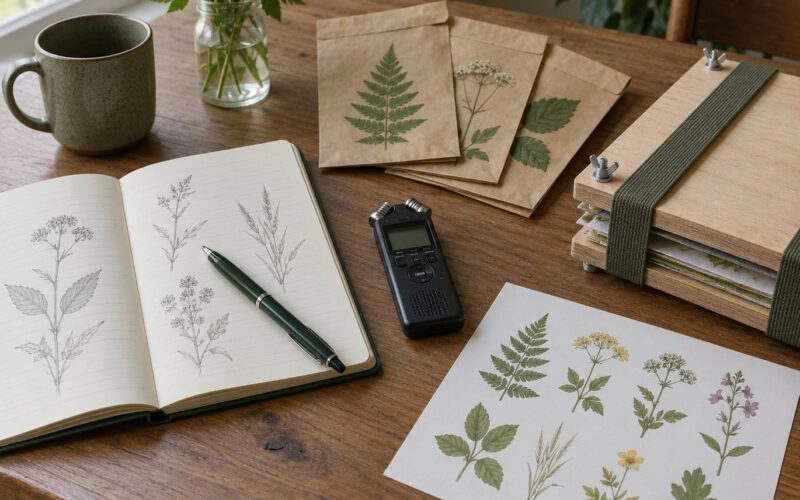
Before you go further, two more habits are worth building. Document every walk in a field journal, and photograph the specimen in place so you can revisit the same population. Experienced foragers consistently say confidence arrives from repeated observation across seasons, not from a single exposure.
How Cultural Knowledge Changes the Meaning of Foraging
Long-standing local and Indigenous knowledge systems encode something a field guide cannot: generations of observation about which plants hold up under drought, when a particular medicine is gathered, how a plant is prepared, and what the land is asking for in a given year.
That knowledge is relational. It is transmitted through people, in place, with obligations attached, and it does not become public property by being written down on a website. Where a community has clear protocols about sharing plant knowledge, respect those protocols, and go through the community or a recognised practitioner rather than around them.
There is a practical reason beyond respect. Knowledge held by a community over generations has been tested against the same ground you are standing in, which is not true of a downloaded checklist. This is also why traditional knowledge should be described as relationship-specific rather than converted into universal instructions that anyone can apply anywhere.
What Does Responsible Foraging Look Like?
Responsible foraging is a short list of decisions made before you pick anything.
- Learn from a qualified instructor who can show you local species in person and name their own limits.
- Confirm you have permission. Rules differ by country, state and landowner, and protected areas often prohibit collecting entirely. National parks, nature reserves and many municipal parks do not allow it.
- Confirm identification with reliable local references, using more than one source and never social media alone.
- Follow community and site rules, including tribal, park and land-management guidance.
- Take an appropriate amount. The common one-tenth heuristic is a starting point: never take more than a small fraction of a stand, and never take the first or the last of a population.
- Skip polluted and treated ground near roadsides, drains, sprayed fields and dog routes.
- Leave anything you cannot confirm. Unknown specimen, unknown location, unknown preparation means you walk away.
- Skip protected and listed species, and check whether a plant has cultural or community significance before you touch it.
One rule covers most mistakes: when in doubt, leave it. Teachers worth taking seriously repeat it often, and an instructor who never says it is telling you something about their standards.
How Can You Learn Foraging Safely?
Start with in-person field instruction from a qualified educator, because that is the format that builds the skill. Look for courses run by foragers with documented regional experience, and for community workshops and guild walks where the ratio of students to guide is low enough for real correction.
Use books, apps and observation platforms as supplements. A regional field guide is a reference you carry; an app is a second opinion on a photo you have already examined yourself. Neither replaces someone standing next to you the first ten times you meet a species. Social media identification requests are a common source of confidently wrong answers, even from well-meaning people.
The scheduling problem is real. Beginners in r/foraging repeatedly describe the same frustration: the mentor whose season overlaps the student’s calendar is rare, and paid courses cost money that beginners often do not have. Workarounds that help: ask a local foraging guild or natural history society about volunteer walks, take a beginner rounder course first, or trade help with a more experienced forager who needs a second pair of hands.
For self-study between sessions, keep a plant list you are actually learning rather than a long species list, revisit the same handful of plants in every season, and build a comparison sheet of the look-alikes for each one. Botanical gardens, herbaria and university extension services are good places to verify a specimen that a teacher is not certain about.
Take your time. People describe foraging as a slow lifelong process with no finish line, and that framing is more accurate than any certification.
Frequently Asked Questions
Can I learn foraging from a plant identification app?
Use apps as a second opinion, never as the first check. They evaluate the photo you give them and cannot see smell, stem cross-section, growth stage, habitat or whether the plant has been sprayed. Carry a regional field guide as your primary reference, confirm with a second source, and learn the species in person before you eat anything.
Why is in-person foraging instruction safer than relying on photos?
A photo drops the features that separate dangerous look-alikes: smell, sap, stem shape in cross-section, growth stage, and where the plant grew. A teacher points those out while the plant is still in the ground and stops you when the specimen is too old, too sprayed or too ambiguous to call. Repeated supervised walks turn that check into a habit.
Do experienced foragers always know every poisonous look-alike plant?
No. Serious foragers work with local experts, herbaria and university extension services for anything unusual, and they apply the rule that an uncertain specimen gets left alone. Confidence comes from repeated observation across seasons, so even long-time foragers treat unfamiliar plants as unknown rather than guessing. Treat anyone who never expresses uncertainty with caution.
Is foraging always sustainable if I take only a small amount?
Amount is only one part of it. Over-harvesting a single stand, taking the first or last plants of a population, stripping one area repeatedly, or collecting protected species will damage a population even when each visit feels small. Check whether the species is listed, follow land-management rules, and spread collecting across sites and seasons.
What should I do if I think I have eaten an unknown plant?
Treat it as an emergency. In the US call Poison Control at 1-800-222-1222 or your local equivalent, go to an emergency department, and do not wait for symptoms or try home remedies or induce vomiting unless a medical professional instructs you. Keep a sample or clear photos of the plant, note when and how much was eaten, and bring that information with you.
How do I find a qualified foraging teacher?
Ask for documented regional field experience, references from past students, and whether they carry liability insurance for guided walks. Good signs: they teach toxic plants before edible ones, they say they do not know when they do not know, and they will name their own limits. Walk away from anyone who promises fast results, discourages official sources, or teaches tasting plants in the field.
Start With One Season of Supervision
The first step is simple and it is not a book or an app: find a qualified local teacher and walk with them through one full season before you collect anything on your own.
That single block of supervised time covers site permissions, contamination, seasonal timing and ethical harvest rules at once, which is more than months of reading gets you. If a course is out of reach, join a community guild walk, ask a natural history society for a local contact, and start your plant list with a handful of species you can find repeatedly.