
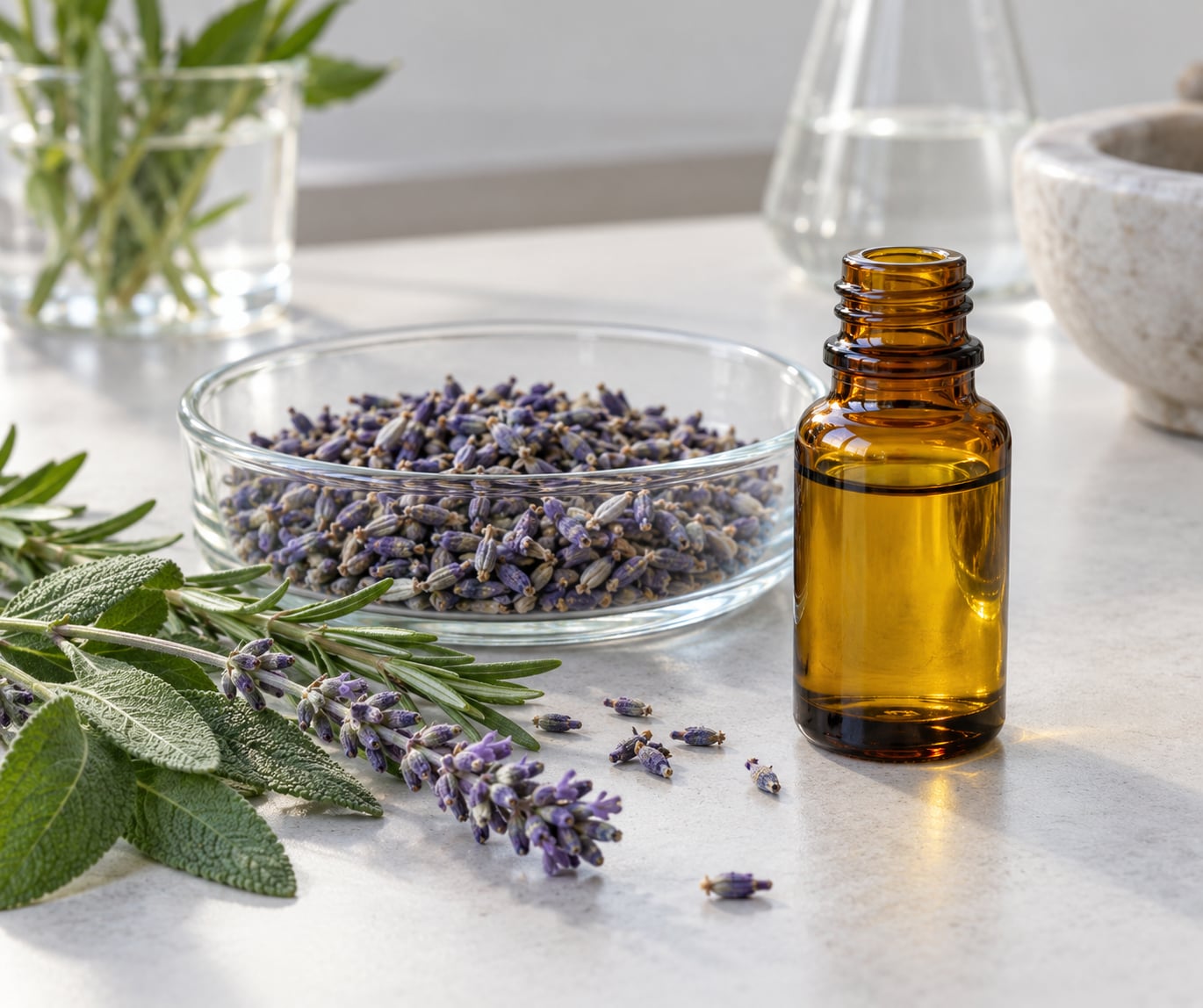
Are plant extracts the same as essential oils? No. An essential oil is only the volatile aromatic fraction of a plant, typically one to two percent of its weight, pulled out by steam distillation, cold pressing or CO2 extraction. A plant extract captures a much broader slice of the plant: water- and alcohol-soluble compounds such as polyphenols, tannins, alkaloids and polysaccharides that never reach the oil.
The essential oils vs plant extracts differences all trace back to one decision a maker makes at the start: which fraction of the plant to keep. Choose the aromatic, volatile layer and you get an oil that smells, travels and irritates if you use it straight. Choose everything that dissolves in water or alcohol and you get a tincture, decoction or dried extract that tastes different, travels differently and carries a much wider chemistry.
Below is a side-by-side comparison, then the practical detail on making methods, concentration, uses, safety and how to read a label that tells you which one you are holding.
Table of Contents
- 1Essential Oils vs Plant Extracts Differences at a Glance
- 2What Is the Difference Between an Essential Oil and a Plant Extract?
- 3How Are Essential Oils and Plant Extracts Made Differently?
- 4Essential Oils vs Plant Extracts Differences in Composition
- 5Which One Is More Concentrated?
- 6What Are the Different Uses and Applications?
- 7How Do Safety and Side Effects Compare?
- 8Which Has Better Research Evidence?
- 9Which Should You Choose?
- 10Frequently Asked Questions
- 11Are essential oils stronger than plant extracts?
- 12Can essential oils replace plant extracts in research?
- 13Is a plant extract always more natural than an essential oil?
- 14Are essential oils safe to apply directly to skin?
- 15Does an essential oil contain the whole plant?
- 16How can I tell whether a botanical product is suitable for research?
Essential Oils vs Plant Extracts Differences at a Glance

| Criterion | Essential oil | Plant extract |
|---|---|---|
| What it is | The volatile aromatic fraction of the plant | A preparation made from whole plant material or specific parts, capturing a wide range of compounds |
| Typical plant parts | Mostly flowers, leaves, bark, roots, seeds, and citrus peel | Roots, bark, leaves, seeds, fruit and sometimes aerial parts, in combination or alone |
| Main chemistry captured | Terpenes, monoterpenes, sesquiterpenes, phenolic volatile compounds | Polyphenols, tannins, alkaloids, flavonoids, polysaccharides, plus some volatile compounds |
| How it is made | Steam distillation, hydrodistillation, cold expression, sometimes CO2 | Water infusion, decoction, maceration, alcohol tincture, percolation, fresh or dried plant material |
| Solubility | Oil-soluble, disperses in carrier oil or alcohol, not in plain water | Water-soluble or alcohol-soluble depending on the method used |
| Concentration | Already very concentrated; almost always diluted before skin use | Varies widely from a cup of tea to a standardized dried extract |
| Aroma | Strong and characteristic, fades with oxidation | Ranged from intense to mild depending on solvent and plant part |
| Typical use | Aroma, diffusion, scent in cosmetics, research on volatile chemistry | Traditional preparations, tinctures, teas, food, topical formulas, supplement capsules, research on non-volatile chemistry |
| Safety profile | Higher irritation and sensitization risk undiluted; some citrus oils are phototoxic | Generally gentler, but still carries real allergy and dosing considerations |
| Choose it when | You want aroma, or you are studying volatile compounds | You want the broader plant profile, or you are studying the whole plant |
One row deserves emphasis: solubility. An essential oil will not mix into water at all, which is why every drop you dilute goes into a carrier oil or a formulated product. An extract made with water goes into water; an extract made with alcohol goes into alcohol. That single fact explains most of the practical differences you run into later.
What Is the Difference Between an Essential Oil and a Plant Extract?
An essential oil is a volatile, aromatic oil that separates from plant material because of its physical properties. Steam or water carries the oil out of the plant, a condenser brings the vapour back to liquid, and the oil layer floats on top of the water. Nothing is added and nothing chemical happens. The oil you get is simply the fraction that was already volatile and fragrant in that plant.
A plant extract is anything made by pulling soluble material out of plant tissue with a solvent. Water, ethanol, glycerine, or a mixture of them. The plant sits in the solvent, the compounds dissolve, the solids are strained out, and what remains is the extract. Because water and alcohol reach far beyond the volatile layer, the finished product can carry tannins, flavonoids, alkaloids, polysaccharides, and mineral salts as well as some of the aromatics.
The scale of the difference is easier to feel than to explain. Volatile oils make up roughly one to two percent of plant matter. That is why distilling enough lavender for a single ounce of oil takes on the order of fifteen pounds of flower. Everything else in that fifteen pounds, the compounds an extract carries, simply does not come across in the still.
Think of the plant as a box of parts rather than a single substance. An essential oil is the handful of fragrant pieces that evaporate. A plant extract is a much larger share of the box, including pieces the oil never touches. Neither is automatically better. They are answers to different questions.
How Are Essential Oils and Plant Extracts Made Differently?

The method is what decides the contents. Nothing about the plant changes between two products; the equipment does.
| Method | What it is used for | What it keeps | What it loses or leaves behind |
|---|---|---|---|
| Steam distillation | Most essential oils from lavender, thyme, peppermint, cloves | Volatile aromatic compounds | Everything non-volatile, plus heat-sensitive notes altered by steam temperature |
| Hydrodistillation | Essential oils distilled in water, often for roots and woods | Volatile compounds, sometimes heavier ones that steam leaves behind | Water-soluble compounds stay in the distillation water |
| Cold expression | Citrus peel oils pressed without heat | Volatile compounds in their most natural state | Only practical for oil-rich peel; nothing from the rest of the plant |
| Alcohol extraction (tincture) | Tinctures, standardised herbal extracts, concentrates | Alcohol-soluble polyphenols, flavonoids, alkaloids, resins, some tannins | Large water-soluble fractions such as polysaccharides |
| Water infusion or decoction | Teas, decoctions, hydrosols, traditional preparations | Water-soluble polysaccharides, mucilage, tannins, minerals, glycosides | Volatile compounds escape as steam; alcohol-soluble resins stay behind |
| Maceration or percolation | Slow herbal extractions, glycerites, oil infusions of plant matter | A slow, solvent-dependent fraction of the plant | Whatever the chosen solvent cannot dissolve |
| Supercritical CO2 | Some essential oils and CO2 extracts for premium and research use | Volatile compounds plus some heat-sensitive non-volatile material | Still excludes the bulk of water-soluble plant matter |
Two details are worth knowing before you try this yourself. Home tincture makers on r/herbalism regularly argue about fresh versus dried material, and both camps have a point: fresh material carries more of the volatile layer and needs less solvent, while dried material concentrates the non-volatile compounds and stores better. And a home extraction can come out far stronger than expected, as one forum user described, a result that was way too strong and smelled overwhelming.
Essential Oils vs Plant Extracts Differences in Composition
Volatile means able to evaporate at ordinary temperatures. That is the whole reason essential oils exist as a category, and it is why an opened bottle of oil slowly fades and eventually smells flat. The molecules that leave first are usually the lighter monoterpenes, which is also why citrus oils degrade faster than a resinous sandalwood oil.
Non-volatile compounds cannot evaporate at room temperature, so they stay. They include phenolic compounds, flavonoids, tannins, alkaloids, bitter principles and polysaccharides. Some of this material is plant defence chemistry, some is structural, some is pigment and gum. None of it reaches an essential oil.
Marker compounds are how researchers and quality testers keep extracts honest. A standardised extract declares the marker, the measured amount, and the extraction ratio, for example a 4:1 dry extract. Without that declaration, two products from the same species can differ several-fold, and neither the plant name nor the front of the label tells you which one you have.
Plant part matters as much as method. Rosemary leaf extract and rosemary flower essential oil are not the same input, and neither matches rosemary seed oil, which is closer chemically to a fixed oil. Three products, three compositions, one plant name on the shelf.
Which One Is More Concentrated?
Concentration and potency are different things, and the confusion between them causes most of the overreach in this area. An extract can be more concentrated and less potent for a given purpose. An essential oil is nearly always the more concentrated product and also the one that carries the higher irritation risk.
Here is the useful frame. A cup of chamomile infusion holds a small amount of volatile oil and a moderate amount of water-soluble material. A dry chamomile extract standardised to a marker may hold many times the plant material per gram. A chamomile essential oil holds a large share of the volatile fraction and almost none of the water-soluble fraction. Ask concentrated about which component and you get a real answer. Ask it as a general question and the label tells you nothing.
Dilution is the other half of this. Dilution reduces the amount of a product per unit of carrier; it does not change what the product contains and it does not make it stronger. Essential oils are routinely diluted one to two percent for facial use and up to five percent for body use, and those numbers describe arithmetic, not a therapeutic threshold.
What Are the Different Uses and Applications?
Essential oils are used where volatility is the point. Diffusing, scenting, aroma research, fragrance blending, and formulations that need the scent molecules to remain intact and detectable. They also appear in laboratory work as the isolated volatile fraction for gas chromatography comparisons, which is exactly why they are useful and exactly why they are narrow.
Plant extracts are used where breadth is the point. Decoctions and infusions are the oldest forms and remain standard practice across many traditional systems. Tinctures put the plant into solution for storage and measured dosing. Dried extracts and capsules standardise a marker compound so a dose means something repeatable. Topical formulas use water and alcohol soluble fractions that actually sit in the product base.
Ethnobotanical work tends to use both, for different reasons. A researcher recording a traditional preparation needs the extraction method, solvent, plant part and duration, because those are what define the preparation. A researcher characterising volatile chemistry needs the oil. Treating the two as interchangeable erases the very detail the study exists to capture.
Research on volatile and non-volatile constituents is published separately and reported separately, which is why a study on a plant does not automatically apply to either product made from it. A neat example of this in the comparative chemistry literature is work evaluating an essential oil and an n-hexane extract of the same Thymus vulgaris material side by side, where the two fractions behaved differently in chemical and biological testing.
How Do Safety and Side Effects Compare?
Both can cause problems, and the essential oil is the more frequent offender in topical use. Undiluted application of a concentrated oil on skin is the commonest route to irritation and sensitisation. Irritation shows up quickly as burning or redness. Sensitisation is slower and worse: repeated exposure to a small amount builds a delayed allergic response, and the product that was fine last month can become the one that flares now.
Phototoxicity matters for a specific family. Cold-pressed citrus oils contain compounds that can react with ultraviolet light and cause burns resembling a severe sunburn on exposed skin. That applies to the oil, not to a water-based extract of the same peel, which is one of the clearer practical differences between the two products.
Ingestion is where the gap widens. As people on r/PlantBasedDiet and r/NoStupidQuestions point out, the common belief that essential oils are plant fats and therefore inert is simply wrong. They are concentrated volatile compounds, many of which are toxic in quantity, and none of them should be swallowed without specific advice from a doctor or pharmacist. Extracts also deserve care, since alcohol tinctures and concentrated capsules carry their own risks.
Children and pets need their own guidance. Concentrated oils and extracts both deserve storage well out of reach, and anyone dealing with a reaction, a burn or an accidental ingestion should contact a poison centre or emergency service rather than a forum.
This section is general information, not medical advice. For anything involving pregnancy, breastfeeding, children, an existing medical condition, or medicines you take, ask a doctor, pharmacist or qualified clinician before using either product.
Which Has Better Research Evidence?
Neither label carries evidence on its own. Evidence attaches to a specific species, plant part, extraction method, solvent, standardisation, dose and outcome, and a paper on one of those combinations says nothing about the other twenty.
This is the practical reason why the general category is weak evidence. A result reported for steam-distilled thyme oil cannot be transferred to an alcohol extract of thyme, because they contain largely different chemistry. A study using a high-dose standardised extract cannot be used to justify a drop of oil on the skin, because the dose, the constituents and the exposure route all differ.
The defensible way to read a claim is to ask five questions: which species and plant part, which extraction method and solvent, what standardisation, what dose, and what outcome measured. A claim that cannot answer those is marketing copy rather than evidence, no matter how many citations sit beneath it.
One further problem deserves a plain mention: adulteration. Because a genuine oil is a single natural substance, it is valuable as an ingredient and can be cut with synthetic fragrance compounds. That is why the fragrance oil confusion, discussed below, is not a rare edge case.
Which Should You Choose?
Pick the essential oil when your goal is aroma, when you are studying volatile chemistry, or when a formulation needs the scent fraction to stay intact. Pick the plant extract when you want the broader profile, when the preparation follows a traditional method, or when a study or a standardised dose depends on the non-volatile compounds.
For practical purposes, here is how I would decide in about a minute:
- Studying plant chemistry: use the oil for volatile constituents and an extract for non-volatile ones, and treat them as two separate samples.
- Following a traditional practice: use the form the practice names, usually an infusion, decoction or tincture, with the plant part specified.
- Aromatherapy or scenting: the essential oil, always diluted for anything that touches skin.
- Topical cosmetic formulation: match the extract to the base, water for aqueous formulas, alcohol or oil for the rest, and check the extract is fit for the solvent system.
- Requiring documented whole-plant constituents: a standardised extract with the marker and ratio declared.
Now the part that saves the most confusion, which is reading the label. To tell an essential oil from a plant extract on an ingredient list:
- Check the botanical name in italics, with the plant part stated. A missing plant part is a warning sign.
- Look at the ingredient count. A genuine essential oil is one ingredient. Multiple lines on an essential oil usually means a fragrance blend.
- Watch for the phrase botanical extract, or extract of alongside a solvent such as water, ethanol, glycerin or propylene glycol.
- Look for Latin extract names ending in extractum, oleum, infusum or tinctura, which tell you the form and the solvent.
- Check whether an extract ratio or marker compound is declared, for example standardised to X percent.
- Look for dilution warnings. A concentrated product with no safety statement is not a good sign.
- Treat marketing names such as Romantic Couture as no botanical information at all.
That second point deserves emphasis, because it is the single most common label problem. On the Fragrantica board, a long-running thread made the same point: genuine essential oils contain a single natural component, while perfume oils are blends that may mix naturals with synthetics. Shops have sold fragrance compounds under the heading essential oil, and only the ingredient list catches it.
And a warning about a different confusion entirely. A carrier oil is a fixed oil pressed from the seeds or kernels of a plant, such as jojoba or sweet almond oil. It has no meaningful aroma, it is not an essential oil, and the two are routinely diluted together. There is no rosehip essential oil as most people mean it: rosehip seed oil is a carrier oil pressed from the hips.
Frequently Asked Questions
Are essential oils stronger than plant extracts?
It depends on which part of the plant you are measuring. An essential oil is very concentrated for the volatile fraction and carries none of the water-soluble material. A standardised extract can be more concentrated for polyphenols and other non-volatile compounds while holding almost no oil. Concentrated is a fact about one component, not a verdict on the product.
Can essential oils replace plant extracts in research?
No, because they contain largely different chemistry. An essential oil holds the volatile fraction and almost none of the non-volatile material, so a study on the extract says little about the oil and the reverse. If your method targets volatile compounds, use the oil; if it targets polyphenols, alkaloids or polysaccharides, use the matching extract and declare species, part, solvent and standardisation.
Is a plant extract always more natural than an essential oil?
Neither is more natural than the other. Both are made by physical processes from plant material, and an essential oil is arguably less processed, since it is simply separated from the plant. What differs is the fraction captured and the solvent used. Judge a product on declared plant part, extraction method, solvent, extract ratio and marker compounds rather than on the word natural.
Are essential oils safe to apply directly to skin?
Rarely. Undiluted essential oils are a common cause of irritation and delayed sensitisation, and cold-pressed citrus oils can cause phototoxic burns in sunlight. Dilute to roughly one to two percent for facial use and up to five percent for body use in a carrier oil, patch-test first, and ask a doctor or pharmacist if you are pregnant, treating a child or take regular medication.
Does an essential oil contain the whole plant?
No. Volatile oils make up only about one to two percent of plant matter, so an essential oil represents a narrow fraction. That is also why distilling a single ounce of lavender oil takes roughly fifteen pounds of flower. Whole-plant constituents such as tannins, alkaloids, flavonoids and polysaccharides are absent from the oil and are what plant extracts are made to capture.
How can I tell whether a botanical product is suitable for research?
Check six things on the label or documentation: the botanical species, the plant part, the extraction method and solvent, the extract ratio if standardised, the marker compound and its measured amount, and any batch identification. Verification by GC-MS is a stronger signal. Without those details, two products sharing a plant name may differ substantially and neither can be reproduced.
The essential oils vs plant extracts differences come down to what you are asking the plant for: the volatile aromatic layer or the broader soluble profile. If it is scent, aroma work or volatile chemistry, the oil is the right form. If it is a traditional preparation, a standardised dose or the non-volatile chemistry, the extract is. Check the label for plant part, solvent and extract ratio before you buy, and dilute anything concentrated before it goes on skin.


