Food as medicine is the idea that what people eat can prevent, ease or sometimes treat health problems, and that eating should be treated with the same seriousness as taking a medicine. This guide walks through the concept of food as medicine explained in plain terms, including where the idea came from, how researchers test traditional remedies, and what the evidence does and does not support.
The phrase covers two quite different things. In one sense it describes everyday nutrition: a plate of beans and greens feeds the body and lowers long-term risk. In the other it describes a specific tradition, where particular foods and drinks are given for a particular purpose in illness, ritual or household care. Mixing those two senses up is the fastest way to overstate what any food can do.
Table of Contents
- 1What Does the Concept of Food as Medicine Mean?
- 2Everyday nutrition versus therapeutic use
- 3How Does Food Function in Traditional Healing?
- 4Nourishment
- 5Ritual and ceremony
- 6Comfort and care
- 7Household care
- 8Teaching
- 9What Is the Difference Between Food and Medicine?
- 10How Do Researchers Study Traditional Food Remedies?
- 11What Should Readers Know About Claims and Evidence?
- 12How Can Food Be Used Safely Alongside Healthcare?
- 13Frequently Asked Questions
- 14Is food as medicine the same as using food to cure disease?
- 15Can traditional African foods be considered medicine?
- 16What evidence supports the health benefits of traditional foods?
- 17Can food be used safely with prescription medicines?
- 18How can I learn about the traditional use of a medicinal plant?
- 19Where can I get reliable nutrition and health information?
- 20Where to Start With This Idea
What Does the Concept of Food as Medicine Mean?
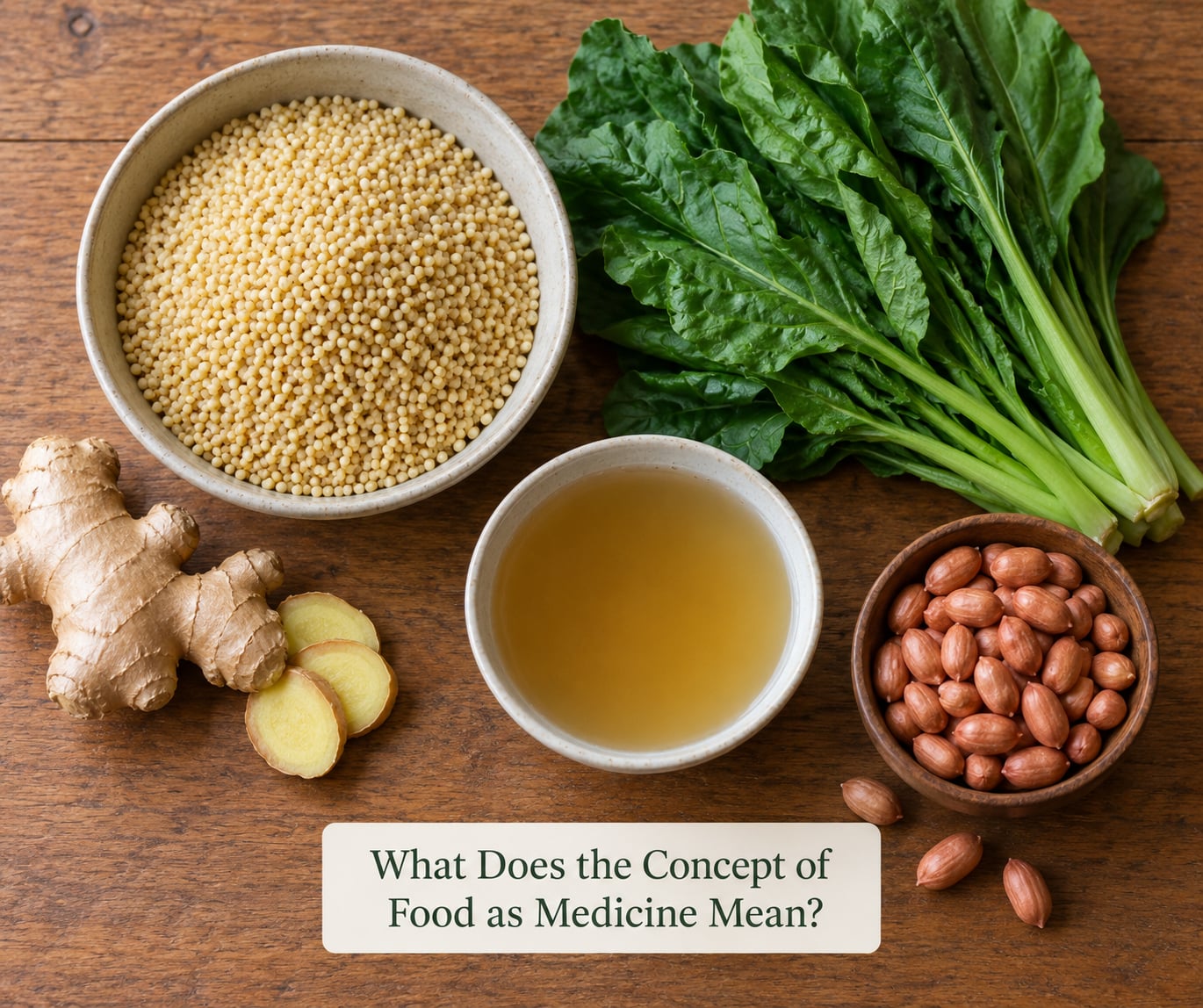
Food as medicine means using foods, chosen and prepared with a health purpose, to prevent disease, manage a condition and support recovery. It treats nutrition as part of healthcare rather than as a private choice, and it recognises that diet affects blood sugar, blood pressure, the gut and long-term disease risk.
It is not a claim that any single food cures anything. A plate of food is a mixture of many compounds acting at once, and the body processes that mixture differently depending on the rest of the diet, the condition and the person.
Everyday nutrition versus therapeutic use
Everyday nutrition is broad and preventive. Eating more vegetables, legumes and whole grains, less salt and less ultra-processed food, is a reasonable default for most people and is supported by a large body of research.
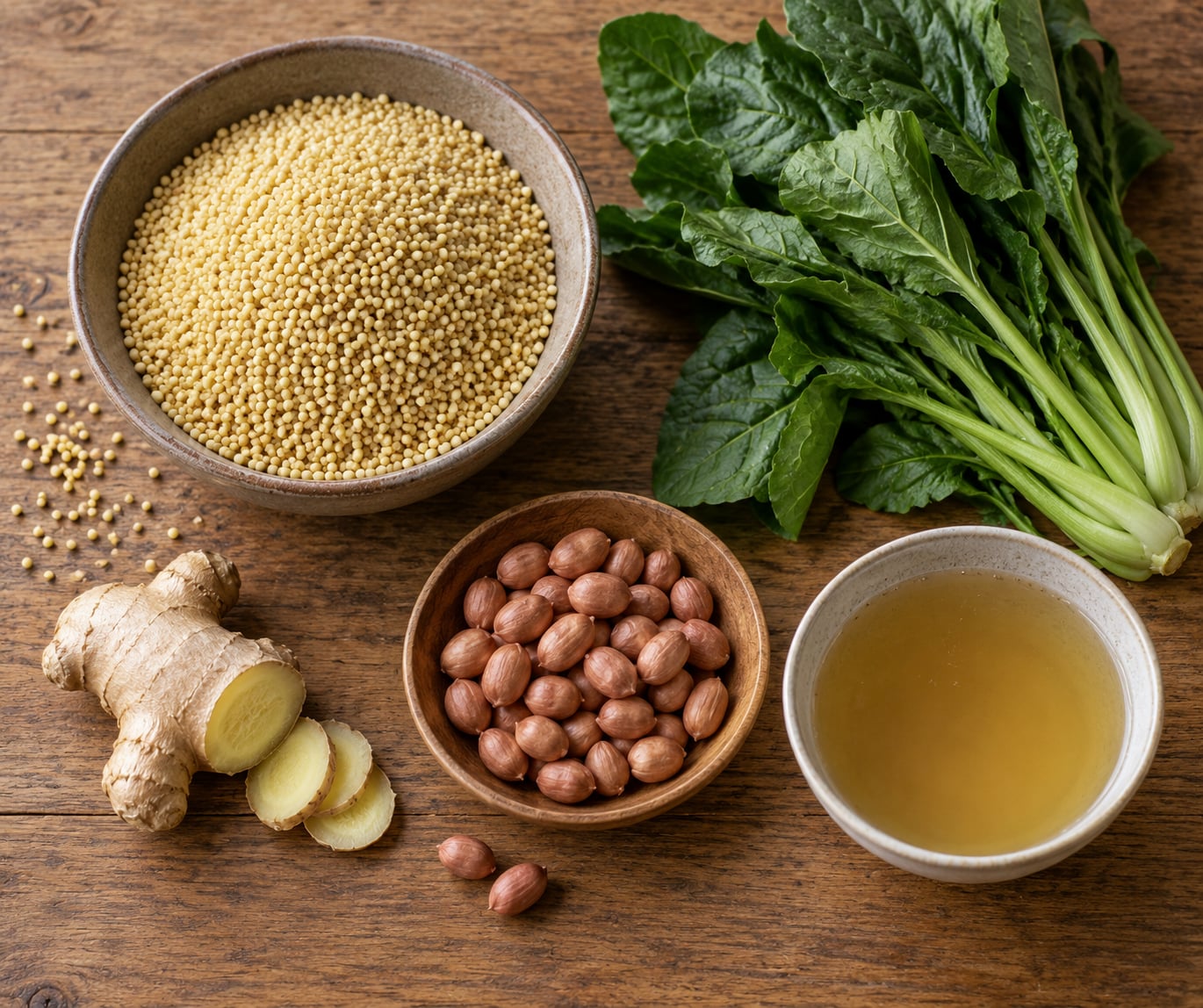
Therapeutic use is narrower. It means a food chosen deliberately for a specific condition or symptom, sometimes in a larger amount, sometimes prepared a particular way, and often under guidance from a clinician or a registered dietitian. Ginger taken as a warm infusion for nausea during a childhood illness sits in that second category. So does a millet porridge given to someone recovering from illness in a household where that is the custom.
How Does Food Function in Traditional Healing?
Traditional healing uses food for far more than nourishment. Across African traditional healing systems, food carries meaning that sits alongside the physical, and a practitioner may work with several of these at once.
Nourishment
Broths, porridges and stews are given to someone who is weak, recovering or not eating well. Millet, maize, sorghum, teff, yams, plantain, peanuts and leafy greens show up again and again because they store well, cook cheaply and feed a lot of people.
Ritual and ceremony
Some foods mark an event, carry an offering or are used at a transition. What is served, how it is prepared and who eats it can carry more weight than the nutrients do.
Comfort and care
A familiar dish offered by someone who cares is part of how a sick person is looked after. Practitioners and families often describe the effect as much social and emotional as physical.
Household care
Infusions, decoctions and poultices made from familiar kitchen or garden plants are used for everyday complaints such as colds, stomach upsets, minor skin irritation and aches. They sit between home care and formal treatment.
Teaching
Advice about what to eat after an illness, during pregnancy, or for a child is passed between generations, often from grandparents to parents. This is health knowledge with a long memory, even when it has never been written down.
Two cautions matter here. Practices differ a great deal between communities, so describing African traditional healing as one single system flattens real variation. And a practice being traditional is not evidence that it works or that it is safe, which is exactly the problem the next sections deal with.
What Is the Difference Between Food and Medicine?
The distinction is not that one is natural and the other artificial. It is about purpose, evidence, preparation, risk and who is responsible for oversight.
| Aspect | Everyday food | Traditional food remedy | Modern medicine |
|---|---|---|---|
| Purpose | Everyday nourishment and pleasure | Comfort, care, ritual, or relief from a minor complaint | Treat, control or prevent a diagnosed disease |
| Evidence | Broad research on nutrients and dietary patterns | Long use, local knowledge, and research that is often thin or mixed | Controlled clinical trials, dosing rules and regulatory review |
| Preparation | Flexible; recipes vary | Set recipes for a specific situation or person | Standardised dose, form and route |
| Risk | Generally low; depends on allergy and portion | Varies widely; can interact with treatment or be wrongly dosed | Known side effects, contraindications and monitoring |
| Oversight | No professional oversight needed | Held by the family, community or traditional practitioner | Prescriber, pharmacist, nurse or dietitian |
| Status | Not a treatment | May be nourishing without being a proven treatment | Regulated intervention |
Read the last row carefully. Something can be genuinely nourishing and still have no proven power over a disease. Most traditional food practices sit in that honest middle space, and treating them as either worthless or miracle-working misreads them.
How Do Researchers Study Traditional Food Remedies?
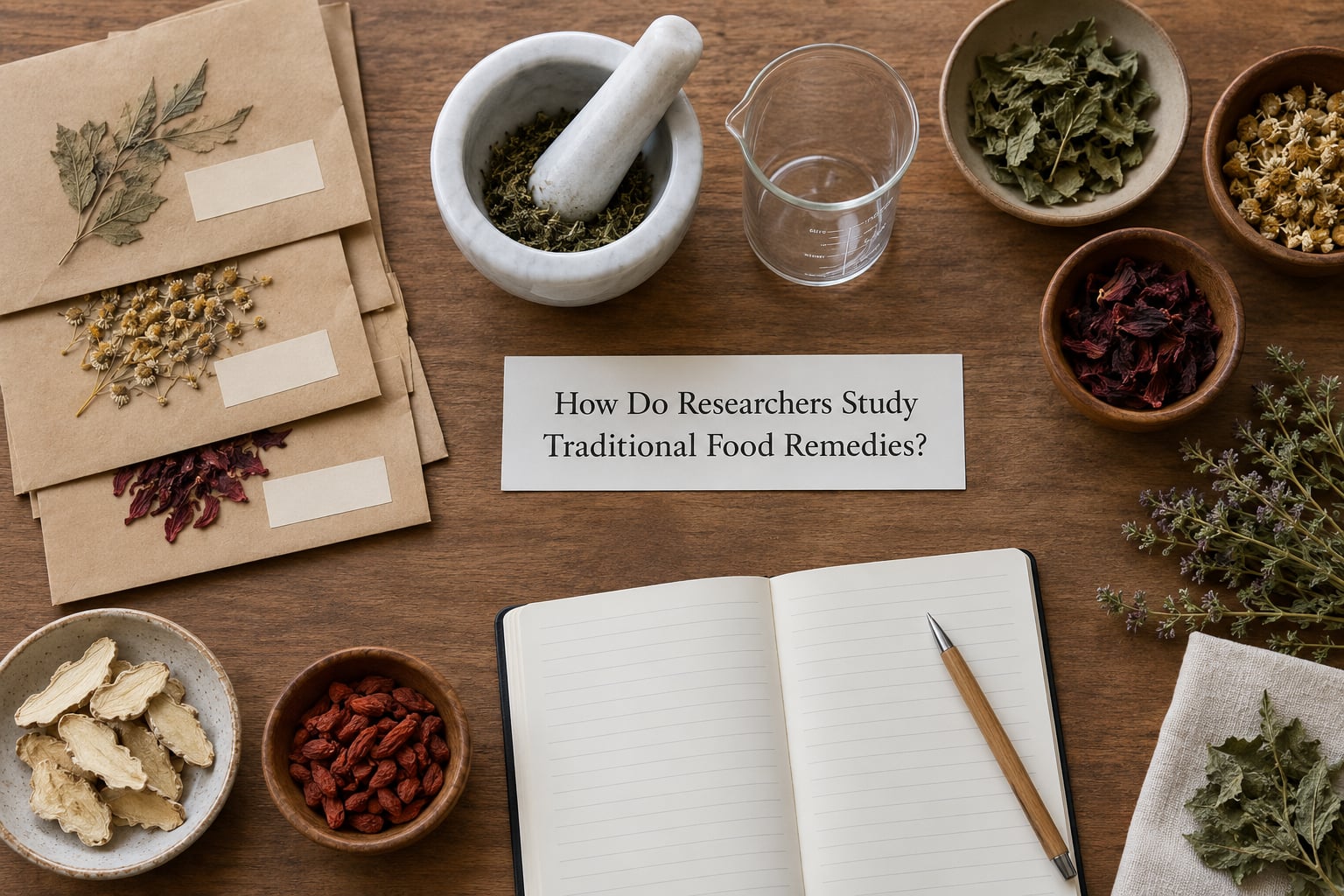
Researchers do not start in a laboratory. The work runs in stages, and a remedy has to survive each one before the next makes sense.
- Ethnobotanical documentation. Record which plants a community uses, which parts they use and what the local name is. Without this step a species can be confused with a close lookalike, which has caused real poisoning.
- Interviews and observation. Speak to the people who actually prepare and give the remedy, and to those who received it. Recorded consent matters here, and so does asking about what did not work.
- Ingredient recording. Note the exact plant part, the amount, the preparation and the combination. A remedy listed only as “ginger” tells a chemist almost nothing.
- Laboratory analysis. Identify compounds, check for contaminants, heavy metals and microbial contamination, and test basic activity in the lab. This shows what a substance does in a dish, not what it does in a person.
- Nutritional assessment. Measure what the food actually contributes: protein quality, micronutrients, fibre, energy density. A remedy may be useful because it feeds someone well while recovering.
- Clinical research. Only this stage can show whether the remedy changes an outcome that matters to a patient. Randomised controlled trials and well-run observational cohorts are the strongest forms, and they are the most expensive and the rarest.
A remedy can be nourishing, culturally important and still fail at the last step. Those three facts sit side by side without contradiction.
What Should Readers Know About Claims and Evidence?
Most disagreement about traditional remedies is really disagreement about which rung of the evidence ladder a claim has reached.
| Level | What it is | What it can tell you |
|---|---|---|
| Anecdote | One person or a family saying it worked | That it is worth testing |
| Laboratory finding | Activity in a dish, cell or animal | A mechanism to investigate |
| Observational study | Patterns in groups of real people | A likely association, often with confounding factors |
| Clinical trial | Randomised human trials and meta-analyses | Whether it changes an outcome in patients |
| Clinical guidance | Recommendations from national or WHO bodies | What should be done in practice, today |
Three things trip people up. Long use is not a safety test, because a practice can be harmful and still be handed down for generations. A laboratory result is not a treatment, because the dose in a petri dish has no relation to a plate. And a study can be real without its finding surviving the next, larger trial.
Scepticism has a fair side too. When something is sold as a cure with no ingredient list, no named study and no clinician involved, that is a marketing pattern rather than a health practice. The useful question is not whether a practice is old, but whether anyone has shown what happens when it is used.
How Can Food Be Used Safely Alongside Healthcare?
Most people using a traditional remedy are not choosing between tradition and treatment. They are doing both, and that is where care matters.
- Tell your clinician everything. Herbal infusions, teas, tinctures and powders all belong on the list of what you take. A pharmacist can flag interactions that are easy to miss, because many are not obviously herbs in a clinical sense.
- Be careful with concentrated forms. A dried root or extract can deliver far more of an active compound than a cooked dish or a cup of tea. Concentration is exactly what makes something potent, and potency is also the risk.
- Watch for contamination. Unregulated dried plant material can carry heavy metals, pesticides or microbes. This is a documented problem, not a theoretical one.
- Handle food safely. Cook poultry to 165°F (74°C), ground meat to 160°F (71°C), and whole cuts of meat and fish to 145°F (63°C). Keep raw and cooked food apart and refrigerate leftovers promptly.
- Respect allergies and pregnancy. Some traditionally used plants are not safe in pregnancy or for young children, and a reaction can be severe.
- Know when to stop. If a child is struggling to breathe, unusually drowsy, or if someone cannot keep fluids down, that is a clinical problem, not a home remedy problem.
None of this means tradition has to be discarded. It means using it where its limits are known, and asking a doctor, pharmacist or registered dietitian about your own situation rather than generalising from an article.
Frequently Asked Questions
Is food as medicine the same as using food to cure disease?
No. Food as medicine describes using foods to support health, prevent disease and manage conditions, which is broader than curing one. Curing a specific disease with food alone is rare and applies to a small number of situations, such as some nutritional deficiency diseases. Most dietary work happens over years as risk reduction and symptom management, alongside medical care.
Can traditional African foods be considered medicine?
Many are used for healing purposes, and that use is real even when a disease is not involved: broths for someone recovering from illness, ginger infusion for nausea, bitter leaves prepared in specific ways. Treating something as medicine in a community is a cultural and practical fact. Whether it treats a disease is a separate question that needs evidence, and practices differ widely between communities.
What evidence supports the health benefits of traditional foods?
Evidence comes in layers. Millet, sorghum, teff, yams, legumes and leafy greens are well studied as parts of dietary patterns that support blood sugar control and cardiovascular health. Specific single-plant remedies are supported mainly by laboratory work and traditional use, with far fewer human trials. The honest summary is that the foods are strongly supported as nourishment, and unevenly supported as treatments for defined conditions.
Can food be used safely with prescription medicines?
Often yes, but not without checking. Some foods and herbal products interact with medicines, including blood thinners, thyroid medicines, some diabetes drugs and certain antibiotics. Concentrated extracts carry a different risk profile from the whole food. Bring a list of everything you eat, drink and take to your doctor or pharmacist, and never stop a prescribed medicine on the strength of a dietary change.
How can I learn about the traditional use of a medicinal plant?
Start with ethnobotanical references, herbarium records and published research from the country and region where the plant grows, then look for the local names and preparation methods, which vary a lot. Ethnobotanical databases and academic ethnobotany publications are more reliable than commercial herb pages. A practitioner or community elder can explain the cultural context, though it does not replace checking safety.
Where can I get reliable nutrition and health information?
National public health agencies, the WHO, national dietary guidelines and hospital nutrition departments publish guidance they review regularly. For personalised advice, a registered dietitian or your doctor is the right person, since they can weigh your medicines, blood results and history. Be cautious of pages selling a named cure, especially ones that promise results without naming a study or a clinician.
Where to Start With This Idea
Start by separating the two meanings. Build your plate from foods that are well supported as nourishment, keep treating tradition as meaningful rather than proven, and take any specific remedy to a pharmacist or registered dietitian before you add it to your routine. That order gets you the benefit without the risk.