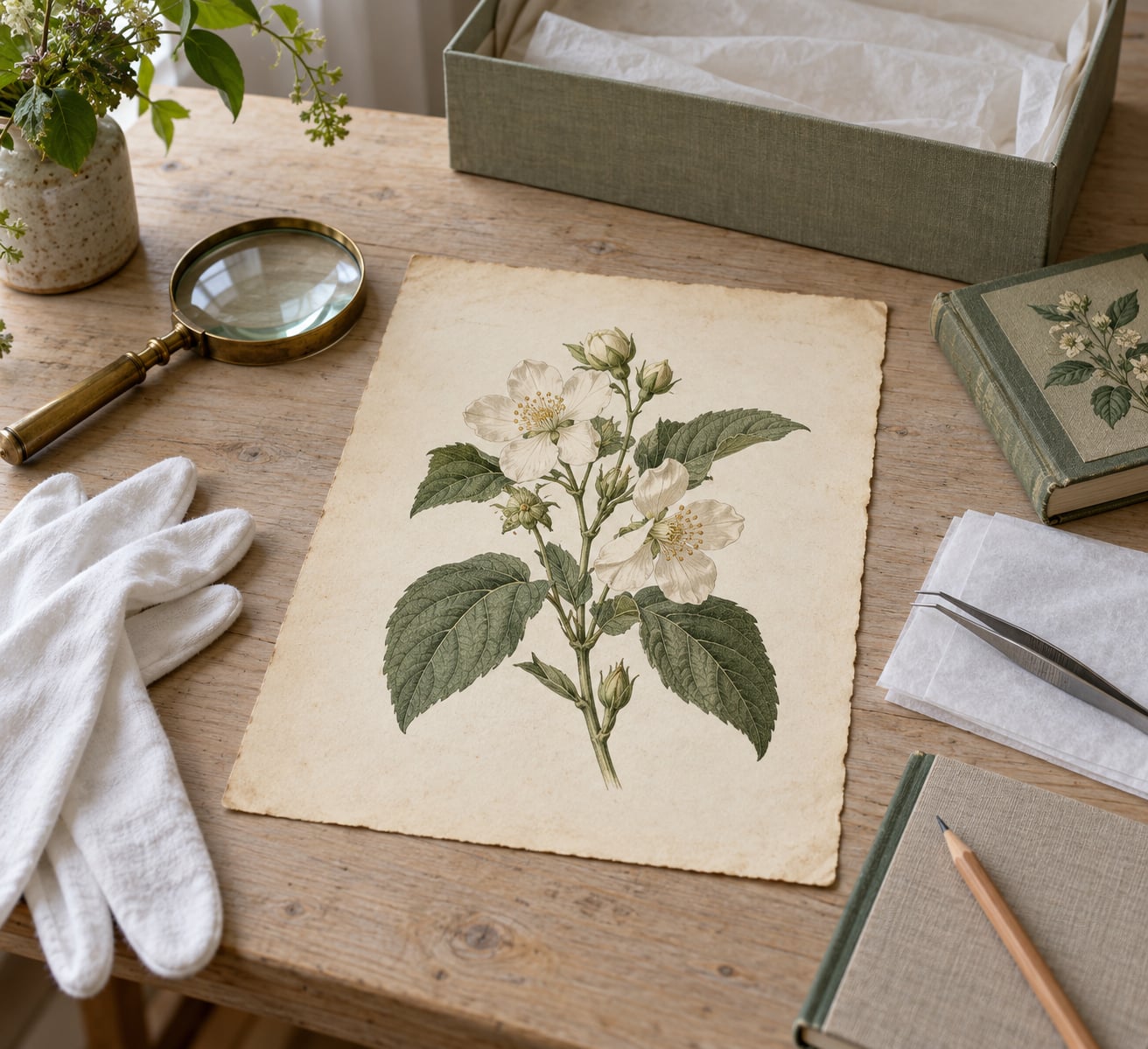
To start collecting botanical prints well, you need four things in order: a narrow focus, the vocabulary to tell an engraving from a lithograph, a habit of checking condition before you pay, and a written record of what you own. It is not a hard discipline to enter, but it rewards patience over impulse buying. A first collection of five or six sheets, studied properly, teaches you more than thirty bought in a weekend.
Botanical prints are illustrations of plants produced on paper as printed images. Depending on technique they are called engravings, etchings, lithographs, chromolithographs or aquatints, and a single printed sheet is usually referred to as a botanical plate or horticultural plate. A bound set of such plates is a flora, and a decorative collection arranged as a book is a florilegium.
The reason these sheets still matter is that they document plant species alongside the naming and classification systems of their own era. Many illustrate plants that are now rare, cultivated elsewhere, or gone from the wild, which is why the old medicinal and ethnobotanical plates still make a genuinely useful reference shelf alongside modern plant guides.
Table of Contents
- 1What You Need
- 2Step-by-Step: Building Your First Collection
- 31. Choose a narrow botanical focus
- 42. Learn the basic terms
- 53. Decide on a budget and a buying tier
- 64. Research sellers and provenance
- 75. Inspect the print before buying
- 86. Start with one or two accessible examples
- 97. Document your first acquisition
- 108. Store and display safely
- 11Common Mistakes
- 12Frequently Asked Questions
- 13What are botanical prints called?
- 14How can I tell an original antique plate from a reproduction?
- 15How do I start collecting botanical prints on a small budget?
- 16How should I care for older botanical prints?
- 17Where is the best place to buy antique botanical prints?
- 18Are botanical prints still in style?
- 19Conclusion
What You Need
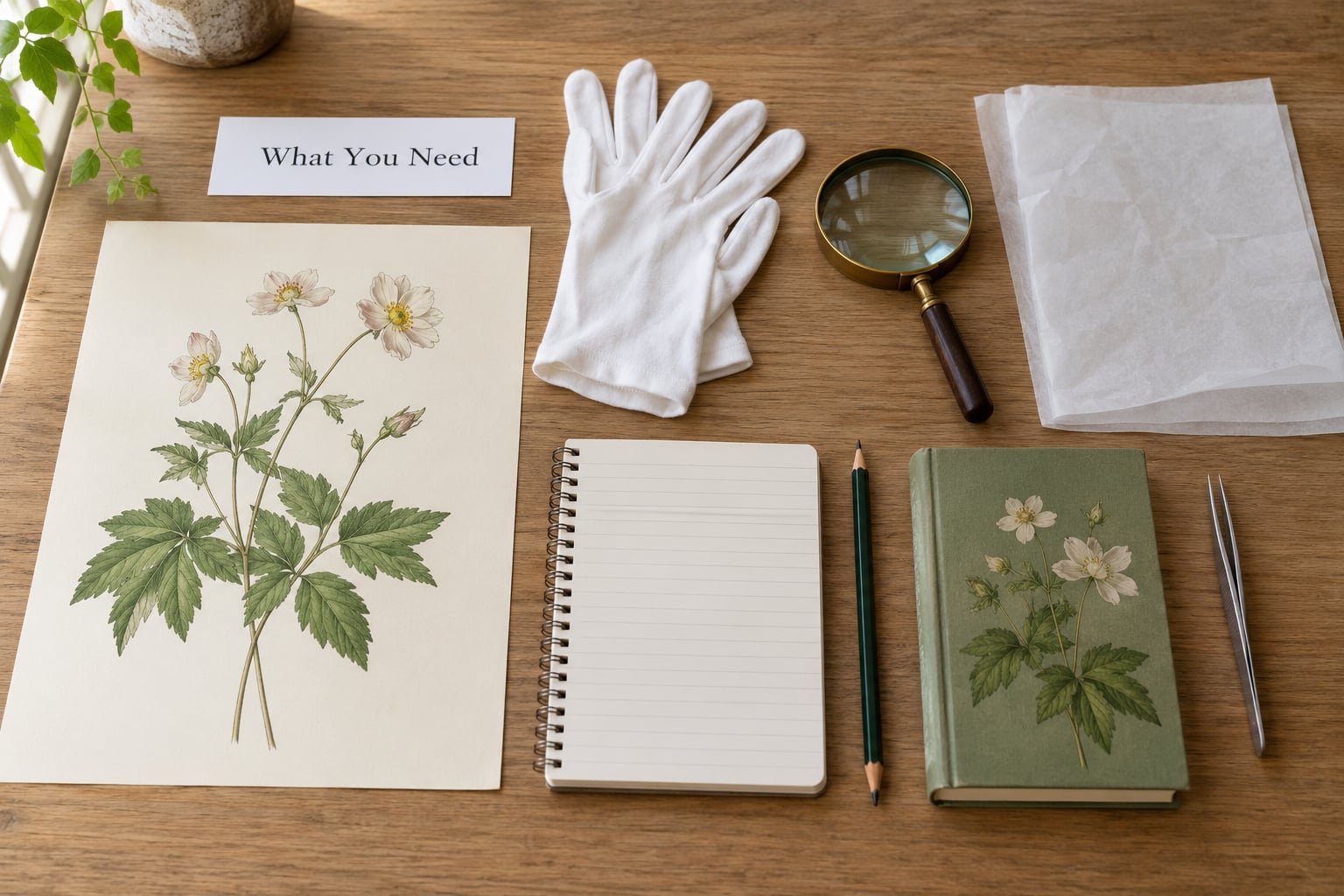
None of this is expensive, and almost all of it can be assembled in an afternoon. The point of gathering it first is that it turns collecting from browsing into inspection.
- A notebook for the collection log. One page per sheet, kept from the day of purchase onward. Dates and prices belong in writing, not in your memory.
- Two or three reference works. A modern field guide for the plant families you plan to collect, plus one illustrated book on botanical artists and their signature works.
- A magnifier and good light. A 10x loupe is enough to check paper surface, plate mark and colour. A bright angled lamp shows cockling and repairs that flat daylight hides.
- Clean cotton gloves and acid-free tissue. Bare clean hands are acceptable for most handling, but gloves stop skin oils transferring to old paper, and tissue stops a print sticking to its neighbour.
- Archival storage materials. Acid-free sleeves or folders, buffered mat board, a rigid box that fits the sheets flat, and tweezers for lifting.
- A source-checking routine. A short written list of the questions you ask every seller, plus a reverse image search method for identifying an unattributed plate.
Collectors who keep proper records rarely regret a purchase. The ones who end up with a wall of unattributed sheets usually cannot remember what half of them are.
Step-by-Step: Building Your First Collection
1. Choose a narrow botanical focus
Beginners who buy “anything botanical” end up with clutter. Scope your interest by region, plant group, period, or one published work. Collectors on forums consistently describe scoping by geography and taxon, for instance North American trees and grasses, or British flowering plants, rather than buying at random.
Four focuses that work well for a first attempt: African and West African medicinal plants, tied to your interest in documented traditional use; a single artist such as Pierre-Joseph Redouté or Georg Dionysius Ehret; one dated reference work such as Curtis’s Botanical Magazine or Sowerby’s English Botany; or a set on one family, orchids being the usual first choice.
2. Learn the basic terms
Vocabulary is what makes a marketplace search work. A search for “botanical plates” returns wallpaper; a search for “hand-coloured copper engraving, 19th century, foxing free” returns the actual thing. Learn these before you spend anything:
- Botanical illustration — the drawn or painted image itself, before printing.
- Engraving — lines cut into a copper or steel plate; the classic botanical technique until the 1830s.
- Etching — acid-bitten lines, freer and softer than engraving.
- Lithograph — drawn on a flat stone or plate, so tone comes from the greasy crayon, not from hatching.
- Chromolithograph — colour lithography, the norm for high-end florilegia and for late 19th-century plates.
- Hand-coloured means colour applied by brush after printing, usually a full plate; hand-tinted means a light wash, often only on the flower.
- Plate mark — the shallow embossed rectangle left by the press around an intaglio plate.
- Impression — a single printed sheet taken from one plate; an edition is numbered, an original antique impression usually is not.
3. Decide on a budget and a buying tier
Four tiers exist, and beginners should sample all of them before committing. Detached or surplus plates from deaccessioned books are the cheapest way to learn the tactile basics of old paper. Affordable originals from specialist dealers come next, usually single sheets with weak but genuine provenance. Sets from one work have more decorative value and require matching dimensions and paper tone. Museum-grade facsimiles printed on archival rag cost the most and are the right choice when documentation matters more than the artifact.
Set aside part of any budget for framing and conservation rather than spending everything on the sheet. A print bought in a damp shop and left unframed can be worth less a year later than you paid.
4. Research sellers and provenance
Ask every seller the same six questions: from which book and edition does this plate come; is it an original impression or a reproduction; what is the paper; what is the plate’s size in centimetres; has it been trimmed, cleaned, or repaired; and is there any documented history behind it.
Sellers who answer all six plainly are worth returning to. Provenance — the chain from book to collection to you — is one of the three variables appraisers weight most heavily, alongside age and condition, so an honest answer in a listing protects you as much as a formal certificate.
5. Inspect the print before buying
Check in this order. Paper first: laid paper shows fine chain lines and a deckle edge, wove paper looks smoother and more uniform, and a modern reproduction usually shows bright, uniform white. Plate mark second: a genuine engraving or etching carries the embossed line, while a lithograph sits flat. Colour third: hand colouring varies slightly within a single petal, while printed colour is flat and repeats exactly across every impression.
Then condition. Foxing appears as small rust-brown spots, usually from damp. Cockling is rippling in the sheet. Tears, trimmed margins, mount stains, and old tape residue all reduce value, and repairs are worth more if disclosed. Look closely at the corners and the reverse for insect damage; old framed paper frequently carries woodworm or silverfish traces, and a set of forty sheets with larvae is a restoration problem, not a collection.
In person, buy nothing you have not held. Online, ask for high-resolution images of the plate mark, a corner and the back, and ask for measurements rather than trusting the listing.
6. Start with one or two accessible examples
Your first purchase should be something you can verify yourself: a modern botanical print from a named artist, or a clearly labelled public-domain reproduction with its source stated. Learning what a legitimate reproduction looks like is the fastest way to avoid being disappointed by an unattributed original later.
7. Document your first acquisition
For every sheet, record the plant name as printed and the Latin binomial, the artist, plate title, book or work, date of publication, medium, dimensions in centimetres, paper type, seller or source, purchase price, edition details, condition notes and anything you are unsure about. Write down uncertainties as uncertainties; a plate you could not attribute is still worth logging, and the gap tells you what to research next.
Photograph the front, the back and the plate mark on day one. That scan settles arguments later, including inherited collections nobody can identify.
8. Store and display safely
Unframed sheets go flat in an acid-free folder inside a rigid box, interleaved with acid-free tissue, away from direct sun, radiators, damp basements and attics. Conditions that swing between dry and humid encourage foxing and mould.
For framed pieces use UV-filtering glazing, an acid-free mat with a window slightly larger than the plate, and spacers so the glazing never touches the sheet. Keep colour-sensitive prints off exterior walls and out of direct afternoon light, rotate what hangs in the sunniest spot, and hang by wires rather than by the top edge of the paper.
Common Mistakes
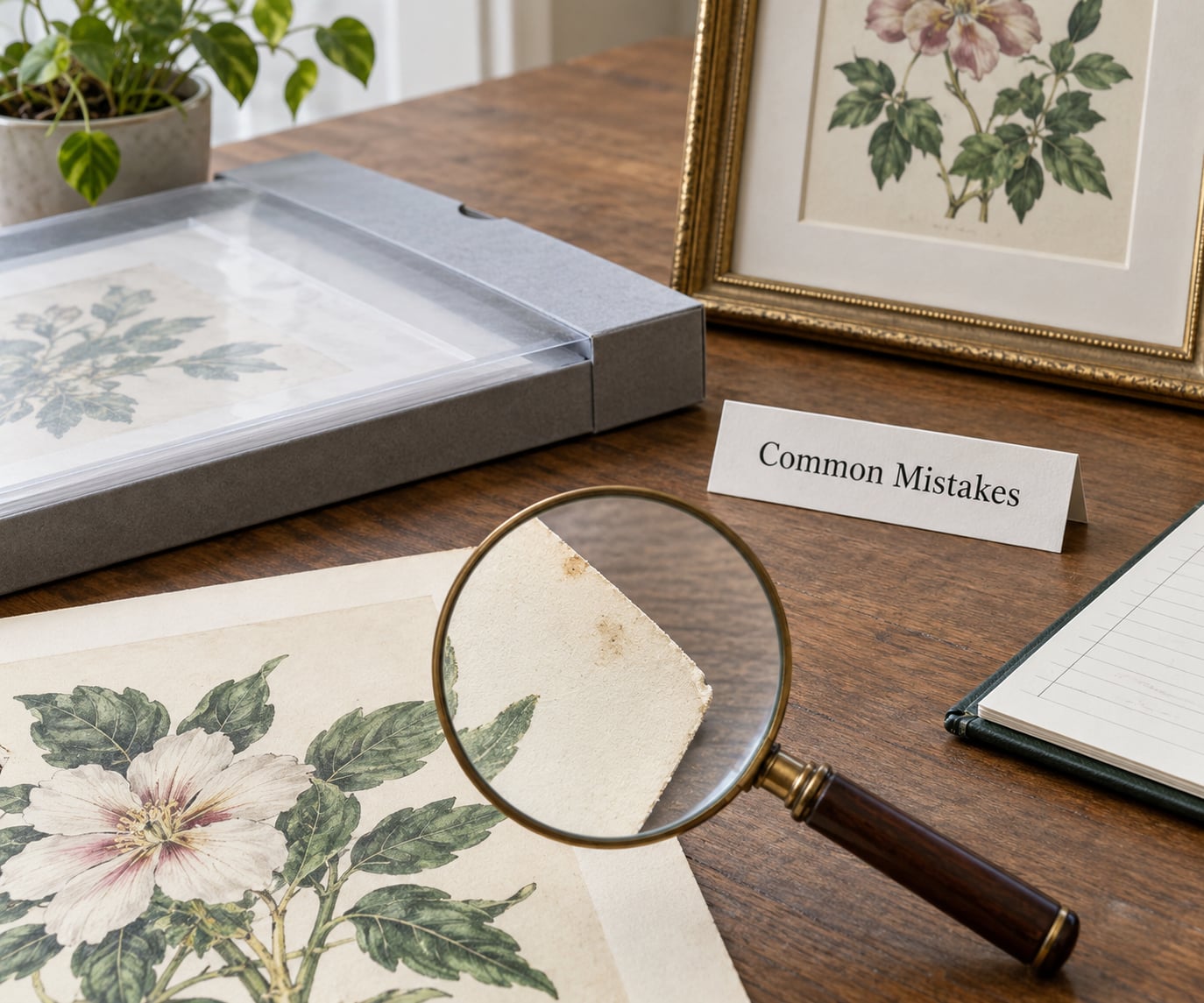
Buying on looks alone. A beautiful image tells you nothing about paper, technique or provenance. Correct it by using the six-question seller checklist before you look at the picture at all.
Treating a reproduction as an original. The tell is not price, it is process: plate mark, paper, and whether the colour varies within a single petal. If a seller cannot say which, assume reproduction.
Ignoring condition to get a rare subject. Severe foxing, trimmed margins and unrepaired tears are common reasons appraisers cut a figure sharply. Prefer a clean common plant over a rare one in bad shape.
Collecting without records. An undocumented set becomes a set of questions. Start the log on the first sheet, not after you have ten.
Using non-archival materials. Ordinary mat board, masking tape and wooden hangers all give back acid, moisture or staining. Acid-free board and polyester tape cost little compared with a print ruined by them.
Overpaying without provenance. A grand-sounding attribution with no documentation behind it is a marketing claim. Ask which book, which edition, which collection; a seller with nothing to say is telling you something.
One more worth flagging: buying framed sets on sight because the frames look right. Check the back for insects before you commit, and check the glazing for scratches and non-UV glass. A print that has been in an uninspected frame for thirty years may need deacidification before it is stored at all.
Frequently Asked Questions
What are botanical prints called?
They are generally called botanical prints or botanical plates. By technique you will find them labelled engraving, etching, lithograph, aquatint or chromolithograph. A single sheet is a botanical plate, a book of plates is a flora, and an arranged decorative collection is called a florilegium. Searching by technique rather than by the word botanical brings far better results on marketplaces.
How can I tell an original antique plate from a reproduction?
Check three things. A genuine intaglio engraving or etching leaves a shallow embossed plate mark around the image, while a lithograph lies flat. Laid paper shows chain lines and a deckle edge; reproductions are usually bright uniform wove. Hand colouring varies slightly within one petal and shows brush strokes, while printed colour is identical on every impression. If a seller cannot name the technique, treat it as a reproduction.
How do I start collecting botanical prints on a small budget?
Buy surplus plates from deaccessioned books, where the paper is genuine but the provenance is thin, and use them to learn how old paper feels and smells. Add clearly labelled public-domain reproductions from institutional archives, which cost little and are honest about what they are. Hold the expensive originals until you know which subjects and artists you actually want.
How should I care for older botanical prints?
Keep unframed sheets flat, interleaved with acid-free tissue, inside a rigid folder in a box stored away from sun, damp and heat. Frame with UV-filtering glazing and acid-free matting so the sheet never touches the glass. Handle with clean dry hands or cotton gloves, lift with tweezers, and never use tape, sticky pads or ordinary mat board to repair a sheet.
Where is the best place to buy antique botanical prints?
Specialist dealers and print fairs give the most inspection time. Auction houses list condition and attribution in writing, which suits research buying. Online marketplaces offer range but demand high-resolution images and clear measurement requests. Local sources such as antique malls, estate sales and library sales sometimes yield whole runs from one work. Institutional digital archives supply free public-domain scans for study and framing.
Are botanical prints still in style?
Yes, and the interest is scholarly as much as decorative. Plant-obsession decorating still leans heavily on botanical imagery, but the durable demand comes from collectors documenting species, regions and historical plant use. The sheets that hold up best over time are the ones with a clear subject, a readable Latin caption and an honest provenance record.
Conclusion
Start smaller than feels satisfying. Pick one plant group or one artist, learn eight terms well enough to search with them, set a budget you can spend twice without regret, and hold your first purchase in your hands before money changes. One well-documented plate that you can identify, explain and store correctly is the foundation of a collection that keeps its value. Everything after that is repetition, and repetition is where collectors actually get good.