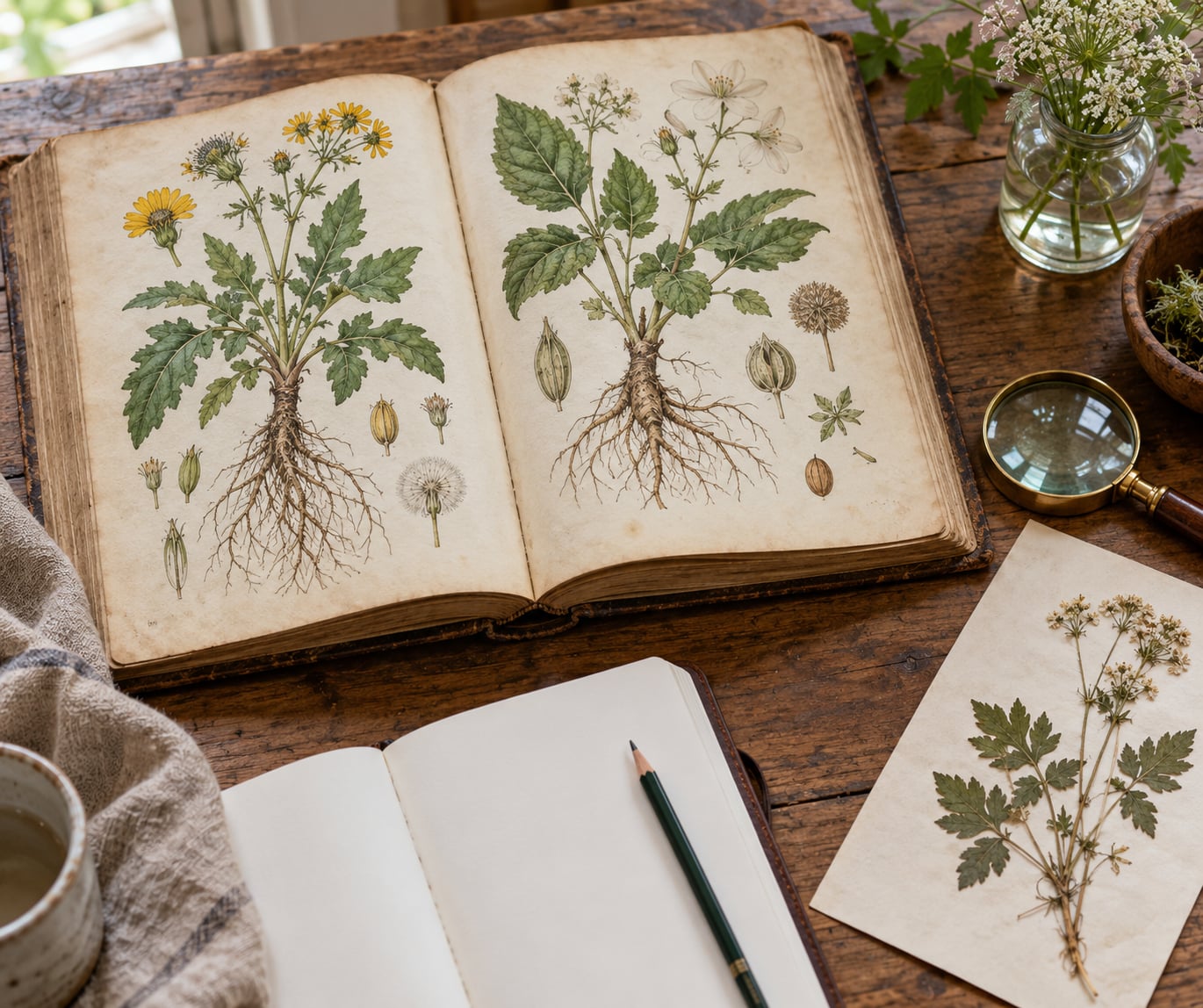
Plant drawings helped early medicine by giving healers a fixed image to compare against the living plant before they cut, boiled or prescribed it. Long before photography, taxonomy or chemical tests, an accurate picture of leaf, flower, fruit and root was the only portable proof of what a medicinal plant actually looked like. That image turned knowledge held by one healer into something a whole workshop, an apothecary in another town, or a student a hundred years later could use, check and correct.
That matters more than it sounds. If you gather the wrong plant, everything downstream fails: the taste is different, the preparation does not work, and in some cases the remedy is simply dangerous. The drawing was the safety check, and in many traditions it was also the archive.
The record is scattered across papyri, manuscripts, printed herbals and archives, and it does not tell a straight line of progress. Images sometimes got better and sometimes got worse. The interesting question is not whether early drawings were accurate in our terms, but what work they were asked to do, and how well they did it.
Table of Contents
- 1How Plant Drawings Helped Early Medicine Record Useful Knowledge
- 2They let a healer identify a plant before harvesting it
- 3They carried knowledge that had no other container
- 4They standardised recipes across distances
- 5They flagged look-alikes, some of them toxic
- 6They recorded plants that were new to medicine
- 7Why Draw a Plant Instead of Only Writing Its Name?
- 8How Did People Identify Medicinal Plants from Drawings?
- 9How Plant Drawings Helped Early Medicine Work in the Field
- 10What Did Early Medical Plant Drawings Preserve?
- 11How Did Plant Drawings Change as Medicine Developed?
- 12Why Are Accurate Plant Drawings Still Useful Today?
- 13What Can We Learn from Mistakes in Historical Plant Drawings?
- 14Frequently Asked Questions
- 15What are plant drawings?
- 16Why are plants important in medicine?
- 17How did medical illustration start?
- 18What is the history of medicinal plants?
- 19Are botanical illustrations still relevant?
- 20Conclusion
How Plant Drawings Helped Early Medicine Record Useful Knowledge
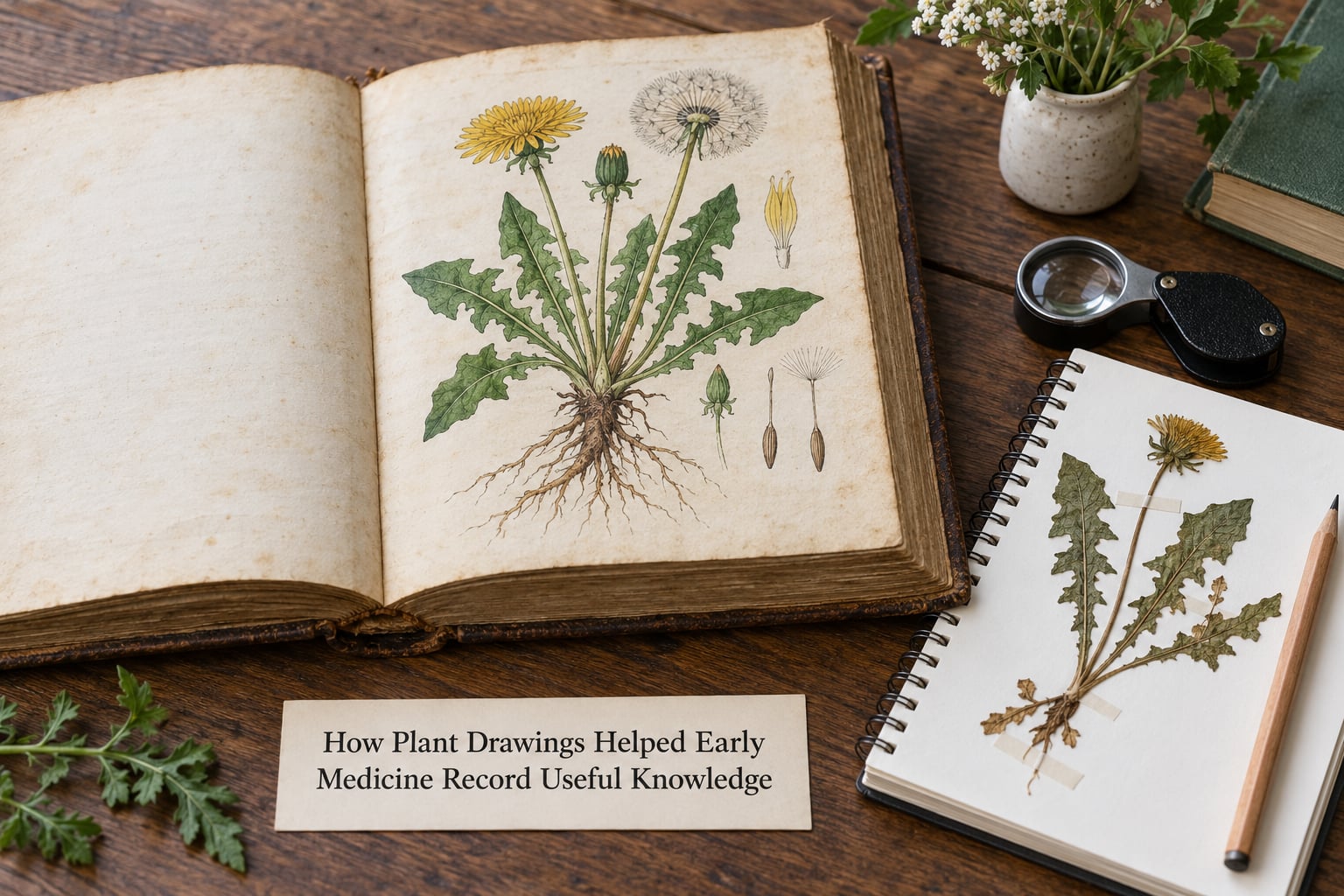
Drawings did five concrete jobs for medicine, and separating them is the fastest way to understand why they mattered.
They let a healer identify a plant before harvesting it
This was the first and hardest job. A root dug from the wrong species cannot be identified afterwards, once it is washed, cut and dried. The drawing was checked against the plant in the ground or on the stem, at the moment when the distinguishing features were still visible.
They carried knowledge that had no other container
A great deal of plant knowledge lived in the heads of local healers, herbalists and food-collectors. When an illustrator recorded a plant for someone who did not grow it, an oral and local practice became something that could travel. The drawing is often the earliest evidence we have that a plant was used this way, by this community, in this region.
They standardised recipes across distances
An apothecary who had never seen the source plant still had to buy, store and sell the dried root, leaf or bark. A plate showing the whole plant, and often a detail of the part used, told a buyer what they were paying for and let a shopkeeper check a consignment.
They flagged look-alikes, some of them toxic
Several dangerous pairs sit close together in the field. Herbals responded by drawing the distinguishing marks of each species on the same page, so a reader could compare them side by side rather than trusting memory. Authors also added plain warnings in the text about which features decide the question.
They recorded plants that were new to medicine
When a plant arrived from a voyage, a trade, or a new colony, and turned out to be valuable, the drawing was how the news spread. The image travelled with the specimen and the sample, so people who had never seen the plant could judge whether what they were buying or growing was the real thing.
Why Draw a Plant Instead of Only Writing Its Name?
A name is short, and it moves badly. It changes between languages and regions, it refers to a group of plants as often as to a single species, and it tells you nothing about the shape of the thing. A drawing carries the features that actually decide identity.
Those features are mostly structural. Leaf shape and whether the edges are toothed or smooth. Leaf arrangement, whether opposite or alternating. Venation, and whether the veins reach the margin. The cross-section of a stem. The number and arrangement of petals, stamens and pistils. Whether the fruit is a capsule, a berry, a drupe or a pod. The seed and its markings. And the root, which is often the part harvested and frequently the hardest to see.
Growth habit matters as much as detail: whether the plant is erect, climbing or creeping, whether it is annual or woody, how tall it stands. A herbal that showed only a flower, with no leaves or root, was of limited use to someone standing in a field.
How Did People Identify Medicinal Plants from Drawings?
The working method was comparison rather than recognition from memory. An apprentice learned one plant at a time, in the garden or on a hillside, with the plate open beside the specimen. The text narrowed the search by habitat, season and taste; the image confirmed or ruled out candidates.
Where two species were easy to confuse, the illustrator usually drew the pair together and let the differences speak. A notch in the leaf margin, a hair on the stem, the direction the hairs lie, the colour of the pith when a stem is cut: small marks, but marks that hold up when a whole plant has to be reduced to a dried root in a shop.
How Plant Drawings Helped Early Medicine Work in the Field
In practice, the loop ran like this. The healer knows the plant from local use and knows roughly where it grows. The drawing narrows the candidates. The living plant is checked against the plate, part by part. Only then is anything harvested, and the plate is compared again against what was actually collected before drying.
That last step is the one people forget, and it is the most useful. Drawings could be wrong, copied, idealised or simply drawn from a dried fragment. Checking the plate against the specimen in hand, including the root that the sale often leaves out, is exactly what a modern ethnobotanist does. The habit is old; only the camera is new.
What Did Early Medical Plant Drawings Preserve?
An illustrated herbal is a hybrid record. The image carries identity, and the text carries everything about use. Read together, a single entry usually holds more than any modern label does.
- Names in several languages, including local, regional and scholarly names, plus synonyms that let a reader connect entries from different traditions.
- The plant part used: root, bark, leaf, flower, seed, sap, or the whole herb, and for a tree sometimes the distinction between inner bark and outer.
- Preparation: fresh or dried, decocted, infused, powdered, expressed, made into wine or vinegar, trodden, or applied as a poultice.
- Habitat and season: wet ground, dry hillside, woodland edge, seashore, and when to gather it, which for many species is a narrow window.
- Taste and qualities: bitter, astringent, sweet, hot or cold in the sense of the humoral tradition, and the classification such as simples and officinals that decided where the substance sat in an apothecary’s shop.
- Substitutes and look-alikes: which species sold under the same name, and which one is dangerous.
- Where it was obtained: the region, garden or market the material came from, which is how a reader today can sometimes trace a plant’s route.
One thing drawings preserve especially well is the plant’s appearance at stages a pressed specimen loses. A flowering stem, a fruiting stem, a seedling, a seed head. A herbarium sheet dries the plant into one moment; an illustration can show four.
How Did Plant Drawings Change as Medicine Developed?
The image changed shape five times, and each change altered what medicine could do with it. Hand-painted manuscripts were accurate but slow and unreproducible. Woodcuts made images repeatable but reversed and coarse. Engraving restored delicacy and allowed hand colouring. Photography removed the draughtsman from the loop, and digital imaging put searchable collections online.
| Era | Key works | Drawing technology | What medicine gained |
|---|---|---|---|
| Ancient Egypt and Mesopotamia | Papyrus Ebers, Assyrian tablets | Painted on papyrus and clay | First written recipes, few or no reliable pictures |
| Greek and Roman | Theophrastus, Pliny the Elder, Crateuas, De Materia Medica | Painted manuscript copies | A picture tied to a name, a part used and a preparation |
| Non-European traditions | Bencao Gangmu, Sushruta Samhita, Badianus Manuscript | Illustrated manuscript, often schematic | Parallel systems for matching a plant to a use |
| Manuscript era in Europe | Anglo-Saxon and Arabic simples, Albertus Magnus | Illuminated manuscript, copied by hand | Standardised plate layout for comparison, but copies drifted |
| Fifteenth to sixteenth century | Hortus sanitatis, Brunfels and Weiditz, Bock, Fuchs, Gerard | Woodcut, then metal engraving | Thousands of identical copies; accuracy returned to the plant |
| Seventeenth to eighteenth century | Culpeper, Parkinson, Blackwell’s Curious Herbal, Flora Graeca | Engraving, hand colouring, field observation | Plants drawn from living specimens in the field |
| Nineteenth century onward | Official floras, pharmacopoeias, herbarium curation | Photography, lithography, later digital scanning | Identification settled by comparison with a documented specimen |
Two moments stand out. The first is Crateuas, whose painted manuscript of De Materia Medica in the early first century set a standard of accuracy that copies often failed to hold. The second is the Renaissance return to accuracy, when Leonhart Fuchs, Hans Weiditz and Hieronymus Bock deliberately drew from the living plant rather than from earlier books. Bookish herbals of the same period copied medieval woodcuts that were no longer recognisable as plants.
Arab-language works, including the influential Book of Simple Drugs of 1334, carried Greek and Indian material into new languages with systematic pictures. Separately, Chinese and Indian traditions built their own systems rather than adopting the European one, and the Badianus Manuscript of 1552 shows the same identification logic applied to plants of the Americas.
Why Are Accurate Plant Drawings Still Useful Today?
Drawings remain useful because field botany has the same basic constraint it always had: you often cannot carry a plant back, and a dried specimen loses most of its information. Accurate botanical illustration is still a legitimate scientific record, kept alongside the specimen itself.
The modern equivalent is the voucher specimen. An ethnobotanist preparing to publish records the plant, deposits a pressed specimen with a collection, and cites the collector, the location, the date and any local uses. The collection holds the specimen; the illustration and description make it legible to someone who cannot visit the hillside. Older drawings do this job for historical material, and modern collections such as those at Kew or in the Biodiversity Heritage Library hold both.
Three things follow. Museums use drawings to match undated or incomplete specimens to a name. Conservation bodies use them to say what a rare species looked like at a known date. And researchers use them to see how a plant was described before modern chemistry existed, which is useful context for studying a traditional use rather than a substitute for testing it.
Two cautions belong here. A drawing records what someone saw or believed, which is not the same as what was there. And a traditional use recorded in an old herbal is historical and ethnobotanical information, not medical advice: nothing in a drawing tells you what to take, how much, or whether it will interact with something else you take. For anything personal, talk to a clinician or pharmacist.
What Can We Learn from Mistakes in Historical Plant Drawings?
The famous failure case is the Narcissus in the Hortus sanitatis of 1491, an image so far from any real plant that it cannot be matched to a species. It is useful not because it was unusually bad, but because it shows what happens when a plant becomes a shape that gets copied.
The recurring errors are easy to name.
- Copy drift. Each copyist simplifies what they do not understand. A leaf margin that was once toothed becomes smooth, a fine hair disappears, colours wash out, and the smoothed version becomes the source for the next copy.
- Idealised proportion. Flowers and fruits are drawn larger than life and stems shorter, because the point was the flower and the fruit. Harmless for beauty, misleading for field use.
- Mixed species on one page. Where a genus holds many similar species, an illustrator may draw several together and produce something that belongs to none of them.
- Missing stages. If only one stage was drawn, the reader has nothing to compare against the rest of the year.
- Colour dependence. A plant drawn in colour with no written note of that colour fails completely in a monochrome copy, and most copies were monochrome.
- Drawn from a fragment. An illustrator working from a dried root or a herbarium sheet has already lost the plant’s structure.
Later botanists fixed these problems in a fairly consistent way: draw from the living plant, show several stages, use the same plate layout so plants can be compared, and describe features in words as well as images so that a copy which loses the image still carries the diagnostic detail.
Judging a plate yourself is not difficult. Ask whether it was drawn from life or copied from another book, whether it shows more than one growth stage, whether the artist wrote where the plant was observed, and whether the diagnostic features in the text match the features in the picture. Where several answers are no, treat the image as a memory of a plant rather than evidence about one.
Frequently Asked Questions
What are plant drawings?
Plant drawings are images of plants made to record, identify and transmit knowledge about them. In early medicine they were the identification standard for herbs: a healer compared the living plant against the plate to confirm the right species before harvesting, preparing or prescribing it, because a name alone cannot show leaf shape, flower structure, fruit or root.
Why are plants important in medicine?
Plants supplied medicine’s first toolkit because a great many effective remedies came from roots, leaves, bark, seeds and flowers that were cheap, local and available when nothing else was. Plant-derived compounds remain central to pharmacology, from aspirin to quinine. Traditional use is not the same as proven effect, so a recorded remedy is a starting point for research rather than a treatment plan.
How did medical illustration start?
It started with the practical need to name a plant someone could not see. Egyptian and Mesopotamian records carried recipes with little or no reliable imagery; Greek and Roman writers such as Theophrastus and Pliny added description; Crateuas painted the plants for De Materia Medica so the image and the name finally travelled together. Everything after that refined the pairing.
What is the history of medicinal plants?
Medicinal plants were the first pharmacopoeia, used for thousands of years before chemistry existed. Written traditions spread that knowledge through works such as the Papyrus Ebers, the Bencao Gangmu, the Sushruta Samhita and De Materia Medica. Later printed herbals from the fifteenth and sixteenth centuries standardised both the recipes and the pictures, and modern drug discovery still builds on plant materials.
Are botanical illustrations still relevant?
Yes. Accurate botanical illustration remains a scientific record, used in museums to identify incomplete specimens and by conservation bodies to document rare species. In field research it plays the same role as a modern photograph, and it pairs with the voucher specimen deposited in a herbarium collection. Historical drawings stay relevant as evidence of what a plant was described as, not as medical advice.
Conclusion
Plant drawings helped early medicine do something drawings still do: fix in place the features that decide whether a plant is the right one. They carried oral knowledge between communities, let apothecaries check what they were selling, put look-alikes on the same page so a reader could compare them, and preserved plants that were new to the written record.
They were also imperfect, and the errors are worth reading as evidence rather than as embarrassment. A simplified leaf margin tells you the illustrator was working from a book. A drawing with one growth stage tells you the plate was made in a hurry or in another country.
If you want to start using them properly, take one image, find the species named in the text beside it, and check both against a modern botanical description and a documented specimen. The Biodiversity Heritage Library, the Royal Botanic Gardens at Kew and JSTOR Global Plants all hold scans you can compare side by side. And for any question about using a plant medicinally, ask a clinician or pharmacist rather than a drawing.