Herbal goods are checked in laboratories, not by eye. A trained analyst takes a representative sample, examines it macroscopically and under a microscope, then runs it through chemical and molecular methods — HPTLC, HPLC, GC-MS, LC-MS/MS, DNA barcoding and isotope analysis — each of which answers a different question about identity, potency and adulterants. How adulteration is detected in herbal goods comes down to combining those methods and reading the results together.
The details below matter for anyone who handles raw plant material, works in traditional practice, or buys herbal tonics and remedies regularly. We have pulled the language out of the journal literature and the quality-control guidance so it reads like an explanation rather than a methods section.
Table of Contents
- 1What Is Adulteration in Herbal Goods?
- 2How Adulteration Is Detected in Herbal Goods
- 3How the Testing Process Moves from Sample to Verdict
- 4Which Tests Reveal Different Kinds of Adulteration?
- 5What Do the Laboratory Results Actually Mean?
- 6Can Consumers or Traders Screen Products Themselves?
- 7Why Can a Product Pass One Test but Still Be Adulterated?
- 8What Should You Do When Adulteration Is Suspected?
- 9Frequently Asked Questions
- 10Can you tell if herbal goods are adulterated by their smell, colour, or taste?
- 11Which laboratory test is most reliable for detecting herbal adulteration?
- 12Why can DNA barcoding fail to detect adulteration in herbal extracts?
- 13Does an authentic-plant certificate prove that an herbal product is safe?
- 14What evidence should I request when sending herbal goods for laboratory testing?
- 15Conclusion: Start with Independent, Traceable Evidence
What Is Adulteration in Herbal Goods?
Adulteration means the material in the package is not what the label says it is, or is not what the specification agreed with the supplier says it is. In practice that covers several quite different situations, and the difference matters because only some of them are dangerous.
The main categories are these:
- Species substitution. A cheaper or look-alike plant replaces the declared one. Stephania tetrandra sold as Aristolochia fangchi, or a Digitalis species passed off as Plantago leaf, are the classic toxic examples.
- Plant-part substitution. The right species, wrong part — cheap leaf or filler used where root, bark or rhizome was specified and priced.
- Bulking and dilution. Starch, dextrin, talc, lactose or an unrelated cheap plant powder added to increase weight and volume. This is usually fraud and waste of money rather than a poisoning risk.
- Undeclared pharmaceutical ingredients. Sildenafil and related PDE-5 inhibitors in sexual-enhancement products, sibutramine in slimming teas, phenylbutazone, dexamethasone and other corticosteroids added to pain remedies or remedies for chronic conditions. This is the category that kills.
- Petrochemical substitution. The right molecule, made from a fossil-fuel feedstock instead of the plant, with nothing on the label to say so. The chemical profile looks correct and the chemistry test alone passes it.
- Unauthorised colouring, contaminating. Dyes added to make a pale extract look rich, or the same drift into unsafe territory: heavy metals, pesticide residues, mycotoxins such as aflatoxins, and microbial contamination.
It helps to keep three words apart. Fraud is the legal framing — a deliberate misrepresentation. Adulteration is the technical framing — the composition does not match the declaration. Poor quality is a third thing: the plant is genuine but under-dried, over-processed, low in marker compounds or contaminated by accident rather than intent. Many failed laboratory samples turn out to be poor quality, not deliberate fraud, and conflating the two damages trust in the whole system.
Appearance and reputation are not evidence. A beautiful root from a respected supplier can still be wrong, and a rough-cut loose powder from a village trader can be entirely clean. What settles the question is analysis of the actual sample in front of you.
How Adulteration Is Detected in Herbal Goods
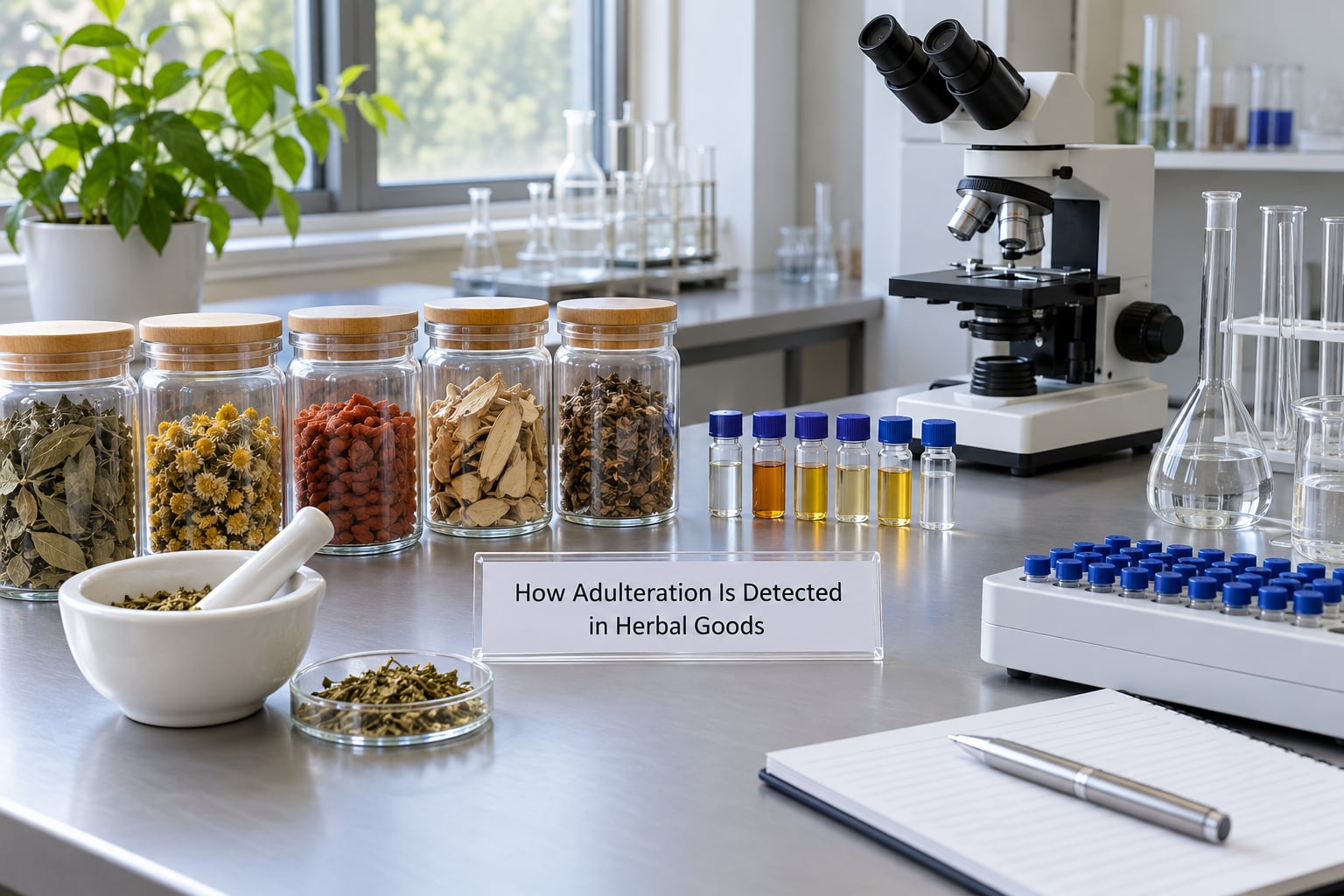
Adulteration is detected by matching a sample against known reference materials using several independent techniques, because no single instrument can answer every question about what is inside a plant product.
The work runs roughly in this order, and each step narrows the field:
- Macroscopic and organoleptic examination. A trained pharmacognosist inspects form, size, colour, texture, fracture, smell and taste against a description and an authenticated reference specimen. Cheap, fast, and it catches the obvious: wrong colour, wrong plant part, musty or chemical smell.
- Botanical microscopy. A tissue section or powder mount is examined for the diagnostic features of the declared species — trichomes, stomata, vessels, stone cells, calcium oxalate crystals, starch granules, aleurone. Still the most reliable single tool for telling closely related species apart, though it is a skill in decline because few people train in it now.
- HPTLC and TLC. The sample is extracted and chromatographed against authentic marker extracts. Matching bands or spots confirm the presence of the expected constituents and flag missing or extra ones. Good for rapid screening of many samples at once; interpretation needs a trained eye.
- HPLC or GC fingerprinting. The full chemical profile of the sample is compared with an authenticated reference fingerprint. Differences in peak pattern and in marker compound concentration reveal substitution, dilution and plant-part substitution.
- Targeted testing for undeclared drugs. LC-MS/MS or GC-MS is run against a panel of synthetic pharmaceutical substances — sildenafil and its relatives, sibutramine, phenylbutazone, corticosteroids, and the like — with detection limits in the low parts-per-million range. This is the confirmatory step for the adulterants that hurt people.
- Spectroscopy with chemometrics. Near-infrared, Raman or ATR-FTIR spectra are run through a classification model built on reference samples. Non-destructive, fast, and increasingly the first-line screen in lower-resource laboratories; it answers “does this look like a known sample or an outlier” rather than naming a compound.
- DNA barcoding and BAR-HRM. Short standardised DNA sequences from a plant barcode region are amplified and compared against reference libraries, or matched by high-resolution melting against a validated curve. Excellent for species identity in intact plant material and mixtures; largely blind to extracts.
- Stable isotope ratio mass spectrometry and radiocarbon analysis. Carbon and nitrogen isotope ratios, and carbon-14 testing of bio-based content, answer a question no other method can: was this molecule grown or made in a reactor?
Reliable conclusions come from agreement. When identity testing, fingerprinting and targeted drug screening all point the same way, the finding is hard to argue with. When they disagree, the disagreement itself is the finding, and a good analyst says so rather than picking the tidiest result.
How the Testing Process Moves from Sample to Verdict
Before any instrument runs, the paperwork decides whether the result means anything.
Chain of custody. The sample is sealed, labelled with batch and product details, and tracked from the shelf to the bench. A submission form records who supplied it, when, and from which batch. Samples that arrive in a resealed bag with a scratched-off label send up an immediate flag, because the identity of the material is exactly what is being tested.
Representative sampling. A homogenised portion is taken from the whole batch rather than from the top of the jar. This is where many informal-market problems hide: the surface layer looks fine while the bulk is mixed. Sampling error is one of the main reasons a single small sample cannot speak for an entire consignment.
Initial screening. Cheap and fast methods go first — macroscopic, microscopy, HPTLC. Screening is designed to catch the obvious failures and discard obviously clean-looking material early, not to certify anything.
Confirmatory analysis. Whatever the screen flags goes to the more expensive, more specific methods. Undeclared pharmaceuticals are confirmed by LC-MS/MS with a second transition, not just one peak in a chromatogram, because a single peak can be a coincidence.
Quality control. Blanks, certified reference materials, duplicate injections, calibration curves and spiked recovery samples all run alongside the batch. An accredited laboratory states these in its report. A report with no mention of any of them has been run outside a controlled system, whatever its conclusions.
Interpretation and report review. A qualified analyst — not just the instrument software — reads the data against the specification for that herb, then a second person reviews before the report is issued.
One thing this process cannot do: prove that an entire product is adulterated from a single test. A single failed or incomplete test shows what was found in that sample, and it may reflect uneven distribution, cross-contamination in the workshop, or a sampling mistake. Equating one abnormal result with a verdict on the whole product is how quality systems lose credibility.
Which Tests Reveal Different Kinds of Adulteration?
Knowing how adulteration is detected in herbal goods means knowing which method catches which problem, because the blind spots differ sharply between techniques.
| Method | What it detects | What it misses | Sample form |
|---|---|---|---|
| Macroscopic and organoleptic | Wrong plant part, gross substitution, mould, chemical smell | Anything chemically similar; skilled blending defeats it | Whole or cut material, powder |
| Botanical microscopy | Species identity from tissue and cell features | Highly processed extracts with no intact tissue | Powder or section |
| HPTLC / TLC | Presence or absence of expected markers and foreign bands | Precise quantification; low-level synthetic drugs | Extract |
| HPLC / GC fingerprinting | Chemical profile match, marker concentration, dilution | A synthetic molecule identical to the natural one; undeclared drugs below the detection window | Extract |
| LC-MS/MS, GC-MS targeted | Sildenafil, sibutramine, phenylbutazone, corticosteroids and similar drugs | Compounds outside the screening panel; very low levels | Extract |
| NIR / Raman / ATR-FTIR with chemometrics | Known samples versus outliers, rapid non-destructive screening | Does not name the compound; depends on a good reference library | Intact material or powder |
| DNA barcoding and BAR-HRM | Species identity in intact plant material and mixtures | Extracts and highly processed products with little DNA; cannot detect a synthetic drug | Plant tissue |
| Isotope ratio MS and radiocarbon | Petrochemical versus plant-derived source of a molecule | Does not identify species or potency; slow and specialised | Purified or single compound |
| ICP-MS, pesticide and mycotoxin panels | Heavy metals, pesticide residues, aflatoxins | Nothing about authenticity — these are safety tests, not identity tests | Digest |
That is why analysts combine them. Identity methods and chemical methods fail in different places, and only a combined profile is hard to fake. A recent study of Indonesian herbal medicines made the point neatly: ATR-FTIR with principal component analysis and hierarchical cluster analysis separated deliberately adulterated samples across a 0–40 percent adulteration range in real plant matrices, cheaply and without destroying the sample — as a screen, not as proof.
A quick note on acronyms, since the literature is dense with them: HPLC is high-performance liquid chromatography; HPTLC is high-performance thin-layer chromatography; LC-MS/MS is liquid chromatography coupled to tandem mass spectrometry; GC-MS is gas chromatography with mass spectrometry; FTIR is Fourier-transform infrared spectroscopy; NMR is nuclear magnetic resonance; PCR is polymerase chain reaction, the basis of DNA barcoding; and IRMS is isotope ratio mass spectrometry.
What Do the Laboratory Results Actually Mean?
Reports are written in the vocabulary of analysts. Here is a plain translation of the findings that come up most often.
| Finding on the report | Likely meaning | What happens next |
|---|---|---|
| Macroscopic or microscopic identification fails | Wrong species, wrong plant part, or a substitute with similar gross appearance | Confirm by HPTLC or DNA barcoding before concluding |
| Extra bands or spots on the chromatogram | Foreign plant material or an undeclared additive | Identify the extra component, isolate and confirm by mass spectrometry |
| Marker compounds below specification | Dilution with filler, wrong plant part, or degraded material | Check whether the same pattern appears across several samples from that batch |
| Unidentified peak in the fingerprint | An unknown constituent — may be a natural variation or an adulterant | Isolate and identify; do not report a pass or fail until it is named |
| Pharmaceutical adulterant confirmed | Undeclared synthetic drug added deliberately | Fail the batch, notify the authority, assess exposed consumers |
| Pesticide residues above the limit | Contamination from agricultural practice or deliberate use | Batch failure on a safety parameter, regardless of identity |
| Heavy metals above the limit | Contaminated growing site, processing equipment, or deliberate addition | Batch failure; trace the source before releasing anything else from that supplier |
| Microbial counts or aflatoxins above the limit | Improper drying or storage, most often mould and mycotoxin | Failure; the material should not be consumed at all |
| Not tested | No evidence exists either way | Ask for the missing panel; silence is not a pass |
Two distinctions are worth holding on to. First, harmful versus non-compliant: an undeclared PDE-5 inhibitor is a health hazard, while a colour dye that is merely unauthorised is a regulatory problem and a reason to distrust the supplier, not a poisoning risk. Second, authentic versus safe: a sample can be the right plant, at the right concentration, and still carry lead, aflatoxin or microbial counts over the limit because it was grown or dried badly. Identity testing answers a different question from safety testing, and a report covering only one of them is incomplete.
Can Consumers or Traders Screen Products Themselves?
Some checks are worth doing before spending money on analysis. None of them is proof. Treat them as triage — a way to decide whether a sample is worth submitting or whether a supplier is worth avoiding.
- Look at the label. A specific botanical name including the plant part, a batch or lot number, a manufacturer address and a registration or licence number are the baseline. Vague names, no plant part, no batch, no way to contact anyone: all red flags.
- Check the certificate of analysis. A real one names the analytical method used, lists the marker compounds found with actual values and reference ranges, carries the laboratory’s name and accreditation details, and refers to a specific batch. A document with a logo, a tick and no numbers is decorative.
- Ask where the laboratory is and check it. Accreditation scope, not just a logo. A certificate issued by a laboratory that has no accredited scope covering herbal identity work is not much use.
- Smell, colour and texture. A sharp chemical smell, an unnaturally vivid colour, clumping that suggests starch, or a texture unlike a comparable batch from the same supplier are all reasons to pause. Genuine variance between seasons and origins is normal, so treat this as a prompt, not a verdict.
- Compare against a known-good batch. If you buy regularly from one source, keeping a retained sample from an earlier verified batch makes future comparisons far easier.
The paper tests, water tests and smell reagents sold online do not belong in this list as reliable tools. They can raise a suspicion, but their sensitivity and specificity are nowhere near what detection of a synthetic adulterant requires, and they cannot distinguish a related species from the declared one.
The honest limitation is access. Sending samples for analysis costs money and time, and small traders and traditional practices rarely have that budget. That is a real gap, not a reason to give up on verification: national drug authority laboratories, university herbal science departments and WHO quality-control guidance all exist to widen access, and a pooled sample from several traders is far cheaper than separate submissions.
Why Can a Product Pass One Test but Still Be Adulterated?
Single-test failures in consumer thinking come from assuming each method looks at the whole picture. None of them does.
Uneven distribution. A synthetic adulterant added in a corner of the drum, or a substitute root mixed unevenly, may be absent from the portion the analyst received and present in the rest of the batch. Multiple samples from different parts of the consignment are the only real answer.
The petrochemical blind spot. This is the most instructive case. A widely cited industry study tested three branded huperzine A products with both HPLC and carbon-14 analysis. HPLC returned a passing marker profile in all three — the molecules were there, at the right concentrations. Carbon-14 testing showed the compound was petrochemical-derived, not extracted from Huperzine serrata at all. The chemistry was right; the origin was fraudulent, and only the isotope method could say so.
Heavy processing. Extracts, decaffeinated powders and spray-dried products have lost the tissue features microscopy relies on and much of the DNA barcoding relies on. Many of the accessible identity tests simply do not apply to them.
Reference material gaps. A fingerprint is only as good as the library it is compared against. If no well-characterised reference exists for that species or that growing region — common for many West African medicinal plants — the comparison is weak, and the analyst should say so rather than implying certainty.
Detection limits. Every method has a floor. Adulterants present at trace levels, or masked by a busy matrix, sit below it. A negative result means “not found above the limit”, not “absent”.
Sample handling. Breakage in custody, contamination in the workshop, or a sample swapped after submission invalidates everything that follows. This is why chain of custody is written into good quality systems.
Accident versus intent. Cross-contamination on shared drying equipment or a shared grinding mill produces a genuine result and a completely different story from deliberate spiking. Sorting those two apart is a matter for the authority and the supplier’s records, not the chromatogram.
What Should You Do When Adulteration Is Suspected?
If something looks wrong, the sensible sequence protects both your health and your ability to get an answer later.
- Stop using it for health purposes. Do not finish the batch to “see how it goes”. If you have been taking it regularly and feel unwell, stop and speak to a doctor or pharmacist, and mention what the product was and roughly how much you took.
- Keep the packaging and every detail you can. Batch number, purchase receipt, seller, date. Photographs of the label and of the product itself. None of it is useful once the packet is thrown out.
- Do not run home experiments. Burning, tasting, soaking in solvents and reagent tests destroy the sample and can expose you to whatever is in it. A kitchen test cannot distinguish a related species from the declared one anyway.
- Get it tested. Approach an accredited laboratory or the national drug authority and ask for a full identity and adulterant panel, not a single test. Tell them the product category, because the panel for a sexual-enhancement product is entirely different from one for a culinary spice.
- Ask for the method, not just the verdict. You are entitled to know which methods were run, what was found at what concentration, and what was not looked for. A report that lists panels it never tested is the most common gap in the whole chain.
- Report it if the results warrant it. Anonymised results help regulators build the picture of which suppliers and which categories are failing, and recalls only happen when failures are reported.
Some situations are urgent rather than procedural. Suspected exposure to an undeclared synthetic drug, severe allergic reaction, breathing difficulty, swelling, severe vomiting, confusion, chest pain, fainting, yellowing of the skin or eyes, or markedly reduced urine output after taking a herbal product: seek medical help immediately and take the packaging with you. Tell the clinician what the product was, since an undeclared sildenafil taken alongside a nitrate drug for the heart can drop blood pressure dangerously, and that combination is not obvious from the symptoms alone.
For anything you take regularly — particularly alongside prescribed medicine, or when pregnant, breastfeeding, managing a chronic condition, or giving anything to a child — a pharmacist or doctor is the right person to ask before you start, not after something goes wrong.
Frequently Asked Questions
Can you tell if herbal goods are adulterated by their smell, colour, or taste?
No. Sensory checks catch only gross problems like mould, a chemical smell or a wildly wrong colour, and trained fraudsters blend, dye and deodorise to defeat them. Smell and appearance also vary naturally with species, growing region, season and drying method, so an unusual batch is not proof of anything. Treat sensory impressions as a reason to investigate further, then confirm with microscopy, HPTLC or chromatography.
Which laboratory test is most reliable for detecting herbal adulteration?
There is no single most reliable test, because the methods fail in different places. Identity is best confirmed by botanical microscopy and HPTLC or HPLC fingerprinting against an authenticated reference; undeclared pharmaceutical drugs need targeted LC-MS/MS or GC-MS; petrochemical substitution needs radiocarbon or isotope analysis. The strongest evidence comes from several orthogonal methods agreeing on the same conclusion.
Why can DNA barcoding fail to detect adulteration in herbal extracts?
Barcoding reads plant DNA, and heavily processed products lose it. Extraction, heating, decaffeination, spray drying and enzymatic treatment all break down nucleic acids, so an extract may carry too little intact DNA to amplify or may contain DNA from processing aids rather than the source plant. It also cannot detect a synthetic drug added to a product at all. DNA works best on intact plant material and mixtures.
Does an authentic-plant certificate prove that an herbal product is safe?
No, and this is the most misunderstood point in the whole field. Identity testing answers whether the material is the declared species, not whether it is free of heavy metals, pesticide residues, aflatoxins, microbes or undeclared drugs. A product can be perfectly authentic and still be unsafe, and a product can be adulterated in ways identity tests do not cover at all. Safety needs a separate panel of tests.
What evidence should I request when sending herbal goods for laboratory testing?
Ask for the full identity and adulterant panel appropriate to the product category, plus safety testing for heavy metals, pesticides and microbial contaminants. Then ask for the method used, the actual measured values against reference ranges, the laboratory’s accreditation scope, and an explicit list of what was not tested. Request that retained samples from the batch are kept, and keep your own sealed duplicate for possible retesting.
Conclusion: Start with Independent, Traceable Evidence
The short answer to how adulteration is detected in herbal goods is that no single test carries the whole truth. Identity methods answer whether this is the right plant; fingerprinting answers whether the chemical profile matches a known reference; targeted mass spectrometry answers whether a synthetic drug was added; isotope analysis answers whether the molecule was grown or manufactured. Chain of custody, representative sampling, documented quality control and a qualified interpreter turn those answers into a verdict you can act on.
The practical first step is smaller than it sounds. Before relying on any herbal product for health use, check three things: that the botanical name and plant part are stated specifically, that a batch or lot number exists and connects to records you can see, and that any laboratory claim comes from a named accredited laboratory with a scope covering this kind of work.
After that, take the questions to someone who can answer them. A doctor or pharmacist for anything you intend to take, particularly alongside prescribed medicine. An accredited laboratory for anything you intend to trust. If the answers are vague, that is itself the finding.