
A referral system between healers and hospitals is a working arrangement, with agreed steps and forms, that moves a patient from community-based care into a health facility for diagnosis or treatment, then carries information about the outcome back to the person who made the referral. It is not a one-way errand. Without the return leg, the healer sends a patient off and never learns what happened.
Most people across sub-Saharan Africa see a traditional or faith healer before they see a clinician, so that first contact is often the only realistic route by which a serious condition such as a respiratory infection, a pregnancy complication, tuberculosis or suspected poisoning ever reaches a facility. That is why referral systems between healers and hospitals sit at the centre of safer care rather than at its edge.
This guide is educational. It explains how such pathways are built and used, and it deliberately avoids diagnosis, dosing and treatment instructions. Any decision about an individual patient belongs with a qualified doctor, nurse or pharmacist.
Table of Contents
- 1What Are Referral Systems Between Healers and Hospitals?
- 2How Do Referral Systems Between Healers and Hospitals Work?
- 3Recognising warning signs
- 4Obtaining consent
- 5Documenting what matters
- 6Contacting the receiving service
- 7Confirming the handover
- 8Sharing results back
- 9Continuing care safely
- 10Referral slip, referral form, referral register: three different things
- 11Who Participates in a Successful Referral Network?
- 12When Should a Traditional Healer Recommend Hospital Care?
- 13How Referral Systems Between Healers and Hospitals Differ Across Settings
- 14What Information Should Be Shared During a Referral?
- 15How Can Consent, Privacy, and Trust Be Protected?
- 16What Barriers Make These Referral Systems Hard to Use?
- 17Distance, cost and transport
- 18Communication loss
- 19Staffing, motivation and attitudes
- 20Non-compliance and self-referral
- 21How Can Referral Pathways Be Improved Safely?
- 22What Should Researchers and Health Writers Report Accurately?
- 23Frequently Asked Questions
- 24What is the difference between a formal referral and an informal healer-to-hospital recommendation?
- 25Can a patient choose whether a traditional healer refers them to a hospital?
- 26Should a traditional healer send medicinal samples or patient records with a referral?
- 27What can a referral system do when there is no telephone, transport, or nearby hospital?
- 28How can traditional healers and hospital staff communicate without compromising safety?
- 29Conclusion
What Are Referral Systems Between Healers and Hospitals?
A referral system between healers and hospitals is the agreed set of steps, forms and communication channels through which a traditional or faith healer hands a patient over to a health facility for clinical assessment, and through which information about that patient’s outcome travels back to the healer.
That definition hides four distinctions worth keeping straight. Referral is not the same as informal advice, where a healer says “you might try a clinic”. It is not the same as an emergency transfer, where a vehicle is arranged under time pressure with little documentation. It is not the same as a consultation, where a hospital clinician invites a healer to attend for learning. And it is not full clinical integration, which would place healers inside the formal health system with defined scopes of practice.
African healing traditions vary enormously by country, community, lineage and individual practitioner, so there is no single model. Some systems are formalised through a national traditional medicine institute or a healer association. Others run entirely on personal trust between one healer and one hospital, with a piece of paper and a phone number. Both count as referral systems; only one has a budget.
How Do Referral Systems Between Healers and Hospitals Work?
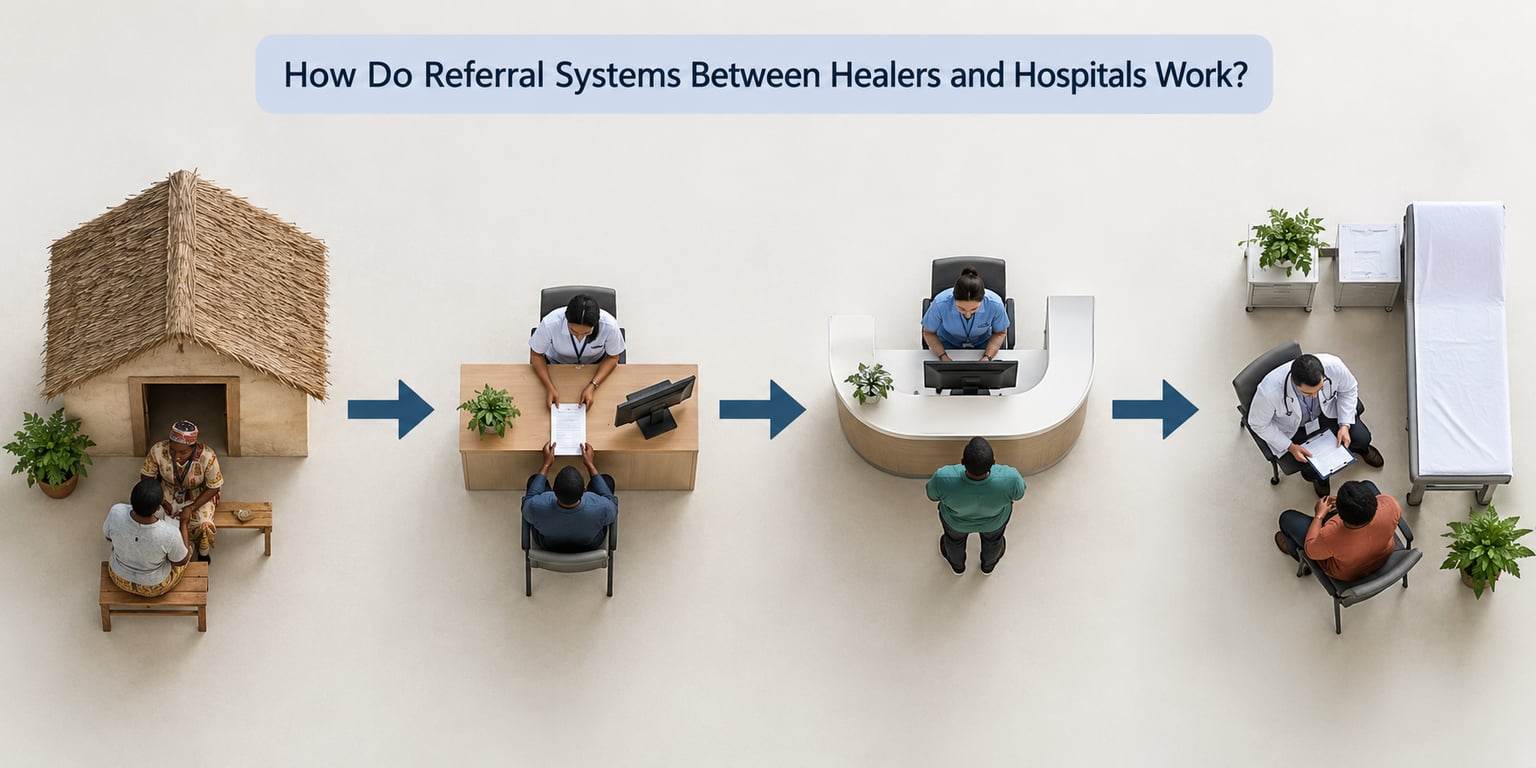
The pathway looks simple on paper and gets messy in practice. A typical sequence runs through seven moves.
Recognising warning signs
The healer decides the problem is beyond what community care can manage. This judgement, not the patient’s enthusiasm, is the pivot point of the whole system.
Obtaining consent
The patient agrees to be referred and understands why. Consent given under pressure, or without an explanation of what happens next, is not really consent.
Documenting what matters
A short record goes with the patient: presenting complaint, how long it has lasted, what has already been tried, and any relevant history.
Contacting the receiving service
Where a phone or radio exists, the healer or a community health worker calls ahead. Where nothing exists, the patient carries the note and presents it at reception.
Confirming the handover
The receiving facility acknowledges the referral and, ideally, gives the patient priority at triage because the paperwork proves an urgent need.
Sharing results back
The clinic returns diagnostic information to the healer. This is the step most often skipped and the one practitioners say they value most.
Continuing care safely
The healer adjusts or continues traditional treatment in light of what the hospital found, so the two approaches do not collide.
Not every service operates formally. Plenty of referrals never leave the healer’s room as paper; they travel as advice between two people who already know each other. That still works, but it leaves no record for anyone to audit.
Referral slip, referral form, referral register: three different things
A referral slip is the small item the patient carries. A referral form is the fuller document the healer completes, often pictorial. A referral register is the register the facility keeps. Practitioners mix these up constantly, and mixing them up is a common reason information disappears.
Who Participates in a Successful Referral Network?
Traditional and faith healers are the entry point. Their responsibility is recognition, documentation and honesty about what they have already administered.
Community health workers bridge the gap. They escort patients, translate, carry forms and often hold the only working phone in the catchment area.
Primary care providers, nurses and pharmacists at health posts and clinics receive the referral, treat what falls within their scope and escalate what does not.
Hospital staff at the receiving end decide triage priority, run investigations and discharge. Their limits of authority are real: most facilities cannot test for everything a healer might suspect.
Emergency services matter when distance makes ordinary transport too slow.
Caregivers and family members carry much of the practical load, often paying transport costs and accompanying patients over long distances.
Regulators, ministries of health and traditional medicine institutes set registration rules, design forms and fund transport support.
And patients themselves sit at the centre. Referral is a request, not an instruction. Authority sits with the person seeking care.
When Should a Traditional Healer Recommend Hospital Care?
Refer immediately, without waiting to see whether the treatment works, when any of these appear.
- Difficulty breathing, or breathing that is fast, shallow or noisy at rest.
- Altered consciousness: confusion, extreme drowsiness, or a person who cannot be roused normally.
- Signs of severe dehydration: no urine for many hours, sunken eyes, or a skin pinch that rebounds slowly.
- A high fever that persists, or any fever with a stiff neck, a rash that does not fade under pressure, or a seizure.
- Suspected poisoning, including ingestion of pesticides, medicines in quantity, or unknown substances.
- Major injury: deep wounds, suspected fracture, heavy bleeding, or burns across a wide area.
- Pregnancy danger signs: bleeding, severe headache with visual changes, convulsions, fever, or reduced fetal movement.
- Any child who is unusually limp, refuses feeds entirely, or is breathing fast while feeding.
- Symptoms that worsen rather than settle after a course of traditional treatment.
Two extra cautions matter for anyone combining traditional and biomedical care. A herbal preparation can interact with prescribed medicine, including antiretroviral therapy and anticoagulants, so the hospital needs to know exactly what was taken and when. And a course of herbal treatment can mask or delay a diagnosis, which is why “wait and see” carries a different risk here.
Referral is often described by practitioners as treatment failure rather than planned escalation. Qualitative work on referral decision-making finds that the framing matters as much as the form: a practitioner who treats the hospital as the next safe step refers earlier and more often than one who treats it as an admission of defeat.
How Referral Systems Between Healers and Hospitals Differ Across Settings
In rural community settings, distance dominates everything. The nearest facility may be hours away, transport is rarely funded, and a mobile phone may be the sole link. Referrals depend on relationships and on patients who have relatives with a vehicle.
In urban areas, facilities exist in numbers, but congestion and staff shortages make them slow. Referral slips are often ignored because the queue is long regardless, which teaches patients that the note is pointless.
Informal practitioner networks operate on personal acquaintance. A healer knows a clinician, calls them, and the patient is seen. Fast and undocumented, and it collapses the moment one of the two people moves away.
Formal public-health programmes register healers, design standardised forms, run training and monitor counts. They can reach scale but need ministry capacity to survive, and capacity is what usually disappears first.
Temporary and humanitarian services face a shorter horizon: staff rotate, supplies run out and referral pathways built for a camp or a mobile clinic have no obvious successor.
What Information Should Be Shared During a Referral?
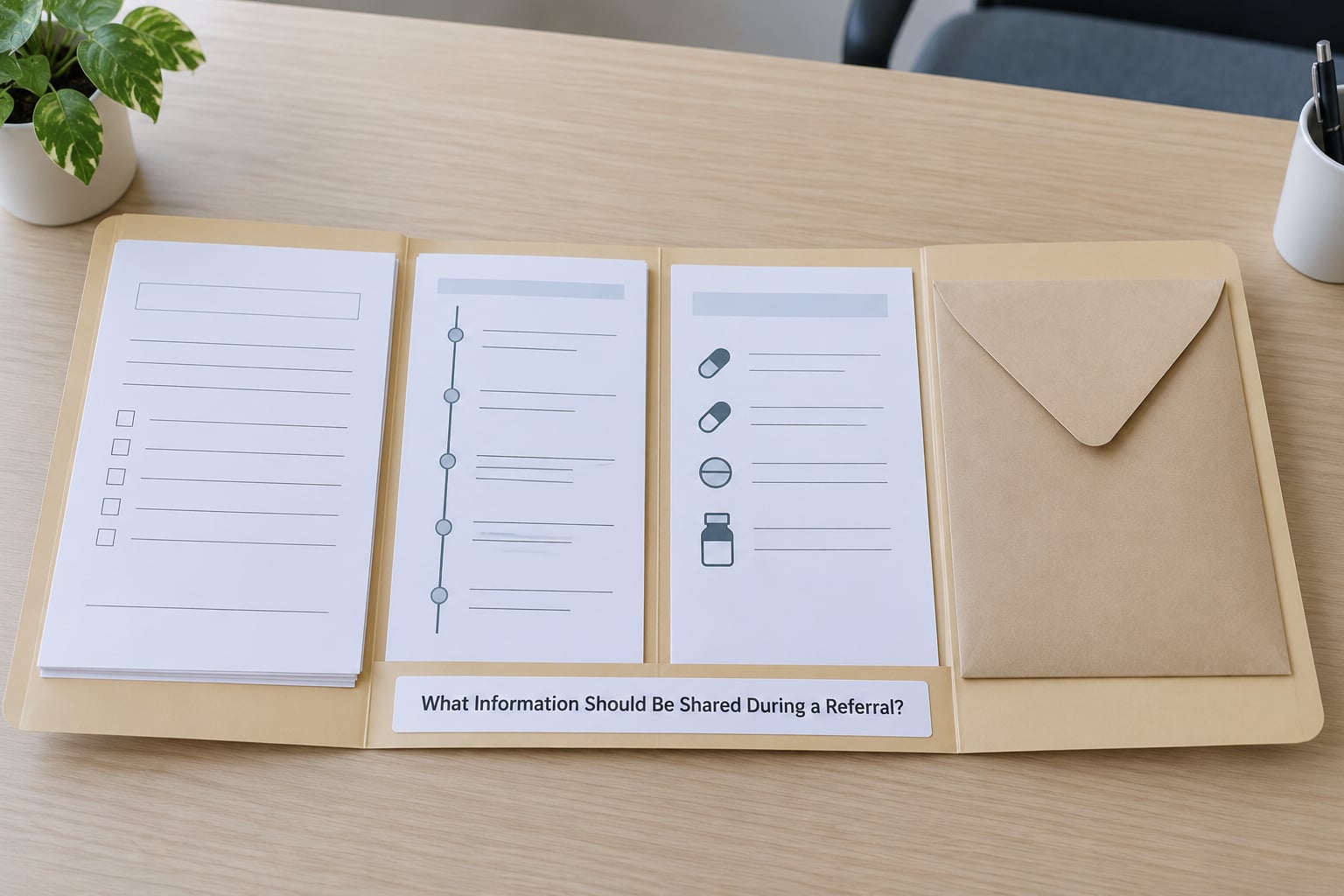
Share what the receiving clinician needs to act, and nothing beyond that.
- The presenting concern, in the patient’s or family’s own words, plus the symptom timeline.
- Relevant history: previous illness, chronic conditions, prior surgery, family history where it changes risk.
- Allergy information, stated plainly rather than implied.
- Current medicines, including traditional preparations, herbal teas, powders and anything taken at the roadside.
- What traditional treatment has already been given, at what dose and for how long.
- Pregnancy status and antenatal history when relevant.
- An emergency contact and the phone number of the referring healer.
- The patient’s recorded consent to share, and their consent to share it back.
Leave out what the clinician does not need. Gossip about the household, a judgement about the family’s circumstances, or details of a mental-health history offered without the patient’s knowledge all damage trust.
Forms designed for low-literacy settings work, and the evidence is specific. In the 2013 Mozambique study led by Audet and colleagues, pictorial referral forms reached 100% completion of the symptom section, 95% for the date and 89% for the healer’s name, among healers with a median of one year of formal schooling and 42% of whom had no Portuguese proficiency. Pictures beat prose in exactly the fields that matter.
How Can Consent, Privacy, and Trust Be Protected?
Explain before you refer. Say plainly what you have observed, why a facility is needed, what will happen there and roughly how long it may take. Patients who understand the reason comply more often.
Record the decision. A tick, a thumbprint, a witnessed mark or a relative’s signature all beat a verbal yes that nobody witnessed.
Keep the right to decline. A patient may refuse a referral, and that refusal deserves a short explanation of the risk they are taking, not a lecture.
Limit what you pass on and state the limit out loud. “I will tell them what you have taken and when, and nothing else” is a sentence that makes referral less threatening.
Protect the return leg too. Diagnostic results belong to the patient, who decides who receives a copy. A healer asking for results should ask the patient, not the facility, and should never request records directly.
Watch for exploitation dressed as referral. A healer who demands payment for a note, or who tells a patient the hospital will refuse traditional treatment, is damaging the system as surely as a facility that ridicules the patient. Both behaviours are documented in the research literature.
What Barriers Make These Referral Systems Hard to Use?
A 2021 systematic review in the European Journal of Health Sciences screened 123 records and drew on 14 studies to group the problems into four clusters: human resource constraints, financial constraints, non-compliance and self-referral, and communication breakdown. The clusters travel well, but they do not look identical in every community.
Distance, cost and transport
The fare often exceeds what a family can spare on the day. Losing a day’s work to travel adds an opportunity cost that rarely appears in any register. Underfunding of referral transport at facility level means the ambulance equivalent is a request that depends on who is watching.
Communication loss
Forms get thrown away. In the Mozambique study, healers reported clinicians discarding referral paperwork, and forms sometimes returned to the healer without the matching symptom section. Missing feedback is the deeper version of the same problem: the loop never closes, so the healer learns nothing and stops trusting the arrangement.
Staffing, motivation and attitudes
Receiving facilities are often understaffed and deprioritise referred patients who arrive without an appointment. Open disapproval by some physicians toward patients who consulted a healer first turns a clinical handover into a humiliation, and patients who witness it stop going.
Non-compliance and self-referral
Some patients never complete the journey. Others walk straight to hospital without going through the community step, which distorts referral counts and congests facilities that were expecting fewer walk-ins. Both behaviours degrade outcomes for everyone waiting.
What research in Eswatini adds is a special weak spot: linkage is thinnest for nutrition, psychosocial support, palliative and home-based care, and it is strongest for the conditions with clear pathways such as HIV testing, tuberculosis screening and antenatal care.
One Ethiopian study found only about 10% of patients arriving at hospital had been formally referred beforehand, with roughly three-quarters of hospital referrals originating at health centres instead. Whatever a healer does, most volume still flows through the formal system.
How Can Referral Pathways Be Improved Safely?
Start with a named contact on each side. A phone number for a person, not a switchboard, changes more referral behaviour than any form.
Publish a referral directory listing facilities, their opening hours, which services they actually offer and how to reach the triage desk. Many failed referrals are simply wrong destinations.
Use agreed forms with symbol-based fields, and design them with healers and community health workers rather than for them.
Train briefly and repeatedly. The Mozambique intervention was a three-day course; referral rates rose by about 35% in median monthly volume afterwards, from 0.25 to 0.34 patients per healer per month. Notably, HIV knowledge scores rose from a median of 67% to 81% but did not predict the referral change. The relationship moved behaviour, not the lecture.
Give priority at triage when a referral note is presented, and make sure the patient is told this in advance. Nothing destroys trust faster than a note that changes nothing.
Collect forms on a fixed routine, such as monthly, so that unfiled paperwork becomes visible rather than lost.
Close the loop with written feedback to the healer wherever patient consent allows. Where it does not, tell the healer that the patient was seen, without clinical detail.
Do not monetise the referral. The Mozambique programme deliberately paid healers nothing, which protected the goodwill the arrangement depended on.
Represent the community in the design. Include patients and caregivers, not only providers on both sides.
Measure delays and outcomes rather than counting forms. In the same Mozambican districts, only 3.5% of referred non-pregnant patients were tested for HIV and 2.5% for tuberculosis, despite high prevalence and symptoms that should have triggered screening. A referral is not the finish line.
On digital options, stay realistic. SMS and mobile referral tools are being piloted across low- and middle-income countries, but evidence for them in low-connectivity rural referral remains thin. Treat them as an addition to a working paper process, not a replacement for one.
What Should Researchers and Health Writers Report Accurately?
Separate documented practice from community perception. A referral described in an interview as smooth and a referral observed at a facility may be two different things, and reporting the first as the second misleads readers.
Record who initiated the referral. Healer, community health worker, family member or the patient themselves changes what the number means.
Note whether feedback reached the original practitioner. Without that field, most “successful” referral programme claims are measuring handovers rather than care.
Avoid treating African healers as one group. Practice, training, association membership and willingness to refer differ sharply between practitioners in the same district, let alone across countries.
Attach numbers to named studies and dates. The 35% increase comes from a 2013 intervention in three high HIV-prevalence rural districts in Mozambique; it is evidence that a specific approach worked somewhere, not a general guarantee.
Frequently Asked Questions
What is the difference between a formal referral and an informal healer-to-hospital recommendation?
A formal referral is documented. The healer completes a form or register entry, the receiving facility files it, and the outcome travels back so care can continue safely. An informal recommendation is verbal advice to seek a clinic, with no record on either side. Informal advice is common and not necessarily bad, but it leaves no trace to audit, no feedback for the healer and no way to know whether the patient ever arrived.
Can a patient choose whether a traditional healer refers them to a hospital?
Yes. The patient decides whether to accept a referral, and that decision should be recorded rather than assumed. A healer can explain the warning signs, describe what the hospital offers and describe the risk of not going, but pressure counts against informed consent. Where someone declines, the useful follow-up is to record why and to arrange a review point, not to repeat the same request at every visit.
Should a traditional healer send medicinal samples or patient records with a referral?
Inform the receiving clinician about every traditional preparation already taken, including the dose and timing, because some interact with prescribed medicine such as antiretroviral therapy. Sending samples is a separate matter and usually unwise, since storage, identification and handling rules differ and unlabelled material can be mishandled. Records should travel only with the patient’s consent, and only the parts the receiving clinician actually needs.
What can a referral system do when there is no telephone, transport, or nearby hospital?
Start with a paper pathway that does not depend on either: a pictorial form the patient carries, a named contact to aim for, and a directory of what each nearby facility can actually do. Community health workers can carry forms and escort patients where they exist. Transport support has to be arranged in advance, usually through the facility rather than the healer, since the healer cannot fund a journey they do not control.
How can traditional healers and hospital staff communicate without compromising safety?
Work through an agreed form, a named contact on each side and a fixed collection routine, and keep the exchange clinical: symptoms, timings, treatments given, results returned. Feedback should confirm that the patient was seen even when clinical detail cannot be shared without consent. Health workers report that being treated as partners, rather than talked down to, is what keeps communication open on both sides.
Conclusion
The safest first step in any referral system between healers and hospitals is small and unglamorous: agree one pathway for urgent warning signs, put it in writing, and make sure every referral is documented, received and acknowledged.
Then close the loop. Confirm that the patient arrived, return what the facility learned where consent allows, and adjust traditional treatment accordingly. Referral systems fail far more often from silence than from distance, and a short note back to the healer is what turns a lost patient into continuity of care.