Children should not take adult herb doses because an adult dose is sized for an adult’s body mass and fully mature organs, while a child’s smaller body concentrates the same amount of an active constituent and clears it more slowly. Children are not small adults, and halving an adult capsule or serving an adult-strength tea is not a safe stand-in for advice from a pediatrician or pharmacist.
The arithmetic behind most adult labels is straightforward. Manufacturers set adult amounts for a body of roughly 70 kilograms with mature liver enzymes, mature kidneys and a closed blood-brain barrier. Apply that same quantity to a 12 kilogram preschooler and the amount of active compound per kilogram of body weight is close to six times higher, landing on organs that are still developing.
There is a second problem that catches families off guard: the word herb on a label says nothing about how strong the product is. A dried root in a decoction, a liquid tincture with a stated extraction ratio, a standardized extract measured to a percentage of active compounds, and a distilled essential oil are four very different things. Only the last of those is close to pure active constituent, and none of them can be swapped for one another by eye or by teaspoon. Guidance here is general information; individual decisions belong with a clinician who knows your child’s history. This guide was reviewed for 2026.
Table of Contents
- 1Why Children Should Not Take Adult Herb Doses
- 2What Makes a Child Different From an Adult?
- 3Why Adult Doses Can Be Riskier for Children
- 4Are All Herbal Remedies Unsafe for Children?
- 5What Should You Do If a Child Takes Too Much?
- 6How to Choose and Discuss Child-Friendly Herbal Products
- 7Frequently Asked Questions
- 8Can I use a child’s weight to work out an adult herb dose?
- 9Is it safe to cut an adult capsule or pour half a bottle into a child’s drink?
- 10Is a herb safe for children just because it has been used traditionally?
- 11What should I do if my child takes an adult dose of an herbal supplement?
- 12What are the main dangers of herbal medicine in children?
- 13Are children’s gummy vitamins and supplements automatically gentler?
- 14Conclusion: Start With a Professional Safety Check
Why Children Should Not Take Adult Herb Doses
Because the adult amount on a label was never calculated for a child’s body. It assumes adult body mass, adult hepatic metabolism, adult kidney filtration and an adult blood-brain barrier, none of which a child has. Giving that amount anyway is not a mild overshoot, it is a proportionally large overdose of whatever the preparation contains.
Two more factors make adult products a poor fit for children. Concentration varies widely between products with the same herb on the front label, because supplement manufacturers are not required to prove potency or purity before sale. And combination products often carry added ingredients, including substances such as melatonin, caffeine or prescription-like actives, that a caregiver would not recognize from the product name.
Older sources of ethnobotanical knowledge assumed a preparation, a plant part and a context, and those traditions are valuable. What they did not assume is a modern concentrated extract delivered to a 2-year-old.
What Makes a Child Different From an Adult?
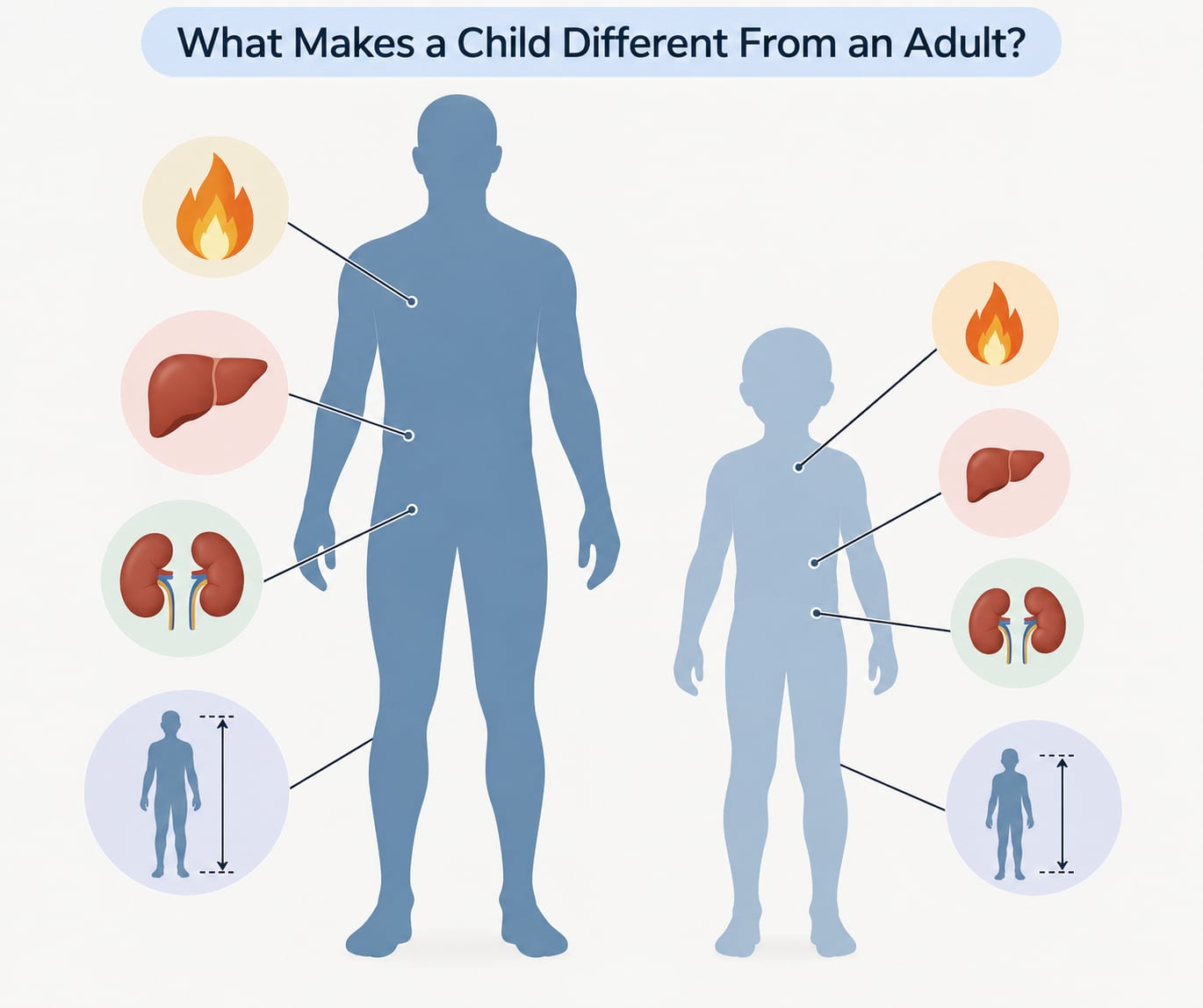
Children differ from adults in five systems that all handle medicinal compounds, and every one of them pushes in the same direction: more exposure, longer exposure. The table below is a general summary of those differences, not an assessment of any individual child.
| Factor | Adult pattern | Child pattern | Why it changes the risk |
|---|---|---|---|
| Body weight and mass | Dose assumed for roughly 70 kg | Infants may weigh 4 to 6 kg; toddlers 10 to 14 kg | The same quantity becomes a far higher amount per kilogram |
| Total body water | About 60 percent of body weight | Closer to 75 to 80 percent in infants | Water-soluble constituents spread through a larger share of body fluid |
| Liver metabolism | Enzyme systems fully developed | Hepatic enzyme activity still maturing | Compounds are broken down more slowly and may accumulate |
| Kidney filtration | Mature glomerular filtration | Renal clearance still developing | Waste products and active compounds are excreted less efficiently |
| Blood-brain barrier and gut | Tight barrier, established gut barrier | More permeable barrier, developing gut mucosa | More of an active compound reaches the brain, and gut upset is more likely |
| Immune system | Long exposure history | Few prior exposures | Allergic and cross-reactive reactions are more likely to be unrecognized |
Read across a row and the direction is always the same: a smaller, less mature system deals with the same amount more intensely.
Why Adult Doses Can Be Riskier for Children
Five reasons come up repeatedly, and they compound each other rather than appearing separately.
- Body weight does the dividing. An amount that is ordinary for a 70 kg adult can be a several-fold overdose per kilogram for a young child. Weight-based dosing is the concept practitioners use, but the conversion belongs to a professional, not to a kitchen calculation.
- The liver is still maturing. Immature hepatic enzyme systems process many plant compounds slowly, so an active ingredient that an adult clears overnight can persist in a child for much longer. Repeated daily use then becomes cumulative exposure.
- The blood-brain barrier is more permeable. More of the compound reaches the central nervous system, which is why neurologic symptoms such as drowsiness, agitation, poor coordination and seizures show up in reports of herbal harm in children.
- Kidney filtration is immature. Renal clearance is still developing, so what is not handled by the liver has to be excreted by organs that are not yet fully able to do it.
- The gut and immune system are still developing. A more permeable gut lets more of the preparation be absorbed, and an immune system with no exposure history reacts differently, sometimes severely.
Weight and size are not the only considerations, though. Some plants have a narrow safety margin, where a small excess of a normally harmless herb becomes a genuine toxicity risk. Concentrations are not always consistent from bottle to bottle, so even a correctly scaled adult product is an unreliable child dose. Combination products may contain undeclared substances, and anything that resembles candy, a gummy or a sweet tea will be reached for by a toddler. Concentrated extracts and essential oils deserve their own caution, since they are the most potent forms and the ones most often stored carelessly on a counter.
Risk also shifts with age. Infants have the least mature systems and the smallest margin. Toddlers are mobile, curious and likely to grab an adult bottle. School-age children can be given adult-looking gummies marketed with cartoon packaging. Adolescents may take adult products independently, often alongside a prescription medicine, which opens the door to interactions.
Are All Herbal Remedies Unsafe for Children?
No. The plant, the preparation, the age, the health condition and the product all matter, and several herbs are used with children under professional supervision. What does not hold is the assumption that a product is safe for children because it is natural, has been used traditionally, or is fine for adults.
Traditional use is a record of practice, not proof of safety. A remedy prepared as a weak whole-plant decoction tells you very little about a standardized extract at ten times the concentration, and a distilled essential oil is closer to a concentrated chemical than to a plant. Ethnobotanical traditions are specific about plant part, preparation and amount, and those details are usually lost when the plant is turned into a capsule or a gummy.
Cross-reactivity adds another layer. Chamomile belongs to the daisy and chrysanthemum family, so a child who reacts to ragweed or chrysanthemums may react to chamomile tea. That kind of connection is invisible on a front label.
Contamination is a documented, separate hazard. Traditional preparations have been found to contain lead, mercury and arsenic, sometimes as deliberate ingredients in the formula rather than as accidental contamination. In the United States, dietary supplements are a category that is not evaluated by regulators for safety or effectiveness before reaching store shelves, so a label is a manufacturer’s claim rather than a tested fact.
What Should You Do If a Child Takes Too Much?
Stay calm and act in a fixed order. Do not wait to see whether symptoms appear before making the call.
- Stop any further exposure. Remove the product from reach and note the time and the estimated amount.
- Keep the container and the packaging. The plant name, the concentration and the batch information are exactly what the specialist will ask for.
- Contact a poison control service. In the United States, Poison Control is 1-800-222-1222, and the line is staffed 24 hours a day. Call Poison Help first rather than waiting for symptoms.
- Seek emergency care immediately for difficulty breathing, unusual sleepiness or unresponsiveness, a seizure, repeated vomiting, severe abdominal pain, or a widespread rash with swelling of the face or mouth. Take the product container with you.
- Do not induce vomiting, give home remedies, or give charcoal or milk unless a poison specialist instructs you to.
Outside the United States, use your local poison service or urgent medical number. If the product was an essential oil, a topical preparation applied over a large area, or a multi-herb blend, say so plainly, because the treatment path differs.
How to Choose and Discuss Child-Friendly Herbal Products
Even a carefully chosen product is a conversation to have with a pediatrician or pharmacist, not a decision to make alone. These checks make that conversation easier, and none of them replaces clinical advice.
- Identify the plant precisely. Write down the full botanical name and the plant part used, not just the common name on the front of the bottle. Common names are shared by unrelated plants.
- Ask what form it is. Infusion, decoction, tincture with a stated ratio, standardized extract and essential oil have very different strengths. A child’s preparation is chosen by form, not by the front label.
- Look for independent testing. A certificate of analysis from a laboratory that did not manufacture the product is more meaningful than a self-declared purity statement on the box.
- Read warnings and age statements carefully. If the label states an age limit, treat it as a floor rather than a suggestion, and note whether it names an age at all.
- Avoid unclear combinations. Blends that mix several herbs make it impossible to know which ingredient caused a reaction, and some are spiked with additional actives.
- Ask about medicines and conditions. Bring a list of everything the child takes, including other supplements, plus any allergies, asthma, liver or kidney conditions.
- Plan how long it would be used. Long daily use in a child has no published pediatric data behind it, so agree a review date in advance instead of continuing indefinitely.
Aspirations aside, the honest position is that most herbs have no established pediatric dose. A clinician who says no is not dismissing traditional knowledge, they are declining to extrapolate from adult data.
Frequently Asked Questions
Can I use a child’s weight to work out an adult herb dose?
Weight is only one input, and pediatric dosing for herbs is not standardized enough to convert safely at home. A child also differs in liver maturity, kidney filtration, total body water and blood-brain barrier permeability, so a per-kilogram calculation built on adult data can be badly wrong. Ask a pediatrician or pharmacist to do any conversion, and treat a label’s adult amount as a starting point for a professional discussion, not a formula.
Is it safe to cut an adult capsule or pour half a bottle into a child’s drink?
Splitting a capsule or halving a liquid does not make an adult product child-safe. Capsules often contain a dose already close to a full adult serving, and liquid products vary in concentration between batches, so half a spoonful is not a predictable amount. Concentrated drops and essential oils are especially easy to overgive. If you are considering any herb for a child, a pediatric clinician should choose the preparation, the form and the amount.
Is a herb safe for children just because it has been used traditionally?
Traditional use records practice, not proven safety, and it rarely specifies the age, the plant part or the preparation. A whole-plant decoction, a tincture with a stated extraction ratio, a standardized extract and an essential oil can differ many times over in the amount of active compound they deliver. Long traditional use also reflects a context where adverse effects in small children may simply have gone unrecorded. Traditional knowledge is worth respecting and worth discussing with a clinician.
What should I do if my child takes an adult dose of an herbal supplement?
Call Poison Control right away rather than waiting for symptoms. In the United States the number is 1-800-222-1222, available 24 hours a day; elsewhere use your local poison service or urgent medical number. Keep the container so the specialist knows the plant, the concentration and the amount. Do not induce vomiting or give home remedies. Seek emergency care for breathing difficulty, unresponsiveness, a seizure, repeated vomiting or facial swelling.
What are the main dangers of herbal medicine in children?
Four categories come up most often. The first is adult-strength dosing, which overwhelms a child’s smaller, less mature body. The second is organ toxicity, particularly liver injury from herbs that stress hepatic metabolism. The third is contamination, including lead, mercury and arsenic found in some traditional preparations. The fourth is reactions and interactions, ranging from allergic and cross-reactive responses to problems when a herb is combined with a prescription medicine.
Are children’s gummy vitamins and supplements automatically gentler?
Not necessarily. Parents report buying children’s gummies that carry herb actives at amounts adults take daily, which is how an adult-strength product ends up in a child’s routine without anyone deciding to give one. Packaging that looks like candy is also a factor in young children reaching for it. Read the active ingredient list and the amount per serving, then take it to a pediatrician, who can tell you whether the product is appropriate for your child’s age and what to watch for.
Conclusion: Start With a Professional Safety Check
The safest first step is simple: do not give an adult herb dose to a child, and do not improvise a smaller one. Note the exact product, the plant name and the amount already given, then ask a pediatrician or pharmacist whether there is age-appropriate evidence, what the risks and interactions are, and whether a safer alternative exists. If a dose has already been taken, call Poison Control at 1-800-222-1222 in the United States without waiting for symptoms.