Body weight may affect how much of an herb’s active compounds reaches your tissues, but the size of that effect depends on the plant, the preparation, your metabolism and the quality of the evidence. Short answer: the same milligram amount is not the same experience for everyone.
Most herbal products are sold in a fixed amount — 400 mg of a root extract, a tablespoon of tincture, one cup of tea. Nobody prints your weight on the box. That mismatch between a standard amount and a non-standard body is the root of a question people rarely ask out loud but notice anyway: why did the same remedy do almost nothing for my friend and quite a lot for me?
Understanding why body weight affects herb response is mostly a pharmacology question, not a folk one. It comes down to how a dose is diluted, where it goes, how fast the liver and kidneys remove it, and how sensitive the target tissue is to what arrives. It is also a question with a lot of fog around it, because most of what we know about weight and dosing comes from research on purified single-compound medicines rather than on whole plants.
Table of Contents
- 1Why Body Weight Affects Herb Response
- 2What mechanisms could link body weight to herb response?
- 3The main reasons why body weight affects herb response
- 4How do dose exposure and body composition differ?
- 5Why do metabolism and elimination vary between people?
- 6Can two people taking the same herb product respond differently?
- 7What does traditional-use evidence tell us?
- 8What should readers avoid assuming about body weight?
- 9What questions should you ask a doctor or pharmacist?
- 10Frequently Asked Questions
- 11Should a person with a higher body weight automatically take more of an herb?
- 12How much of a traditional herb response depends on body fat?
- 13Why do herbal product labels often show the same amount for everyone?
- 14Can traditional use provide evidence for a body-weight-based herb adjustment?
- 15When should someone ask a healthcare professional before using an herbal product?
- 16Key Takeaways
Why Body Weight Affects Herb Response
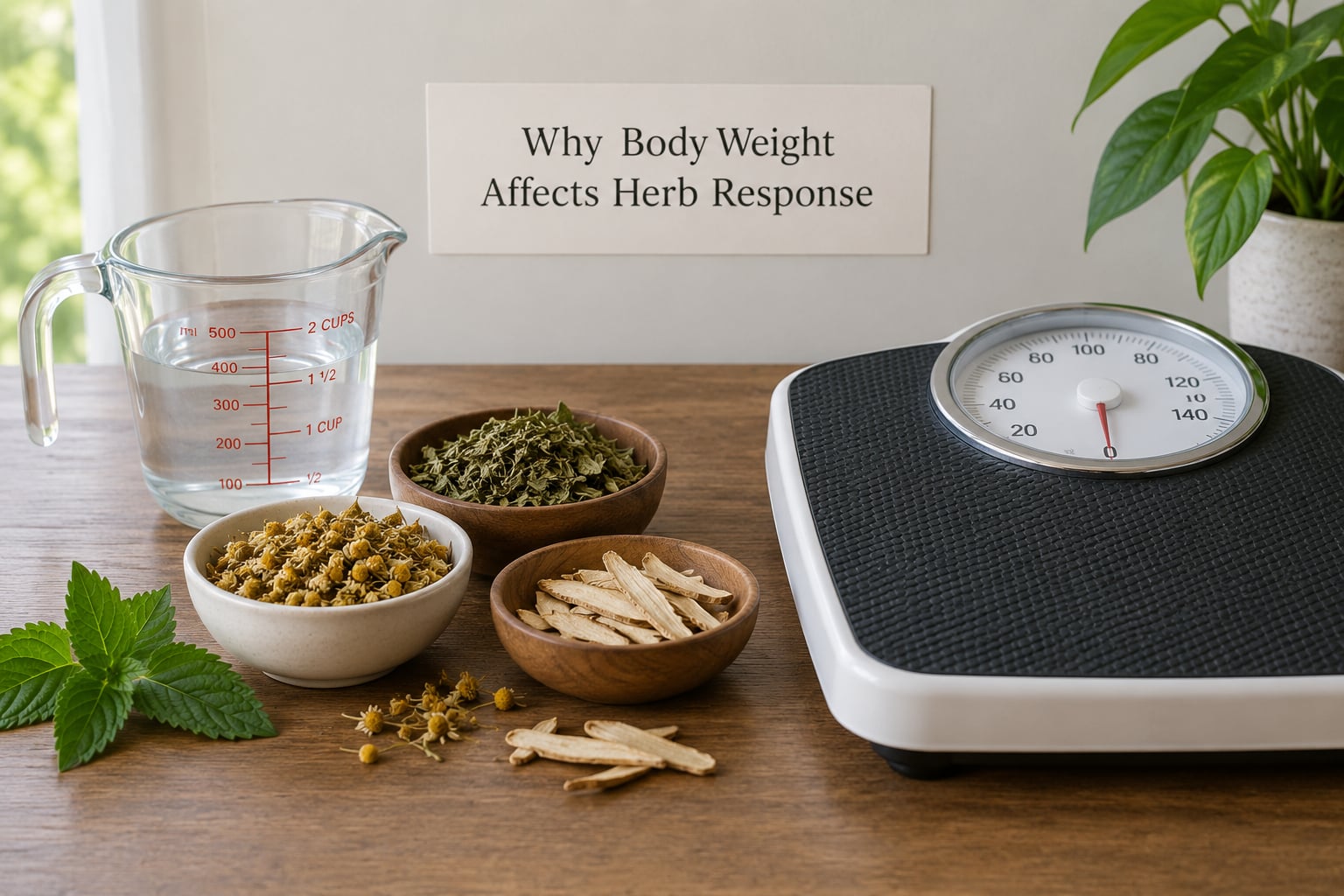
A fixed amount of an herb is spread across whatever body it lands in, and the body handles it differently depending on size and composition. Pharmacokinetics, the study of what the body does to a substance, covers absorption, distribution, metabolism and excretion. Body weight touches all four.
Think of it as dissolving a spoon of sugar in water. The same spoon changes the taste far more in a small glass than in a bucket. Herbal compounds behave in a similar way for the fraction of the dose that is water-soluble and not bound to protein before it reaches circulation.
The practical version matters more than the metaphor. Most herbal labels assume a reference adult, and they never ask whether that adult weighs 55 kg or 110 kg, has a different ratio of fat to lean tissue, or takes six prescription medicines alongside the herb. So the label is not wrong so much as silent.
What mechanisms could link body weight to herb response?
Researchers usually group the explanations under two headings. Pharmacokinetic mechanisms describe what the body does to the compound — how much is absorbed, how it is distributed, how quickly it is broken down and removed. Pharmacodynamic mechanisms describe what the compound does once it arrives — how strongly it binds, how many receptors are present, how sensitive the tissue is.
Body weight leans hardest on the pharmacokinetic side, but not exclusively.
Dilution across total body water. Water-soluble compounds circulate in body water, which scales roughly with mass. The same 500 mg spread through 30 litres is a different concentration than the same 500 mg spread through 45 litres.
Where the compound goes. Fat-soluble constituents, including many terpenes and some flavonoids, prefer to sit in adipose tissue. A person with a larger fat store may park more of the dose away from the bloodstream for a time, which flattens the peak and stretches the tail.
Absorption. Stomach volume, gastric emptying speed, gut surface area and the presence of food all change how much of an oral preparation actually crosses the intestinal wall. Larger bodies do not simply absorb in proportion to mass.
Metabolism. Liver size does not scale perfectly with body weight, enzyme activity varies between individuals, and metabolic conditions common at higher body weight can slow the breakdown of some compounds.
Elimination. Kidney filtration has a ceiling. Once it is reached, extra body size does not buy extra clearance, so compounds can accumulate more than a naive calculation would suggest.
Tissue response. Receptor density and downstream signalling are not weight-based, but the metabolic environment around them can change how well a signal translates into an effect.
The main reasons why body weight affects herb response
- A fixed amount of herb is diluted through a different volume of body water, so the concentration reaching blood differs.
- Fat-soluble constituents are stored in different amounts of adipose tissue, changing the peak level and how long the compound lingers.
- Absorption varies with stomach volume, gut transit and food, independent of body size.
- Liver and kidney capacity do not scale in proportion to body weight, so clearance can be relatively slower in a larger body.
- Body fat percentage changes the size of the storage reservoir for lipophilic plant compounds.
- Microbiome differences between two people of the same weight can change how plant compounds are converted before they are absorbed.
How do dose exposure and body composition differ?
Dose exposure is the amount taken. Body composition decides how that amount is shared out. Two people can take identical amounts of the same preparation and receive genuinely different exposure — how much reaches circulation, how much is stored, how long it stays there.
Take a purely illustrative example, not a recommendation. Suppose a water-soluble extract contributes 200 mg of a marker compound. Spread across body water of 30 litres, that works out to roughly 6.7 mg per litre. Across 45 litres, roughly 4.4 mg per litre. Same amount in the mouth, and the body is working with about a third less concentration.
Now add a lipophilic constituent from the same plant. In someone with a higher proportion of body fat, a portion of that compound leaves the bloodstream and sits in adipose tissue. The measured plasma level dips, and what you feel as an effect may arrive later and last longer.
| What is measured | What it tells you | What it misses |
|---|---|---|
| Amount in the product | What went in the mouth | How much was absorbed |
| Body water and lean mass | How the water-soluble part is diluted | Storage in fat tissue |
| Percentage of body fat | Size of the reservoir for lipophilic compounds | How much the liver clears |
| Assay of a marker compound | Concentration measured at one point in time | Peak and total exposure over time |
This is why body mass index is a blunt instrument here. BMI cannot tell you how much fat you carry versus muscle, how much water sits in your tissues, or how your organs are functioning. It is useful for population studies and a poor dosing variable.
Body surface area, estimated by formulas such as Mosteller’s, sits somewhere in between. It was designed for chemotherapy dosing and it does track with some drug exposure better than raw weight does. But it assumes a body shape that most of us do not have, and no evidence supports it for whole-plant preparations.
Where the numbers genuinely line up is with lean body weight, which approximates the tissue mass doing the metabolising work. Several drug classes are dosed on ideal or lean body weight precisely because total weight overstates them. For herbs, that logic is reasonable to keep in mind but there is no validated formula to follow.
Why do metabolism and elimination vary between people?
Even two people with identical body weight can handle the same herb differently, and body weight is only one of the reasons. Clearance depends on enzyme activity, organ function and genetics, and most of those factors are independent of size.
Microsomal CYP450 enzymes in the liver are the workhorses of drug metabolism, and the same enzymes process many plant compounds, including the alkaloids and flavonoids found in common herbs. The amount of a given enzyme varies several-fold between people for genetic reasons alone, and enzyme activity shifts with liver disease, alcohol, smoking, diet and certain medications.
First-pass metabolism matters as much. Anything swallowed passes through the intestinal wall and the liver before reaching systemic circulation, and both can destroy a portion of the dose. If a larger gut and liver surface happen to express more of the enzymes that break a compound down, a larger fraction of the same amount never reaches circulation.
Kidneys filter the blood and have a finite ceiling on how much they can clear per minute. Past that ceiling, extra body size does not deliver extra clearance. Kidney function also declines with conditions such as diabetes and high blood pressure, which are more common at higher body weight.
Insulin resistance adds another layer. It changes how enzymes are expressed and how quickly the liver turns things over, and it shifts how fat tissue behaves as a storage site. None of this is specific to herbs, but it compounds whatever the weight itself does.
Finally, the gut microbiome. Some plant compounds are inactive until gut bacteria convert them, so two people with the same weight, the same product and the same meal can absorb different amounts of the active form.
Can two people taking the same herb product respond differently?
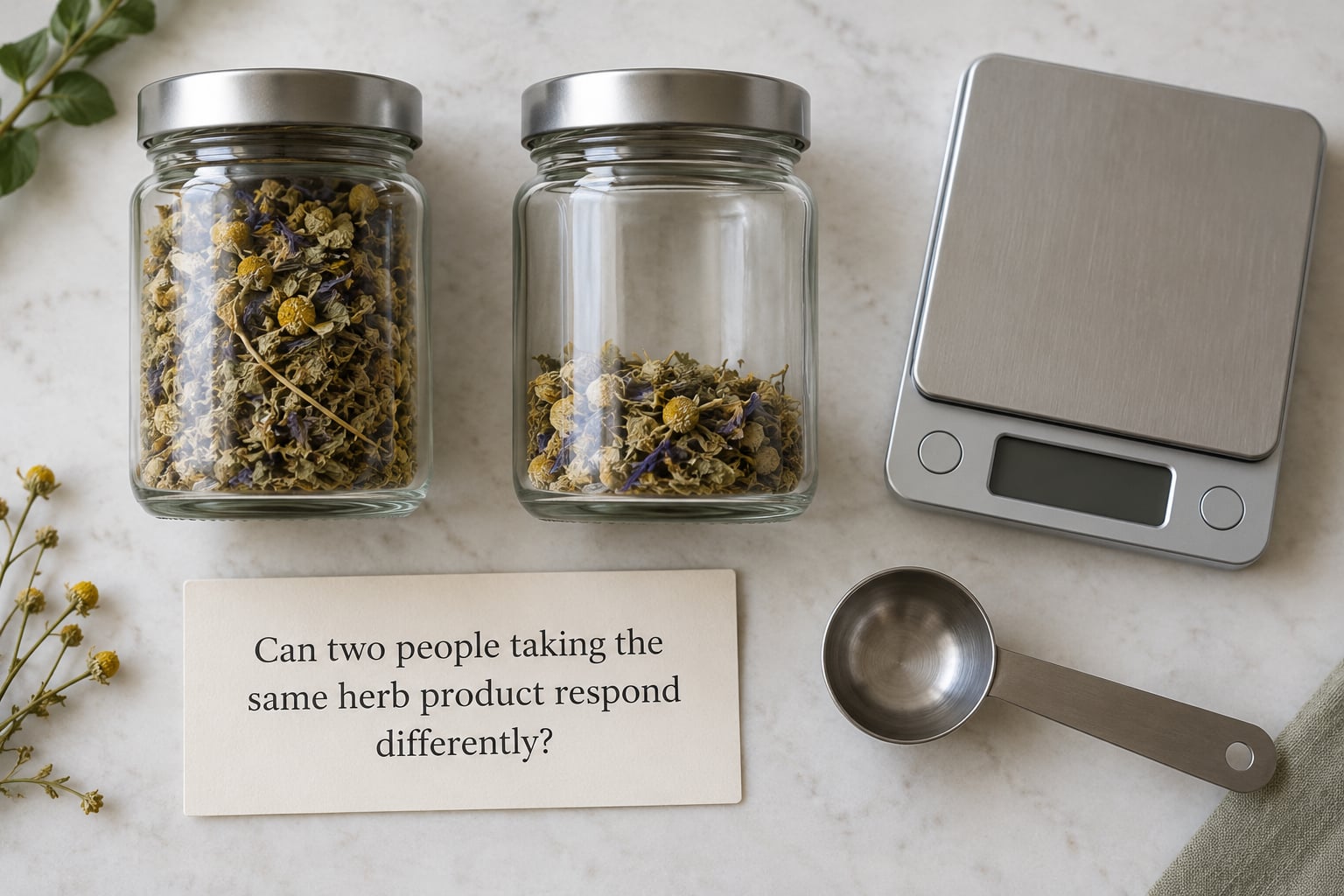
Yes, and the reasons stack. Body size is one layer. Product composition is another, and it is the layer most people never think about, because two products with the same plant name on the front can contain meaningfully different amounts of the compounds that matter.
Plant part matters, so a root extract and a leaf extract of the same species are different products. Preparation matters, since a decoction pulls out different fractions than a tincture or a capsule of dried powder. Harvest season, soil, storage age and processing all shift constituent content, which is why batch-to-batch variation is a real confounder in any comparison between two people taking the same product.
Adherence and timing matter too. Taking an extract with a fatty meal, or splitting it across the day rather than taking it all at once, changes peak levels without changing the total.
| Factor | Where the difference comes from | Likely effect on response |
|---|---|---|
| Body size | Same amount distributed through more or less tissue and water | Lower concentration in a larger body for water-soluble compounds |
| Body fat percentage | Size of the reservoir for fat-soluble constituents | Flatter peak and longer tail for lipophilic compounds |
| Metabolic capacity | Enzyme activity, liver and kidney function | Faster or slower conversion and removal |
| Product composition | Plant part, extraction method, harvest and batch | Different amounts of active compounds in the same-named product |
| Microbiome and food | Bacterial conversion of plant compounds, meal timing | Different share of the dose converted to active forms |
| Tolerance and duration | How long the herb has been taken | A familiar herb can feel like it stopped working |
That last row is worth pausing on. People often describe an herb as having stopped working, when what changed is their own response to it. Receptor sensitivity, gut bacteria and general health all shift over months.
And the outcome being measured matters. Sleep quality, digestion, joint comfort and lab markers do not improve on the same schedule, which means two people can take the same product for the same eight weeks and honestly disagree about whether it did anything.
What does traditional-use evidence tell us?
Traditional records are genuinely valuable, but they answer a different question than a dose-response study. Ethnobotanical documentation shows which plants were used, for which complaints, and in which regions, often across very long periods and many practitioners.
What it rarely provides is a controlled comparison, a standardised preparation or a measured outcome. A remedy recorded as “a handful of leaves boiled and taken as a cup” tells you the plant and the general shape of the preparation. It does not tell you how much active compound that handful contained on the day it was picked, or what happened in the person who drank it.
Traditional systems also adjusted remedy strength to the patient. Descriptions of decoction strength varying with the person, infusions given more frequently to children or the frail, and preparations made more dilute for a large frame all point in the direction of weight-aware dosing. That is a useful historical observation about practice, not a validated dosing rule.
Some traditional frameworks categorise people by constitution, temperament or the hot and cold balance of the remedy, not by kilograms. Translating those categories into milligram-per-kilogram terms is an interpretive step, and it should be labelled as one rather than presented as if the original practitioners were doing arithmetic.
So traditional-use evidence helps identify which plants mattered and which safety concerns showed up across generations. It cannot establish a precise body-weight adjustment.
What should readers avoid assuming about body weight?
Several widely repeated assumptions do not hold up, and getting rid of them makes the whole topic clearer.
- Natural products are automatically weight-neutral. A plant compound still has to be absorbed, distributed and cleared. The physics does not care where it grew.
- A heavier person always needs more. More body size means more dilution, and it can also mean slower relative clearance and a larger fat reservoir. Both directions of effect are real at the same time.
- A lighter person always needs less. A smaller body can show a higher concentration from the same amount, and lower tolerance is common in frail or older adults for reasons unrelated to weight.
- Synthetic drug dosing rules transfer directly to herbs. Most dosing formulas were built on purified single-compound drugs with known potency. A plant preparation has variable content and several active fractions.
- If the label says a standard amount, that amount is right for everyone. Labels set a general adult reference and are not a personalised plan.
- Concentration in blood equals effect in the tissue. Some compounds act directly, some need conversion, and some act on the gut itself without much reaching circulation.
Another one deserves its own mention: that a stronger feeling means a more effective product. Intensity is not a measure of benefit, and a preparation that hits harder because its compounds are more concentrated is not necessarily one with better evidence behind it.
What questions should you ask a doctor or pharmacist?
If weight, medication or a health condition is in the picture, this is a conversation worth having before you start, not after something feels off. Bring the actual product, because the label and the plant name alone are often not enough for a pharmacist to assess what is in it.
- Which plant is this, and which part of the plant is in this product?
- Is the amount on the label adjusted for body weight or body size at all?
- What is standardised in this product, and what is known about batch variation?
- Does this herb interact with any of my prescription medicines, including over-the-counter products?
- Does my kidney or liver function affect how this is handled?
- Are there conditions in my history where this would be inappropriate?
- Is this safe if I am pregnant, breastfeeding, or planning either?
- Am I allergic to this plant or to others in the same family?
- What should make me stop taking it, and who do I call if I develop a warning sign?
A pharmacist can usually screen an herbal product against your medication list in a short appointment. That single check prevents more harm than any dosing refinement discussed in this article.
This article is educational. It is not dosing instruction, and it cannot account for your medical history, your other medicines or your organ function.
Frequently Asked Questions
Should a person with a higher body weight automatically take more of an herb?
No. A larger body dilutes a fixed amount through more tissue and body water, which can mean a lower concentration, while at the same time liver and kidney capacity do not scale proportionally, which can mean slower clearance. Those two effects push in opposite directions. There is no validated weight-based herbal formula, so any change to an amount should come from a clinician who knows your medicines and health history, not from your weight alone.
How much of a traditional herb response depends on body fat?
Body fat matters most for fat-soluble plant constituents such as terpenes and some flavonoids, which move out of the bloodstream into adipose tissue. A larger fat store can flatten the peak and lengthen the time a compound remains in the body. For water-soluble constituents the effect of fat is smaller than the effect of total body water. Research on this is mostly extrapolated from single-compound drugs, not whole-plant preparations.
Why do herbal product labels often show the same amount for everyone?
Labels use a general reference adult and a standardised extract, which is what makes comparisons and product consistency possible. They are not written to be weight-adjusted, and most carry no dosing data at all for whole-plant preparations. Since extract strength also varies with plant part, harvest and processing, the amount on the label tells you very little about what an individual should take.
Can traditional use provide evidence for a body-weight-based herb adjustment?
Traditional records identify which plants were used, for which complaints, and which safety problems appeared over generations. Some descriptions do show practitioners adjusting strength to the patient’s condition. They do not contain controlled comparisons or measured constituent amounts, so they cannot establish a body-weight-based rule. Treating a traditional heuristic as a modern dosing calculation goes beyond what the record supports.
When should someone ask a healthcare professional before using an herbal product?
Ask a doctor or pharmacist first if you take any prescription or over-the-counter medicine, if you have a liver, kidney, heart or clotting condition, if you are pregnant or breastfeeding, if you are preparing for surgery, or if you are giving an herbal product to a child or an older or frail adult. A pharmacist can screen a product against your medication list in a short appointment, and that check prevents more harm than any dosing discussion.
Key Takeaways
Start with the specific product rather than the plant name, because two products with the same herb on the label can contain different amounts of active compounds. Then check reliable safety information for that preparation, and ask a doctor or pharmacist before use whenever you take other medicines, have a health condition, or are pregnant or breastfeeding.
Body weight is a real variable in how much of an herb reaches your tissues, but it is one variable among several, and none of them justify adjusting an amount on your own. The mechanisms are well described for purified medicines and only partly established for whole plants. Treat that gap as a reason to involve a clinician rather than to fill it with a formula from the internet.