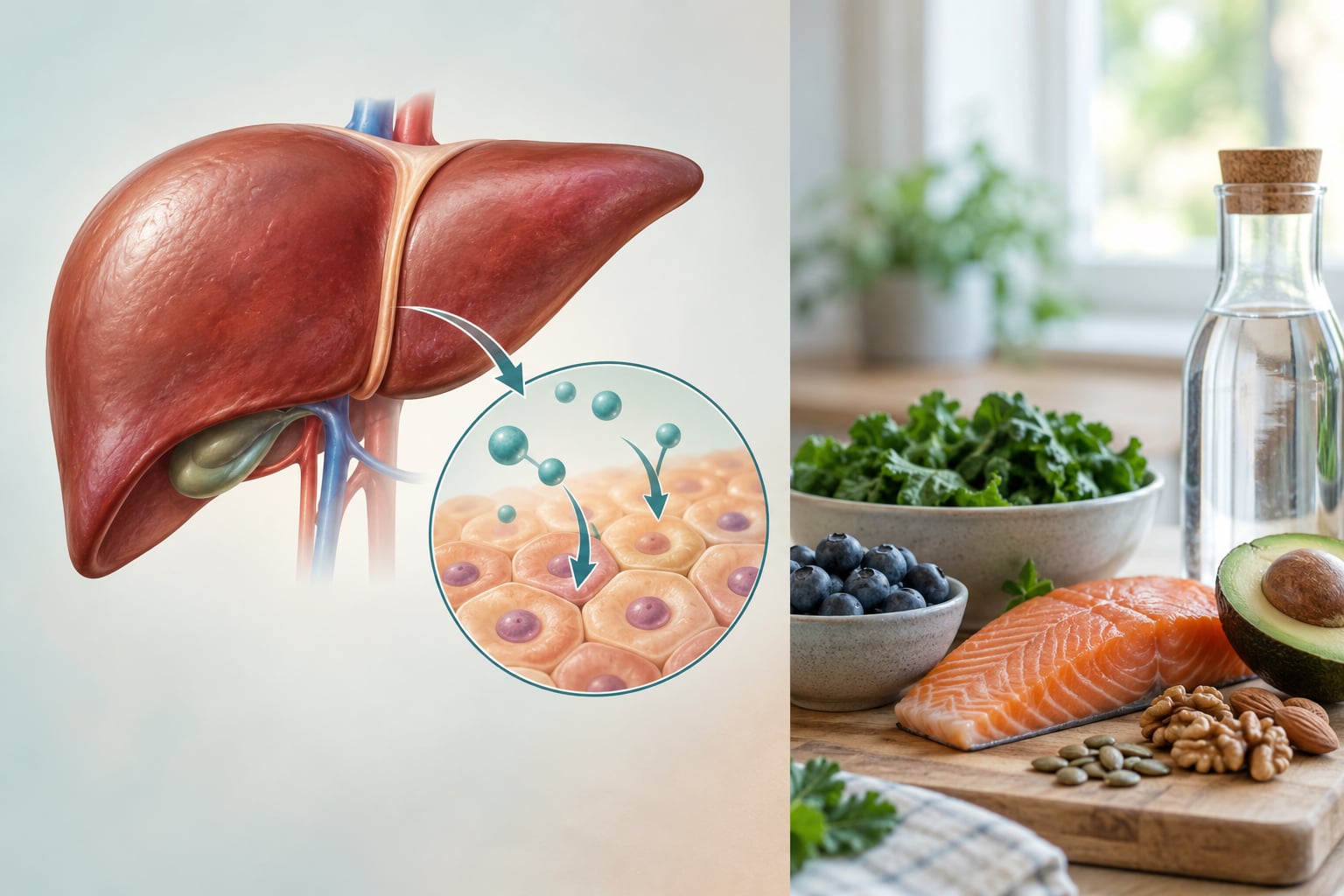
Hepatotoxicity means damage to the liver caused by a substance. That substance is usually a medicine, but it can also be a herbal remedy, a supplement, alcohol, a workplace chemical or a poison. Liver cells get injured, enzymes such as ALT and AST leak out into the blood, and the organ may not work properly for a while. The rest of this article unpacks what hepatotoxicity means in plain language, why the liver matters so much, and which warning signs deserve a phone call rather than a search.
This article is general information, not medical advice. Drug-safety guidance changes, and only a clinician who knows your history can tell you what any of it means for you.
In plain language, hepatotoxicity means:
- Damage to the liver caused by something you took, swallowed, breathed in or were injected with.
- Liver cells, called hepatocytes, being injured or killed off.
- Substances that the liver struggles to break down, or the by-products it makes while trying.
- Often nothing at all in the early stages, which is exactly why blood tests matter.
- Something caused by medicines, herbs, supplements, alcohol, chemicals, viruses or the body’s own immune system.
- Usually reversible once the cause is removed, but not always.
- Sometimes predictable and dose-related, sometimes entirely unpredictable.
- A reason to contact a doctor or pharmacist promptly, and to get urgent help for severe signs.
Table of Contents
- 1What Is Hepatotoxicity?
- 2How Does Liver Injury Happen?
- 3Medicines and supplements that can be hepatotoxic
- 4Herbal remedies and traditional preparations
- 5Alcohol, chemicals and other exposures
- 6Predictable toxicity versus unpredictable reactions
- 7What Are the Common Symptoms of Hepatotoxicity?
- 8Warning signs that need urgent medical attention
- 9Hepatotoxicity in Plain Language: What Happens Inside the Liver?
- 10Stage one: the liver meets something it cannot handle
- 11Stage two: liver cells become stressed, inflamed or destroyed
- 12Stage three: liver function starts to show
- 13Hepatotoxicity vs Other Forms of Drug or Supplement Injury
- 14Hepatotoxicity and hepatitis are not the same thing
- 15Jaundice is a sign, not a cause
- 16Liver failure is an outcome, not a diagnosis
- 17How Is Hepatotoxicity Diagnosed and Monitored?
- 18What doctors look at when they decide whether a substance caused it
- 19What can throw off a liver test
- 20What Should You Do If You Suspect Liver Injury?
- 21How long does the liver take to recover?
- 22How Can You Reduce the Risk of Hepatotoxicity?
- 23Frequently Asked Questions
- 24Can hepatotoxicity be cured?
- 25What are the first signs of hepatotoxicity?
- 26How long does it take for the liver to recover from hepatotoxicity?
- 27What are the most common drugs that cause hepatotoxicity?
- 28Do herbal supplements cause liver damage?
- 29When should I worry about elevated liver enzymes?
- 30Conclusion: Start With the Definition and Warning Signs
What Is Hepatotoxicity?
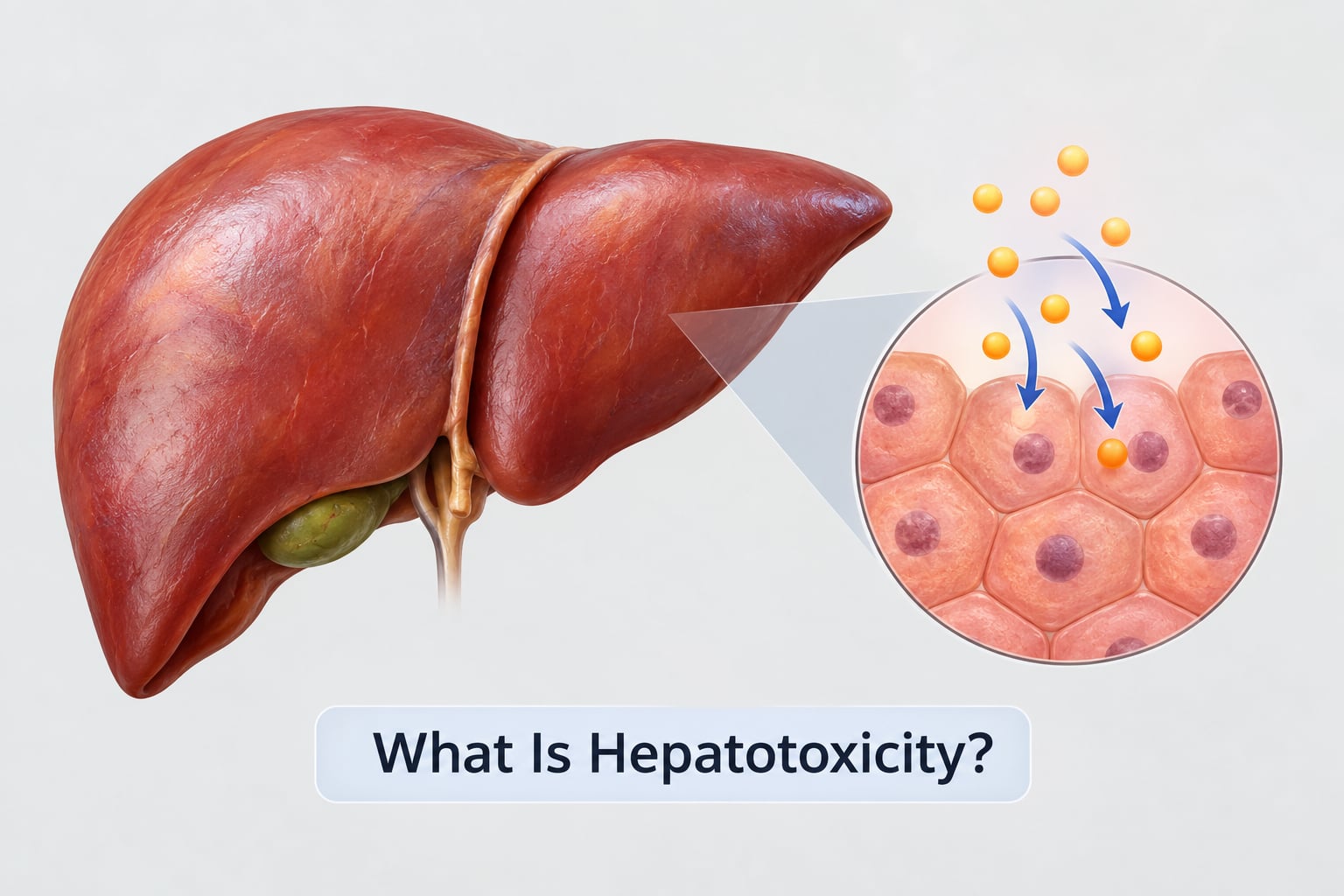
The word itself is easier than it looks. Hepa comes from the Greek hepar, meaning liver. Toxin comes from toxikon, meaning poison. The ending -ity turns a word into a condition. Put together, it describes one thing: a liver that has been injured by a substance.
Clinicians usually split that injury into two broad groups. Direct injury happens when a substance, or the reactive chemicals the liver makes while processing it, attacks liver cells. Indirect injury happens when the damage is set off by something else, most often an immune reaction that the body mounts against the substance, or a blockage of the bile ducts that carry digestion waste away from the liver.
Why does any of this matter? The liver is the body’s largest chemical processing plant. It breaks down what you eat and drink, builds the proteins that carry things around your blood, stores energy, and clears substances your body cannot use. When hepatocytes are damaged, all of that work gets harder.
One useful caution. Hepatotoxicity describes the injury, not the seriousness of it. Two people can have the same word on their chart and completely different outlooks, because the cause, the dose and their underlying health all differ.
How Does Liver Injury Happen?
Not every exposure causes injury. Plenty of people take the same medicine for years without trouble. Risk depends on the dose, how long you were exposed, whether you took more than one substance at a time, whether your liver was already unwell, and how your individual genetics handle that particular compound.
Medicines and supplements that can be hepatotoxic
Prescription medicines are the best-known cause. A review in the Annals of Hepatology estimated that drug-related injury accounts for roughly 40 to 50 percent of the liver disease cases hepatologists see, and for about half of acute liver failure cases in the United States. Around 1,000 drugs have been implicated.
Some follow a predictable pattern tied to dose. Others cause trouble through an unpredictable reaction that has nothing to do with how much you took, which is why package leaflets warn about liver problems even at normal doses.
Named examples that show up repeatedly in liver literature include isoniazid for tuberculosis, methotrexate, valproic acid, certain antipsychotics and anticonvulsants, and the combination of amoxicillin with clavulanic acid. That last one is a good illustration of how small a risk can be: the same review puts its rate at roughly 1 to 5 cases per million people exposed, and it is still one of the most common drug-related causes clinicians encounter.
Acetaminophen is the best-known preventable example, and it behaves differently depending on the scenario. A single large overdose floods the liver with a by-product it cannot neutralise fast enough. Lower doses taken every day over time cause a quieter problem, particularly when combined with regular alcohol use.
Over-the-counter painkillers raise a different question. NSAIDs, which include ibuprofen and naproxen, are more often associated with stomach, kidney and bleeding problems than with liver injury, and most regulatory bodies treat them as low-risk for the liver at normal doses. That is not the same as zero risk. Taking more than the label allows, combining them, or using them alongside other medicines changes the picture, and a pharmacist can tell you where you stand.
Supplements fall into the same category with less labelling. Concentrated extracts, weight-loss products and combination stacks can contain pharmacologically active amounts with no dose printed on the box.
Herbal remedies and traditional preparations
This is worth its own conversation, because it is where general guidance runs out and individual assessment begins.
A review on herbal hepatotoxicity examined 185 publications and named 60 herbs with reported liver injury, among them kava and green tea extract. It also made a point that is easy to miss: erroneous diagnoses turned up in up to 47.1 percent of initially suspected cases. Herbal products vary by batch, plant part, growing conditions and preparation method, so linking a specific product to a specific liver result is genuinely difficult.
That difficulty cuts both ways. It does not mean traditional plant remedies are harmless, and it does not mean they are dangerous. It means assessment is hard, and that the honest answer to any single herb is a conversation with a clinician rather than a sentence on a website.
Alcohol, chemicals and other exposures
Alcohol is a well-established liver stressor, and risk rises sharply with the amount consumed over time. Strong alcohol also makes several medicines more damaging to the liver, because the liver handles both and competing demands reduce its spare capacity.
Workplace and environmental chemicals can cause the same kind of injury, particularly solvents and industrial compounds encountered without proper protection. Viral hepatitis is a different mechanism, but the result looks similar on a blood test. Autoimmune conditions, where the immune system attacks the liver itself, and inherited metabolic conditions round out the list.
Mushroom poisoning deserves a separate mention because of how severe and sudden it can be. Amanita phalloides, sometimes called death cap, causes rapid liver failure with few early warning signs. It is a medical emergency the moment a wild mushroom is suspected.
Predictable toxicity versus unpredictable reactions
Two patterns sit underneath everything above. Predictable, dose-related toxicity behaves like any other dose effect: more exposure means more damage, and the threshold is broadly similar across people. Unpredictable, idiosyncratic reactions happen in a small number of people at ordinary doses, driven by their immune system or their genetic makeup. That second group is why a medicine can be unremarkable for millions of users and still carry a liver warning.
What Are the Common Symptoms of Hepatotoxicity?
Here is the part that unsettles people most: early liver injury often produces no symptoms at all. A review in the Annals of Hepatology notes that many compounds show no hepatotoxicity at early stages, which is the main reason clinicians rely on blood tests rather than on how someone feels.
When symptoms do appear, they are usually vague, which makes them easy to blame on something else:
- Unusual tiredness that rest does not fix.
- Nausea, vomiting or a general loss of appetite.
- Discomfort or a dull ache in the upper right side of the abdomen, under the ribs.
- Itchy skin, sometimes without a visible rash.
- Dark urine, the colour of strong tea.
- Pale or clay-coloured stools.
- Yellowing of the skin or the whites of the eyes, called jaundice.
- Swelling in the legs or abdomen, or bruising more easily than usual.
None of these on its own points to a cause. Fatigue and nausea have hundreds of ordinary explanations, and jaundice in particular can come from conditions that have nothing to do with a substance you took. Only blood tests and a proper history separate the possibilities, which is why symptom lists are a reason to get checked rather than a way to work out what happened.
Warning signs that need urgent medical attention
Certain signs mean you should stop reading and get help now, rather than booking a routine appointment:
- Confusion, unusual drowsiness or difficulty concentrating, which can signal hepatic encephalopathy.
- Vomiting blood, or black tarry stools.
- Severe or persistent abdominal pain, especially in the upper right.
- Jaundice that appears quickly or deepens over hours or days.
- Very little urine, or swelling of the abdomen.
- A bleeding tendency that seems to have appeared from nowhere.
- Any of the above after a suspected overdose or wild mushroom exposure.
For a suspected overdose in the United States, contact Poison Control on 1-800-222-1222 or your local emergency number, and do not wait for symptoms.
Hepatotoxicity in Plain Language: What Happens Inside the Liver?
Three stages, in order. They do not always happen, and each one does not always mean the next. This is where what hepatotoxicity means in plain language stops being a definition and starts being a mechanism you can follow.
Stage one: the liver meets something it cannot handle
Everything absorbed from the gut passes through the liver before it reaches the rest of the body. A large share of the work is done by a family of enzymes called the cytochrome P450 system, which chemically transforms substances so the body can excrete them. The trouble starts when the transformation produces something more reactive than the original, or when the liver’s natural buffers cannot keep up. One of those buffers is glutathione, a molecule the liver makes in large amounts and spends on neutralising oxidants. Deplete it and the cells start taking damage.
Stage two: liver cells become stressed, inflamed or destroyed
When hepatocytes are injured, three broad patterns show up under the microscope. Necrosis means cells die and burst, spilling their contents. Cholestasis means bile drainage is blocked, so waste builds up in the liver and backs up into the blood. Steatosis means fat accumulates inside the cells until they are swollen and dysfunctional. Alongside these, the immune system often responds with inflammation, and that response can itself add to the damage.
This is also where an unpredictable reaction usually bites. In an idiosyncratic injury, the body builds immune cells against a piece of the substance, and those cells later attack hepatocytes that carry a similar shape. The liver was healthy before the exposure. The damage comes from the response.
Stage three: liver function starts to show
Injured cells release enzymes that were supposed to stay inside them. ALT and AST appear in the blood at higher levels than usual, which is the signal a routine liver panel picks up. When enough function is lost, bilirubin climbs, the liver stops making clotting factors properly, and waste that the brain should be shielded from begins to affect thinking and alertness.
If the injury is mild and the cause is removed, hepatocytes regenerate and the blood tests fall back toward normal over weeks to months. If it is severe or prolonged, scar tissue builds up instead, and that scar does not reverse the same way.
Hepatotoxicity vs Other Forms of Drug or Supplement Injury
Hepatotoxicity is specifically about the liver. A medicine can cause trouble in several organs at once, and only the liver-based version carries this name. Four terms get mixed up more often than any others.
Hepatotoxicity and hepatitis are not the same thing
Hepatotoxicity means liver injury caused by a substance, and it is the subject of this article. Hepatitis means inflammation of the liver, usually from a virus such as hepatitis A, B or C. A person can have hepatitis with no substance involved at all, and a person can have hepatotoxicity with no virus involved. The blood tests can look similar, which is part of why clinicians ask detailed questions rather than relying on the label.
Jaundice is a sign, not a cause
Jaundice is the yellowing that comes from a build-up of bilirubin. It can show up in hepatotoxicity, but it also appears in hepatitis, blocked bile ducts and a long list of other conditions. Treat it as a reason to get tested, not as an answer.
Liver failure is an outcome, not a diagnosis
Liver failure means the liver can no longer do its essential jobs. It is a severe outcome rather than a synonym for hepatotoxicity, and most liver injury never gets anywhere near it. Hearing the phrase on a chart is serious, but it is still a situation for a specialist rather than something to interpret alone.
Other organs have their own names. Kidney injury from a medicine is nephrotoxicity, nerve injury is neurotoxicity, and damage to blood cells shows up as cytopenias. A single product can cause more than one of these at the same time, which is why a new medicine or supplement is worth mentioning even when the liver is the organ you are worried about.
How Is Hepatotoxicity Diagnosed and Monitored?
Diagnosis is mostly pattern recognition. A clinician takes a timeline of what you took and when, examines you, and orders blood tests. No single test proves that a substance caused a liver injury, which is why the process is described as a diagnosis of exclusion.
The usual markers, each one explained plainly:
- ALT (alanine aminotransferase) and AST (aspartate aminotransferase) are enzymes concentrated inside hepatocytes. High levels suggest liver cells are leaking.
- ALP (alkaline phosphatase) rises mainly when bile ducts are involved, which points to a cholestatic pattern.
- Bilirubin is a waste product the liver normally clears. When it accumulates, it causes jaundice.
- INR measures how well the liver makes clotting factors, which is one of the clearest signs that real function is failing.
Researchers grade the pattern against multiples of the upper limit of normal, the top of the reference range printed on your result. Many reviews, including clinical criteria used to score suspected cases, treat liver enzyme elevation above roughly three times the upper limit of normal as a signal of injury, and levels above five times the upper limit of normal as a marker of more serious injury. Those are research definitions, not a personal prognosis. Your result has to be read alongside your history, your age, your symptoms and your other blood markers.
Imaging such as ultrasound can check for obstruction or structural change, and a hepatologist or gastroenterologist takes over when the picture is unclear or the injury is severe.
What doctors look at when they decide whether a substance caused it
Clinicians weigh several clues together. Latency, meaning how long it took between the exposure and the injury, is a big one: direct toxins tend to act within 24 to 72 hours, unpredictable immune reactions usually within one to eight weeks, and a few culprits such as isoniazid or methotrexate can take months or years. Dechallenge, meaning whether liver tests improved once the substance stopped, is often the most persuasive evidence available.
The reasoning behind that is worth stating plainly. Research on herbal hepatotoxicity found the initial suspicion wrong in a large share of cases, and a review of causality methods notes that in suspected cases generally, the attribution is revised often. Nobody should diagnose themselves from a leaflet, a forum thread or a lab result, which is also why rechallenge, deliberately re-exposing someone to see if the reaction returns, is essentially never done in people rather than in laboratory studies.
What can throw off a liver test
Results do not always mean what they look like. Strenuous exercise can raise muscle enzymes that register as liver enzymes. Recent alcohol, fatty liver, thyroid problems and some non-liver conditions can shift the numbers. Infection or inflammation elsewhere in the body can lift them too. That is another reason a single abnormal value is a prompt for a conversation, not a verdict.
What Should You Do If You Suspect Liver Injury?
If a doctor has told you a medicine may be affecting your liver, the usual advice is to contact them or your pharmacist before your next dose and follow what they say. Do not keep taking a product you have been told to stop, and do not keep taking one you suspect is causing symptoms without raising it first. That is the general shape of the guidance; the specific decision belongs to a clinician who knows your situation.
While you are working that out:
- Do not add new medicines, supplements or herbal preparations.
- Do not use alcohol to self-medicate or to test whether you feel better.
- Write down everything you take, including doses, and bring the list to your appointment.
- Ask whether your next liver panel can be brought forward rather than waiting for a routine check.
- Keep the packaging of any supplement involved, since batch information matters for investigation.
Seek urgent care for the red flags listed earlier: confusion, vomiting blood, black stools, severe abdominal pain, jaundice that is deepening fast, very little urine, or any of this after an overdose or suspected mushroom poisoning.
How long does the liver take to recover?
Most mild, reversible injuries begin improving within days to a few weeks of the cause being removed, and blood tests usually return to normal within a few months. The liver is unusually good at regenerating. Severe acute cases are a different story, where recovery takes months and some people need intensive support or, rarely, a transplant. Anyone in that group is under specialist care, not reading a general article.
How Can You Reduce the Risk of Hepatotoxicity?
None of this is about fear. Millions of people use medicines and herbal preparations safely every day. These are habits that lower risk without treating every product as a threat.
- Follow the official directions and take no more than the label or prescription allows.
- Keep a single list of everything you take, and show it to any doctor or pharmacist who treats you.
- Avoid combining several products without asking someone qualified. Interactions matter as much as single doses.
- Be cautious with herbal products of unknown identity or unverified composition, particularly concentrated extracts. Weight-loss and body-building products have a poor track record here.
- Use reputable safety information: official drug agency leaflets, public health service pages and peer-reviewed reviews.
- Limit alcohol, particularly alongside regular medicines, and tell your doctor how much you drink rather than estimating at the appointment.
- Stay current on routine blood tests if you take long-term medicines, especially the first few months after starting something new.
- Store and use chemicals with proper ventilation and protection, and follow workplace guidance.
Being specific helps more than being anxious. A doctor can act on “I take this supplement three times a week and my ALT doubled”. They cannot act on “I might be poisoning myself”.
Frequently Asked Questions
Can hepatotoxicity be cured?
Most cases are reversible rather than cured outright. When the responsible substance is stopped and the injury was mild, the liver regenerates and liver enzymes usually return to normal within weeks to a few months. Severe injury is a different situation: it may need hospital care, and a small number of people need a transplant. Your own outlook depends on the substance, the dose and your liver health, so ask your doctor rather than reading a general timeline.
What are the first signs of hepatotoxicity?
The honest answer is often that there are none. Early liver injury frequently causes no symptoms at all, which is why routine blood tests catch it. When signs do appear, they tend to be fatigue, nausea, poor appetite, a dull ache under the right ribs, itchy skin, dark urine, pale stools or yellowing of the skin and eyes. These are non-specific, so symptoms alone cannot show the cause.
How long does it take for the liver to recover from hepatotoxicity?
Mild, reversible injury usually starts to improve within days to a few weeks after the cause is removed, with blood tests settling back over a few months. The liver regenerates efficiently, which is the reason most cases do not become long-term problems. Severe acute injury can take months of hospital-level care, and chronic repeated damage leads to scarring that does not reverse the same way.
What are the most common drugs that cause hepatotoxicity?
Reviews commonly cite isoniazid, methotrexate, valproic acid, certain anticonvulsants and antipsychotics, and the combination of amoxicillin with clavulanic acid. Acetaminophen is the best-known cause when a large single dose is taken, and lower daily doses can cause quieter damage over time. An older review in the Annals of Hepatology put drug-related injury at roughly 40 to 50 percent of liver disease cases seen by hepatologists.
Do herbal supplements cause liver damage?
Yes, and the size of the problem is genuinely hard to measure. A review of 185 publications named 60 herbs with reported liver injury, including kava and green tea extract. Products vary by batch, plant part and preparation, and that same review found the initial suspicion was wrong in up to 47.1 percent of suspected cases. That means neither reassurance nor alarm is a safe default. Tell your doctor about every herb and remedy you use.
When should I worry about elevated liver enzymes?
Do not read the number alone. Research criteria treat enzyme levels above roughly three times the upper limit of normal as a sign of injury, and above five times as more serious, but those are grading tools rather than personal predictions. Muscle damage from exercise, alcohol, fatty liver, thyroid problems and infection elsewhere can all shift the figures. Ask your doctor how your result fits your history, and request an earlier repeat test if things change.
Conclusion: Start With the Definition and Warning Signs
Hepatotoxicity is a plain enough idea once the words are taken apart: a substance has injured the liver. It can come from a prescription medicine, an over-the-counter drug, a herbal preparation, alcohol, a chemical, an infection or the body’s own immune system, and it can be predictable or completely unexpected.
Two things are worth carrying away from what hepatotoxicity means in plain language. Early injury is often invisible, so blood tests matter more than how you feel. And the cause is nearly never something a layperson can pin down from symptoms alone, because liver enzyme changes have many explanations.
So the useful next step is small and specific. Write down what you take, note when it started and what changed, and take that list to a doctor or pharmacist. If you have confusion, vomiting blood, black stools, severe abdominal pain or jaundice that is deepening quickly, treat that as urgent rather than as a question for next week.
Clinical guidance on medicines and herbal products shifts as new evidence appears. What is written here is general information for 2026, and it is not a substitute for advice about your own health.