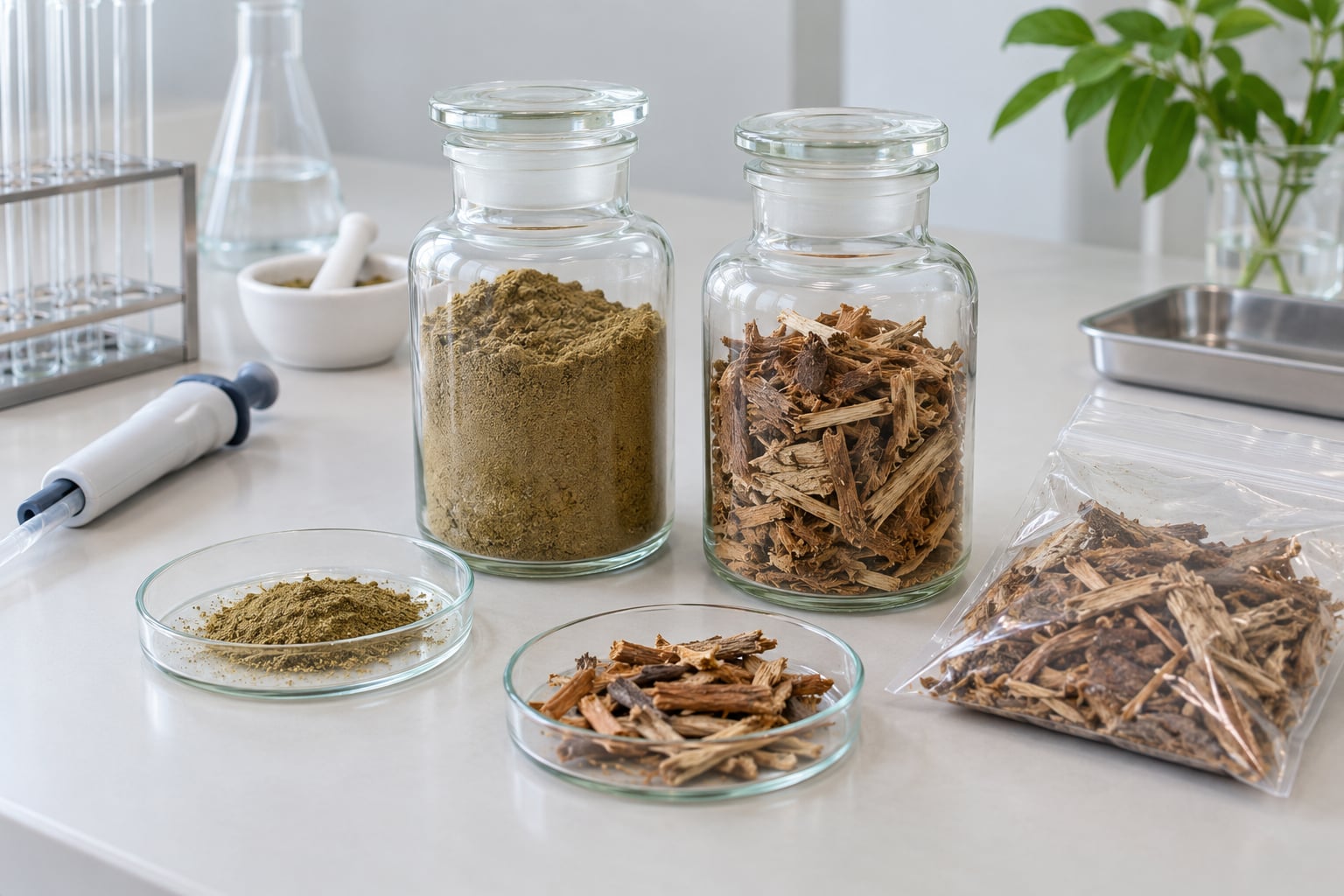
Heavy metals in imported herbal products means lead, arsenic, cadmium or mercury found in herbs, roots, barks and traditional preparations sourced from overseas. Plants take metals up from soil and water through their roots, and processing equipment, storage containers and shared drying surfaces add a second route. Most measured levels sit well below the daily intake limits regulators use, but a meaningful minority of products exceed them, and some traditional preparations add metals deliberately as part of the process.
That last part is where most public conversation goes wrong. The statistic that sticks in people’s minds is that one in five Ayurvedic medicines bought over the internet contained detectable lead, mercury or arsenic. Detection and harm are not the same thing, and separating them is the single most useful thing this article does.
This guide is written for students, researchers, health writers and consumers who want a defensible account of the issue rather than a scare. Nothing here is medical advice, and the sections near the end explain who you should actually ask when a decision affects your health.
Table of Contents
- 1What Are Heavy Metals in Imported Herbal Products?
- 2How Do Heavy Metals Get Into Herbal Products?
- 3Soil uptake: the pathway researchers find most often
- 4Water, air and processing equipment
- 5Intentional addition in bhasma and rasa preparations
- 6The import layer most people never see
- 7Which Heavy Metals Are Most Often a Concern?
- 8Why detectability is not the same as toxicity
- 9Why the limit you read changes the answer
- 10How Can Consumers Check Imported Herbal Products?
- 11How to read a certificate of analysis
- 12Which imported herbs and product categories get flagged most often
- 13What Does Laboratory Testing Actually Show?
- 14How Can Researchers and Manufacturers Reduce Contamination?
- 15Who Should Decide Whether a Product Is Safe to Use?
- 16What to do if you suspect exposure
- 17Why detox teas are not the answer
- 18Frequently Asked Questions
- 19Are all imported herbal products unsafe because of heavy metals?
- 20What is the most concerning heavy metal in traditional herbal products?
- 21Can a home testing kit detect heavy metals reliably?
- 22Does a certificate of analysis prove that an herbal product is safe?
- 23What should I do if I suspect a herbal product contains lead or mercury?
- 24How can I find independent testing for an imported herbal product?
- 25Conclusion
What Are Heavy Metals in Imported Herbal Products?
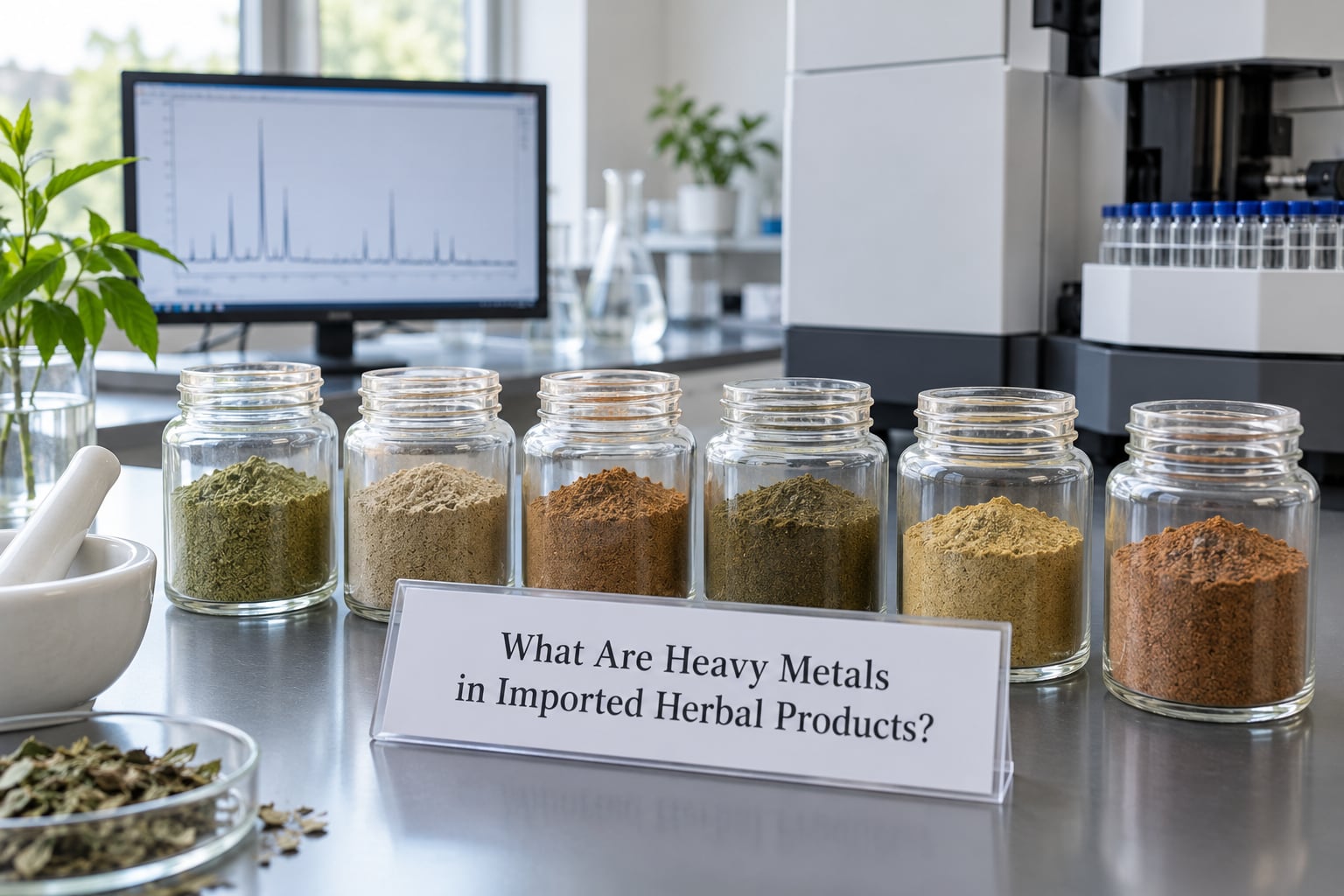
Heavy metal is a loose chemical label, not a precise one. It generally means metals that are toxic at low dose, and in herbal-product research it almost always means four elements: lead (Pb), arsenic (As), cadmium (Cd) and mercury (Hg).
Those four dominate the published findings on contamination in imported herbs, powders, teas and traditional medicines. A broader reading pulls in nickel, chromium, antimony and tin, which show up in smaller studies of manufacturing equipment and processing aids.
It helps to separate three very different situations that get lumped together in headlines.
- Background trace levels. Every plant on earth takes up small amounts of metals from its growing environment. A detectable amount is the normal state of any botanical material, not evidence of a defect.
- Contamination above a limit. The harvested material, or the finished product, exceeds a specific regulatory or industry threshold for one or more metals. This is the category with real health relevance.
- Intentional addition. In certain traditional pharmaceutical traditions, metals are purified and compounded into a finished preparation as part of its stated formulation. That is a deliberate manufacturing choice, not a supply chain failure, and it needs a different conversation from accidental contamination.
One more thing belongs in the definition. A heavy metal result is a measurement of a material, not a measurement of a person. Whether any given product poses risk to any given user depends on the chemical form of the metal, the amount consumed per day, how long it is used, and the health of the person using it.
How Do Heavy Metals Get Into Herbal Products?
Contamination is rarely one dramatic event. It is usually the sum of several ordinary-looking steps, which is exactly what makes it hard to catch without testing.
Soil uptake: the pathway researchers find most often
Plant roots take up dissolved metals from soil along with water and nutrients. Lead and cadmium in particular accumulate in the root and lower stem, so root and bark powders tend to be where measured levels are highest.
If a growing area sits near a mine, a smelter, a waste site, an intensive coal-fired industrial zone, or land with a history of sewage irrigation or agrochemical use, those metals concentrate in the topsoil. The plant then stores them in the part of the plant that gets harvested and dried.
Research on spices and herbs traded worldwide has found that lead in particular is a global food-safety problem rather than a regional one, with elevated results repeatedly reported from multiple exporting regions.
Water, air and processing equipment
Contaminated irrigation or processing water adds a second uptake route, and dry regions make it worse because irrigation carries the load when rainfall does not.
Airborne deposition is slower but real, particularly for plants harvested close to industrial corridors. Drying racks, milling equipment, storage silos and reused sacks are the post-harvest routes, and this is where hygiene has the largest effect.
A few concrete examples from the literature make the point better than the chemistry does: brass or lead-soldered fittings used to funnel material; a grinding surface shared with a mineral product; bulk material dumped onto an unsealed tarp next to a road; and containers that were previously used to hold a metal-rich material and were not cleaned between runs.
Cross-contamination of this kind leaves no visible trace, which is why a clean-looking sample in a sealed bag proves nothing on its own.
Intentional addition in bhasma and rasa preparations
Some Ayurvedic pharmaceutical categories described as bhasma or rasa preparations incorporate purified metals such as lead, mercury, arsenic or gold as part of a traditional processing method that is claimed to render the metal safe in small doses.
This category deserves separate treatment because it inverts the usual framing. There is no contaminated harvest here. The metal is present because it is supposed to be.
Whether a specific preparation meets its stated traditional specification, whether that specification matches modern toxicological limits, and whether the label discloses the metal are three different questions. Practitioners often argue that these formulations are traditional medicines rather than supplements and are dosed accordingly, which is a reasonable position about classification and does not resolve the measurement question.
Consumers who use these preparations should treat the disclosure of the metal on the label as the starting point, not the end of the enquiry. A product with no ingredient disclosure at all offers nothing to evaluate.
Unregulated consumption of herbal medicine, particularly from unlicensed or unauthorised overseas apothecaries, has been described in the recent literature as a distinct toxicological risk, with cadmium and lead contamination reported among imported products from Southeast Asian sources.
The import layer most people never see
Once material leaves the growing site it changes hands repeatedly, and at every handover the paperwork gets thinner.
Most herbs move in bulk consignments rather than as finished retail units. A single lot can be split, blended, re-exported through a third country and repackaged before it reaches a shelf, and at each of those points the record of which field it came from can degrade to a commercial invoice that lists a species and an origin country but no farm.
Port-level screening is real, but it is selective and it operates on samples rather than on every container. Customs testing prioritises categories with a history of problems, and chemical multi-element screening of bulk agricultural commodities is a fraction of the volume that passes through.
The consequence is a jurisdictional gap. A grower may be working to one national standard, an exporter to another, a repacker to none, and an importer to a third. No single party in that chain is obliged to do the one test that would answer the consumer’s question, and each is answering a different customer’s specification.
African and diaspora ethnobotanical supply chains illustrate this clearly, and they are also the least documented for consumers. Raw bark, root and leaf material is commonly gathered from wild or semi-wild populations and aggregated through collection agents rather than cultivated plots, so there may be no fixed field to test and no repeated harvest from the same ground. Wild-harvested material can be entirely legitimate and well made, and it carries a different traceability problem from a farmed crop that simply has a different risk profile.
Ceremonial powders, incense bases and ritual blends often share the same supply chain as medicinal raw material, move in smaller and more informal consignments, and are sold in paper or plastic with little labelling. Where regulatory testing capacity is limited, informal trade is exactly where a documented chain of custody is least likely to exist.
Which Heavy Metals Are Most Often a Concern?
Four metals account for nearly all the reported concerns, and each has a distinct health profile.
Lead is a cumulative neurotoxin with no known safe threshold for children. It affects neurological development, kidney function and blood pressure, and the body stores it in bone, where it can be released over years. Lead is the contaminant most often found in remedies, powders and ceremonial products, and it is the one most frequently associated with clinical cases.
Arsenic is a known carcinogen. Inorganic arsenic is the toxic form, and the health effect depends heavily on which chemical species is present, which is one reason an elemental total arsenic number on a report is not the whole story.
Cadmium damages the kidneys and accumulates there over decades, so harm can appear long after exposure stops. The kidneys have a limited capacity to excrete it, which makes cumulative dosing the central concern. A 2024 systematic review of heavy metals in spices and herbs from worldwide markets reported cadmium among the metals most consistently detected.
Mercury is a neurotoxin, and the effect depends on which form it takes. Elemental mercury vapour and methylmercury behave very differently from each other, and methylmercury is associated with neurological harm in particular.
| Metal | Main health concern | Where it accumulates | Notes on chemical form |
|---|---|---|---|
| Lead (Pb) | Neurological harm, kidney and blood pressure effects | Bone, released slowly over years | Concern in children and in anyone with iron deficiency |
| Arsenic (As) | Carcinogen; skin, bladder and lung effects | Kidneys, liver, skin and nails | Inorganic form is the toxic one; a total figure hides the species |
| Cadmium (Cd) | Kidney damage, bone effects | Kidneys, with limited excretion capacity | Cumulative; harm can appear decades after exposure stops |
| Mercury (Hg) | Neurological harm, kidney effects | Kidneys, brain | Elemental vapour and methylmercury behave differently |
Risk in all four cases rises with dose per day and with length of use. Three groups deserve explicit mention: children, who absorb more and whose nervous systems are still developing; people who are pregnant or breastfeeding; and anyone who is iron deficient or anaemic, because iron deficiency increases absorption of lead and cadmium. Anyone combining several products made from the same raw herb can also accumulate exposure without realizing it.
Why detectability is not the same as toxicity
This is the point that most public discussion gets wrong, and it deserves its own paragraph.
In 2008, a study published in JAMA bought Ayurvedic medicines over the internet and laboratory testing found detectable lead, mercury or arsenic in about one in five products, with some exceeding the California Proposition 65 limits. That finding is real and it has driven a great deal of useful reform attention.
What the headline number leaves out is dose. The American Ayurvedic Medical Association re-analysed the same underlying data set using ANSI/NSF, EPA and FAO/WHO thresholds rather than Proposition 65’s much stricter limits, and reported that the share exceeding the less conservative thresholds fell to roughly 8 percent, and to about 5 percent when deliberately metal-containing preparations were excluded.
The gap between those figures is not someone fudging a number. Different standards set limits for different purposes and at different levels of protection. Proposition 65 limits are drawn to be conservative and to reduce long-term cancer risk, so a product can exceed a Proposition 65 threshold while remaining below the daily intake limit a toxicologist would use to judge an average adult’s intake.
The honest reading: a detectably positive result tells you the metal is present. It does not tell you the dose reaches a harmful level. Both facts matter, and the missing ingredient in most alarming headlines is the dose.
Counterpoint worth hearing: industry groups argue that traditional formulations were designed and dosed as medicines, not as supplements, and that evaluating them against supplement categories can misclassify them. That argument has force, and the answer is not to dismiss it or to accept it uncritically. It is to read the label, find out what the metal is and how much per day the serving contains, and take that number to a clinician who can interpret it.
Why the limit you read changes the answer
There is no single global limit for metals in herbal medicines, and the frameworks that exist are not interchangeable. Comparing a product against the wrong one is the most common way a fair number gets misread.
| Framework | Who sets it | What the numbers are | Why the result differs |
|---|---|---|---|
| California Proposition 65 | State of California | Maximum allowable dose levels, set low and conservatively | Designed to reduce long-term cancer risk; far stricter than intake limits, so exceedances are common |
| ANSI/NSF 173 | US certification standard | Limits expressed against the daily serving | Written for certified commercial products and their serving sizes |
| US EPA | US environmental regulator | Tolerable daily intake, usually body-weight based | Applies to environmental exposure rather than to a supplement label |
| FAO/WHO JECFA | UN food safety body | Allowable daily intake for contaminants in food | Food-based rather than product-based; WHO recommends uniform upper limits for lead and cadmium in herbal medicines |
Individual countries also set their own additional limits, and comparison work published in the herbal-medicine literature has noted the divergence directly. The practical result is that two laboratories can analyse the same sample, use the same method, and produce results that lead to opposite conclusions, entirely because they applied different thresholds.
How Can Consumers Check Imported Herbal Products?
Labels rarely print metal content, and certification that specifically covers metals is uncommon among herbal products as opposed to multivitamins. That leaves the burden with the person buying. Here is the sequence I would use.
- Identify the product completely. You need the botanical name in Latin, the plant part used, the country of origin, and the name and address of the manufacturer or distributor. Without those, no other check is possible.
- Find the lot or batch number on the label and keep it. Every serious test result attaches to one lot, and the lot is what makes a result applicable to your bottle.
- Ask for a certificate of analysis that names the lot. A generic PDF for the company, a different lot, or a page with no lot number is close to worthless for your purposes.
- Check the issuing laboratory’s accreditation. ISO/IEC 17025 accreditation is the widely recognised marker for a lab that can produce defensible numbers. A certificate should also show the analytical method and the detection limit.
- Look for GMP and GACP statements. Good manufacturing practice covers processing and record-keeping. Good agricultural and collection practices covers cultivation and harvest. Neither replaces a metals test, and both tell you the supplier has a system rather than a habit.
- Search the regulator’s recall and warning-letter databases for the manufacturer name, not just the brand name. Absence of a listing is weak evidence, but a listing ends the question.
- Buy less often and smaller. A single lot is the only unit a test covers, so short supply cycles reduce the number of unknown lots you rely on.
Consumers on herbal and ethnobotanical forums consistently name the same thing as the only proof they find credible: a dated, publicly available certificate of analysis linked to a specific lot. Long-established suppliers get named as suspect in those discussions without published data, which is worth noticing precisely because it is the opposite of evidence.
How to read a certificate of analysis
Three things trip people up, and all three are about units.
A contaminant result is usually expressed in the material itself, as parts per million or micrograms per kilogram. A safety limit is usually expressed as an intake, as micrograms per day or micrograms per kilogram of body weight per day. Converting between them requires knowing the daily dose of the finished product, which is why two results that look wildly different on paper can describe the same real exposure.
Next, check which metal and which threshold. A report that lists a result against an internal specification is not the same as a result compared against a regulatory limit, and the two lines can look like two different findings.
Finally, look for the date, the lot number and the method. A report generated once a year for a product made in continuously shifting lots tells you about the past, not about what is in your container.
Which imported herbs and product categories get flagged most often
Categories, not individual plant names, carry the pattern. Products from unlicensed or overseas apothecaries, bulk loose powders, and single-ingredient root and bark powders tend to show higher results, because they have fewer controlled steps between the soil and the consumer.
Metal-containing traditional preparations are a distinct and higher-exposure category by design. Slimming blends are frequently multi-ingredient products with long, poorly documented supply chains, and testing has repeatedly found undeclared pharmaceuticals and metals in products bought online.
Herbal teas and infusions deserve their own note, because the answer is not simply about which plant. Tea blends draw on bulk commodity trade, so contamination follows the ingredient and the supply chain. A consistent, moderate level across many teas reflects background uptake, while a single outlier batch usually points to a specific lot, supplier or metal-bearing additive.
Root and bark powders, ceremonial powders and marine or seaweed-derived products carry the same upward pressure for a different reason, since those materials either sit in the soil layer where metals accumulate or concentrate trace metals from seawater.
| Product category | Typical contamination pattern | Why |
|---|---|---|
| Metal-containing bhasma and rasa preparations | Highest, by design | Metals are added deliberately as part of the stated traditional process |
| Bulk loose powders from unlicensed or overseas apothecaries | Wide spread, sometimes well above limits | Few controlled steps between field and consumer |
| Multi-ingredient slimming blends bought online | Variable, with undeclared substances common | Long, poorly documented supply chains and reformulation between shipments |
| Herbal teas and infusions | Mostly consistent background levels, with occasional outlier batches | Bulk commodity trade; an outlier usually points to one lot or additive |
| Single-ingredient root and bark powders | Higher than leaf or flower material | Roots and barks sit in the soil layer where metals accumulate |
| Marine and seaweed-derived products | Cadmium and arsenic as the main concerns | Seawater concentrates trace metals into marine tissue |
| Wild-harvested African and diaspora raw material | Unknown more often than high | Aggregated through collection agents with no fixed field to test or document |
Ashwagandha comes up often in consumer questions, and the pattern is the same as for any root powder. Ashwagandha does not manufacture lead, and the concern is contamination of the root and the supply chain that dried and milled it, which is a problem for any botanicals sourced the same way. A specific batch’s result tells you about that batch, not about the plant.
What Does Laboratory Testing Actually Show?
A laboratory report is a snapshot of the sample that was submitted, measured by the method named on the sheet. Both halves of that sentence matter.
Sample selection. Solid botanicals are heterogeneous. One scoop from a 200-kilogram drum tells you very little about the drum unless the sample was prepared under a documented, representative protocol, typically a composite of many increments taken across the batch and then ground and mixed before digestion. Powdered products allow a proper composite; a dried root given as a handful of pieces often does not.
Preparation. Solid samples generally need acid digestion before analysis, which is straightforward for clean powders and more error-prone for materials with high fibre or resin content. Cross-contamination during preparation is a documented source of false positives, which is why accredited laboratories run blanks and duplicates.
Method. Inductively coupled plasma mass spectrometry is the workhorse for multi-element screening, with atomic absorption spectrophotometry still common for single metals or higher concentrations. Flame atomic absorption is less sensitive for some elements, so the method on the report tells you how much a non-detect really means.
Detection versus quantification. A result below the detection limit is not a result of zero, and the difference matters more than most consumers realise. A laboratory reporting below 1 part per million has told you the true value is somewhere below that, which is a very different statement from a laboratory reporting 0.1.
One result covers one lot at one moment. Even a flawless report says nothing about the next lot, the same product from a different harvest, or material already sitting in your cupboard that predates the report. This is the core limitation, and it is why a single certificate of analysis on a website is a starting point rather than a conclusion.
Testing a small quantity yourself is possible, through consumer-facing laboratories that accept walk-in samples, but the sample quantity, the cost and the interpretation all work against an individual buyer. For most people, spending the same effort on finding a supplier who publishes lot-linked certificates costs less and answers the question better.
How Can Researchers and Manufacturers Reduce Contamination?
The controls that work sit at specific points in the chain, and a 2026 review of contaminants in medicinal plant materials published in the Journal of Medicinal Plants Studies put the causes in similar terms: poor farming practice, improper harvesting and unsanitary processing and storage, alongside pesticide residues and microbial load.
Cultivation. Survey the growing site before harvest, including soil history and nearby land use. Test the soil rather than guessing, because a plant growing in contaminated soil will not become clean through handling. Move or exclude plots that fail, and document the decision.
Harvesting. Keep soil off the harvested material, avoid harvesting from contaminated ground, wash where the practice is appropriate, and dry on clean, dedicated surfaces rather than tarps on the ground. Roots and bark need more attention than leaves.
Processing. Dedicate equipment by product class where possible, verify that grinders and fittings contain no lead-soldered or brass components in contact with the material, and keep stainless steel and food-grade surfaces as the default.
Supplier verification. This is the step most often missing. A written specification, an audit, a sample tested before acceptance, and a requirement to declare the country and site of origin for every incoming lot are what turn a good intention into a control.
Record-keeping. Lot numbers that trace raw material through processing to the finished unit are the precondition for every recall, every complaint investigation and every certificate of analysis. A manufacturer that cannot produce a lot-linked record cannot respond to a question about one bottle.
Verification testing. Batch testing against the four metals plus whatever else the product warrants, in an accredited laboratory, with the result kept on file and available on request.
At the regulatory level, the same 2026 review called for globally harmonised frameworks and wider adoption of GACP and GMP, which is the underlying problem in one sentence. There is still no single worldwide limit for metals in herbal medicines. WHO recommends uniform upper limits for lead and cadmium across herbal medicines, while individual countries set their own additional limits, and an importer can move between frameworks without ever crossing a legal line.
Who Should Decide Whether a Product Is Safe to Use?
A laboratory tells you what is in a material. Only a clinician can tell you what that means for one person’s blood pressure, kidney function, pregnancy status, iron levels and current medications.
Bring a doctor or pharmacist the product itself, the lot number and the certificate of analysis. Those three things turn a general question into a specific one, and the answer is specific in a way a label cannot be.
People using metal-containing traditional preparations, people who intend to take a product long-term, parents giving herbs to children, and anyone who is pregnant, breastfeeding or iron deficient all have reasons to ask before starting rather than after.
What to do if you suspect exposure
- Stop using the product and set the container and packaging aside.
- Keep the lot number and the receipt. Without them, results cannot be tied to a batch and a report cannot be interpreted by anyone.
- Ask a clinician about testing. Blood lead and 24-hour urine testing exist and are used for exactly this situation, and the clinician chooses which is appropriate.
- Report it. Adverse events involving herbal products can go to the FDA MedWatch programme in the United States or the equivalent scheme in your country.
- Expect follow-up. Lead in particular leaves the body slowly, and repeat testing shows whether levels are falling.
Chelation, when it is indicated, is prescribed and monitored by a clinician. It is not something to obtain on your own or combine with other agents.
Why detox teas are not the answer
Nothing an herbal preparation does replaces removing the exposure. Many “heavy metal detox” teas contain their own plant material with its own contamination history, so the treatment adds a second uncontrolled variable to a problem that needs a measurement and a stop.
The sequence that actually works is unglamorous: stop the source, get a clinical test, and let a clinician decide whether any treatment is needed. Most people who do that find the answer is reassuring, which is another reason to test rather than speculate.
Frequently Asked Questions
Are all imported herbal products unsafe because of heavy metals?
No. Nearly all plant material contains some lead, arsenic, cadmium or mercury absorbed from soil and water, and a detectable result is not a harmful result. What matters is whether the daily dose reaches a safety limit. Studies of internet-purchased Ayurvedic medicines found detectable metals in about one in five products, but re-analysis using EPA, ANSI/NSF and FAO/WHO thresholds put exceedances closer to 8 percent, and about 5 percent once deliberately metal-containing preparations were excluded.
What is the most concerning heavy metal in traditional herbal products?
Lead is the one most frequently found and most often linked to documented clinical cases. Arsenic follows, and its effect depends on which chemical species is present. Cadmium accumulates in the kidneys over decades, and mercury is a neurotoxin whose behaviour depends on its form. Children, pregnant people and anyone who is iron deficient are more sensitive to all four.
Can a home testing kit detect heavy metals reliably?
Consumer test kits vary a great deal in accuracy, and many are aimed at water rather than solid botanical material. A positive home result is difficult to interpret without a chain of custody, and a negative one may simply reflect a poor detection limit. If you need an answer about a specific batch, an accredited laboratory using a documented composite sampling protocol is the more reliable route.
Does a certificate of analysis prove that an herbal product is safe?
Not on its own. A certificate of analysis is only useful if it names your lot number, shows the analytical method and detection limit, comes from an ISO/IEC 17025 accredited laboratory, and compares the result against a named limit. It covers one batch at one moment, and it says nothing about the next lot or the bottle already in your cupboard.
What should I do if I suspect a herbal product contains lead or mercury?
Stop taking it, keep the container, packaging, lot number and receipt, and talk to a doctor or pharmacist about blood lead or 24-hour urine testing. Reporting the product through FDA MedWatch or your national equivalent creates a record that can support a recall. Do not start a chelation product or a detox tea on your own; treatment decisions belong with a clinician.
How can I find independent testing for an imported herbal product?
Ask the seller for a lot-linked certificate of analysis from an ISO/IEC 17025 accredited laboratory, and check that the lot number on the certificate matches the one on your container. Consumer-facing laboratories accept walk-in samples, though sampling a small bag rarely represents the bulk consignment it came from. For herbal materials specifically, published lot-level certificates are rarer than they are for vitamins, so availability is itself informative.
Conclusion
The safest first step with heavy metals in imported herbal products is unglamorous. Identify the product and the manufacturer properly, find the lot number, and look for a certificate of analysis tied to that lot from an accredited laboratory.
When provenance is missing, the sensible move is to skip the product rather than guess. When the risk is unclear but you still want the herb, look for a supplier who publishes lot-level results and states where the material was grown and processed.
And when the question is about you, take the container and the paperwork to a doctor, pharmacist or qualified public-health laboratory. They can weigh your actual dose against your actual body, which no general article can do.
The underlying studies referenced here include the 2008 JAMA investigation of internet-purchased Ayurvedic medicines and the American Ayurvedic Medical Association’s response to it, an EPA HERO record on toxic metal content in frequently prescribed herbal medicines, CDC work on lead in spices, herbal remedies and ceremonial powders, a 2024 systematic review of heavy metals in spices and herbs from worldwide markets, and a 2026 contaminant review in the Journal of Medicinal Plants Studies. Limits differ by country and by authority, so check the standard that applies where you buy. This article is general information and not medical advice.