A certificate of analysis (COA) is a laboratory report recording the test results for one specific batch of a product: what the material is, how much of the active compound it contains, and the outcome of whatever contaminant panels were commissioned. To read one, match the batch number on the report to the number printed on your product, then compare each result against the specification limit printed in the same row. This guide is about laboratory certificates of analysis, not certificates of appreciation.
Reading one takes about ten minutes once you know the layout. Most of that time goes into three checks that catch nearly everything: does the report belong to this batch, was an outside laboratory involved, and which rows say nothing was tested at all.
Dried roots, barks, seeds and powdered plant material are where I would spend that ten minutes first. These materials pick up metals from soil and processing equipment, carry pesticide residues into the supply chain, and can grow mould toxins in storage. The report tells you what one laboratory found in one sample. It does not tell you the whole story, and a good reader knows exactly where its authority stops.
Here is the quick scan in five moves, and the detail sits underneath each one.
- Match the batch number. A report for a different lot says nothing about the material in your hand.
- Check who did the testing. An accredited outside laboratory carries far more weight than an internal quality team.
- Read the result against the limit in the same row. Without that pairing, a number means nothing.
- Log what was not tested. Absent rows and NT entries are the most misleading part of most reports.
- Write down your questions. A supplier who answers them is telling you something useful too.
Table of Contents
- 1What You Need to Read a Certificate of Analysis
- 2Step-by-Step: Reading a Certificate of Analysis
- 3How to Identify the Product and Laboratory
- 4How to Read the Certificate of Analysis Header
- 5How to Interpret Each Test Result
- 6How to Compare Results With Specifications
- 7How to Check the Report and Sample Integrity
- 8Common Mistakes When Reading a Certificate of Analysis
- 9Frequently Asked Questions
- 10Who can issue a certificate of analysis?
- 11What does Pass mean on a certificate of analysis?
- 12Is a certificate of analysis proof that a product is safe?
- 13What is the difference between None Detected and Not Tested?
- 14What is the difference between a COA and an MSDS?
- 15How recent should a certificate of analysis be?
- 16Conclusion
What You Need to Read a Certificate of Analysis
You need four things on the desk, and two of them usually have to be requested.
The first is the report itself, in full. Photographs of one panel usually miss the footnote that says the sample was received in a condition that limited the work.
The second is the product itself, or at least its packaging and labels. You are looking for the lot or batch number, the botanical name including the plant part, the declared extract ratio if there is one, and any claim the label makes that the report should support.
The third is the specification used to judge the results. Sometimes the report names it in the header, sometimes it is buried in a footnote as a reference to a pharmacopoeia monograph or a customer specification sheet. If no specification is named anywhere, the pass and fail columns are borrowed from the laboratory rather than from you, and you cannot tell whether the limits were sensible for this material.
The fourth is the laboratory’s own details: name, address, accreditation scope, and a way to contact them. Accreditation claims are easy to check and worth checking, because ISO/IEC 17025 accreditation applies to a defined list of tests at a defined place, not to every result a laboratory has ever produced.
Useful to have alongside: the last COA for the same supplier, so you can see whether results move around between harvests. Suppliers that publish per-batch reports consistently are behaving very differently from those that publish one specimen document and reuse it forever.
Step-by-Step: Reading a Certificate of Analysis
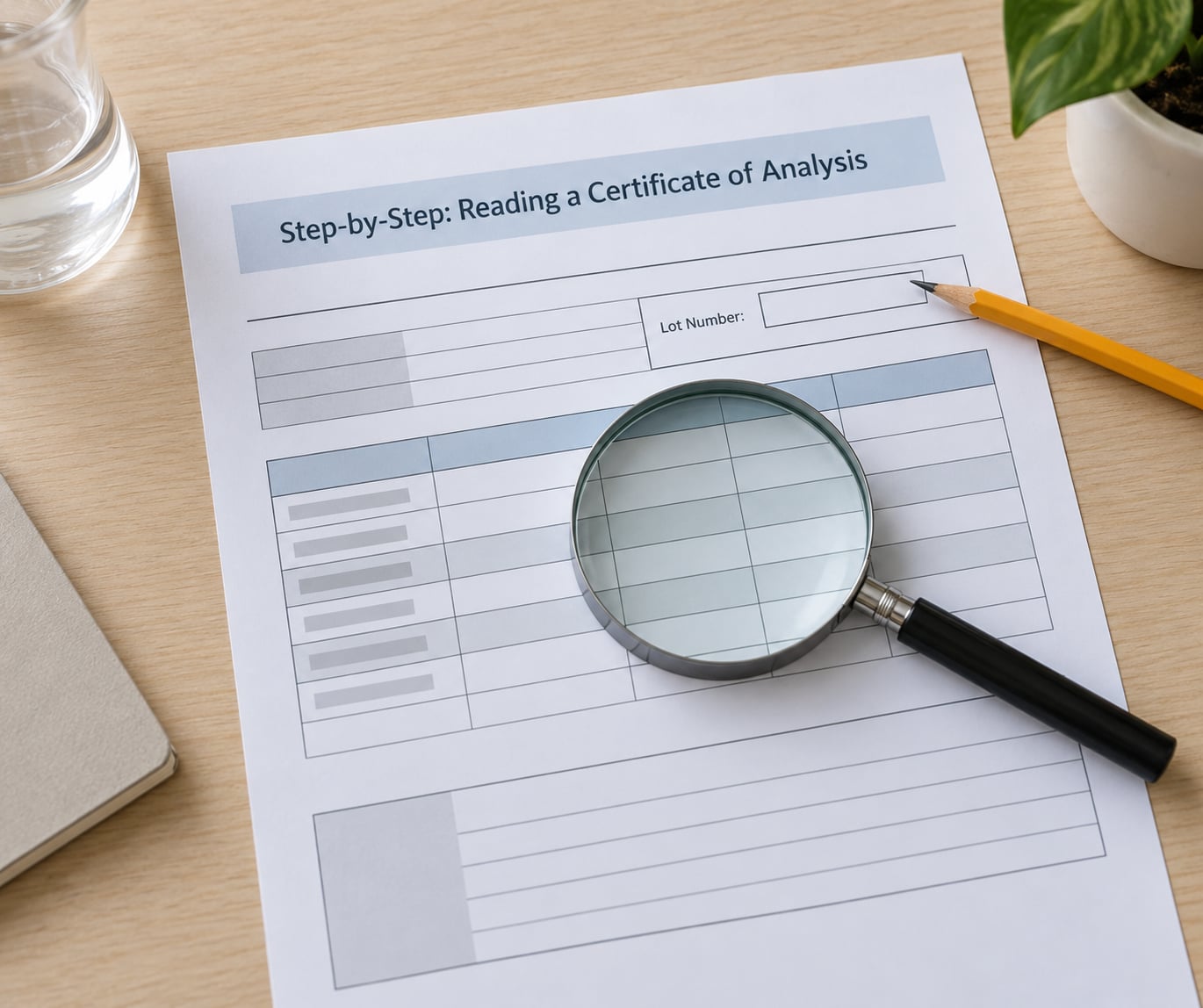
Work through a report in the order below. The order is not arbitrary: each step confirms that the next one is worth reading.
How to Identify the Product and Laboratory
Start at the identity block, before any number gets your attention. You are checking that the material described on the report is the material described on your label.
Compare the botanical name, including the plant part and any preparation form such as dried root, powdered root or 1:5 hydroethanolic extract. A report for Zea mays stigma and one for Zea mays whole plant are different documents even though the species matches.
Then check the batch or lot number, the sample receipt date, the test date, the submitting organisation, the laboratory name and the report or document number. If the lot number on the report does not match the number printed on your product, you are reading about someone else’s material. Nothing later in the document fixes that.
Note the form the sample arrived in. Reports often carry a line stating that the sample was received as powder, cut pieces or extract, and that the results apply to the material as submitted. That line is also where a laboratory will tell you it received a client-supplied sample with no seals, which matters for how much weight the results carry.
How to Read the Certificate of Analysis Header
The header explains why the work was done and what was asked for, which is often more revealing than the results themselves.
Look for the requested testing list. A report commissioned for identity, marker compounds and heavy metals is a different exercise from one commissioned for a full contaminant package, and neither is automatically complete.
Check the dates. Sample receipt, analysis date and report approval date tell you how fresh the material was when it was tested and how long the work took. A report approved years ago for a wild-harvested root describes a harvest season that has long passed.
Look at the customer field too. When the laboratory lists the seller or the manufacturer as the client, you know testing was arranged commercially by the party being tested. When it lists you or your clinic, the sample moved independently before analysis.
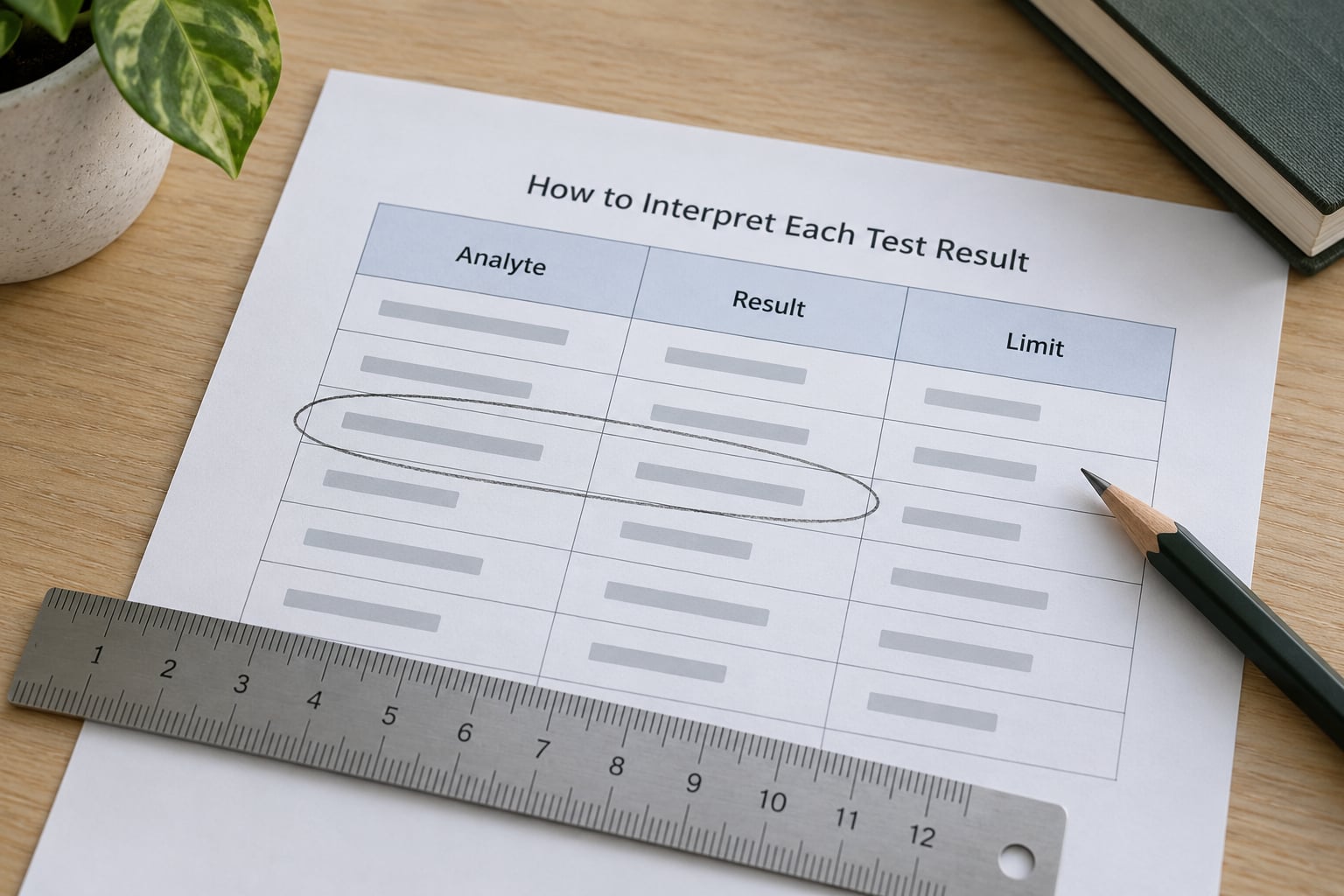
How to Interpret Each Test Result
Results live in a table, usually one row per analyte. Read each row as a sentence with a missing verb, because the laboratory has left the verb for you to supply: this much of that substance was found, against a limit of this much.
| Analyte | Result | Specification or limit | Status |
|---|---|---|---|
| Total ash | 7.4% | Not more than 10% | Pass |
| Loss on drying | 6.1% | Not more than 12% | Pass |
| Lead | 0.3 ppm | Not more than 1.0 ppm | Pass |
| Arsenic | 0.6 ppm | Not more than 2.0 ppm | Pass |
| Total plate count | 2 x 10³ CFU/g | Not more than 104 CFU/g | Pass |
| Aflatoxin B1 | Not detected | Not more than 5 ppb | Pass |
| Pesticide screen | Not tested | Not applicable | None |
| Marker compound | Not reported | Not stated | None |
Three things in that table deserve a second look.
The lead result is 0.3 ppm against a limit of 1.0 ppm. It passes, and it is also a detectable number rather than an absence. A buyer who only checks the status column misses the difference between comfortably clean and just inside the line.
Aflatoxin reads “Not detected”, which is not the same as zero. Below a certain concentration the instrument cannot separate signal from background noise, so the laboratory reports a detection limit and says the compound was not found above that threshold. The limit of detection is the lowest level the method can reliably distinguish from noise; the limit of quantitation is the lowest level it can measure to a stated degree of accuracy. Both should appear in the report footnotes.
The pesticide screen is the row to notice. “Not tested” with a status of none means nobody looked. A blank cell means the same thing, just less politely. Neither is a pass.
Markers such as ND, NT and NR are worth keeping straight, because they are used loosely and inconsistently:
| Marker | What it usually means | What you may conclude |
|---|---|---|
| ND, none detected | Tested; not found above the detection limit | Below the threshold, not zero |
| NT, not tested | Outside the scope of this commission | Nothing at all |
| NR, not reported | Often means below the quantitation limit, sometimes means withheld | Ask the laboratory which it means |
| NTD | Not tested, or not detectable; conventions differ | Ask before relying on it |
Units matter as much as numbers. Parts per million and parts per billion are mass fractions, so 1 ppm equals 1 mg/kg and 1 ppb equals 1 microgram/kg. Colony-forming units per gram is a count of viable organisms, so results are usually compared against an acceptance criterion rather than a single ceiling.
How to Compare Results With Specifications
A result and a limit are different kinds of statement, and mixing them up is the most common error in this whole process.
The result is a measurement: a number this laboratory produced from this sample. The specification limit is a boundary someone decided in advance, usually written into a monograph, a customer specification or a regulatory framework. The pass column is the two compared. The result does not improve because a limit is generous, and it does not become a failure because a limit is strict.
Reference values also vary by purpose. A limit for a food ingredient is not the limit for a medicinal herb, and limits for one plant part are not automatically right for another. If a report cites a reference framework, check the edition in force in 2026, because pharmacopoeias are revised and the numbers move.
For botanical material, these are the reference points you will meet most often:
| Determination | Typical reference range cited for herbal medicinal material | Why it matters |
|---|---|---|
| Lead (Pb) | Roughly 0.5 to 10 ppm depending on the drug and plant part | Accumulated from soil; highest in roots and bark |
| Arsenic (As) | Roughly 0.2 to 2 ppm depending on the drug | Soil uptake and irrigation water; often the limiting metal |
| Mercury (Hg) | Roughly 0.1 to 1 ppm | Wild-harvested material and shared processing |
| Cadmium (Cd) | Roughly 0.2 to 2 ppm | Soil accumulation, especially in roots |
| Total plate count | Typically 103 to 104 CFU/g | General hygiene of dried and powdered material |
| Yeast and moulds | Typically 102 to 103 CFU/g | Early warning for storage problems |
| Salmonella, E. coli | Absent in the tested portion | Pathogen screen, not a numeric comparison |
Treat those ranges as orientation rather than as law. They vary by monograph, by plant, by part used and by the framework the laboratory is working to. Their value is that they tell you whether a supplier’s limits are plausible for the material or laughably loose.
One more distinction worth holding onto: a certificate may not prove every claim on a label. A clean heavy-metal panel says nothing about potency, and a strong marker-compound assay says nothing about pesticide residues. Coverage is what you are judging, not quality in the abstract.
How to Check the Report and Sample Integrity
This is the step people skip, and it is the one that decides how much the other steps are worth.
Check whether the laboratory is accredited, and check the scope rather than the logo. ISO/IEC 17025 accreditation is granted for specific methods at specific locations. A laboratory can be accredited for lead by one technique and unaccredited for pesticide screening carried out the same week.
Look for a named analyst or a review and approval signature with a date. A document issued with no approval status and no version number has not been through any visible review.
Check for revision numbers. If a document has been reissued, the original should be marked superseded, and you should be holding the current version.
Consider the chain of custody. Independent sampling, sealed samples and a documented handover are stronger than a sample that travelled in an unlabelled bag and arrived with a note saying the condition was unknown.
Then read the whole document rather than the table, because most of the important caveats are written below the table in the footnotes.
Two practical situations come up constantly. The first is a lot number that returns nothing on a brand’s lookup page. That usually means the brand tests representative batches rather than every one, which tells you something real about their process even though it leaves your bottle unverified.
The second is a seller who declines to release the batch report. Refusal to provide a batch-specific report after a direct, specific request is a signal in itself, and a stronger one than any logo.
Before you email anyone, know what to ask for: the report for your lot number, the accreditation scope covering the tests shown, the detection limits, the specification used, and the name of the reference standard. A short, specific request gets answered more often than a general demand for proof of quality.
For readers working with material that will be given to other people, it helps to keep a simple log: date, supplier, lot number, tests performed, tests skipped, and follow-up questions. Over two or three harvests that log becomes the only reliable way to notice drift, because no single COA will tell you that.
Common Mistakes When Reading a Certificate of Analysis
These are the errors I see most often, and each has a simple fix.
Treating “Not Detected” as zero. The substance may be present below the method’s detection limit, which is often micrograms per kilogram. In a report that is fine; in your reasoning it is not, and it matters more for a substance with a very low tolerable intake.
Treating “Not Tested” as a pass. A missing row is missing data. Write untested next to the substance in your notes so you remember the gap when you next meet that supplier.
Reading a result without its limit. A number alone is uninterpretable. Always find the specification in the same row or in the footnotes before forming a view.
Ignoring the unit. Switching between ppm, ppb and percent changes a number by factors of a thousand. Check the unit column every single time, especially on reports you have read before.
Accepting a report for the wrong batch. Generic specimen documents circulate constantly. Check the lot number first, before anything else, every time.
Assuming the certificate is third-party. Certificates can be issued in-house by a manufacturer or supplier. Look at who the laboratory is and who the customer is.
Treating a pass as a safety guarantee. A COA reports on the tests that were ordered. It does not cover interaction with medication, dose suitability, pregnancy, or effects on a particular person. Those questions belong with a doctor or a pharmacist.
Comparing limits set for a different purpose. Limits for a food ingredient, a medicinal herb and an agricultural commodity are not interchangeable. Check what framework the limit comes from.
Trusting a logo without checking the scope. Accreditation seals and certification marks are easy to display and easy to crop. Verify the laboratory in the accrediting body’s own register.
Skipping the footnotes. Statements about sample condition, deviations from method and out-of-scope results live below the table, and they change how the table should be read.
One habit closes most of these gaps: give every row a status in your own words. Measured and within limit, detected and within limit, not detected above the detection limit, or not tested. If a row does not fit those four, ask the laboratory what it means.
Frequently Asked Questions
Who can issue a certificate of analysis?
Any laboratory that performs the analysis can issue one, including a manufacturer’s own quality department, a contract testing laboratory and an independent third-party laboratory. The difference is independence, not authority. A report from an accredited outside laboratory with a named analyst, a stated method and a specification limit carries more weight than an in-house document with no method reference. The client field tells you who commissioned the work, which is often the seller being evaluated.
What does Pass mean on a certificate of analysis?
Pass means the measured result fell inside the specification written next to it. That comparison only means something when you know the specification, its source and the detection limit behind the measurement. A pass on a single analyte says nothing about the other rows, and a panel full of passes still says nothing about tests that were never commissioned. Read the limit column, not the status column, and judge coverage separately from results.
Is a certificate of analysis proof that a product is safe?
No. A certificate reports what was tested, in one sample, on one date. It cannot tell you about interactions with medication, safe dosage, effects during pregnancy, or how an individual person will respond. It also cannot rule out a contaminant that was never on the testing list, or variation between the tested sample and the material you received. For personal health decisions, take the report to a doctor or pharmacist and keep it separate from the safety conversation.
What is the difference between None Detected and Not Tested?
None detected means the laboratory looked and did not find the substance above the method’s detection limit. Not tested means the analysis was never part of this commission, so the report carries no information either way. The difference matters most for contaminants people assume are covered, such as pesticide residues on herbal material. Mark every untested substance in your notes, and treat it as an open question when you next deal with that supplier.
What is the difference between a COA and an MSDS?
A certificate of analysis describes a finished product: its identity, measured content and contaminant results for a specific batch. A safety data sheet, historically called an MSDS, describes hazards for handling, storage and transport, and is built around the chemicals present rather than the batch quality. A certificate of conformity states that a product meets a published standard, without necessarily presenting test data. None of the three substitutes for the others.
How recent should a certificate of analysis be?
For dried botanical material, a few years is already a long time, because results move with harvest site, season and storage conditions. For a manufactured product, a representative batch report from the current production period is usually the practical expectation, though requirements vary by sector and jurisdiction. If you need assurance about the material in your hand, only a report for that lot number will do. Age matters less than batch match and covering the tests you care about.
Conclusion
Four actions get you most of the value from a certificate of analysis. Identify the sample and confirm the batch number matches your product. Verify that an outside laboratory did the work and that its accreditation covers the tests shown. Read every result against the limit and unit printed beside it, and treat detection limits honestly rather than as zero. Then write down what was not tested and what you want clarified.
Keep the report with the product, note the questions you sent, and log the answers. That record is worth more a year later than the certificate itself, especially for herbal material where every harvest tells a different story.