Third-party testing is independent laboratory analysis of a product sample, reported as a certificate of analysis. It can confirm that a plant material is the species it claims to be, that its marker compounds are present at the stated amount, and that tested contaminants sit inside stated limits. What third party testing actually proves stops there. It says nothing about whether the herb works in people, whether the result covers the batch in your hand, or whether the product suits your health situation.
That last part is where most of the confusion sits. A clean report is a good sign, and for readers of traditional or ethnobotanical preparations it is often the only hard evidence available. But a laboratory measures material, not outcomes, and it measures the sample it was handed, not every package on a shop shelf.
This is general information about how laboratory analysis works and what its results can support. It is not medical advice, and it does not replace a conversation with a doctor or pharmacist about anything you intend to take regularly.
Table of Contents
- 1What Third-Party Testing Actually Proves in a Lab Report
- 2How Do Independent and Third-Party Laboratories Differ?
- 3Which Properties Can Laboratory Testing Establish?
- 4What Third-Party Testing Actually Proves About Plant Identity
- 5How Do Purity and Adulteration Results Work?
- 6What Can Testing Reveal About Heavy Metals and Other Contaminants?
- 7Why a Lab Result Does Not Prove That a Herb Works
- 8Why a Test Result Does Not Prove That a Product Is Safe for Everyone
- 9How to Read a Third-Party Test Report
- 10What Should Readers Look for in African Traditional-Medicine Research?
- 11What Follow-Up Evidence Can Strengthen the Findings?
- 12Frequently Asked Questions
- 13Does a third-party testing certificate prove that an herbal product is safe?
- 14What should I check on a herbal product’s laboratory test report?
- 15Does passing third-party testing prove that a traditional medicine works?
- 16Are naturally occurring ingredients automatically safe if the product passes testing?
- 17What can I do if a herbal product has no accessible third-party test report?
- 18What to Check First
What Third-Party Testing Actually Proves in a Lab Report
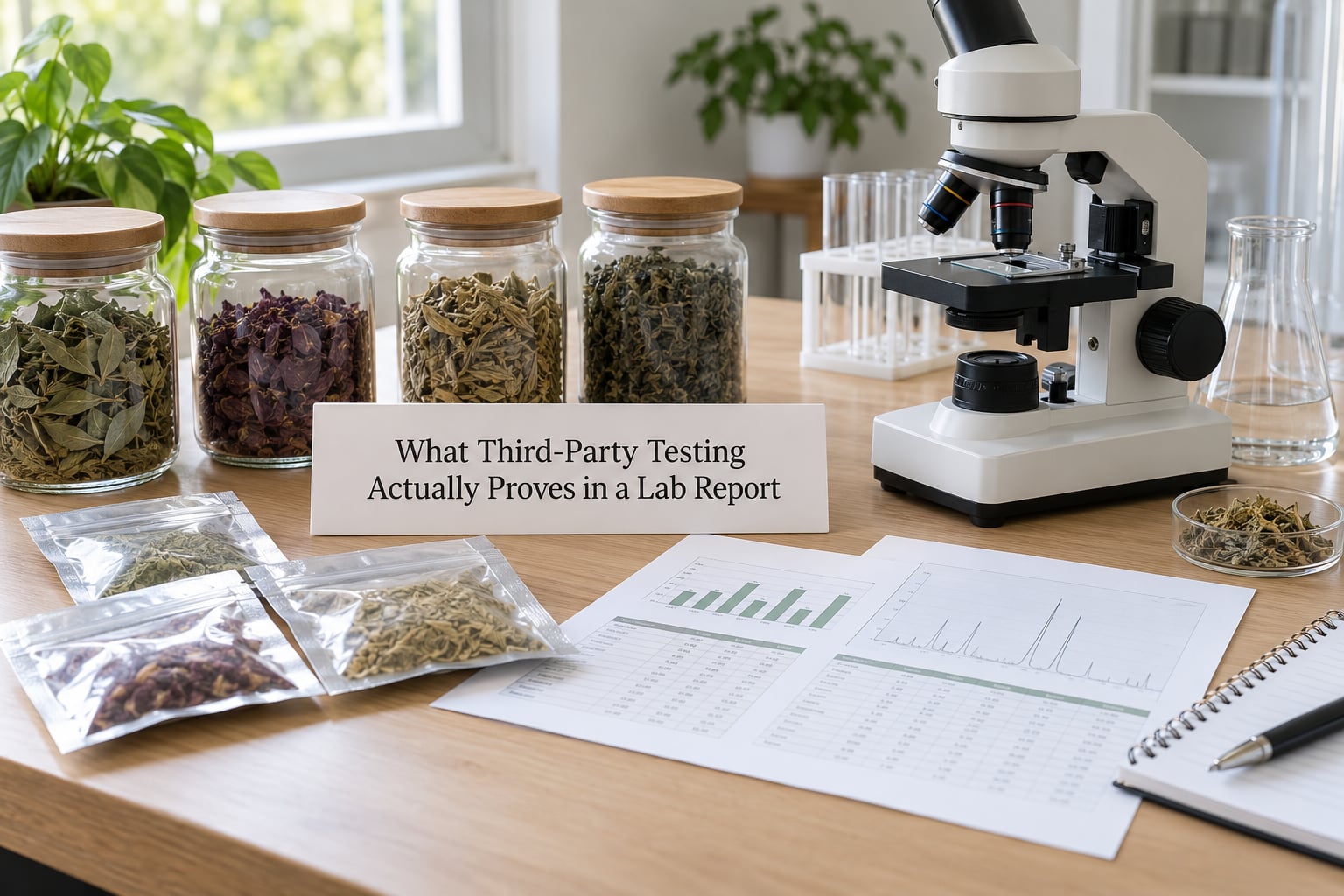
A laboratory report records what was measured, what value came back, and which limit that value was judged against. Read that way, each line of a certificate of analysis supports a narrow conclusion and no wider one.
| Claim on the report | What the result shows | What it does not show |
|---|---|---|
| Identity confirmed | The tested material matches a reference standard for that species | That the species is the right one for the intended traditional use |
| Marker compound at X% | That marker measured at that percentage in that extract | That the marker is the one responsible for any effect |
| Heavy metals within limits | Lead, arsenic, mercury and cadmium fell under the stated thresholds | That pesticides, mycotoxins or microbes were also absent |
| Microbial screen passed | Counts for the organisms tested stayed under the limit | That no untested pathogen was present |
| Purity confirmed | No unexpected adulterant was detected above the detection limit | That nothing was missed below the detection limit |
Every result on the page belongs to one batch, drawn on one date, and reported against the limits the commissioning party chose. A report is a measurement of a sample. Extending it to other batches, other harvests or other formulations is an assumption, not a finding.
How Do Independent and Third-Party Laboratories Differ?
Third-party means someone other than the seller paid for and submitted the analysis. Independent is stronger: it implies the laboratory has no commercial stake in the result. The two are often used as if they were identical, and the difference matters when a report is being judged.
Independent laboratory. A separate organisation with its own quality system, no ownership interest in the product, and no incentive from the outcome.
Third-party laboratory. Any lab the brand does not own, commissioned for a fee. It is independent in ownership, and that is the part most readers can verify.
Commissioned manufacturer testing. The brand pays, which removes the seller from the lab bench but not from the framing. The panel, the limits and the sample point are still the brand’s choice.
Accredited laboratory. A lab assessed against ISO/IEC 17025 for specific methods. Accreditation attaches to a scope of work, so it is worth reading which tests are covered rather than treating the word as a blanket seal.
None of this guarantees the right method was used or that someone competent interpreted the result. A lab can be independent and still be handed a sample pulled from a warehouse corner, run a method that suits the contract rather than the analyte, and issue a technically flawless report about the wrong question.
Which Properties Can Laboratory Testing Establish?
Testing falls into a handful of evidence categories, and each one answers a different question. Identity asks what the material is. Composition and markers ask what is in it and how much. Purity asks whether anything unexpected came along. Microbiological and contaminant work asks what hazards are present. Consistency asks whether this batch resembles the last one.
Keeping them separate matters, because reports often compress all of it into the single word quality. A material can be authentically identified and still be contaminated. It can be pure and still be a different species from the one the preparation intends.
What Third-Party Testing Actually Proves About Plant Identity
Identity testing compares the sample against a known reference. Macroscopic examination covers shape, texture and colour. Microscopy looks at internal structure. DNA barcoding compares a genetic sequence to a library. Chromatography builds a chemical fingerprint and matches it to a reference profile.
So what third party testing actually proves at this stage is narrow and useful: the material submitted was consistent with the reference standard named on the report. It also narrows rather than closes the question. DNA confirms the genus and often the species, while a chemical fingerprint can match a chemotype within a species, and closely related plants share compounds enough that a signature alone may not settle the identification.
A correct identification does not establish that the plant is safe, that it is effective, that the dose on the label is appropriate, or that a related species was not partly substituted. It also does not travel from the raw root in a laboratory to the decoction someone actually prepared at home.
How Do Purity and Adulteration Results Work?
Purity testing looks for material that should not be there. In the herbal world that usually means a filler or bulking agent, a cheaper substitute species, a synthetic drug added for effect, or a plant material that has been stretched with something else entirely.
Three limits decide how much a purity result is worth. The detection limit is the lowest level the method can reliably see, so an analyte below that number is not the same as an absent one. The matrix effect matters because plant material interferes with some instruments and can push a real result in either direction. Most important is sampling: testing one spoon of a tonne tells you about that spoon.
So the honest reading of a purity pass is that no adulterant above the stated detection limit was found in the samples submitted. It does not follow that the whole production run was free of adulterant, and it does not cover anything the panel never looked for.
What Can Testing Reveal About Heavy Metals and Other Contaminants?
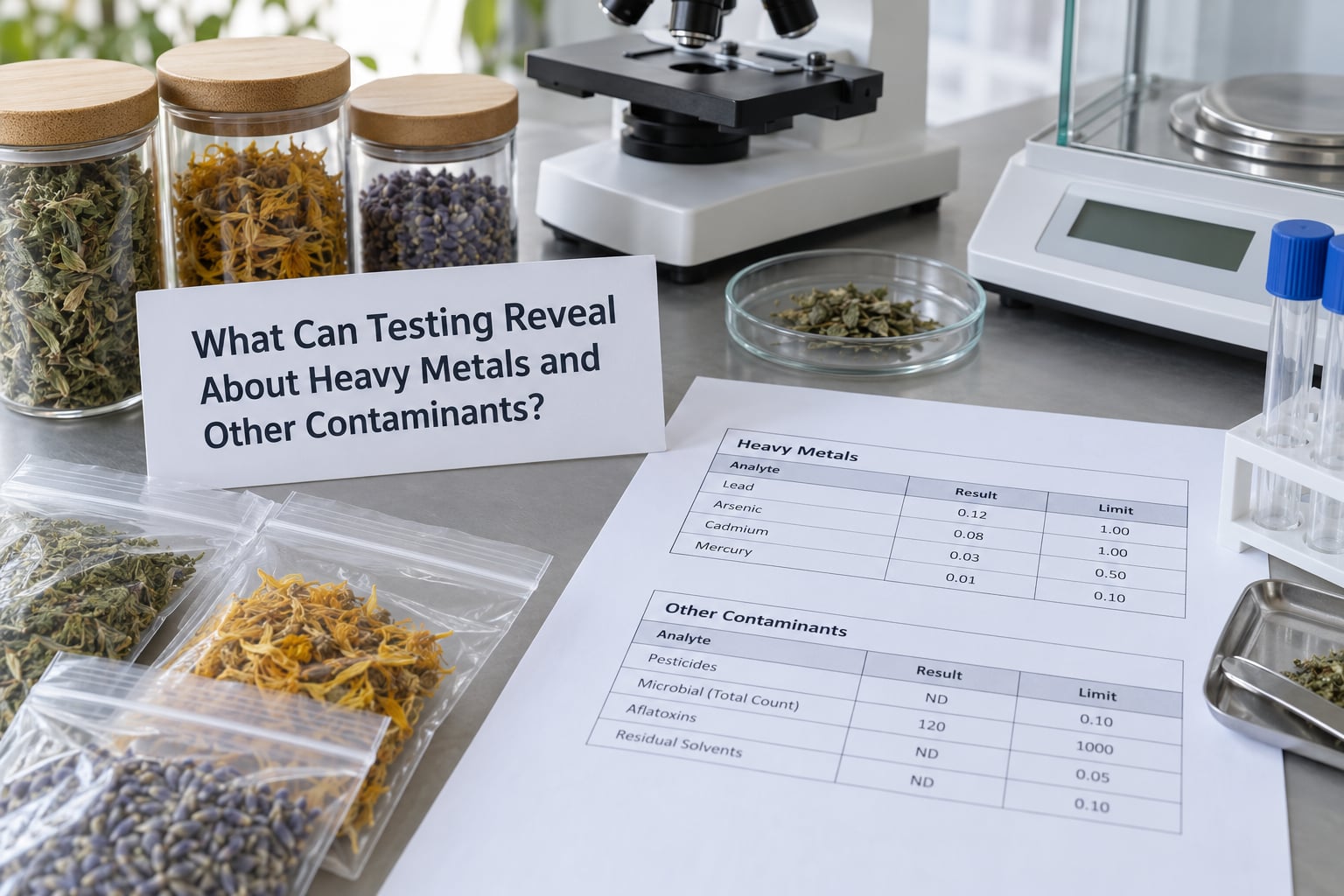
Metals are quantified with techniques such as inductively coupled plasma mass spectrometry, which measures lead, arsenic, mercury, cadmium and others in parts per million against a stated reference standard. Pesticide residues, mycotoxins such as aflatoxin, and microbial counts in colony-forming units per gram are measured with their own separate methods.
Contamination enters a botanical product through doors that have nothing to do with the factory. Soil and groundwater uptake put metals into the root. Harvest site decides how much. Drying equipment, shared milling machinery and storage conditions add the rest. A plant that grows in a metal-rich area can carry a load into a clean-looking powder.
Three points deserve care. Results are batch-specific and dated, so an old report describes an older batch. A pass on one contaminant is a pass on that contaminant only, because panels vary widely and a narrow panel can look thorough. And a reporting limit above the level you care about produces a result that means very little.
Why a Lab Result Does Not Prove That a Herb Works
Analytical chemistry measures what is present. Clinical research measures what happens to people. Moving between them takes evidence that a laboratory cannot supply.
A marker compound at a stated percentage tells you the extract contains that compound at that concentration in that sample. It does not tell you the compound reaches an effective concentration in the bloodstream, that it acts on a target in the way researchers propose, or that the preparation produces a measurable change in a person.
Bioavailability is the gap people find most surprising. Something can be present in generous amounts and absorbed poorly, or absorbed and broken down before it does anything. That question is answered in human studies, not on a chromatogram.
Traditional use is a separate knowledge system built over generations of observation, and it deserves to be taken seriously as recorded evidence. It is still not the same thing as controlled clinical evidence, and the two answer different questions about the same plant.
Why a Test Result Does Not Prove That a Product Is Safe for Everyone
A batch of material does not know who is going to take it. The report contains no information about the person reading it.
Consider conditions, current medicines, allergies, age, pregnancy status, how long the product will be used and how much of it. Two people with the same clean certificate can have completely different exposure and completely different risk. Interference with prescription medicines is a good example of something a laboratory panel will never detect, because it depends on the person and the drug rather than the plant.
That is the point where reading stops and a conversation with a doctor or pharmacist should start. Anyone taking a preparation daily, anyone giving one to a child, and anyone who is pregnant, breastfeeding or managing a long-term condition deserves individual advice. If you develop symptoms such as swelling, breathing difficulty, a rash with fever or anything else that worries you after starting a product, stop and get medical help rather than searching for a second certificate of analysis.
How to Read a Third-Party Test Report
Most reports are more readable than people expect. You are checking for a handful of specific things, and each one tells you whether the document can be trusted or is decoration.
Laboratory name and accreditation. A named lab can be looked up. Check that ISO/IEC 17025 scope covers the specific methods used.
Batch or lot number. It must match the number printed on your package. A report for a different lot is not evidence for the bottle in your hand, and this is the single most useful check you can make.
Analyte names and units. Lead, arsenic, mercury and cadmium in parts per million mean something specific. So do counts in colony-forming units per gram.
Result, limit and method. Each line should show a measured value, the limit it was compared against, and the method reference.
Dates. Sample date, test date and report date. An undated certificate describes nothing in particular.
Chain of custody. Whether the report says the submitted sample was sealed and represents the batch, and who took it.
Disclaimers. Reputable labs state clearly what the report does and does not cover. A document with no limitations paragraph deserves suspicion.
If something is missing, ask the seller directly which lab ran the test and which batch it covers. A straightforward answer takes a day. Deflection takes longer and means the answer was no.
What Should Readers Look for in African Traditional-Medicine Research?
African medicinal-plant research carries a specific documentation problem: many preparations are prepared from more than one species, in locally variable ratios, sometimes by several processors before the final product exists. Testing has to account for that or the result answers the wrong question.
Check whether the scientific name of each species is given rather than a common name, since common names shift between regions and languages. Look for voucher specimens, the preserved reference samples deposited in a herbarium that let anyone re-examine the identification later. Methods should be published rather than summarised, with the full results attached.
Read-across is where care is needed. Chemotype, harvest season, growing altitude and processing all change chemical content, so a clean result from one harvest cannot be generalised to another. Testing a raw root sample does not verify a standardised extract, and testing an extract does not verify a decoction someone boiled at home.
In Africa, NAFDAC registration and listing relate to registered herbal medicines and their manufacturers, while WHO quality control methods for herbal medicines provide reference frameworks for testing. Neither replaces a batch-specific report from a named laboratory. Producer or trader groups that publish their own results add a layer most sellers do not, and that is worth looking for.
What Follow-Up Evidence Can Strengthen the Findings?
Analytical confirmation is the first rung, not the last. The evidence builds in stages, and each stage depends on the one before it being solid and reproducible.
Identification comes first, then chemical composition and marker content, then stability and shelf-life data. Toxicology and preclinical research follow, and only after that do controlled human trials address whether the preparation works and at what dose. Reviews and meta-analyses sit on top of the trial evidence.
Two questions separate solid work from weak work at every stage. Can someone else repeat the method and get the same answer? And who funded it? A funded conflict is not disqualifying, but it belongs in the paper where readers can judge it. Single certificates without published methods sit at the bottom of this ladder, however clean they look.
Frequently Asked Questions
Does a third-party testing certificate prove that an herbal product is safe?
No. A certificate of analysis shows what was measured in one sample from one batch, and it can support conclusions about identity, marker content and tested contaminants within stated limits. It cannot account for your health conditions, other medicines, allergies, dose or duration of use, and it does not cover hazards the panel never looked for. Safety for a person is a clinical question that needs a doctor or pharmacist.
What should I check on a herbal product’s laboratory test report?
Start with the laboratory name and its ISO/IEC 17025 scope, then confirm the batch or lot number on the report matches your package exactly. Check the analyte names and units, the measured result beside the limit it was judged against, the method reference, and the sample, test and report dates. Look for a statement about whether the sample was sealed and representative of the batch.
Does passing third-party testing prove that a traditional medicine works?
No. Analytical testing confirms what is in a sample, not what happens in a person. That a marker compound measures at a stated percentage says nothing about whether it is absorbed in useful amounts or affects any outcome. Effectiveness needs preclinical research followed by well-designed human trials. Long-recorded traditional use is meaningful evidence of a different kind, and the two should not be treated as interchangeable.
Are naturally occurring ingredients automatically safe if the product passes testing?
No. Naturally occurring does not mean harmless. Some plants contain toxic compounds at ordinary doses, and a contaminant panel measures hazards present in the sample rather than the inherent risk of the species. A clean report also covers only the batch tested and only the analytes on the panel. If you take medication, are pregnant or breastfeeding, or give products to children, ask a clinician before use.
What can I do if a herbal product has no accessible third-party test report?
Ask the seller which laboratory tested the product and which batch the report covers, then ask for the report itself with its lot number and dates. A named accredited lab answers quickly; evasion is itself information. Treat undocumented products with caution, especially for daily use, and consider alternatives that publish results per batch. If you already use one, a pharmacist can help you weigh what you do not know.
What to Check First
Work down this list in order, and stop at the first gap you cannot close.
- Identify the exact product and batch. Match the lot number on your package to the number on the report.
- Verify the laboratory and the method. A named lab with ISO/IEC 17025 scope covering the tests actually run.
- Review the analytes and limits. Ask what was not on the panel, because that is usually the honest answer.
- Confirm which claims the report supports. Identity and contaminants, yes. Effectiveness and personal safety, no.
- Take medical advice before personal use, especially if you take medicines or plan to use a preparation long term.
Understanding what third party testing actually proves keeps you from over-reading a document and under-reading its limits. A report is real evidence about a defined sample on a defined date, and it is worth having. It is one part of evaluating a herbal product, not a verdict on it.