Written records of healing are rare because the knowledge was usually stored in people rather than on paper: transmitted by demonstration and apprenticeship, guarded in some cases as sacred, and in many places written down only by outsiders who renamed and reshaped what they collected. Fewer still survived damp, war and neglect.
That gap gets read constantly as evidence that these traditions were thin or unscientific. They were not. What is missing is the paperwork, and the paperwork was missing for reasons that have very little to do with the quality of the medicine.
Table of Contents
- 1Why Written Records of Healing Are Rare
- 2What Counts as a Written Record of Healing?
- 3Which Factors Made Healing Knowledge Hard to Record?
- 4How Oral Tradition Changed What Was Preserved
- 5Why written records of healing were lost or never made
- 6What Role Did Colonial Collection and Classification Play?
- 7Why Are African Healing Traditions Especially Hard to Trace?
- 8What Can Still Be Learned from Fragile or Partial Records?
- 9How Can We Interpret Old Healing Texts Safely?
- 10What Does the Missing Record Mean for Research Today?
- 11Frequently Asked Questions
- 12Does the lack of written records mean traditional healing did not exist?
- 13Why did many traditional healers keep knowledge verbally?
- 14Are colonial herbals reliable records of African medicinal knowledge?
- 15How do researchers identify the plant named in an old text?
- 16What can oral histories contribute that archived documents cannot?
- 17Why are African medicinal-plant histories often incomplete?
- 18What to Take Away First
Why Written Records of Healing Are Rare
Five forces do most of the explaining. Many communities had no script, or no publishing infrastructure, at the moment the knowledge was forming. Much of what healers know is procedural: how a bark is judged, when a decoction is ready, which smell means a root was gathered in the wrong season. Demonstration teaches that in a way a sentence cannot. Some knowledge is restricted on purpose, held by lineages or revealed during initiation. Colonial governments and missionaries often treated the practice as witchcraft and drove it, and its record-keeping, underground. And what did get written was frequently misplaced, translated into a botanical name that no longer matched local use, or never indexed at all.
The result is an archive that is genuinely thin rather than one that was never made. Those are different problems, and they call for different responses.
What Counts as a Written Record of Healing?
It is worth being precise, because “no record” gets used for two very different things. A remedy book in a practitioner’s hand is a record. So is a printed herbal, a hospital or mission register listing treatments given, an inspector’s report, a gravestone inscription, an ethnobotanical field notebook, and a herbarium sheet carrying a collector’s label with a plant name and a locality.
One caution applies to all of them. A written record is a filtered object. It captures what the writer could see, what the law allowed them to write down, and what a later cataloger understood the label to mean. Some records are also translations written a second or third time removed, and some are written by the very researchers who went looking.
Which Factors Made Healing Knowledge Hard to Record?
Each row below is a separate mechanism. They overlap, but they do not produce the same kind of absence.
| Factor | What it did to the record | Supportable example |
|---|---|---|
| No script or no press | Knowledge formed before any way existed to write it down in that language | Egyptian tomb finds and the Ebers Papyrus survive because the script existed; comparable African practice often had no such carrier |
| Cost of producing a book | Manuscripts were objects, not everyday media, so few copies circulated | Even literate medical traditions survived as single copies until printing |
| Specialist, tacit knowledge | Skill is judged by demonstration, so it resists a fixed recipe | Makhubu’s 1998 Science essay notes acquisition through dreams and ancestral revelation rather than texts |
| Ritual restriction | Some material was not meant to be written or read by outsiders | Cultural Survival Quarterly reports healer opposition rooted in fear that sacred knowledge would be sold or given away |
| Geographic mobility and environment | Records travelled badly and decayed where they were stored | Tropical humidity and insect damage are routine causes of manuscript loss in the field |
| Political suppression | Record-keeping was discouraged alongside the practice | Criminalisation of traditional practice under colonial-era witchcraft law pushed it underground |
| Unreliable cataloguing | Documents survive but remain uncatalogued, misfiled or unread | Local plant names get filed under a Latin binomial that later readers cannot match back |
How Oral Tradition Changed What Was Preserved
A learner watches a master part a leaf, smell a root, and decide a patient is not ready for the strong preparation. Some of that is teachable in a sentence and most of it is not. The judgement sits in the hands, in a lifetime of seeing cases.
Oral transmission is often described as a downgrade from writing. It is not. It handles context, sequence and adaptation better than a fixed text does, and it lets knowledge stay attached to the community that holds it responsible. What it does badly is survive the death of the last person who practised it well.
Makhubu, writing in Science in 1998, put the danger plainly. Information passed generation to generation within families “holds the inherent danger of loss or distortion of critical information”. Nothing in that sentence says the knowledge was simple. It says the storage medium has one point of failure.
Why written records of healing were lost or never made
| Pathway | What happened | How to spot it |
|---|---|---|
| Never written by choice | The knowledge was held in practice and kept inside a community on purpose | Rich practice with no document trail, and a community that answers questions carefully |
| Written, then lost or displaced | Records were destroyed, sold, translated out of context or shipped to a colonial archive abroad | Item references and translated copies in European collections, with no matching local record |
| Written, surviving, uncatalogued | The document exists and nobody has indexed it or connected it to its topic | Collections full of isolated notes that no reader has read as medical material |
Conflating these three is the usual error in shallow accounts of the subject. “No records” means different things depending on which one applies, and the ethics of trying to fix it differ completely.
What Role Did Colonial Collection and Classification Play?
Collectors did not usually gather neutrally. They gathered what was portable, presentable or useful to a metropolitan institution, and they gathered unevenly. Once material left, it left in a taxonomic system rather than a social one: a preparation recorded as a species name, stripped of who gathered it, when it was gathered, what else it was combined with, and what the healer warned against.
That stripping matters more than it looks. A decoction is a relationship between a plant, a season, a dose and a patient. Reduce it to a binomial and you keep the ingredient and lose the reason it worked, along with every caution that came with it.
Yeboah’s 2000 paper on traditional health knowledge for primary health care makes the mechanism plain: such knowledge can only be obtained from healers and pharmacists through oral communication. There was no other channel, and the channel that existed was the one that produced the least paper.
Why Are African Healing Traditions Especially Hard to Trace?
It helps to say up front that Africa is not one tradition with one history. Hundreds of languages, many writing systems with limited use for medicine, and thousands of distinct local practices sit under any single label. Any generalisation here should be treated as a rough map.
With that said, four features recur. Local plant names shift with region, season and language, so one remedy can leave several untraceable paper trails. Knowledge is specific to a place, a soil and a season, which makes it poorly suited to being lifted out into a general manual. Documentation followed colonial administrative interest, so it thinned out wherever formal health systems replaced community ones. And community restrictions mean some material was never going to enter an archive, whatever the archivist wanted.
Recent work by Bussmann and colleagues, published in 2025, argues that ethnobiology needs a different publication paradigm precisely because the old extractive model has done damage. Recording something is not a neutral act.
What Can Still Be Learned from Fragile or Partial Records?
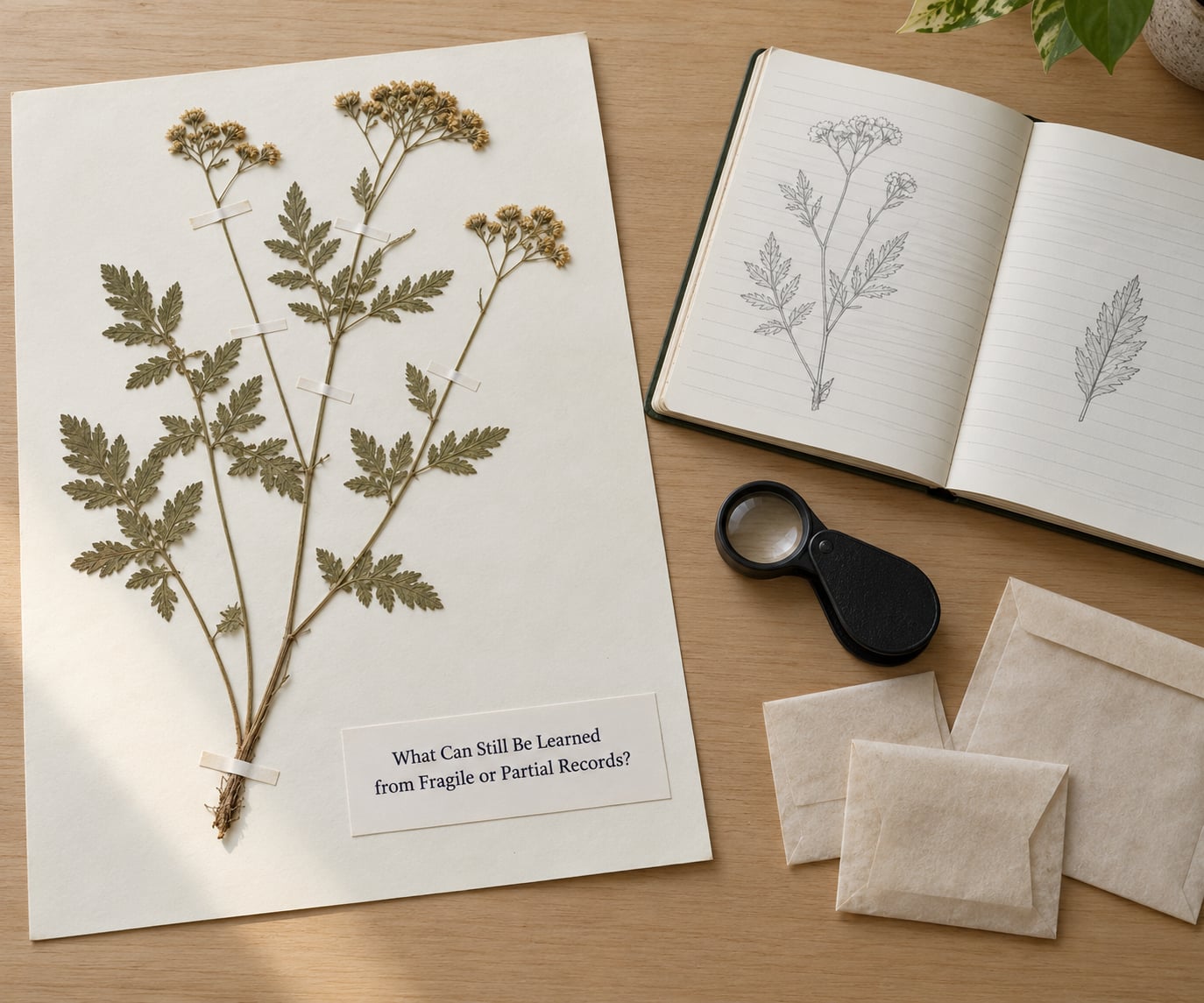
Historians and ethnobotanists rarely trust one source type. They triangulate. A plant name in a manuscript gets checked against herbarium specimens from the same locality, against the living plant’s current local names, against what a practitioner of that region calls it now, and against linguistic work on the name itself.
Oral history adds the sequence a document flattens: who learned what, from whom, and what changed. Archaeological evidence settles questions about a plant being present in a place at all. Linguistic data can date a name’s spread. Living practice shows which details are still operational rather than remembered.
Contradictions are normal and should be reported, not smoothed away. When a record conflicts with what people do now, the interesting question is usually why they diverged.
There are named examples where a record did survive and is worth knowing. The Hieroi Logoi, discussed by King in The Lancet in 2014, preserve an ancient patient’s own account of his suffering. The Ebers Papyrus carries the oldest known written mention of a named plant used as a remedy. The 1985 psoriasis study involving the Cree healer Russell Willier was recorded on videotape and in photographs, with six of ten patients reported as improving. Rare does not mean absent.
How Can We Interpret Old Healing Texts Safely?
Use a fixed sequence before you trust anything. Identify the author, the patron and the purpose; a text commissioned to prove a point needs reading differently from a field notebook. Establish date and provenance, because a remedy name can travel with a trade route rather than with the people who use it. Compare plant names against regional floras and herbarium records rather than trusting a single translation. Check how later authors cited it, since the second and third users of a recipe are often where the drift shows up. Separate observed effects from cosmological framing without discarding the framing. Then flag the parts where sources disagree.
One boundary holds regardless of how well an old text is analysed. Historical sources describe what people believed and what they prepared; they are not a basis for treating yourself or anyone else. Plant preparations vary in concentration, can interact with prescription medicines, and can be contaminated. Anything about your own health belongs with a doctor or a pharmacist, and so does any warning sign.
What Does the Missing Record Mean for Research Today?
An uneven archive does not stay neutral. It shapes which plants appear on national and global medicinal species lists, which regions get described as pharmacologically rich and which get ignored, and which names and stories dominate popular retellings of African medical history. Where documentation followed colonial and post-colonial funding, the record is thickest exactly where extraction was most active.
Contemporary practice pushes back in two directions at once. Community-led documentation keeps control with the people holding the knowledge, often recording on their terms rather than extracting into a paper. Benefit-sharing rules such as those developed under the Convention on Biological Diversity try to attach reciprocity to any later use. Neither settles the ethical problem, and researchers still describe the difficulty of studying a practice without changing it.
The useful question is no longer whether knowledge should be written down. It is who writes it, in what language, with what consent, and what happens to it afterwards.
Frequently Asked Questions
Does the lack of written records mean traditional healing did not exist?
No. A missing document is evidence about documentation, not about the practice. Indigenous knowledge traditions have long included recognition of natural substances, classification of illness and preparation of medicines, and they operated for centuries without a written pharmacopoeia. Where records are thin, historians have to infer rather than dismiss.
Why did many traditional healers keep knowledge verbally?
Partly practical. Writing was rare, costly and often limited to languages a healer did not read. Partly cultural. Apprentice transmission through demonstration carries more context than a fixed recipe, and some material was restricted to a lineage or revealed in initiation. Partly political. Under pressure from authorities that treated the practice as witchcraft, keeping it visible on paper carried real risk.
Are colonial herbals reliable records of African medicinal knowledge?
They are evidence, but not transparent evidence. Collectors selected unevenly, translated local names into botanical binomials, and often recorded the plant while dropping the preparation, the season and the cautions around it. Read them alongside herbarium specimens, regional floras and oral history, and treat the gaps in them as part of the record rather than as mistakes.
How do researchers identify the plant named in an old text?
By cross-checking several source types at once. The written name is matched against herbarium specimens from the same locality, current local names, regional floras and linguistic evidence about the name. A match still needs confirmation from someone who works with the plant, because the same vernacular label can cover different species across a few hundred kilometres.
What can oral histories contribute that archived documents cannot?
Sequence, relationship and change. Documents tend to fix a remedy at a moment; oral testimony can show who learned it, from whom, and how it was modified along the way. It also records the reasons and cautions attached to a preparation, which are usually the first things to disappear from a collection catalogue. Its weakness is the same as its strength: it is living and revisable.
Why are African medicinal-plant histories often incomplete?
Several reasons stack on top of each other. Documentation tracked colonial administrative interest rather than medical interest, and many traditions had no writing system in wide use for this purpose. Local plant names shift across languages and regions, so records do not line up. Much knowledge was deliberately withheld, some of it was lost when lineages broke, and what survives in overseas collections is often uncatalogued or detached from its context.
What to Take Away First
Missing documents are not proof that healing knowledge was never there. On the evidence of Makhubu, Yeboah and the later work on ethical ethnobotanical publication, the reasons written records of healing are rare are largely about scripts, transmission, restriction, politics and damp archives rather than about the depth of the practice.
So before concluding anything from an empty shelf, ask four questions: who was in a position to write this down, who decided what got written, where the material ended up, and who has read it since. That is where most of the missing record actually went.