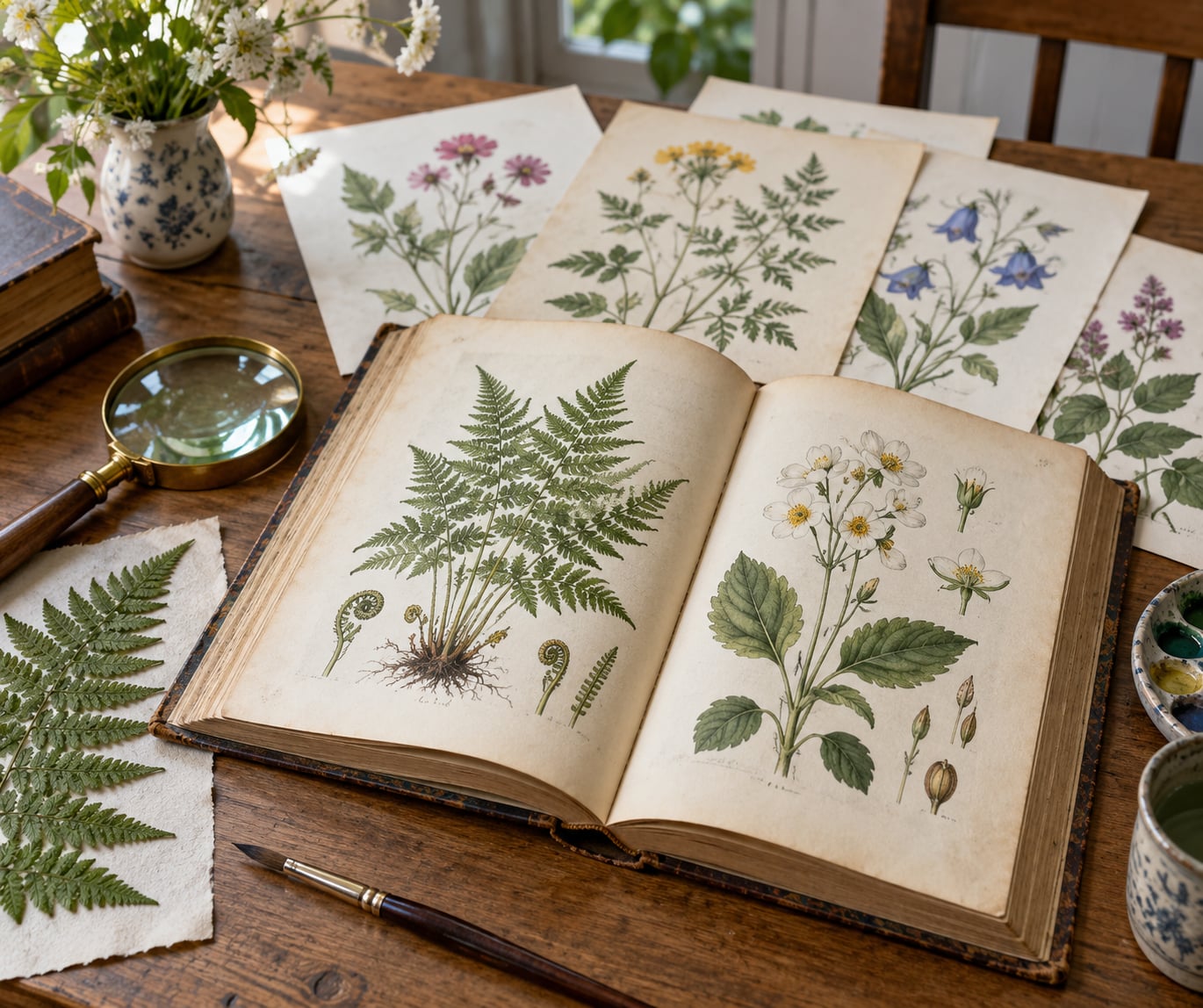
Botanical illustration is the accurate depiction of a plant drawn to show its diagnostic features, and the most famous botanical illustrators and their work stretch across four centuries of that practice. Maria Sibylla Merian, Pierre-Joseph Redouté, Marianne North, Margaret Mee and Mary Vaux Walcott are the names most readers meet first, and each solved a different problem: insect life cycles, aristocratic roses, whole habitats, Amazon orchids and American wildflowers.
What follows is a working list rather than a ranking, because the field has never had a single canonical top ten. Each profile gives the person, the work that made them, the technique they relied on, and the reason their approach still matters to anyone who handles plants, seeds, or field records.
Table of Contents
- 1Famous Botanical Illustrators and Their Work at a Glance
- 21. Pierre-Joseph Redouté and the Art of the Rose
- 3Why Redouté’s roses still look like portraits rather than diagrams
- 42. Walter Hood Fitch and the Documentation of the Kew Gardens
- 53. Marianne North and Plants in Living Color
- 64. Franz Eugen Köhler and the Encyclopedic Flora
- 75. Maria Sibylla Merian and Insects Among Plants
- 86. Matilda Smith and the Practical Traditions of Botanical Drawing
- 97. Margaret Mee and Brazilian Amazon Orchids
- 108. Mary Vaux Walcott and American Wildflowers
- 119. Ernst Haeckel and the Artistic Boundaries of Nature Study
- 1210. Regina Olson Hughes and Contemporary Botanical Art
- 13Frequently Asked Questions
- 14Who is considered the most famous botanical illustrator of all time?
- 15What is Maria Sibylla Merian’s most famous work?
- 16What was Maria Sibylla Merian known for?
- 17Who are some famous female botanical artists?
- 18Are botanical illustrations still relevant today?
- 19Who is the most famous botanist in history?
- 20Conclusion
Famous Botanical Illustrators and Their Work at a Glance
| Illustrator | Lifespan | Region | Signature Work | Medium | Distinctive Contribution |
|---|---|---|---|---|---|
| Pierre-Joseph Redouté | 1759–1840 | France | Les Roses | Watercolour, stipple engraving | Made the flower portrait an art form without losing botanical rigour |
| Walter Hood Fitch | 1817–1892 | Scotland and England | Curtis’s Botanical Magazine | Lithograph and steel engraving | Turned a written description into a plant a reader could recognise |
| Marianne North | 1830–1890 | England | 833 paintings at Kew | Oil on paper, painted in the field | Painted whole plants in their habitat instead of isolated specimens |
| Franz Eugen Köhler | 1796–1875 | Germany | Köhler’s Medizinal-Pflanzen | Colour lithographic plates | Put accurate colour plates of medicinal species into pharmacists’ hands |
| Maria Sibylla Merian | 1647–1717 | Germany and Suriname | Metamorphosis Insectorum Surinamensium | Hand-coloured engraving | Showed each insect on its host plant across a complete life cycle |
| Matilda Smith | 1834–1923 | England | Illustrations of the Ferns | Watercolour and lithograph | Served specialists and general readers with the same plate |
| Margaret Mee | 1909–1988 | Brazil and England | Amazon orchid watercolours | Watercolour, painted in the field | Painted endangered plants and campaigned to keep them standing |
| Mary Vaux Walcott | 1860–1943 | United States | Wild Flowers of America | Watercolour on paper | Recorded American wildflowers as a volunteer field worker |
| Ernst Haeckel | 1834–1919 | Germany | Kunstformen der Natur | Lithograph and watercolour | Stretched observation into symmetrical compositions that still divide viewers |
| Regina Olson Hughes | 1899–1994 | United States | USDA orchid watercolours | Watercolour on board | Carried the scientific plate tradition into the twentieth century |
1. Pierre-Joseph Redouté and the Art of the Rose
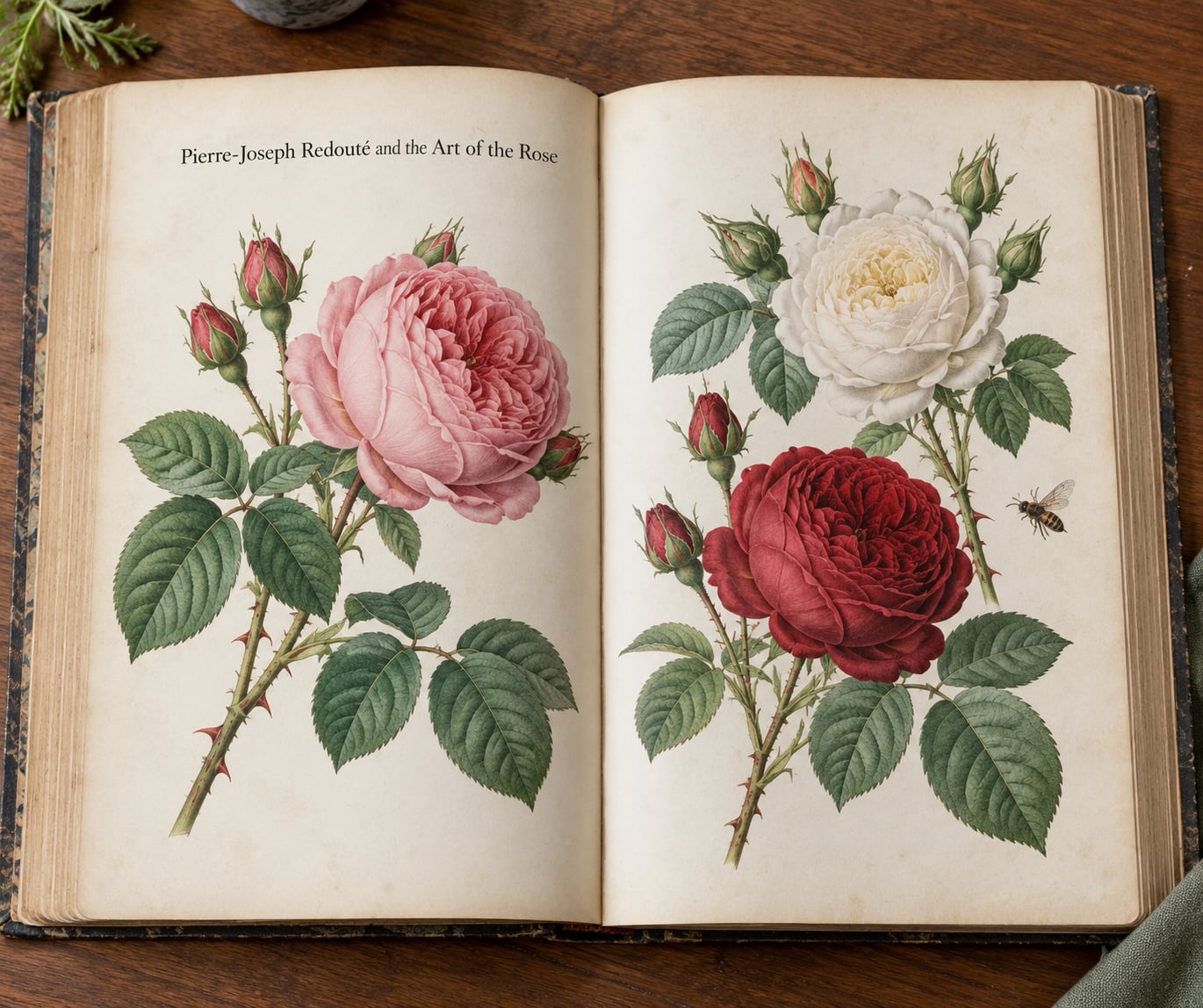
Why Redouté’s roses still look like portraits rather than diagrams
Pierre-Joseph Redouté painted more than 200 rose varieties for Les Roses, a three-volume work published between 1817 and 1824 for Empress Josephine at Malmaison. He never pressed a rose and made it flat. Each flower was drawn from life, often with the outer petals dropped, which is why the plates read as three-dimensional portraits of a plant rather than a specimen pinned to a board.
His printed plates were made by engravers working from his watercolours, using a technique called stipple engraving. Rather than cutting lines, the engraver stippled the plate with thousands of tiny dots, and colour was applied by hand after printing. Redouté’s drawings were the source, not the finished objects, so his name sits on work several hands produced.
That division matters when you look at his output. He ran a workshop in which specialists handled leaves, stems, and the reproduction work while he focused on flowers, which is why his total plate count looks so enormous next to his personal output.
Les Liliacées, issued across the fourteen years from 1802 to 1816, widened the range considerably and is the harder work to overlook. Later botanists argued about whether he exaggerated softness to please a patron, and that argument has never fully settled, which is itself a sign of how close his invention sits to the evidence.
Collectors now treat Redouté as the test case for the difference between botanical illustration and botanical art. Both traditions demand accuracy, but the purpose differs: one exists to let you name the specimen, the other exists to let you feel it.
2. Walter Hood Fitch and the Documentation of the Kew Gardens
Walter Hood Fitch drew for Curtis’s Botanical Magazine from 1834 until the magazine’s end in 1977, and the volume is the point. He produced close to 10,000 plates across roughly 27,000 pages, which makes him arguably the most productive botanical illustrator who ever worked, if you count output rather than fame.
Fitch drew from the herbarium, not only from a live plant. That distinction shaped his work and gave it a lasting edge. When John Lindley needed plates for Illustrations of Himalayan Plants, written in the 1850s partly to explain why plants sent back from India could not always survive the sea journey, Fitch drew from dried material that had crossed oceans and still rendered it recognisable.
He was also curator of the herbarium at the Royal Botanic Gardens, Kew, which put him inside the institution rather than outside it as a hired draughtsman. Editors trusted his image to carry information the text had no room for, and readers learned to read a plate as an argument.
His weakness is the flip side of his method. Working at speed from preserved material produced a large volume of competent, standardised work, and some plates have the flattened quality of plants that never held a pose in life. Where Redouté individualised his subjects, Fitch standardised his, and the difference between the two styles tells you a lot about what each publication needed from its artist.
3. Marianne North and Plants in Living Color
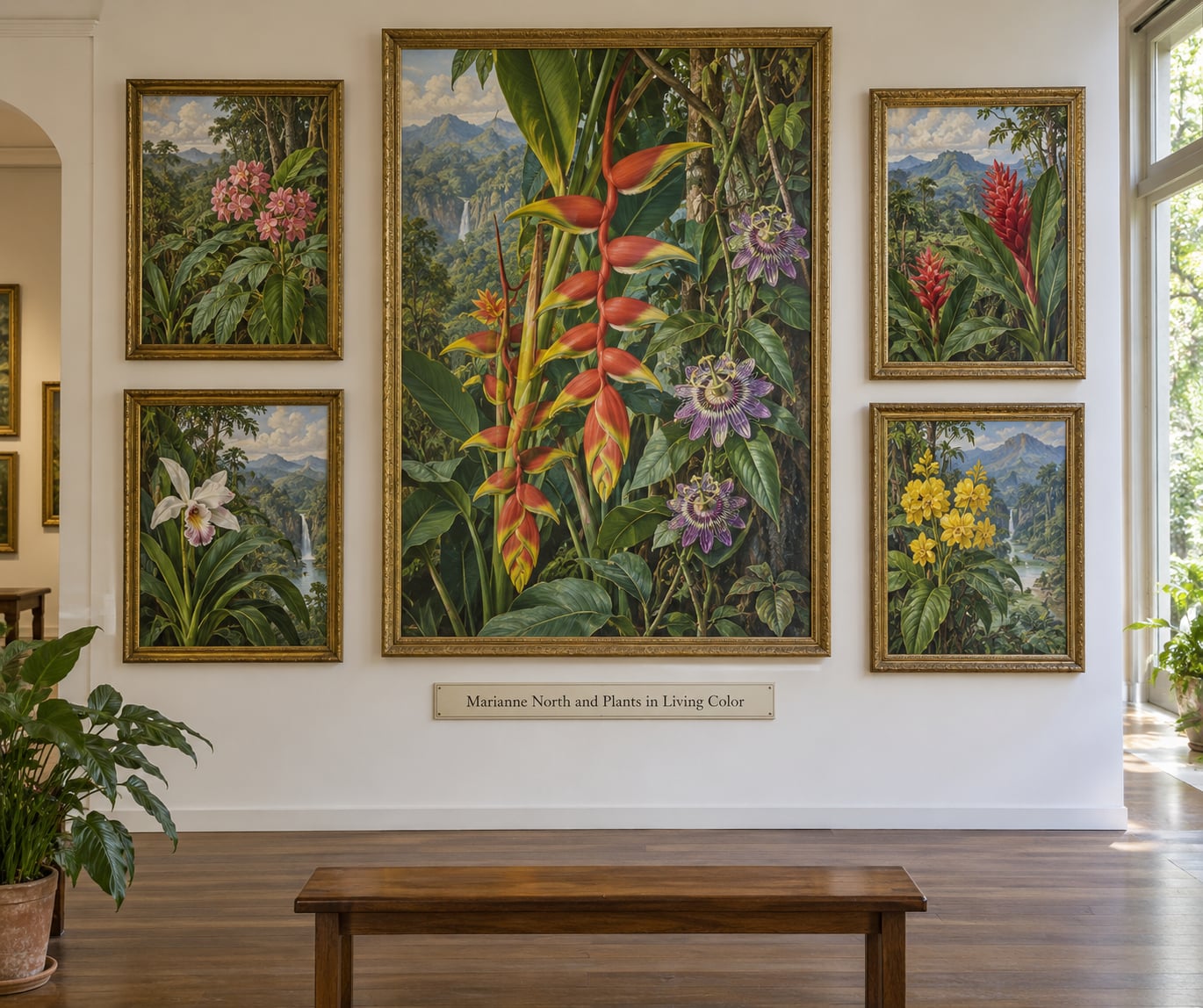
Marianne North never trained as an artist and never held a formal botanical post. She travelled, she painted, and she left 833 oil paintings to the Royal Botanic Gardens, Kew, where they hang in the Marianne North Gallery she insisted be built for them.
Her method broke with the studio convention in a specific way. Instead of painting a cut branch on a blank ground, she painted the plant standing where it grew, with the forest behind it, the light coming from one side, and often another species growing through the frame. A plate of Bromelia in the field can tell you something a diagram cannot: how tall it stands next to a person, what climbs it, and what colour the air looked like at that altitude.
Her Recollections of a Happy Amateur, published in 1888, reads less like an art book and more like a traveller’s notebook. She describes painting in heat, insects landing on wet colour, and the practical problem of carrying paper through country that no one had mapped.
North’s plates still matter for ethnobotanical work, because the habitat detail is functional. If you are researching how a plant is gathered, what grows beside it, and when it fruits, a field painting records that information that an isolated specimen label cannot.
4. Franz Eugen Köhler and the Encyclopedic Flora
Franz Eugen Köhler trained as a painter and apothecary, and he worked at exactly the point where botanical art meets the pharmacy counter. His plates, issued in the German-language pharmaceutical tradition as Köhler’s Medizinal-Pflanzen, put accurate colour images of medicinal and officinal species in front of people who needed to identify a dried leaf or bark sample.
That audience changes what a plate has to do. A flower portrait can afford painterly licence; a dispensary reference cannot. Colour has to be right in the parts that are ground or steeped, the leaf shape has to survive being pressed flat, and the label has to match what the buyer is holding in their hand. Köhler’s plates are unusually obedient to that requirement.
He worked within a wider European project that translated botanical traditions from several countries into a shared reference format. Similar plates appeared for medicinal plants across German, French, and English markets, and a herbal or physician could compare a continental plate with a local herbarium sheet and reach a reasonable identification.
For anyone interested in how plants reached communities through traditional healing, this corner of the history matters as much as the gallery painters. The plate was not decoration on the medicine trade; in many districts it was the only reliable image a practitioner ever saw of the plant in their hand.
5. Maria Sibylla Merian and Insects Among Plants
Maria Sibylla Merian travelled to Suriname from 1699 to 1701 and did something almost nobody had done: she recorded complete life cycles. Metamorphosis Insectorum Surinamensium, published in 1705, sets each caterpillar beside the plant it feeds on, then the pupa, then the adult insect, often with the eggs as well.
Her plate format is the innovation. Before Merian, an insect drawing was usually an ornament and a plant drawing was usually a specimen. She put the two in one frame and made the relationship between them the subject, which is an ecological argument made in a format nobody had attempted at that scale.
She had been drawing insects and plants since she was young, and she supported the Suriname trip by selling work, financing research herself through an annuity she arranged. The method was demanding: she observed rearing, recorded dates, and only painted what she had seen develop.
Her descendants kept the work going. Daughters Dorothea and Johanna ran the studio that completed the later volumes, and her great-granddaughter also became an illustrator, which makes the Merian line one of the few documented artistic matrilineages in the field.
If you want a single answer to what Maria Sibylla Merian was known for, it is that life-cycle plate. Anyone studying medicinal plants, insect pollinators, or host-plant relationships will still open it.
6. Matilda Smith and the Practical Traditions of Botanical Drawing
Matilda Smith spent most of her working life inside institutions, first as John Lindley’s assistant at the Royal Horticultural Society and later at Kew, and she came to hold the role of curator of botanical art. Her work sits between the scientific plate and the popular natural history book, and it serves both without dumbing down either.
The Ferns, produced with Thomas Moore, is the clearest case. Fern identification depends on the arrangement of sori on the underside of the frond, a feature no casual observer will notice and no photograph reproduces well in an old publication. Smith drew it, and the plates circulate to this day.
Her method was to work from living material wherever she could, then check against the herbarium. Drawing from a live frond gave her the curve and translucency that a pressed specimen flattens away, and the herbarium sheet told her whether the plant in front of her was typical.
Because she worked with curators, scientists, and readers rather than a single patron, her legacy is a set of habits rather than a signature look: check the diagnostic feature, say the scale, name the binomial, and leave out whatever is decorative and misleading. Those habits are still the working standard for botanical art.
7. Margaret Mee and Brazilian Amazon Orchids
Margaret Mee made three expeditions to the Amazon between 1957 and 1968 and painted the plants she found, on the spot, at roughly life size. Her subjects skewed toward orchids because orchids were the plants most likely to disappear before anyone recorded them properly.
She worked alongside Japanese botanical partners in Brazil and later with the Mapufuji Tropical Botanical Garden in São Paulo, and those collaborations produced Folia Amazonica, a journal of botanical art and field research. That journal is the reason her work functions as documentation rather than as decoration.
The conservation argument came later and it changed how her paintings are read. Mee used them to argue that a species described in a scientific paper and never photographed in its habitat is a species nobody is watching. Plants she painted became reference points for later habitat protection campaigns.
Her practical method is worth copying. She carried prepared watercolour stock and a small field kit, and she painted fast at low resolution before the light or the plant changed, producing sheets that are rough compared with a studio study and far more useful as habitat records.
The fellowship named in her memory brings artists into the Amazon to work with botanists, and it exists because she showed that the two jobs could be done by the same person in the same place.
8. Mary Vaux Walcott and American Wildflowers
Mary Vaux Walcott took a different route in. She was a Philadelphia botanist who taught herself to paint and then offered her services to the Smithsonian National Herbarium, becoming a volunteer illustrator there around 1908 and working there for the rest of her life.
Over three decades she produced well over a thousand paintings and sketches of North American wildflowers, and Wild Flowers of America, issued in colour in 1917 and 1918, is the part most people encounter. The book was deliberately affordable, which put her work in hands that a limited-edition florilegium would never have reached.
Her field method was consistent: she found the plant, noted where and when, painted it on site, and often pressed a specimen to verify the identification. The combination means her images carry the same evidence a herbarium sheet does, but you can read them without handling a fragile sheet.
Walcott’s Chesapeake Bay notebooks are the more revealing documents for researchers, recording where a species still grew, when it flowered, and what surrounded it. Read alongside later surveys, they show how a meadow or a hillside changed over a century.
She is a good model for anyone documenting regional flora now, because her scale was local and ordinary rather than exotic, and that is where most plant knowledge actually lives.
9. Ernst Haeckel and the Artistic Boundaries of Nature Study
Ernst Haeckel was a marine zoologist before he was anything else, and his botanical and nature material came out of his work on organisms nobody else had drawn. Kunstformen der Natur, issued in 1904, arranged deep-sea forms and microscopic structures into plates of near-perfect radial symmetry.
Those plates are stunning, and they are also the clearest case in the list of observation sliding into invention. Haeckel drew from specimens and from published descriptions, sometimes completing a form whose full development he had not seen, and the symmetry he imposed to unify a group could attribute to a specimen features it lacked.
Botanical illustration depends on the difference between a plate that helps you identify a plant and a plate that helps you feel how large life is. Haeckel is usually read on the second side, which is why he sits in this list as a boundary marker rather than as a model for a working botanical artist.
He is worth reading alongside the botanical tradition rather than outside it. His method, drawing from a specimen and a description at once, is exactly what modern illustrators do when a type specimen is lost and only the published description remains.
The controversy around his later human evolution work is a separate and much darker subject, and it is the reason several institutions now display his biological plates only with context attached.
10. Regina Olson Hughes and Contemporary Botanical Art
Regina Olson Hughes carried the scientific plate into the twentieth century at a level of finish that few others matched. She worked for the United States Department of Agriculture, produced orchid watercolours including a portrait of the national orchid, and became the first woman president of the American Society of Plant Taxonomists.
Her plates are gouache and watercolour on prepared board, built up in thin layers so that the colour reads as depth rather than opacity. She insisted on the diagnostic structures, the reproductive parts, the scale and the binomial, and the painting quality arrived on top of that rather than replacing it.
Hughes also pushed accessibility, producing public garden and institutional commissions that put fine botanical work where people encounter plants rather than in a private collection. She studied at Gallaudet University, and her advocacy for botanical artists with hearing loss opened doors in a trade that had very few of them.
What contemporary practice took from her is the fusion: society memberships such as the Society of Botanical Artists and the American Society of Botanical Artists, juried exhibitions like the RHS Botanical Art Show, and awards that reward a scientific drawing by the standards of a science panel. That system is the twentieth-century form of the patronage Redouté and North had.
Her career is a useful answer to the question of whether this tradition ended. It did not. The medium moved to lithography and then to digital layering, and the standard for accuracy did not move at all.
Frequently Asked Questions
Who is considered the most famous botanical illustrator of all time?
There is no official ranking, but Maria Sibylla Merian (1647-1717) is usually named first, because Metamorphosis Insectorum Surinamensium showed each insect on its host plant across a complete life cycle. Pierre-Joseph Redouté (1759-1840) is the other name that comes up constantly, since Les Roses made the flower portrait an art form. Ask ten specialists and you will get ten answers.
What is Maria Sibylla Merian’s most famous work?
Her most famous work is Metamorphosis Insectorum Surinamensium, published in 1705 after two years in Suriname. Its plates follow caterpillars, pupae and adult insects beside the plants they feed on, so a reader can trace a full life cycle on one page. It is still consulted for plant and insect relationships, and the original drawings are held in institutions including the Natural History Museum in London.
What was Maria Sibylla Merian known for?
Merian was known for combining accurate observation with published botanical documentation, and for doing it far earlier than her contemporaries. She reared her subjects rather than drawing from imagination, recorded where each species was found, and insisted on showing the whole life cycle. Her work sits between botany and natural history, which is why it reaches beyond plant specialists.
Who are some famous female botanical artists?
The short list usually includes Maria Sibylla Merian, Elizabeth Blackwell, Marianne North, Matilda Smith, Sarah Drake, Blanche Ames, Margaret Mee, Mary Vaux Walcott and Regina Olson Hughes. Between them they worked from the seventeenth to the twentieth century, in studios, herbaria and Amazon field camps. North’s 833 paintings at Kew and Mee’s Amazon orchid watercolours are the two most visited collections.
Are botanical illustrations still relevant today?
Yes, though the role has shifted. Photography and field guides handle routine identification, but hand drawing still gets used where a diagnostic feature must be isolated and labelled, where colour must be exact, and where a type specimen has been lost. Ethnobotanical and habitat documentation still depend on field illustration, and botanical societies continue to judge scientific accuracy formally.
Who is the most famous botanist in history?
Carl Linnaeus is usually credited as the most influential, because his naming system gave every species a two-part Latin name and made plants comparable across continents. No botanist has been more quoted, and the famous botanical illustrators and their work of the eighteenth century were often built around his descriptions. If you are asking who the most famous botanical illustrator is, that is a different question with a different answer.
Conclusion
Pick the artist whose problem matches yours. If you want to see what a plant looks like rather than what it means to you, start with Redouté. If you need evidence rather than beauty, start with Mee or Walcott. If you want the whole habitat rather than the specimen, start with North.
Whatever you choose, copy the habit rather than the finish. Look at the plant closely, isolate the feature that identifies it, name it properly, and write down where and when you saw it. Every illustrator on this list did those four things before they worried about style.
That record still earns its keep. An illustration is often the only description that survives when the specimen, the forest, or the collector is gone.