Powdered herbs lose potency faster than whole or cut material because grinding multiplies the exposed surface area of the plant. That extra surface lets oxygen, moisture, heat and light reach the volatile oils and active constituents far faster than they can in an intact leaf or seed. Fine powder also loses aroma and colour almost immediately, and aroma is only a rough proxy for what is happening chemically.
The rest of this guide explains the mechanism in plain language, compares forms, ranks the storage factors that matter most, and covers what packaging and handling actually help. It is general information about storage science, not advice about treating a health condition.
Table of Contents
- 1Why Powdered Herbs Lose Potency Faster Than Whole Herbs
- 2What changes at the moment of grinding
- 3What Changes When an Herb Is Ground Into a Powder?
- 4Why Powdered Herbs Lose Potency Faster: The Chemical Changes
- 5Oxidation of oils and phenolics
- 6Volatilization of aromatic compounds
- 7Hydrolysis and moisture-driven reactions
- 8Photodegradation
- 9Which losses matter most
- 10How Does Moisture Ruin Powdered Herbs?
- 11Does Air, Heat, or Light Cause More Damage Than Particle Size?
- 12Does Powdered African Herbal Medicine Always Lose Potency Faster?
- 13Which Packaging Slows Potency Loss the Most?
- 14How to Store Powdered Herbs Without Accelerating Their Decline
- 15Can You Tell Whether a Powdered Herb Has Lost Potency?
- 16Frequently Asked Questions
- 17How long does powdered herbal medicine keep its potency?
- 18Is powdered herb stronger than the same herb in whole-leaf form?
- 19Should powdered herbs be refrigerated?
- 20What is the best container for storing powdered herbs?
- 21Can you tell if powdered herbs are still potent by smell or color?
- 22Does drying an herb always remove all of its active compounds?
- 23Conclusion
Why Powdered Herbs Lose Potency Faster Than Whole Herbs
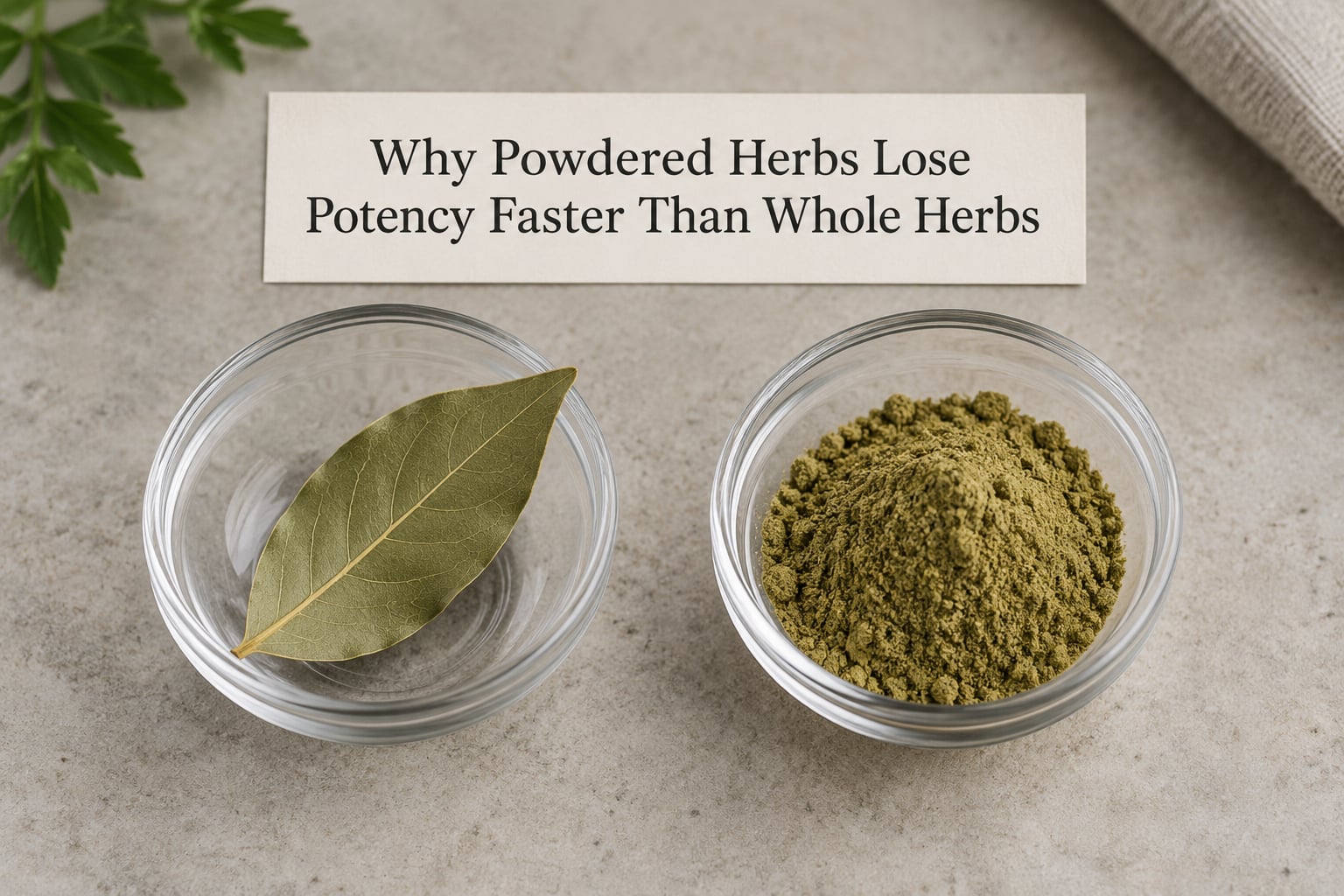
The short answer is surface area. A whole seed has a hard coat around a small amount of interior material. Crush it into a fine powder and the same material is spread across thousands of tiny particles, each one open to the air around it.
Nothing about the chemistry changes when you grind. What changes is how much of the material is exposed, and for how long, to the four things that break plant compounds down: oxygen, water, heat and light.
What changes at the moment of grinding
- Surface area multiplies. Fine powder has far more exposed area per gram than a broken leaf, and that is the core reason why powdered herbs lose potency faster than whole material.
- Cells rupture. Grinding tears open cell walls that were acting as tiny protective rooms. Oils, pigments and enzymes that were sealed in now sit exposed.
- Volatile oils start leaving. Terpenes and other aromatic molecules evaporate from an open surface at room temperature, and the more open surface there is, the faster they go.
- Enzymes meet their substrates. Drying slows these reactions but does not always stop them. Damage to a powder is more complete and more uniform than damage to an intact leaf.
- Handling losses multiply. Every transfer, every scoop, every spill that powder dusts out of the container is material you will never get back.
- Light penetrates further. A thin layer of powder is more exposed to light than the outer surface of a dense leaf bundle.
Grinding is also the loss event itself. A whole jar of seed that sits in a cupboard for a year loses very little until someone opens it. The same material ground on day one has already started degrading on day one.
What Changes When an Herb Is Ground Into a Powder?
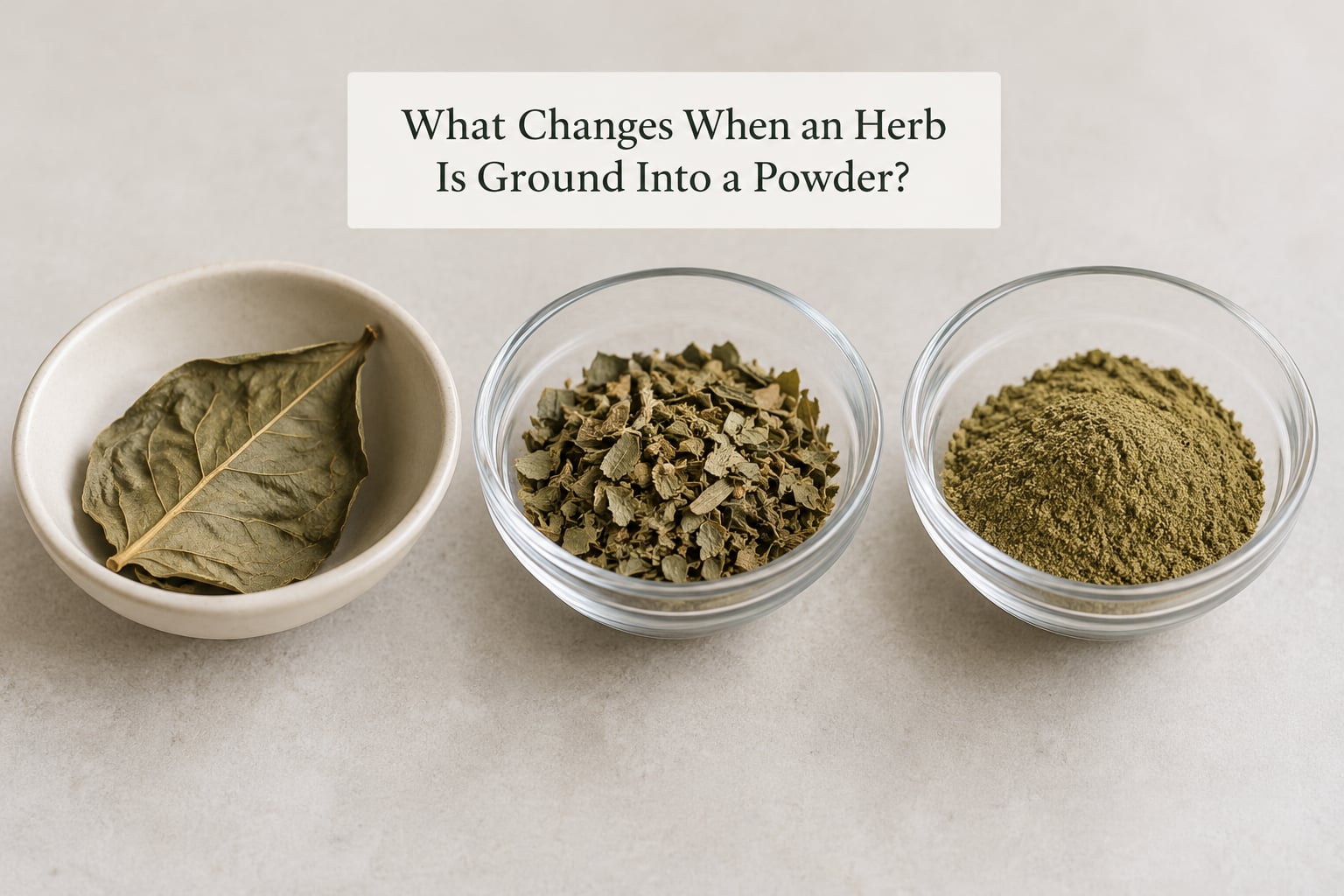
Particle size changes four practical things: how much material is exposed, how the powder behaves physically, how fast moisture moves in and out, and how much of it ends up lost during handling.
| Form | Exposed area | Moisture behaviour | Relative durability | Best use |
|---|---|---|---|---|
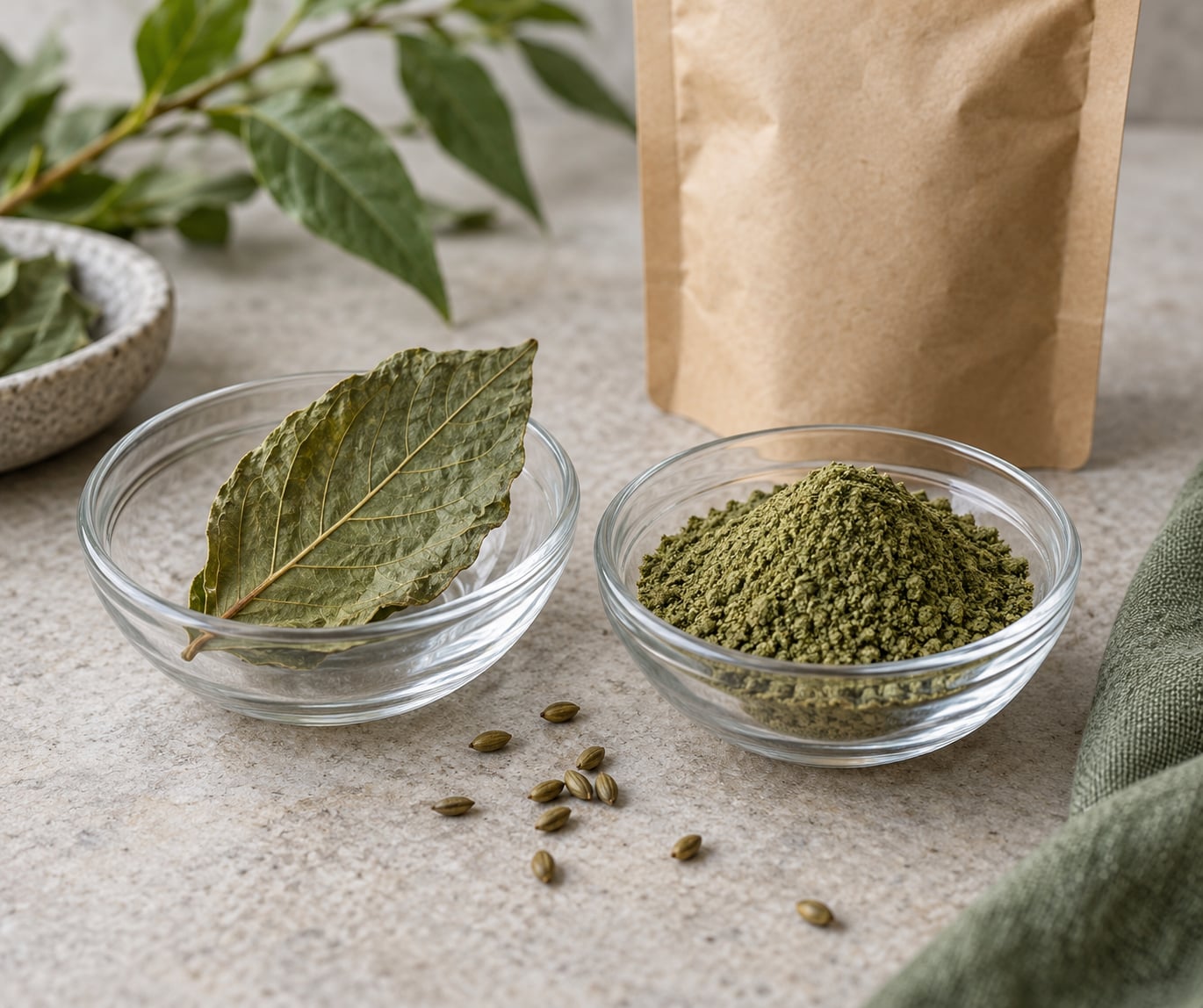
| Whole leaf or seed | Low | Slow to gain, slow to lose | Best of the dried forms | Long storage, grind to use |
| Coarsely broken | Moderate | Moderate exchange | Middle ground | Teas, coarse blends |
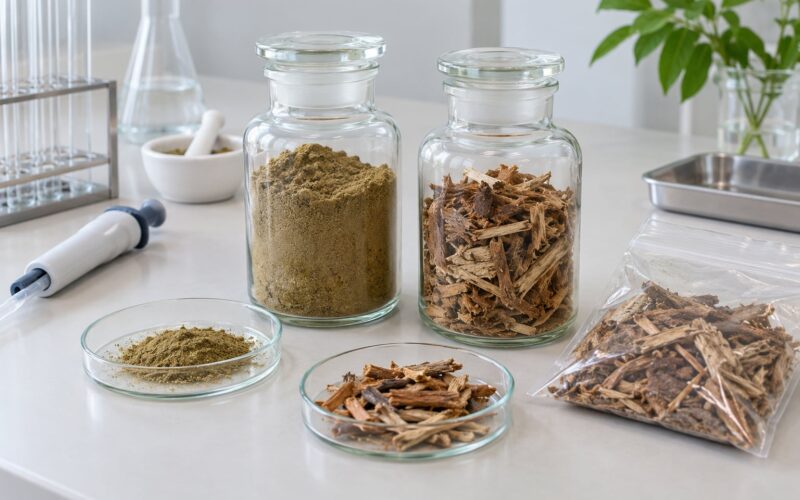
| Fine powder | Very high | Quick to gain, quick to lose | Shortest of the dried forms | Capsules, sachets, snuffs, dispersions |
| Freeze-dried powder | High, but very dry | Very low residual moisture | Good, if kept dry and sealed | Blends, teas, powder formulations |
Freeze-dried material sits apart from the rest because the drying step is gentle. Water is removed under vacuum while frozen, so the plant tissue is not cooked and volatile compounds are less damaged in the process. Suppliers of freeze-dried material commonly put retention figures in the region of 90% of aroma and nutritional value, which is far better than heat drying achieves.
That advantage only holds while the powder stays dry and sealed. Once a freeze-dried jar is opened and sits in humid air, it ages on the same clock as any other powder.
Why Powdered Herbs Lose Potency Faster: The Chemical Changes
Four reaction types account for most of what you observe in a jar of ageing powder. Not every herb responds to all four in the same way, so treat these as likely pathways rather than universal rules.
Oxidation of oils and phenolics
Terpenes and phenolic compounds react with oxygen in the air. This is autoxidation: the compound joins oxygen, forms unstable intermediates, and ends up as a mixture of aldehydes, ketones and acids. Those by-products smell stale or resinous, and the original aroma is gone.
Oxidation also destroys pigments. Chlorophyll turns to pheophytin and dull olive tones, which is why old powdered green material looks brown rather than green.
Volatilization of aromatic compounds
Aromatic molecules are already on the edge of becoming gas. Grinding a leaf that held those molecules in oil glands and ducts exposes them to moving air, and they leave the material. A jar of powder that has lost its scent has usually lost real chemistry along with it.
Hydrolysis and moisture-driven reactions
Water splits certain compounds, esters and glycosides among them, into smaller pieces that may be less active. This reaction needs water, which is why moisture control matters as much as oxygen control for many preparations.
Photodegradation
Light drives photochemical reactions that heat alone would not trigger. Pigments break down, and some oils become phototoxic or irritating on skin when used topically. Clear jars and thin plastic bags put powder directly in the path of this damage.
Which losses matter most
Losing aroma is the loss people notice. Losing the constituents that made a preparation useful is the loss that matters for medicinal and ceremonial use. The two usually run together, but not always: some non-volatile constituents such as tannins and saponins can stay largely intact while the aromatic fraction disappears, and some pigments fade well before their own activity changes.
That is the honest limit of the smell test. A powder that still smells strong may have lost non-volatile actives. A powder that smells faint may have lost mostly volatiles. Smell tells you something has changed, not what.
How Does Moisture Ruin Powdered Herbs?
Powder takes on water far faster than an intact leaf does, and it holds that water in a way that makes trouble. Dried plant material is hygroscopic, meaning it pulls moisture from the air until it reaches equilibrium with the surrounding humidity.
Once moisture is present, several things happen at once:
- Water activity rises. Stability work in the botanical industry generally treats water activity below about 0.60 as the point where most moulds and yeasts cannot grow. Above roughly 0.60, microbial risk starts to matter.
- Mould can appear. Yes, dry herbs can mould, especially powder. Condensation inside a container is enough to give fungi what they need.
- Powder clumps and cakes. This is a physical change, and on its own it does not mean spoilage. Many people assume caking equals rotting, which is not true.
- Hydrolysis speeds up. Water gets into the reaction pathway and starts splitting compounds.
- Headspace oxygen gets used up. With moisture present, oxidation reactions can proceed even in low-oxygen packaging.
A useful distinction here: a moisture percentage reading and water activity are not the same number. A powder can read as acceptable on a total moisture test and still sit at an aw high enough to drive degradation. Where you can measure only one, water activity is the more informative one.
| Moisture control | How it works | Where it is unsuitable or limited |
|---|---|---|
| Desiccant packet | Absorbs water vapour inside the sealed container | Does nothing once saturated; follow the maker’s instructions and never let it touch the powder |
| Oxygen absorber | Removes oxygen from the headspace | Adds no moisture control; wasted if the powder was not dry to begin with |
| Vacuum sealing | Removes most air from the container | A headspace still exists, and resin can slowly let oxygen back through |
| Refrigeration | Slows reactions by lowering temperature | Condensation risk each time a cold container is opened in warm air; can make clumping worse |
| Freezing | Very low temperature slows reactions sharply | Condensation on thawing; only useful if material is sealed against moisture before freezing |
Does Air, Heat, or Light Cause More Damage Than Particle Size?
No single factor wins, and it depends on the herb. Particle size sets how fast you get started; the storage environment decides how quickly it continues.
Heat is the strongest accelerator per degree. Chemical reaction rates climb steeply with temperature. This is why commercial stability work runs samples at elevated temperature and humidity to model long-term storage in weeks rather than years.
Oxygen is usually the largest continuous load because a jar is opened repeatedly and air is present in the headspace every time it is opened. Oxygen absorbers help only if the seal is good.
Light matters most for pigmented and aromatic material. It is cheap to fix with opaque packaging, which is why it is an easy win.
Humidity is the biggest regional variable. The same powder stored in a dry climate and a humid one will diverge quickly. High ambient relative humidity, above roughly 65%, is treated in stability work as the point where fungal risk becomes a serious concern.
So the ranking shifts by material. In a hot, humid kitchen, humidity and heat win. In a climate-controlled storeroom opened daily, oxygen and repeated handling win. In a south-facing window, light wins on its own.
Does Powdered African Herbal Medicine Always Lose Potency Faster?
Not always, and the framing itself is worth correcting. Traditional powdered preparations, dried botanicals sold loose, and standardised extracts are three different categories with different storage problems.
Dried botanical material is plant tissue with whatever moisture the drying process left behind. It is the category where particle size matters most, and where a traditional dispensary storing bulk stock loses value steadily once powder is made.
Standardised extracts are different. They are often produced as a liquid or a fixed-ratio powder with a known marker content, and stability is managed through formulation, packaging and testing rather than through the shopper’s cupboard.
Traditional powders and snuffs add their own risk factors. Hand preparation in humid conditions, sieving in open air, storage in paper or cloth packets, and repeated warming before use all expose material to moisture and heat.
Two cautions for anyone working with these materials. Composition varies between batches and between sources, so two jars labelled the same way may not be equivalent. And appearance says nothing about potency or safety. The only reliable way to know what is in a powdered preparation is laboratory testing for defined compounds or a validated fingerprint, which commercial producers use and most informal supply chains do not.
If a preparation is intended for a health condition, or if a product has an unknown history, mould, damp patches or contamination, stop using it and ask a qualified health professional.
Which Packaging Slows Potency Loss the Most?
Good packaging does three things at once: it keeps oxygen out, water vapour out and light out. The best option is the one that does all three and stays sealed between uses.
| Packaging | Blocks | Limits |
|---|---|---|
| Amber or opaque glass jar with airtight lid | Light and air exchange; moisture if the seal is good | Glass is heavy and opaque, so you cannot see the contents; seals fail with age |
| Light-protective foil or metallised bag | Light and oxygen; vapour well if laminated | Harder to reseal once opened; pinholes are common |
| Vacuum-sealed pouch | Most air and vapour | Once opened it is an open bag; resin lets oxygen back slowly |
| Ordinary paper packet or sachet | Nothing durable | Air, vapour and light all pass through; powder also leaks out of damaged corners |
| Container plus desiccant and oxygen absorber | Moisture and oxygen together | Costs more; both need the seal to hold, and both need replacing when spent |
Follow the instructions for anything you add to a sealed container. A desiccant that has turned saturated is doing nothing, and a packet in direct contact with powder can contaminate it.
How to Store Powdered Herbs Without Accelerating Their Decline
Most damage in home and dispensary settings comes from ordinary habits rather than from the storage environment itself. A shelf-stable jar in a cupboard can be spoiled by a warm kitchen, a daily-open lid and a damp spoon.
- Store whole where you can. Grind to use, not in advance. This single change reverses most of what this article describes.
- Use a dedicated spoon per jar. A communal scoop carries moisture and cross-contamination between materials.
- Aim for a cool, dark, dry cupboard, away from the stove, the window and the sink.
- Avoid humidity swings. Moving a jar between a warm kitchen and an air-conditioned room, or opening a chilled container in warm air, drives condensation.
- Use desiccants where humidity is a real problem, and replace them on schedule rather than waiting for the packet to look used.
- Label every container with the plant name, the part used, the date it was ground and the date it was opened. Most discarded jars are discarded because nobody remembers.
- Open once, pour what you need. Repeated open-and-close cycles pump oxygen and moisture into the headspace.
- Freeze only properly sealed material. Freezing slows reactions sharply, but any moisture that condenses on thawing gets straight into the powder.
Follow any preparation-specific instructions you were given. There is no honest universal shelf life for powdered herbal material, and anyone who gives you one is guessing.
Can You Tell Whether a Powdered Herb Has Lost Potency?
Not reliably. Sensory evaluation, called organoleptic assessment in the trade, tells you that change has happened. It does not measure what is left.
A simple field check takes under a minute. Crush a small amount between your fingers and smell it, then rub a little into your palm and smell again, since warmth releases volatiles trapped in the powder. Compare the colour against a fresh sample of the same plant, and check whether the powder still flows freely or has gone hard and lumpy. Taste a very small amount only if the material is one you normally consume.
What the results mean:
- Weak or flat aroma suggests volatile loss. That is a real change, and it is the most reliable sensory signal available.
- Darker or duller colour suggests pigment breakdown, which is real but does not map neatly onto activity.
- Caking on its own is mostly a handling and humidity issue, not proof of spoilage.
- Normal smell and colour do not guarantee potency. Non-volatile constituents may have declined without any sensory trace.
For anything where potency genuinely matters, laboratory analysis is the only real answer. Producers use HPTLC fingerprinting to confirm identity and marker compound assays to check whether defined constituents are still in range. Stability work accepts a marker variation of about 5% before treating a batch as out of specification.
Frequently Asked Questions
How long does powdered herbal medicine keep its potency?
There is no single shelf life for powdered herbal material. Durability depends on the plant species, which compounds matter, the drying method and the storage conditions. Fine powder ages far faster than whole or coarsely broken material because of its exposed surface area. Airtight, opaque, cool, dry storage slows loss considerably. Where a defined preparation has a validated shelf life, follow that specification rather than a rule of thumb.
Is powdered herb stronger than the same herb in whole-leaf form?
Grinding raises the rate at which a herb releases its constituents, so powder extracts faster and is often used that way on purpose. But the same process exposes those constituents to oxygen, moisture, heat and light, so a powder that has been stored for months can be weaker than fresh whole leaf. In other words, powder concentrates the delivery and concentrates the losses at the same time. Freshness and form are separate questions.
Should powdered herbs be refrigerated?
Usually not, and in humid conditions refrigeration can do more harm than good. Every time a cold container is opened in warm air, condensation forms on the powder, which raises water activity and invites mould. If your kitchen is genuinely hot and humid, a sealed container in a conditioned cupboard usually beats a refrigerator. Freezing works better for long storage, but only if the material is sealed against moisture before it goes in and stays sealed until it is needed.
What is the best container for storing powdered herbs?
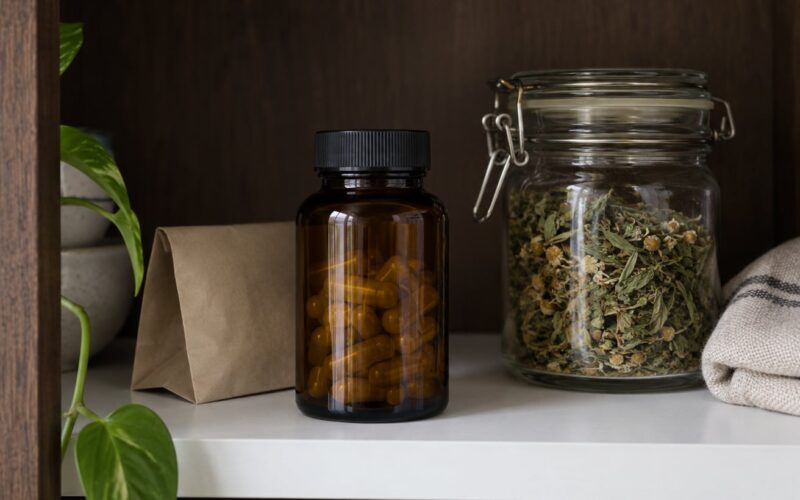
An airtight container that also blocks light. Amber glass with a tight lid is the classic choice, and metallised or foil-laminated pouches work well as long as you reseal them properly after each use. Paper and cloth packets block nothing. Add a desiccant if you live somewhere humid, and never let it touch the powder directly. Any absorber or sachet is only as good as the seal around it.
Can you tell if powdered herbs are still potent by smell or color?
Partly. A weak or flat aroma is a genuine signal that volatile oils have been lost, and colour change usually reflects pigment breakdown. Neither tells you about the non-volatile constituents that matter for medicinal use, and a powder can smell fine while those have declined. Smell confirms that something has changed; it cannot measure what remains. Where potency matters, only laboratory testing of defined compounds or a validated fingerprint answers the question.
Does drying an herb always remove all of its active compounds?
No. Drying is a preservation step rather than a neutral one. It stops enzymatic and microbial activity and removes the water that microbes need, but the process itself can cost you something. Heat drying drives off volatile oils and can cook heat-sensitive constituents, while shade drying and freeze-drying lose less. Freeze-dried material is generally reported to retain around 90% of its aroma and nutritional value. What remains also depends heavily on the plant species and the part of the plant used.
Conclusion
Greater exposed surface area is the central reason why powdered herbs lose potency faster than whole material. Grinding does not make the chemistry weaker on its own, but it opens thousands of small surfaces to oxygen, water, heat and light, and moisture, heat, poor packaging and repeated handling decide how quickly the decline runs.
Start with three habits: store the herb whole and grind to use, keep the powder sealed, opaque, cool and dry, and label the jar so you know how old it is. Use smell and colour as warnings that something has changed, not as proof of quality. For potency or safety questions on a specific preparation, ask a qualified health professional or rely on laboratory testing rather than on appearance.