Tannins are a family of bitter, astringent plant polyphenols that bind to proteins. In a living plant they deter herbivores and insects, screen ultraviolet light, buffer oxidation and bind metals. In tea they create the drying puckering sensation, the body and much of the color of the cup. Everything else follows from that protein-binding property.
The word covers a chemically diverse group, not one substance. Tea is the most famous source, but the same chemistry shows up in acorns, bark decoctions, cacao, coffee, legumes, berries and nuts. This guide connects the biology in the leaf to the taste in the cup, and separates what is well established from the wellness folklore that surrounds tannins.
Table of Contents
- 1What Are Tannins?
- 2Condensed tannins, hydrolyzable tannins and phlorotannins
- 3Tannin is not the same thing as tannic acid
- 4What Tannins Do in Plants and in Tea
- 5How Tannins Protect Plants
- 6Why Tea Leaves Are Especially Rich in Tannins
- 7What tannins do in plants and in tea, in one sentence
- 8How Tannins Create Tea’s Taste and Astringency
- 9What Happens During Tea Fermentation and Oxidation
- 10How Brewing Variables Change Tannin Levels
- 11What Tannins Do in Tea’s Color and Appearance
- 12What Tannins Do When You Drink Tea
- 13Tannins in Other Plants and Foods
- 14What Tannins Do During Food Processing
- 15Common Tannin Myths and Practical Conclusions
- 16Frequently Asked Questions
- 17Are tannins in tea harmful?
- 18How much tea contains the most tannins?
- 19Does milk reduce or neutralize tannins in tea?
- 20Do tannins in tea prevent the body from absorbing iron?
- 21Are tannins the same as caffeine?
- 22Does decaffeinated tea still contain tannins?
- 23Conclusion
What Are Tannins?
Tannins are plant-made compounds rich in hydroxyl groups, which means they grip proteins and other large molecules. A tannin molecule needs enough of those groups to cross-link proteins before it counts as a tannin rather than a simple polyphenol. That threshold is why chemistry writers describe them by behaviour rather than by one exact structure.
The mechanism is worth holding onto, because it explains almost everything else. When a tannin touches a protein, the protein unfolds, binds, and precipitates out of solution. Hide soaked in bark liquor turns into leather for exactly this reason.
Condensed tannins, hydrolyzable tannins and phlorotannins
Condensed tannins, also called proanthocyanidins, are built from flavan-3-ol units such as catechin and epicatechin. They dominate tea, cocoa, apples and red wine, and they break down rather than hydrolyse when boiled in acid.
Hydrolyzable tannins are built around a central glucose or gallic acid core and split into simpler pieces in acid or base. Oak bark, myrobalan, Terminalia species, sumac and acorns are full of them, which is why the leather trade has always worked with bark rather than with tea leaves. Phlorotannins, found in brown algae such as kelp and eelgrass, form a smaller separate group with their own astringent bite.
Tannin is not the same thing as tannic acid
Tannic acid is a specific commercial extract, mostly gallotannins from tree bark, used in ink, dye mordants and leather. Tannin is the whole category. Coffee does not contain tannic acid, and neither does tea; if someone tells you otherwise, the label on a chemistry textbook is the better source.
What Tannins Do in Plants and in Tea
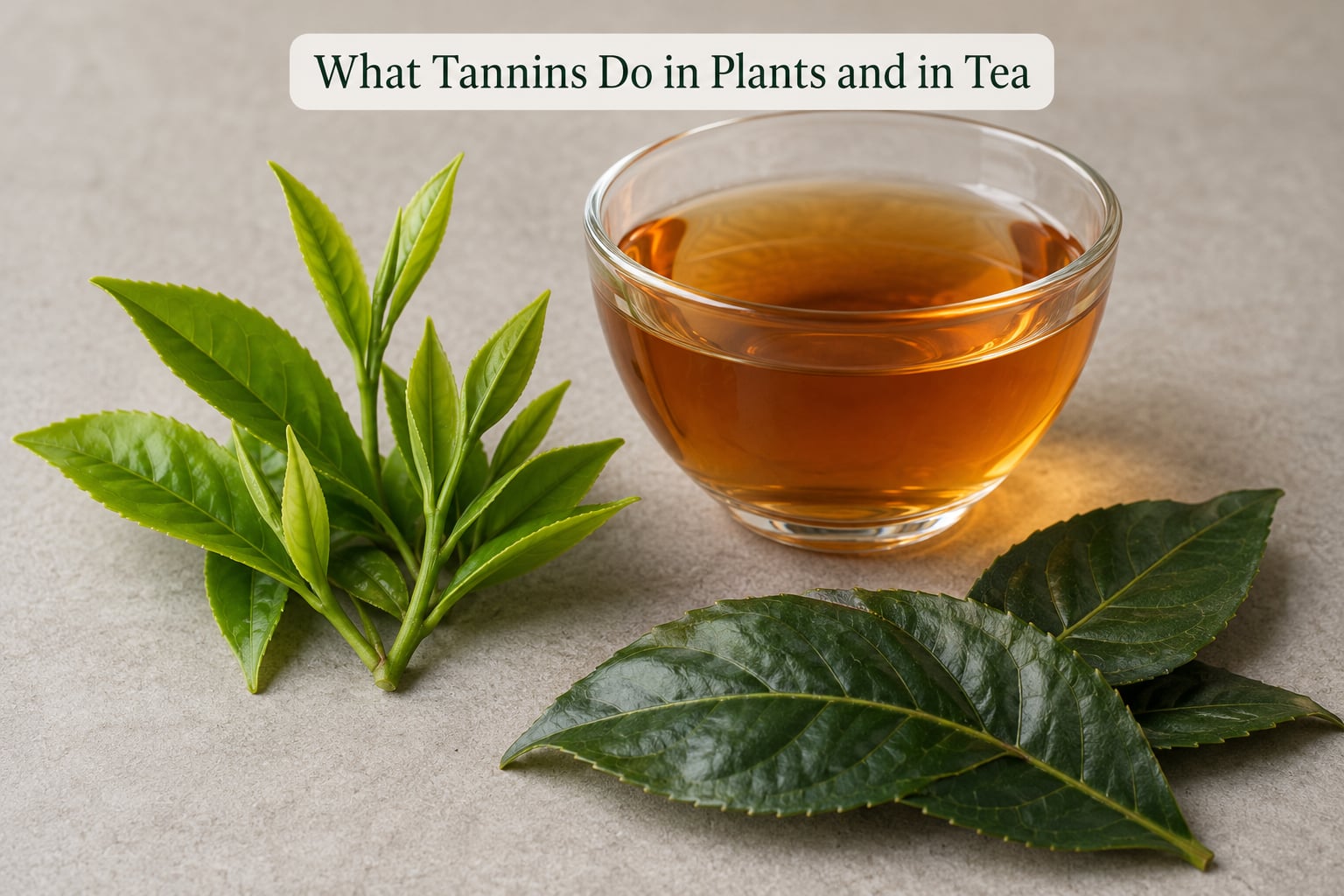
In the plant, tannins are a defense and a regulatory system. They make leaves, bark and unripe fruit unappealing and harder to digest for herbivores, they absorb ultraviolet radiation, they bind or chelate metals, and they limit oxidative damage. In the cup, the same molecules are harmless flavor compounds whose effects come from protein binding in saliva: the dry, puckering feeling, some bitterness, and much of the color of brewed tea.
So the short answer to what tannins do in plants and in tea is that they are defensive in the living plant and expressive in the cup. Nothing about the molecule changes. What changes is the protein it meets, and how much of it dissolves into the water.
| Role in the living plant | Role in the tea cup |
|---|---|
| Deter herbivores by binding digestive proteins and enzymes | Bind salivary proteins and create astringency |
| Reduce the nutritional value of leaves for insects | Add body and a drying finish to the liquor |
| Screen ultraviolet radiation on exposed tissue | Contribute to color once oxidized into theaflavins and thearubigins |
| Bind or chelate iron and other metals | Bind non-heme iron in the gut when consumed with meals |
| Buffer oxidation and store compounds in the vacuole | Sit beside caffeine and give it company, but act quite differently |
How Tannins Protect Plants
A plant cannot move away, so it makes itself less worth eating. Tannins are one of the oldest and most widespread answers to that problem.
Herbivore deterrence. Tannins bind proteins, including digestive enzymes such as trypsin, so an animal that eats tannin-rich tissue extracts fewer nutrients and grows more slowly. Tannin levels are often highest in young leaves, bark, seeds and unripe fruit, which are the parts most worth defending.
Insect defense. Insects that feed on tannin-rich plants tend to be slower-growing and more exposed to pathogens, because the same proteins they need are being tied up. This is a drag on pest populations rather than a chemical kill, and it is one reason tannin-rich plants often suffer less insect damage overall.
Antimicrobial activity. Tannins can inhibit the growth of some bacteria and fungi, which helps protect damaged tissue and, in food, slows spoilage. This is why astringent bark preparations have a long history of use for skin and gut complaints.
Ultraviolet shielding. Tannins absorb ultraviolet radiation and sit in the epidermis, acting as a natural sunscreen for leaves and bark that spend their lives in direct sun.
Metal binding and oxidation buffering. Tannins chelate iron and other metals, absorbing them into the vacuole as a stored or inactive form. That keeps free metal ions from catalyzing oxidative damage inside the cell. Plant biologists have also described dedicated tannin-assembly organelles, often called tannosomes, in species such as alfalfa, though the picture is still being refined.
Soil and allelopathy. Tannins leach from fallen leaves and bark into the soil, binding nitrogen and slowing its release. Some species use this defensively, altering soil chemistry around their own roots to hold off competitors.
Why Tea Leaves Are Especially Rich in Tannins
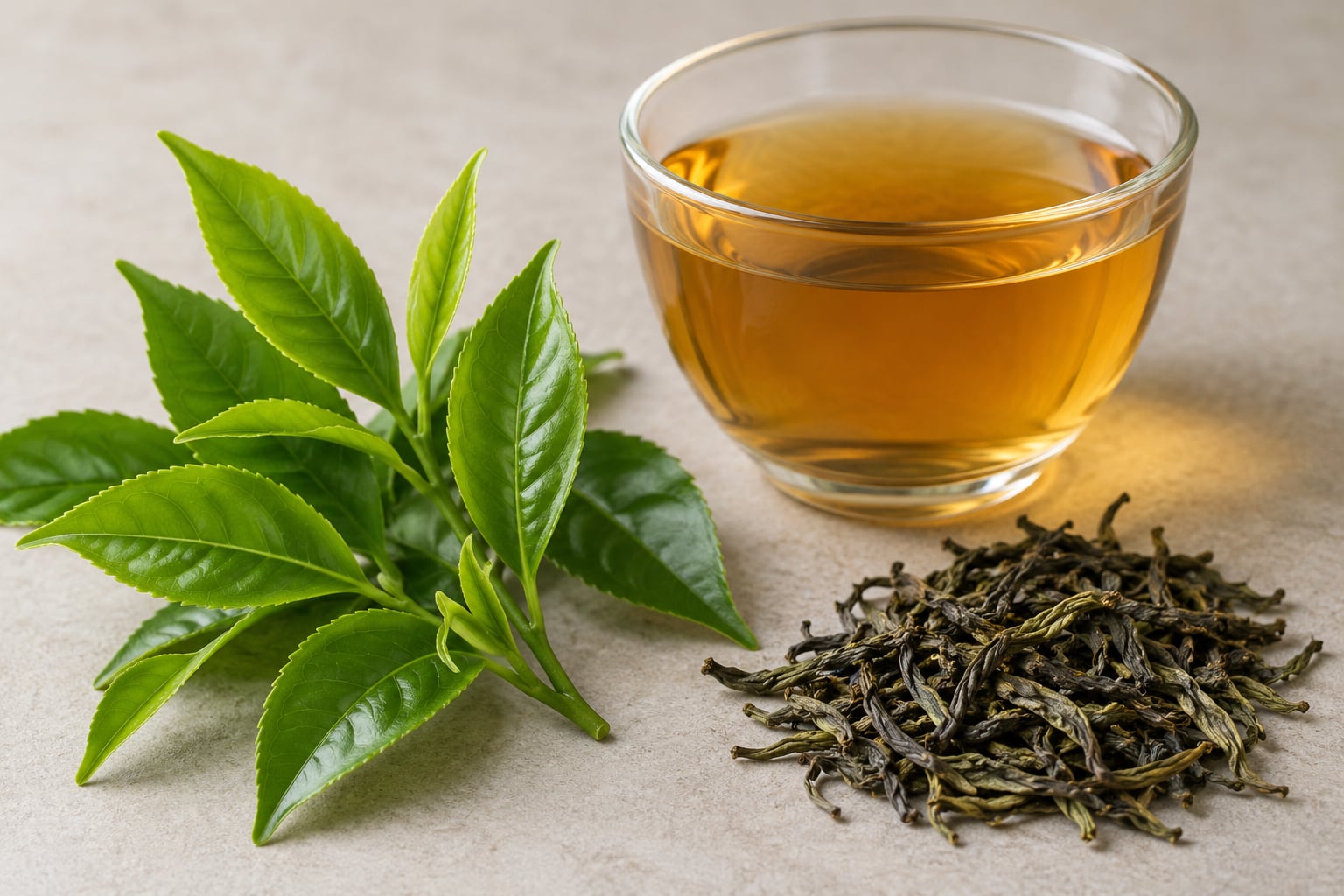
Tea is Camellia sinensis, and young leaves and the fine tip buds are among the most tannin-loaded plant tissues people regularly eat. In the leaf, tea contains flavan-3-ols: catechin, epicatechin, and galloylated versions such as epigallocatechin gallate and epicatechin gallate, where a gallic acid group is attached to the flavan-3-ol core.
Those compounds are the building blocks. What lands in your cup depends on what happens to them after picking, which is why green tea and black tea from the same bush taste nothing alike. The two leaves are also where tannins concentrate, because the tender new growth is the most exposed tissue the plant has.
What tannins do in plants and in tea, in one sentence
They make a plant harder to eat, and in a brewed leaf they make the drink feel dry on the tongue and give it color and body.
How Tannins Create Tea’s Taste and Astringency
Astringency is a tactile sensation, not a taste in the strict sense. Tannins in solution bind to proteins in saliva and to proteins in the moist lining of the mouth, and the complexes precipitate. Mucins that normally lubricate those surfaces get pulled out of the mix too.
What you feel is a roughness across the tongue, a dry tightening at the sides of the mouth, and a puckering that makes the cheeks pull in. The classic case is an over-brewed black tea: the flavor is still there, but the surface of the mouth feels sanded.
Bitterness is a different signal, produced by other compounds including caffeine, and the two are easy to confuse. Astringency is drying and tightening, and it tends to arrive after the sip. Bitterness is taste, sharp, and it arrives with it. A tea can be bitter without being astringent, and a mild-tasting tea can still be strongly astringent.
Strength matters too. Astringency grows with concentration, so the same leaf in half the volume tastes more punishing than the same leaf in a full cup. That is why a 1 gram to 30 millilitre gongfu brew can feel severe while a 1 gram to 250 millilitre western brew from the same leaf feels round.
What Happens During Tea Fermentation and Oxidation
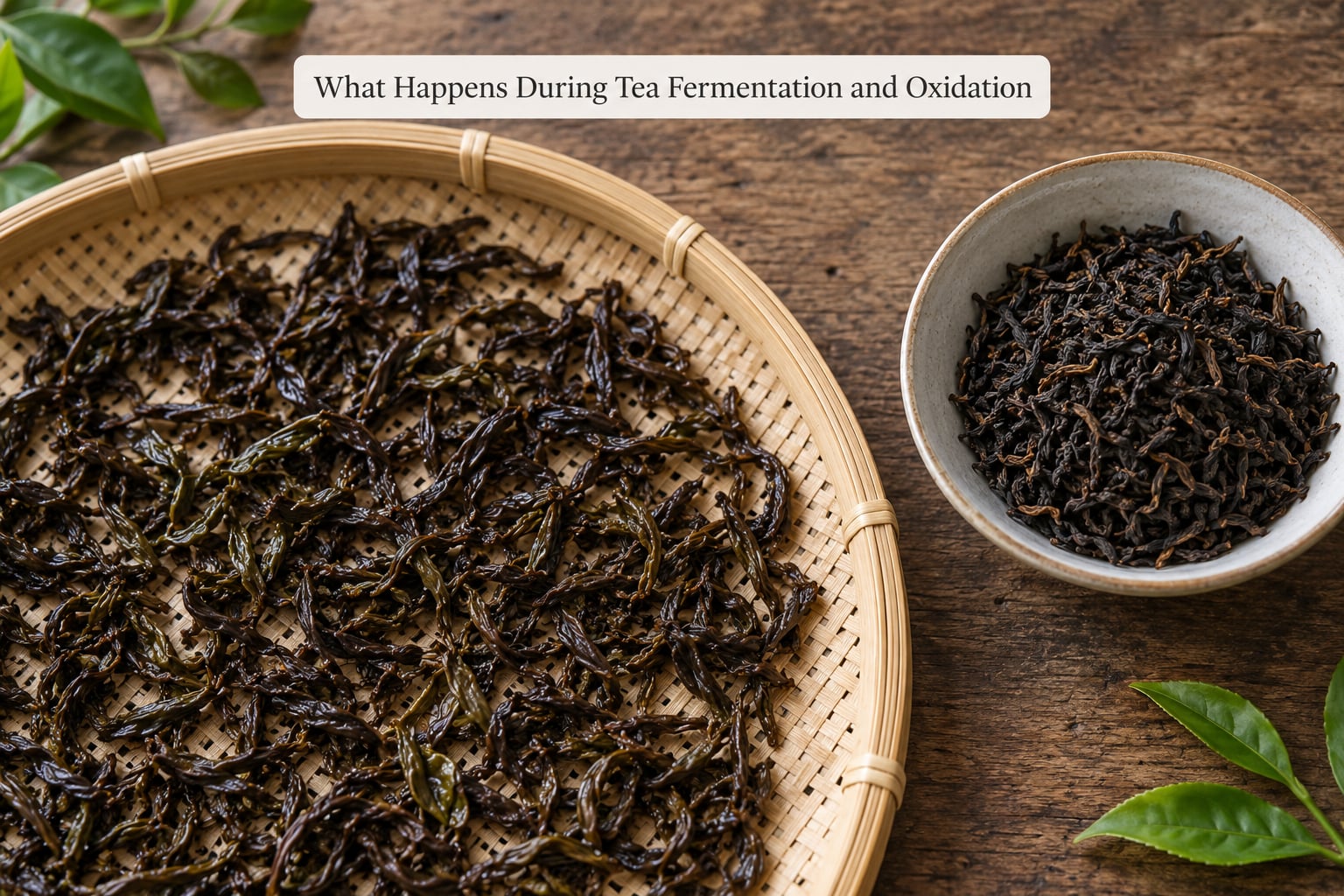
One clarification first: tea is not fermented by microbes in the way that yogurt or wine is. What happens after the leaf is plucked is a controlled oxidation driven by plant enzymes. Tea makers say fermentation out of habit, but the mechanism is enzymatic.
Rolling or bruising the leaf ruptures the cells, so the polyphenol oxidase enzyme meets its substrate, the flavan-3-ols, with oxygen available. The catechins link together into theaflavins, which are bright and brisk, and into thearubigins, the browner, heavier compounds that dominate the body of a black tea.
So the longer a maker allows that oxidation, the more the astringent green precursors are converted. Green tea is heated soon after plucking to halt the enzyme, keeping the catechins largely intact and the cup sharp and vegetal. Oolong is stopped partway, which is why it sits between the two. Black tea goes all the way. White tea, oddly enough, is often lightly bruised and oxidized in shade or sun, giving it a gentler profile than its reputation suggests.
One wrinkle worth knowing: astringency in black tea is not weaker than in green tea simply because oxidation happened. The transformed products still bind proteins. The body and sweetness around them are what make the cup feel rounder.
How Brewing Variables Change Tannin Levels
Every tea has a tipping point where extracting flavor turns into extracting bitterness. Home brewers talk about it constantly, and once you know which lever you are turning, you can find yours.
- Water temperature. Hotter water pulls tannins out faster and in greater quantity. Around 70 to 80 degrees Celsius suits green and white tea, while 90 to 100 suits black and oolong. Dropping 10 degrees noticeably softens a tea that has gone harsh.
- Steep time. Astringency compounds with every extra minute, more steeply than flavor does. If the cup is sharp, cut 30 seconds before you cut leaf.
- Leaf size and grade. Fine whole-leaf grades and powdered matcha have a large surface area per gram, so they give up their tannins faster. Larger broken-leaf black tea extracts more slowly in the first steep.
- Leaf-to-water ratio. Doubling the leaf doubles the concentration of everything, tannins included. Volume dilutes; it does not remove.
- Agitation. Stirring, sloshing and swirling increase the contact area and pull tannins into solution. Gentle pouring keeps more of the leaf back where it started.
- Water chemistry. Very soft water lacks buffering minerals, and pH affects how fast tannins extract. Very hard water dulls flavor. Filtered water gives a much more repeatable cup than kettle water from a hard region.
- Re-steeping. A second infusion is usually milder in astringency than the first even at a longer time, because the readily soluble fraction is already gone. Third and fourth infusions get progressively thinner, and the astringency thins with them.
Cold brewing sits at the other extreme. Cool water and hours of contact extract gently, and drinkers consistently report a smoother, less astringent cup. The tradeoff is slower flavour development and less of the brew’s structure.
What Tannins Do in Tea’s Color and Appearance
Color is where the oxidation story shows up most visibly. In a green tea the liquor is pale yellow-green because the flavan-3-ols are still small, unoxidized molecules. In black tea, theaflavins give the red-amber glow and thearubigins push the color toward deep russet and brown.
Leaf appearance follows the same logic. Dark, twisted black tea leaves have been fully oxidized; pale green and white needle leaves have not. Very dark, matte, fully oxidized leaves also show up in post-fermented teas such as pu-erh, where microbial activity over years changes the profile again. Tannins are not the only pigments at work, but they are central to the story.
What Tannins Do When You Drink Tea
The honest summary is that tannins in tea are a normal part of the diet and not a poison, with one well-documented caveat.
The caveat is iron. Tannins bind non-heme iron, the form found in plant foods and most supplements, and reduce how much of it you absorb. Mainstream nutrition guidance is careful here: the effect matters most for people who already have low iron stores, including menstruating women, frequent blood donors, pregnant people and people with diagnosed iron deficiency. If iron is a concern for you, drinking tea between meals rather than with them is a common practical adjustment, and your doctor or a registered dietitian can confirm what suits your situation.
Tea tannins have also been studied for antioxidant and cardiovascular associations, and large observational studies link higher tea intake with some cardiovascular markers. Those findings are real but observational, which means they cannot by themselves prove cause. No mainstream body recommends tea as a treatment for any condition.
Astringency itself is not harm. It is a signal that your salivary proteins have been bound, and it fades as you sip water or eat something with protein in it. Very concentrated decoctions of tannin-rich bark taken in large amounts over time are a different question, and those deserve professional advice rather than a forum thread.
Tannins in Other Plants and Foods
You meet tannins constantly without thinking about them. Cacao and dark chocolate carry them alongside theobromine, which is part of why cocoa can taste bitter and drying. Coffee contains chlorogenic acids, a related polyphenol family, and coffee drinkers get a rough, drying finish from the same protein binding.
Acorns need leaching with repeated changes of water before they are edible, and that ritual exists because of tannin. Nuts, chickpeas, lentils, kidney beans and peas all carry tannins, which is why some legumes benefit from soaking and why their digestibility improves afterward. Berries such as pomegranate, persimmon and unripe apples are tannin-rich enough to pucker.
Red wine gets its structure from both skin tannins and micro-oxygenation through oak, and the drying grip of a well-aged tannic wine is a textbook demonstration of the same chemistry. Cider, tea, and unripe persimmon behave the same way.
Industrial tannins are worth separating from natural ones. Quebracho and mimosa extracts are used to tan leather, and henna acts as a natural dye and mordant. None of these are the same substance as tea tannins, even where the behaviour looks similar.
What Tannins Do During Food Processing
Cooking changes tannin content in predictable directions, and the results explain a lot of familiar cooking advice.
Boiling and prolonged simmering in water extract tannins, and the water carries them away. That is exactly how acorn leaching works, and why traditional tannin-rich foods are boiled repeatedly. In an open pot, a little liquid evaporates, so the remaining liquid grows more concentrated and more tannic.
Roasting and dry heat do something different. They drive off moisture and break tannin structures down, and Maillard browning compounds then supply the roasted flavor that partly masks what remains. That is a large part of why coffee and roasted nuts taste the way they do.
Milling and fermentation act on tannins too. Grinding increases surface area and releases more, while microbial fermentation in foods like cocoa and pu-erh partially degrades or transforms tannin structures over time, softening them. Storage matters as well, since oxidation and slow reaction with other food components shift both tannin level and the color it produces.
None of this makes tannin-rich food dangerous. It is chemistry you can taste, and cooking is simply a way of steering it.
Common Tannin Myths and Practical Conclusions
Three claims come up constantly, and none of them hold up cleanly.
The first is that tannins are toxic. They are not, at ordinary food and drink intakes. Tannic acid has its own hazards as a concentrated chemical reagent, which is a different thing entirely from the tannins in a cup of tea.
The second is that tea is unhealthy, or that one tea is the unhealthiest. Tea contains caffeine, and caffeine has real limits for some people, especially pregnant people and those with certain heart conditions. That is a caffeine question, not a tannin question, and the two are frequently confused.
The third is that milk cancels tannins. It does not. Milk proteins, especially casein, bind tannins and drop them out of solution, which genuinely reduces astringency. But the tannin is still in the cup, it is just traveling bound to protein, which is also why casein is used as a fining agent in brewing and wine.
What to do with all this depends on what you want. For a gentler cup, lower the temperature, shorten the steep, use more water for the same leaf, and stop stirring. For a fuller body, push the opposite way deliberately. If iron is a personal concern, separate tea from iron-rich meals and ask a professional about your own situation.
Frequently Asked Questions
Are tannins in tea harmful?
No, not at normal drinking levels. Tea tannins are ordinary dietary polyphenols found in cacao, coffee, legumes and countless fruits. The one documented concern is reduced absorption of non-heme iron, which matters mainly for people with low iron stores. If iron is an issue for you, drink tea between meals and ask your doctor or a registered dietitian.
How much tea contains the most tannins?
Black tea generally carries the most tannins by weight, followed by oolong, then green, then white. Matcha sits high too, because it is powdered whole leaf, but you use a much smaller amount of it. Darjeeling and other oxidized leaf teas fall on the darker, more astringent end of that range.
Does milk reduce or neutralize tannins in tea?
It reduces the effect rather than removing anything. Casein and other milk proteins bind tannins and precipitate them out of solution, so the puckering fades. The tannin is still present, just traveling bound to protein. This is the same chemistry that makes casein useful as a fining agent to clear chill haze in homebrew.
Do tannins in tea prevent the body from absorbing iron?
They reduce absorption of non-heme iron, the form in plant foods and supplements, by binding it in the gut. For most people eating a varied diet this is not a problem. It matters more if you have low iron stores, are pregnant, menstruate heavily or donate blood regularly, and you should get individual advice before changing how you drink tea.
Are tannins the same as caffeine?
No, they are different compounds with different effects. Caffeine is an alkaloid that acts on the nervous system and causes the buzz and the lift. Tannins are polyphenols that bind proteins and produce dryness, astringency and some bitterness. Tea contains both, and people routinely blame one for what the other is doing.
Does decaffeinated tea still contain tannins?
Yes. Decaffeination targets caffeine, not polyphenols, so the flavan-3-ols and their oxidized products remain in the leaf. A decaf tea still steeps to an amber color and still turns astringent if you over-brew it, and the body and tannin character can be similar to the caffeinated version.
Conclusion
Tannins do two jobs across their whole life in the plant. They make leaves and bark harder for animals to eat and easier for the plant to survive, and in a brewed leaf they turn into flavor, color and the dry grip at the back of your mouth.
If you want to change how a cup tastes, look at four things first: how the tea was processed, how much leaf you used per milliliter, how long it steeped, and how hot the water was. Those four explain most of the difference between a smooth cup and a punishing one.
On the health side, tannin content is not the concern most wellness posts imply. For most people, tea is a normal part of a healthy diet. If iron is a personal concern, that is worth a conversation with a doctor or registered dietitian rather than a general rule about tea.