An ethnobotanical survey is a structured field study that documents how a defined community names, classifies, uses, manages and values plants. How ethnobotanical surveys are conducted follows a fairly fixed sequence: define the question, secure permission, sample deliberately, interview semi-structurally, document every plant with a voucher specimen, cross-check identities, then analyse and report the findings back to the community. A serious study takes months and often runs across seasons or years, and it starts long before anyone walks into a village.
The method is not improvised in the field. The decisions that make the difference between a credible survey and a rejected manuscript are made at a desk, weeks earlier, and mostly involve other people: the community council, the ethics committee, the national parks authority, the herbarium.
The stages of an ethnobotanical survey at a glance:
- Define one focused, answerable research question.
- Review the published literature and existing collections.
- Obtain ethics committee clearance before fieldwork.
- Secure community, local authority and individual consent.
- Apply for research, collection and export permits.
- Choose the study area and a sampling strategy.
- Recruit a diverse, purposeful set of informants.
- Build a semi-structured interview guide and data sheet.
- Pilot the guide and revise it with local colleagues.
- Run interviews, free listings and guided field walks.
- Collect, press and label voucher specimens with metadata.
- Identify plants against herbarium references and databases.
- Analyse descriptively and with quantitative indices.
- Report transparently and return results to the community.
That list is the skeleton. The rest of this guide explains what each stage actually involves, and where fieldwork most often goes wrong.
Table of Contents
- 1What You Need
- 2Step-by-Step: How Ethnobotanical Surveys Are Conducted
- 31. Define the Research Question and Study Design
- 42. Prepare the Community Research Agreement
- 53. Build a Sampling and Interview Plan
- 64. Record Knowledge in a Consistent Format
- 75. Collect and Identify Plant Specimens Safely
- 86. Cross-Check Identities and Information
- 97. Analyze, Report, and Share Results Responsibly
- 10Common Mistakes
- 11Frequently Asked Questions
- 12What is the first step in conducting an ethnobotanical survey?
- 13How many people should an ethnobotanical survey interview?
- 14Do ethnobotanical surveys require plant specimens?
- 15How are local plant names confirmed botanically?
- 16Can ethnobotanical survey results prove that a plant is safe or effective?
- 17Conclusion
What You Need
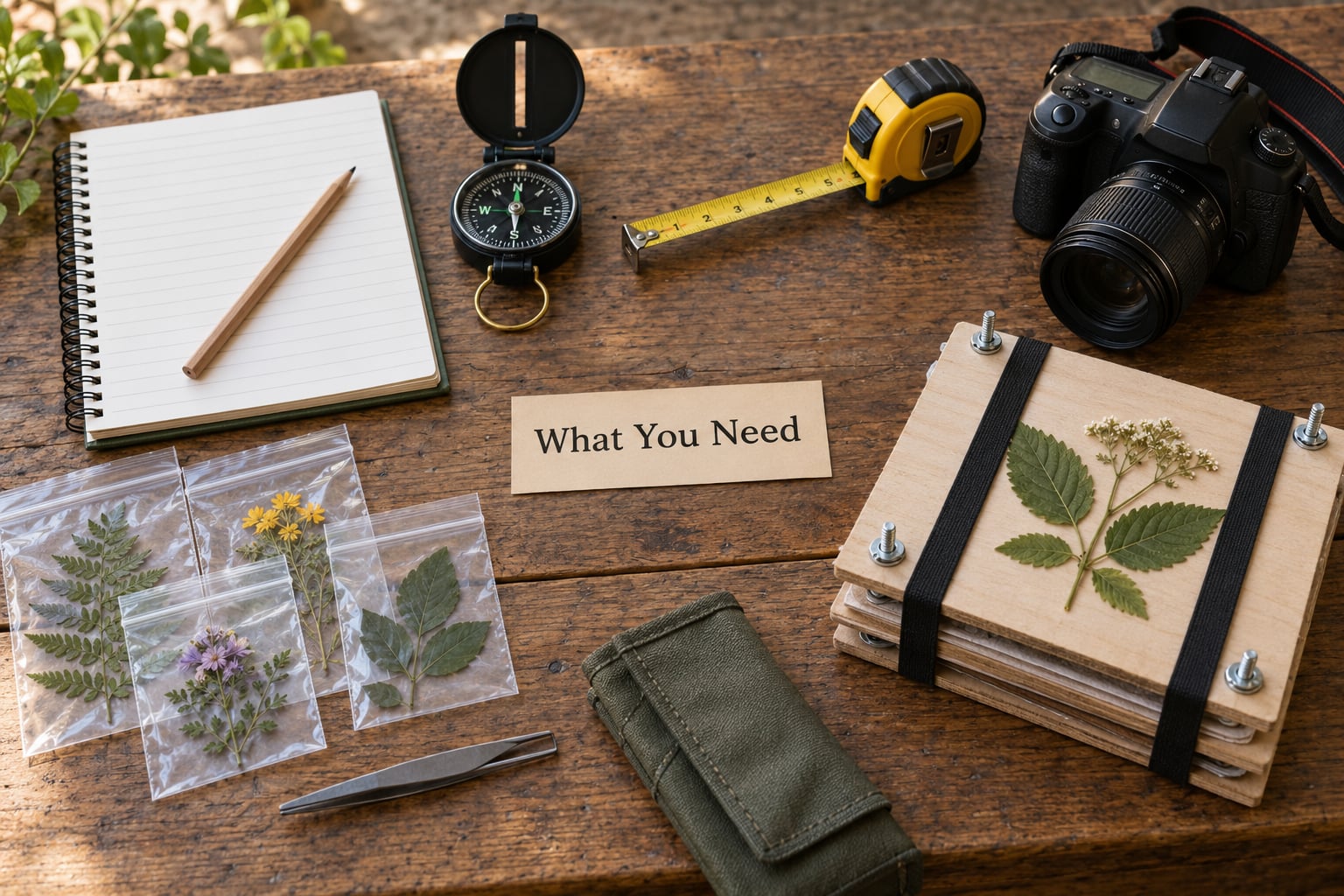
You cannot start collecting until several separate things are in place: a written design, permission, permits, tools, specimen supplies, ethical documents and a safety plan. Beginners usually prepare the kit and forget the rest, then lose a season to a permit dispute.
A written research design. One page is enough at the start. It states the question, the population, the methods, the sample size, the analysis and the timeline. Ethics committees and funders will both ask for it, and it is the document that stops the study drifting once fieldwork starts.
Community permissions, on two levels. The first is collective: the chief, ward council, elders’ council or village assembly who agree that research may happen in their area. The second is individual: each knowledge holder’s informed consent for a specific interview. One without the other is not enough, and the collective agreement does not stand in for the person’s consent.
Legal permits. Most African countries require a research permit, a national plant collection permit, and often a separate export or biosafety permit before any specimen can leave the country. Protected-area managers add their own conditions. Start these applications months ahead; they are the single most common reason a planned field season slips.
Field and recording tools. A field notebook that survives wet weather, a camera with a scale bar, a GPS handset or phone, a hand lens, pruning scissors, a compass, measuring tape, label tape, a pencil, spare batteries and a power bank. If you are recording digitally, a tablet loaded with an ODK or KoboToolbox form replaces the paper notebook but never replaces the notebook for scratch observations.
Specimen supplies. A plant press with card and blotting paper, waterproof labels, collection bags for non-pressed material, and a way to dry or preserve samples before they spoil. Working in humid conditions, a press that cannot be dried in the field is a press that fails on day four.
Ethical documents. Ethics committee approval, a consent form in plain local language, a recorder with a translated withdrawal-of-consent script, and a written plan for handling sacred, restricted or confidential knowledge. The International Society of Ethnobiology Code of Ethics and the CARE Principles for Indigenous Data Governance both expect you to have these in place before the first interview.
People and safety. A local research assistant who is trusted in the community, a driver, a first-aid kit, a charged phone with local numbers, and a written check-in schedule. Add health and travel insurance that actually covers the region. Fieldwork in remote areas also needs medical clearance in some countries.
Step-by-Step: How Ethnobotanical Surveys Are Conducted
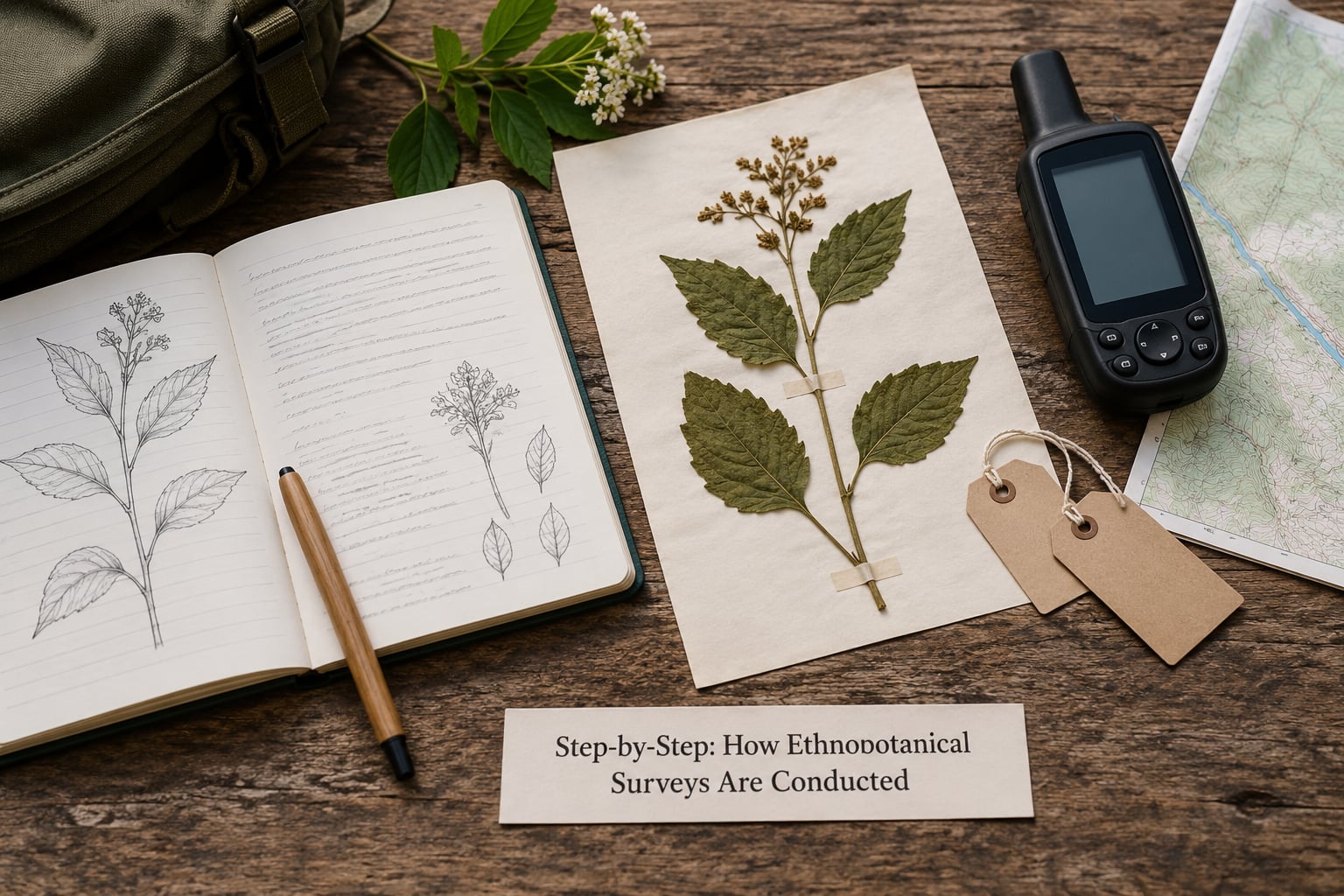
The workflow below runs in the order most experienced ethnobotanists actually work in. Skipping ahead usually means collecting plants you are not permitted to collect, or interviewing people you have not properly asked.
1. Define the Research Question and Study Design
Start by turning a broad interest into one question you can answer within a season. “African medicinal plants” is too wide. “Which plants do traditional birth attendants in one district use for postnatal recovery, and what do they agree on?” is answerable, bounded and honest about its limits.
Write the method before the first conversation. Decide whether the study is quantitative (how many informants cite a species), qualitative (how knowledge is organised, transmitted and contested), or mixed. Specify which methods you will use, with what sample, and how you will analyse it. If the answer is a semi-structured interview guide with 30 informants and a species-use table, say so in the design document.
Then read what already exists. Regional floras, herbarium databases, previous survey papers and published ethnomedicinal studies tell you which species are likely, which areas have been over-studied, and which questions remain open. Skipping this step means you may spend four months documenting plants somebody published in the 1990s. Plants of the World Online, World Flora Online and GBIF are the standard starting points for the botanical side; Martin (1995), Alexiades (1996) and Weckerle et al. (2018) are the standard methodological texts.
2. Prepare the Community Research Agreement
Permission has three layers and you need all three: access, ownership and benefit. Layer one is collective permission from local authorities. Layer two is individual consent from each knowledge holder. Layer three is an agreement about what happens to the knowledge afterwards.
Approach through existing structures. A traditional healers’ association, a village head, a ward office or a district health office will tell you who holds authority faster than any other route, and going around them damages trust permanently. Expect the conversation to include practical terms: who hosts you, where you can walk, whether you may photograph, whether specimens leave the country, whether local names are published, and what the community receives at the end.
On consent, be flexible in form and strict in substance. Written consent is the default where literacy and law allow it. Oral consent, recorded on an audio device with a witness, is a documented and accepted practice where forms are inappropriate or the topic is sensitive; a published field ethnobotany study reported using exactly this approach during group discussions. Whatever the form, the person must be able to refuse, to skip any question, and to withdraw afterwards.
Some knowledge should never be recorded or published: sacred and restricted species, initiation and ritual knowledge, and anything a participant asks you to withhold. Agree in advance how you will mark these records, and hold a separate register of what you promised not to publish. Where the country is party to the Convention on Biological Diversity, access and benefit-sharing obligations under the Nagoya Protocol may apply to the whole project, not just the commercial stage, so check before collecting.
3. Build a Sampling and Interview Plan
Sample purposefully. You are trying to cover the kinds of knowledge holders, not to hit a random number. In practice that means traditional healers, herbalists, elder women with household knowledge, farmers, pastoralists, food vendors, market traders, and people who use plants for self-care — with a realistic spread of age, gender and geography in the study area.
Inside that frame, snowball sampling is common and legitimate: each informant can refer you to others. It is efficient and it skews toward one network, so pair it with a second route into the sample, such as going through the market or the clinic, or asking a different first participant.
On numbers, plan for depth rather than statistical power. Twenty-five to thirty informants is a realistic target for a focused ethnomedicinal survey of a single district, and small samples are the norm in published work. What matters is coverage and the honesty of the stated limits: a survey of one village does not represent a country, and your methods section must not imply that it does.
Decide when to stop with something better than a fixed deadline. Track new species per additional informant and plot a cumulative species curve. When the curve flattens and new interviews are returning mostly familiar species, you have reached saturation. Some studies run until no new plant use appears across ten consecutive interviews; the important part is that you measured it rather than guessed.
Build the interview guide as semi-structured: a short list of open prompts you can follow in different orders depending on the person, plus a checklist that must be covered. Pilot it with two or three people from the community, then revise the wording with a local assistant who can tell you which questions nobody will understand.
4. Record Knowledge in a Consistent Format
Consistency is what makes the dataset analysable later. Every plant use report needs the same fields, recorded the same way, by every interviewer. This is the sheet most published surveys are built from:
| Field | What to record |
|---|---|
| Informant code | Anonymous identifier, participant category, community, date |
| Local name | Exact local name and language; every name the person gives, with spelling and phonetic notes |
| Botanical identity | Accepted name, authority, family, voucher number; or marked as unresolved |
| Habitat and growth form | Where it grows, and tree, shrub, herb, climber or geophyte |
| Part used | Root, stem bark, leaf, flower, fruit, seed, whole plant, gum or resin |
| Mode of preparation | Recorded in the informant’s own words; recorded for documentation, not for reproduction as instructions |
| Route of administration | Oral, topical, inhaled, inserted or other |
| Use | Condition or ailment treated, and whether it is a remedy, preventive, food, ritual or material use |
| Cautions and restrictions | Prohibitions, pregnancy warnings, seasonal limits, who must not use it |
| Confidence | Direct report, second-hand, or recalled by a family member |
Mark clearly what the informant said versus what you observed. A guided field walk tells you where a plant grows and whether it is abundant; it does not tell you whether the informant actually uses it. A second-hand report on a childhood remedy is weaker evidence than a first-hand one, and your data sheet should say so.
Prepare descriptions of common plants before interviews and show them during the session. A recent methods commentary reported that letting participants point at a photograph or a preserved specimen instead of naming a plant from memory measurably improved identification accuracy. It also reduces the confusion that comes from one local name covering several species, or several names covering one species.
5. Collect and Identify Plant Specimens Safely
A voucher specimen is a dried, pressed, labelled plant with reproductive material, deposited in a recognised herbarium so that anyone can later check what you actually found. Without one, a reported species is a claim; with one, it is a verifiable record. This is why voucher specimens matter more than photographs, which serve as a supplement rather than a substitute.
Collect only what the permits and the community agreement allow, and only what the local authority permits for the species in question. Avoid rare, protected or listed species unless the permit specifically covers them. Do not instruct readers to harvest plants they cannot identify; for this article’s purposes, specimen collection is a professional activity carried out by trained and permitted researchers, and any medicinal claim needs a clinician or pharmacist rather than a field guide.
For each specimen: assign a unique collection number, record the exact locality with GPS coordinates, note the habitat, the collector’s name and the date, then press it with the plant arranged so that leaves, flowers and fruit are all visible. Label in permanent ink and in a format the herbarium accepts. Many herbaria will reject material without flowers or fruit, so plan several visits if the species flowers outside your window.
Photograph everything at the time of collection, including leaves, bark, flowers, fruit and the whole habit, with a scale reference and a shot of the label. Photographs help you settle identifications later and they matter enormously when material cannot be pressed.
6. Cross-Check Identities and Information
Verify every identification against more than one source. Send material to a trained taxonomist, compare it with the descriptions and herbarium sheets in the regional flora, and check the accepted name against Plants of the World Online or World Flora Online. Record the determiner’s name and date on the sheet. GBIF occurrence records are useful for confirming distribution, not for confirming identity.
When identification stays uncertain, say so in the dataset and the paper. Use a clearly labelled provisional name, or an open morphological description such as “a small tree with opposite leaves, undetermined”. Studies that quietly assert a species from a poor-quality photograph are a recognised failure mode, and reviewers increasingly check the vouchers.
Cross-check the use data the same way. Where one informant’s preparation detail conflicts with another’s, record both and note the disagreement rather than picking the tidier version. Where nobody in a community uses a plant, and it turns up in the literature instead, that difference is itself a finding worth reporting.
Where physical collection is genuinely impossible, a photographic voucher plus a leaf sample for DNA barcoding is a documented fallback. Barcoding can settle a species to family or genus reliably and to species level with a reference library; it cannot replace a herbarium sheet, so treat it as a partial record and label it as one.
7. Analyze, Report, and Share Results Responsibly
Start with descriptive statistics: how many species, how many families, which growth forms, which parts used, which habitat. Then add the quantitative indices that let you rank species by how strongly the community endorses them. Each has a formula, and each answers a different question.
| Index | Formula | What it measures |
|---|---|---|
| Use value (UV) | UV = sum of citation scores / total informants in the survey | How important a species is across the sample |
| Relative frequency of citation (RFC) | RFC = cited informants / total informants, as a percentage | Share of the sample that mentioned the species |
| Informant consensus factor (Fic) | Fic = (NU – NUP) / (NU – 1) | Agreement among informants on a use; values above 0.5 indicate consensus |
| Fidelity level (FL) | FL = reported uses by the majority / all reported uses of that species | How uniformly a species is used for one purpose |
| Cultural salience index | Sum of participant scores per species across a free listing | Which plants matter most in local plant knowledge overall |
Interpret indices cautiously. Consensus factor falls when one of the few informants disagrees, and small samples make all of these unstable. Report the sample size next to every value, and treat high numbers as prompts for further work rather than conclusions.
In the discussion, separate what people report from what has been demonstrated. A well-run survey tells you what a community uses a plant for and how consistently. It says nothing about whether the plant works, at what dose, or whether it is safe — those questions belong to laboratory work and clinical trials, and traditional use is evidence about tradition. Report preparation details as documented cultural knowledge rather than repeating them as instructions anyone might act on, and direct readers to a doctor or pharmacist for any personal health question.
Report methods in enough detail that the study could be repeated: the sampling frame, the number and categories of informants, the consent procedure, the interview guide, the identification procedure, the voucher deposition codes, and the analysis. Return the results. A printed summary in the local language, a visit to the council, and a copy of any publication to the participants and the local authority cost very little and decide whether the next researcher gets cooperation or suspicion. Follow the reporting standards in Weckerle et al. (2018) and the Nagoya Protocol and CARE requirements that apply to your project.
Common Mistakes
These seven errors show up repeatedly in survey papers and in the fieldwork behind them. Each one has a straightforward correction.
Collecting before obtaining permission. A plant in your hand with no community agreement behind it is both an ethical failure and a permit offence. Fix: get collective agreement and individual consent before collecting anything.
Treating a local name as a botanical identity. One vernacular name often covers several unrelated species, and the same species carries different names across a few kilometres. Fix: record every local name you hear, then tie each identification to a voucher specimen.
Overgeneralising the findings. A survey of one village gets written up as if it describes a whole continent. Fix: state the study area, the sample and the selection method in the first paragraph of the results, and phrase conclusions as what this community reported.
Publishing preparation instructions as health advice. Documenting a decoction method and telling readers how to make it are different acts with different consequences. Fix: record preparation in the informant’s terms for documentation, and add an explicit safety statement directing readers to a clinician.
Losing specimen metadata. A pressed plant with no locality, date, collector or number is nearly worthless. Fix: number and label everything in the field, the same day, before it is pressed.
Publishing identifiable knowledge without consent. Naming a healer and the restricted use they disclosed can expose them to community pressure or commercial interest. Fix: mark restricted records at the point of collection, keep a separate register, and strip them from the published dataset.
Stopping the interview count at whatever felt enough. Fix: track a cumulative species curve and use saturation to justify where you stopped, then report the justification.
Two smaller habits pay for themselves. Record everything on the day it happens, because recall degrades fast once you are back at base. And write field notes that separate what you saw from what you were told, since the published paper depends on that distinction surviving.
Frequently Asked Questions
What is the first step in conducting an ethnobotanical survey?
Define one focused, answerable research question in writing, then decide the study design, sample and analysis before any fieldwork. Everything downstream depends on it: permits, ethics clearance, recruitment and the interview guide are all justified by that first page. If the design cannot be written clearly, the study is not ready to start.
How many people should an ethnobotanical survey interview?
For a focused ethnomedicinal survey of one district, 25 to 30 knowledgeable participants is a realistic target and matches most published work. What matters more than the number is coverage: traditional healers, herbalists, elder women, farmers, market traders and people who use plants for self-care. Track a cumulative species curve and stop when new interviews stop producing new species.
Do ethnobotanical surveys require plant specimens?
A voucher specimen is what makes a reported species verifiable, so a rigorous survey should deposit one in a recognised herbarium whenever permits allow. Photographs of leaves, bark, flowers and fruit supplement this but do not replace it. Where collection is genuinely impossible, a photographic voucher plus a leaf sample for DNA barcoding is a documented fallback and should be labelled as partial.
How are local plant names confirmed botanically?
Record every local name the informant gives, then tie each name to a pressed voucher specimen and identify it through a trained taxonomist, the regional flora, and Plants of the World Online or World Flora Online. Vernacular names overlap across species and differ between communities, so the name is never the identification. Where the ID stays uncertain, report it as undetermined rather than guessing.
Can ethnobotanical survey results prove that a plant is safe or effective?
No. A survey documents what a community uses a plant for and how consistently people report it. That is evidence about traditional knowledge, not about pharmacology. Questions of safety, dose and effectiveness need laboratory study and clinical trials under medical supervision. This information is general and educational; talk to a doctor or pharmacist before using any plant medicinally.
Conclusion
A defensible ethnobotanical survey is mostly paperwork done early and carefully. The fieldwork itself is the easy part once the question is sharp, the community has agreed, the permits are issued and the data sheet is fixed. Skip any one of those and the plants you press will not be publishable.
Your first action is small: write one local research question on a single page, take it to the village council and the ethics committee, and build a standard field record that every interviewer will use. Everything after that is repetition, verification and returning the results to the people who gave you the knowledge in the first place.