
Clinical trials move through a fixed sequence of stages, each answering one question: Phase 0 asks whether a candidate behaves as expected in people, Phase 1 whether it is safe and at what dose, Phase 2 whether it works, Phase 3 whether it beats standard treatment, and Phase 4 what years of real-world use reveal. Understanding how clinical trials phases work matters whether you are reading a recruitment listing or judging a remedy claim.
Updated for 2026. This is general information about how medical research is organised, not medical advice. For decisions about your own treatment, talk to your doctor or pharmacist.
Table of Contents
- 1What Are Clinical Trial Phases?
- 2How Clinical Trials Phases Work From Start to Finish
- 3What Happens in Phase 1?
- 4What Happens in Phase 2?
- 5What Happens in Phase 3?
- 6Why Are Phase 4 Trials Important?
- 7How Do the Trial Phases Differ?
- 8Why Does a Drug Skip or Fail a Trial Phase?
- 9How Can Readers Judge Clinical Trial Evidence?
- 10Frequently Asked Questions
- 11What are the four phases of clinical trials?
- 12Why do clinical trials need multiple phases?
- 13How many people are usually studied in each phase?
- 14Does a treatment need to pass every phase before doctors can prescribe it?
- 15Can a traditional or herbal medicine go through the same clinical trial phases?
- 16What happens if a treatment fails during a clinical trial?
- 17What Should Readers Remember About Trial Phases?
What Are Clinical Trial Phases?
A clinical trial is a research study that tests an intervention — a drug, a biologic, a device, a surgical technique, a behavioural programme or a botanical extract — in people, following a written protocol approved by regulators and an ethics committee.
Phases exist because laboratory results are not evidence of working medicine. A compound can look promising in cells or animals and then do nothing in people, or work well and cause harm at the dose that produces the effect. Each phase strips away one layer of doubt before anyone commits to the larger and more expensive next step.
So the phase number tells you one useful thing: how far the evidence has been tested, and what question is still open. A higher number is not automatically better or worse for the person taking part. Phase 4 medicines are the most studied of all, while Phase 0 participants rarely benefit personally at all.
How Clinical Trials Phases Work From Start to Finish
The full pathway runs in this order, and each transition is a gate rather than a formality.
- Preclinical research. Laboratory work and animal studies test how a candidate works, whether it can be manufactured consistently, and whether it shows any signal worth pursuing.
- Regulatory authorisation to test in people. The sponsor files an application (called an IND in the US) with laboratory results, manufacturing information, the proposed trial protocol and the qualifications of the research team.
- Phase 0. Optional exploratory studies that test how a candidate behaves in people before larger trials begin.
- Phase 1. Small, closely monitored groups establish safety, tolerability, pharmacokinetics and a workable dose range.
- Phase 2. Larger groups test whether the intervention produces a measurable effect on the disease.
- Phase 3. Large randomised confirmatory trials compare the intervention against the current standard of care.
- Approval review. The full data package goes to the regulator (an NDA in the US). Reviewers examine effectiveness, safety, manufacturing and labelling.
- Phase 4. Monitoring continues after approval, across far larger and more varied populations than any trial could enrol.
Between every one of those steps sits an institutional review board, which checks that the trial is fair, that risks are proportionate to potential benefit, and that participants consent freely. Anyone can withdraw at any point without losing their usual care.
What Happens in Phase 1?
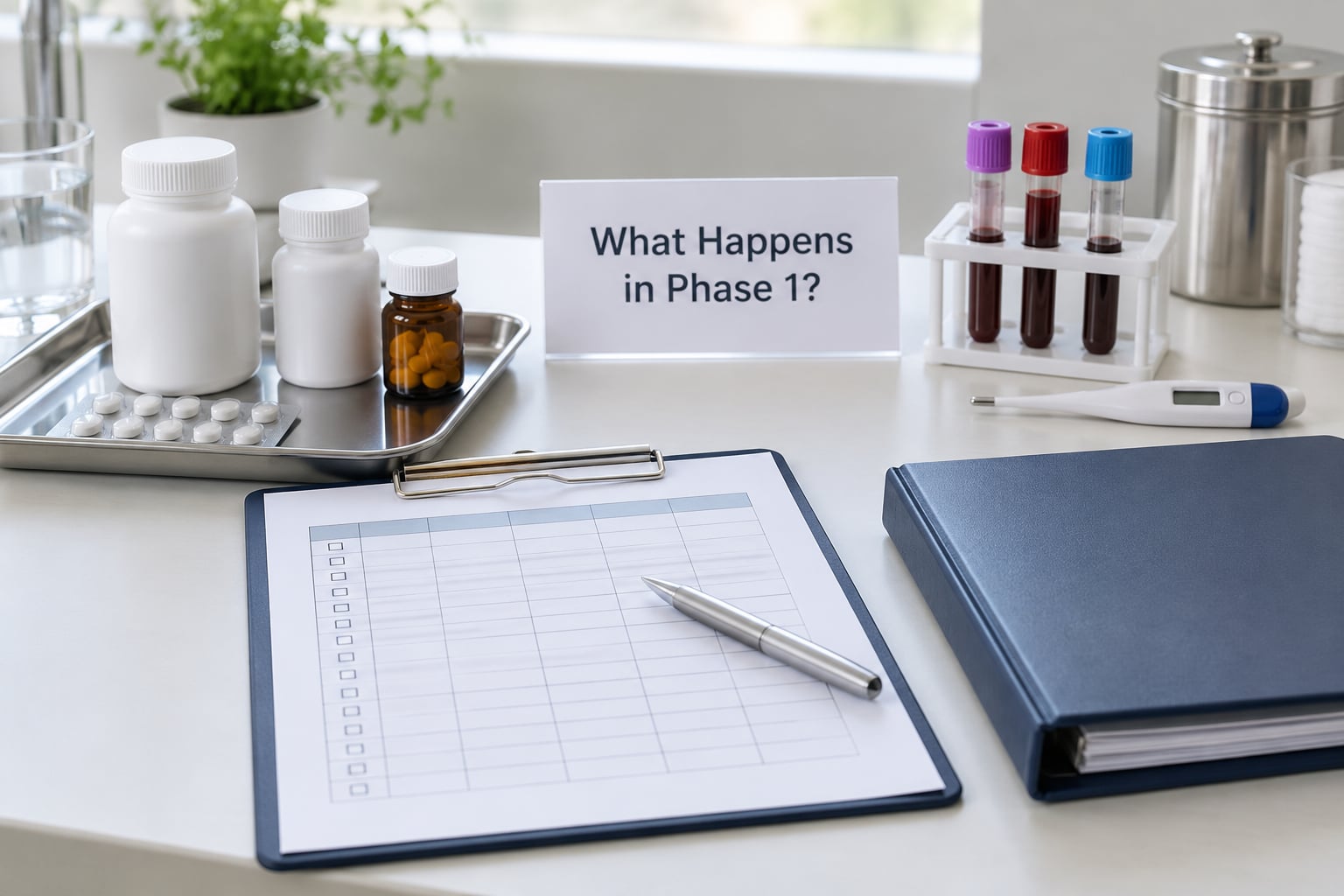
Phase 1 tests safety and dose, usually in roughly 10 to 50 participants, and it is the phase most often misunderstood.
Participants are frequently healthy volunteers for ordinary medicines. For serious conditions with few treatment options, patients with advanced disease may be enrolled instead, since the balance of risk to potential benefit differs. Phase 1 is monitored intensively: frequent visits, repeated blood draws, vital sign checks and sometimes continuous observation during dosing.
Dose escalation is the defining feature. A first small group receives a low single dose, and if nothing concerning appears, the next cohort receives a slightly higher dose. Researchers measure how fast the body absorbs the candidate, how it is distributed and cleared, and at what point side effects become unacceptable — the maximum tolerated dose. Blood and other samples are analysed for how the drug changes markers of disease, which is pharmacodynamics.
Here is the limitation that matters: a study this small cannot detect a harm that affects one person in ten thousand. A single unexpected event in twenty participants may or may not be caused by the candidate. Phase 1 produces a plausible dose and a first look at tolerability, not proof of benefit.
Sub-phases use shorthand here: 1a is typically a single ascending dose study in a small group, and 1b covers multiple-dose cohorts or expansion groups enrolled once a workable dose is known.
What Happens in Phase 2?
Phase 2 asks whether the candidate works, in roughly 25 to 100 or more participants who all have the condition being treated.
Unlike Phase 1, these studies usually define a primary endpoint in advance — a specific measure that counts as success, such as the proportion of tumours responding, a change in symptom score, a fall in blood pressure or time without disease progression. Fixing that endpoint beforehand is what stops researchers from declaring a win after the fact by picking whichever measurement happened to look good.
Many Phase 2 studies include a comparison group, sometimes an existing standard treatment and sometimes a placebo when withholding active care would be ethical. Treatment typically runs for months rather than weeks, because some effects need time to appear.
A Phase 2 result is usually described as a signal rather than proof. A moderate improvement in a hundred participants can look convincing and still shrink or vanish in a larger, better-controlled trial, where a modest real benefit competes against normal variation between people.
Again, the shorthand: 2a is dose-finding, narrowing which dose carries forward, and 2b confirms effect at the chosen dose. This is also where many candidates stop. Promising early-stage work that showed a safety signal and a hint of activity still fails to produce a clear effect at this stage.
What Happens in Phase 3?

Phase 3 tests whether the candidate is better than what people already receive, in hundreds to thousands of participants, usually across multiple countries and hospitals.
These are the confirmatory trials. Participants are randomly assigned to the new treatment or the comparison group, and where feasible neither the participant nor the treating team knows which arm they are in. Randomisation balances known and unknown differences between people before any treatment happens, so a difference in outcomes is harder to explain away. Blinding stops expectations from influencing reporting or care.
The large numbers have a specific reason. A real but modest benefit — a few extra months without progression, a small drop in hospital admissions — is invisible in a small study. Detect it and rule out chance, and a study needs enough participants, followed long enough, to see that gap clearly. Statistical power, not enthusiasm, sets the sample size.
Phase 3 also gathers the safety profile at scale and over longer treatment periods, checks whether subgroups respond differently, and produces the manufacturing and quality data needed for approval review. Most candidates that start Phase 3 do not make it through, and the reasons are usually effectiveness that falls short in a large population, side effects that only emerge with wide exposure, or a benefit too small to justify the risk or cost.
Why Are Phase 4 Trials Important?
Phase 4 starts after approval and studies the medicine in ordinary practice, across populations far larger and more varied than any trial: different ages, other illnesses, other medicines taken alongside, pregnancy, long-term use.
Two things change here. Rare harms become visible, because a trial of 3,000 people cannot reveal a complication appearing in one person per 100,000, while a registry of several hundred thousand patients can. And real-world effectiveness can diverge from trial effectiveness, because trial participants are often more closely monitored and more selected than everyday patients.
Phase 4 work also covers research the approval studies did not: use in new diseases, new combinations, different formulations, long-term quality of life and cost-effectiveness. Regulators can act on what it finds, from changing the label to restricting use or, rarely, withdrawing a product.
Understanding that Phase 4 exists is a useful corrective. Medicines are not finished products when approved; their evidence keeps growing afterwards, in both directions.
How Do the Trial Phases Differ?
| Phase | The question it answers | Typical participants | Randomised? | Placebo? | Typical length |
|---|---|---|---|---|---|
| Phase 0 | Does it behave as expected in people? | About 10 to 50 | Sometimes | Rarely | Several months |
| Phase 1 | Is it safe, and at what dose? | About 10 to 50 | Rarely | No | Several months to a year |
| Phase 2 | Does it work? | About 25 to 100+ | Sometimes | Sometimes | Several months to two years |
| Phase 3 | Is it better than standard care? | Several hundred to thousands | Yes, usually | When ethical | Two to five years |
| Phase 4 | What happens in wide, long-term use? | Thousands to millions, observational | Sometimes | Rarely | Years to decades |
These are patterns, not rules. Rare-disease studies run at small scale out of necessity, some Phase 2 studies use placebos, and some Phase 3 trials are single-arm because no ethical comparison is possible. The right question when reading any listing is what that specific study was designed to find out, not which phase number it carries.
The clearest single difference between Phase 2 and Phase 3 is scale and comparison. Phase 2 looks for a signal of effect in a moderate group and is allowed to be exploratory. Phase 3 is designed in advance to prove or disprove a difference against standard care in a large randomised population, and it is the evidence regulators rely on most when weighing benefit against risk.
Why Does a Drug Skip or Fail a Trial Phase?
Candidates are stopped, paused or sent back for redesign for a handful of recurring reasons.
- Safety signals. A serious adverse event pattern, an unexpected toxicity in a specific group, or a death attributed to the candidate can trigger a clinical hold.
- Not enough effect. A candidate may work far less well in people than in the laboratory, or not at all.
- Study design failure. If the effect is smaller than expected, an underpowered trial can simply be unable to detect it. That is a design problem, not proof the candidate is useless.
- Manufacturing or quality problems. A candidate that cannot be produced consistently, at the required strength and purity, cannot move forward regardless of its results.
- Ethical problems. If continuing would expose participants to disproportionate risk, or if the comparison cannot be offered fairly, the trial stops.
- Commercial or strategic withdrawal. Sponsors abandon candidates when projected demand no longer justifies the cost, which happens to perfectly good science.
Skipping or merging phases happens too. Some candidates already have extensive human safety data, such as a repurposed medicine, so they may begin at Phase 2. Modern designs also combine phases to move faster, which is why listings sometimes read Phase 1/2 or Phase 2/3.
How Can Readers Judge Clinical Trial Evidence?
When you see a claim that something works, these are the questions that separate a well-tested finding from a hopeful one.
- Was there a comparison group? Improvement over time alone proves little. People often improve because of natural recovery, other treatment, or changes in their routine.
- Was assignment randomised, and was it blinded? Randomisation reduces selection bias; blinding reduces the influence of expectations.
- How many people were included? A trial of eight participants cannot support a general claim, however well run.
- Was the main outcome fixed in advance, and did it match what people care about? A laboratory marker can improve while patients feel no different. Quality of life and function matter.
- Were side effects reported as carefully as benefits? Only one of these answers tells you whether the treatment is a good choice.
- Who funded it? Industry sponsorship is common and not disqualifying, but it is a reason to look harder at who analysed the data and whether an independent group ran it.
- Do the conclusions match the evidence? Watch for headlines claiming a treatment works when the study measured something narrower.
Readers arriving from traditional-medicine research should apply the same filter with extra care. Plant products vary between batches in concentration of active compounds, which makes standardising a dose genuinely hard, and a preparation sold on tradition and tradition alone has not cleared any phase. Where botanical products are studied as drugs, they face the same sequence as any other candidate.
Frequently Asked Questions
What are the four phases of clinical trials?
Phase 1 tests safety and finds a tolerable dose in about 10 to 50 participants. Phase 2 tests whether the treatment works, usually in 25 to 100 or more people with the condition. Phase 3 compares it against standard care in hundreds to thousands of randomly assigned participants. Phase 4 monitors it after approval in far larger populations over many years. Some studies also run a Phase 0 exploratory stage first.
Why do clinical trials need multiple phases?
Because uncertainty gets smaller only in steps, and each step is expensive. A trial of a dozen people can reveal a dangerous dose but cannot detect an adverse event affecting one person in ten thousand, nor a modest but real benefit. Phases let researchers answer safety first, then effectiveness, then comparison, each time with the smallest study that can settle the question. A candidate that fails a phase stops there rather than exposing more people to something unproven.
How many people are usually studied in each phase?
Phase 1 typically enrols about 10 to 50 participants, Phase 2 around 25 to 100 or more, and Phase 3 anywhere from several hundred to several thousand. Phase 4 studies involve thousands to millions of people, though usually through observational records rather than a planned trial. Numbers depend on the condition: rare diseases run smaller studies because the populations are small, and some Phase 3 trials need large samples to detect a modest benefit.
Does a treatment need to pass every phase before doctors can prescribe it?
No. Doctors can and regularly do prescribe investigational treatments outside trials through expanded access, which is intended for people with serious conditions and no good alternatives. Patients can also receive an unapproved drug through compassionate use. What the phases control is what a company may advertise or sell commercially. Being prescribed an investigational drug outside a trial usually carries more uncertainty than a licensed one, and it does not mean the phases were skipped.
Can a traditional or herbal medicine go through the same clinical trial phases?
Yes, and it faces the same requirements as any other candidate if a company wants to sell it as a medicine. The hard part is consistency: a plant’s concentration of active compounds changes with soil, season, harvest and processing, so researchers must first find a marker compound and a manufacturing method that give every dose the same potency. Only then do Phase 1 onwards apply. Most herbal products on sale are marketed as supplements instead, which in the US means no FDA premarket review of effectiveness or safety.
What happens if a treatment fails during a clinical trial?
The trial stops or pauses, and the sponsor reports what was seen. Serious safety problems can lead to a clinical hold from the regulator until the sponsor answers safety questions. An ineffective candidate is usually abandoned, and the findings may still be published or summarised. Failure at one phase is common and not proof the underlying idea is worthless. The same candidate can be reformulated, given a different dose, tested in a different group, or applied to another condition.
What Should Readers Remember About Trial Phases?
Each phase answers one question in a fixed order: is it safe, does it work, is it better than what we have, and what happens over years of use. The bigger the group, the stronger the evidence, and the further along a study is the more that is already known.
What to do first, if you are weighing an actual option: ask which phase the trial is in, what question it is designed to answer, what the comparison group receives, and what happens to your care if you withdraw. Then take those answers to your doctor or pharmacist, who can weigh them against your situation.