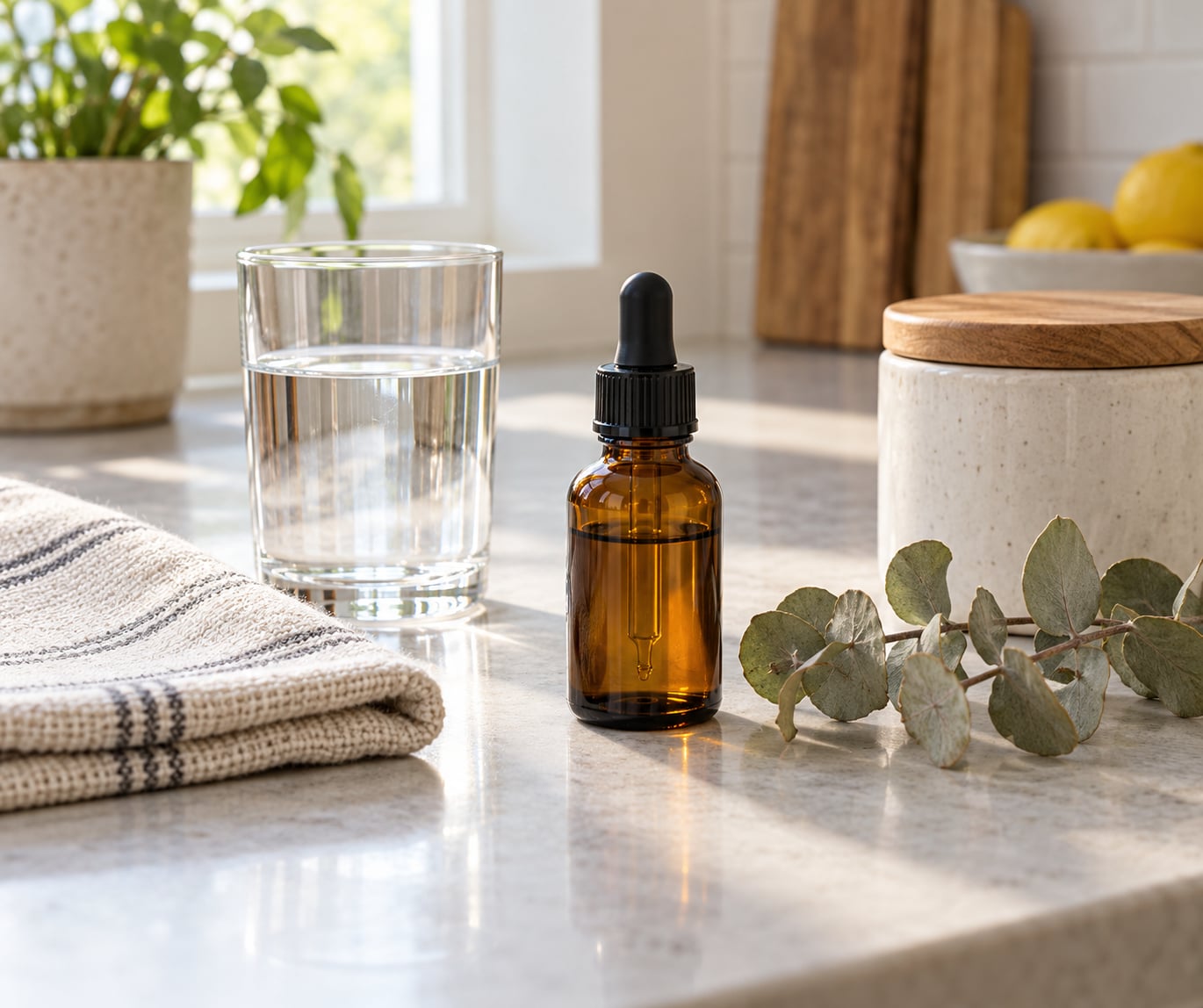
Essential oils should not be swallowed because they are concentrated, fat-soluble plant compounds delivered in one unfiltered dose, and several common ones — camphor, wintergreen, eucalyptus and sage — can trigger seizures in small amounts. The National Capital Poison Center and the Royal Children’s Hospital Melbourne both treat ingestion as a poisoning risk, not a wellness practice.
If someone has just swallowed one, call Poison Control in the United States on 1-800-222-1222, or your local poison information service, before doing anything else. Do not wait for symptoms, and do not induce vomiting.
Most people who search this question are not trying to build a wellness protocol. They put a drop in a drink, a child found a bottle, or a pet licked something off a bath. This guide covers the accidental case first, then the deliberate debate about “internal use” labelling, so you can make sense of both.
A note on what follows: this is general safety information, not medical advice, and it does not replace a doctor, pharmacist or poison specialist who knows the bottle and the person in front of you.
Table of Contents
- 1What happens if an essential oil is swallowed?
- 2Which swallowing risks matter most?
- 3Are any essential oils safe to take by mouth?
- 4How can ingestion happen accidentally?
- 5What should you do if someone swallows an essential oil?
- 6Are there safer ways to use essential oils?
- 7How do you choose and store essential oils safely?
- 8What does the evidence say about oral benefits?
- 9What questions should you ask a health professional?
- 10Frequently Asked Questions
- 11What if my child swallows an essential oil?
- 12Do essential-oil diffusers make the air safe to swallow or breathe?
- 13Can essential oils help with sleep, anxiety, or digestion?
- 14Are essential oils safe during pregnancy or for babies?
- 15What if an essential oil gets on my skin or in my eyes?
- 16When does accidental ingestion trigger an emergency call?
What happens if an essential oil is swallowed?
The short version: it travels down to the stomach largely intact, is absorbed across the gut lining as a concentrated dose, hits the liver in a single pass, and then moves through the bloodstream into the brain. Depending on the oil, it can burn the mouth and gut, depress the central nervous system, cause seizures, destroy liver tissue, or go into the lungs instead of the stomach.
Four things make this different from any other way of using the same bottle.
1. Concentration. Essential oils are produced by steam distillation or expression, which packs the volatile aromatic fraction of a plant into a small volume. The distillation process also strips out the vitamins, minerals, enzymes, fibre and water that a whole plant or a herbal tea contains. What is left is a potent chemical fraction, not a weakened version of a remedy.
2. Fat-solubility. These compounds are lipophilic, so they cross cell membranes and the blood-brain barrier readily. That is a large part of why scent affects mood and alertness so quickly, and it is also why they reach brain tissue at full strength when swallowed.
3. No first-pass dilution. Inhaled aroma molecules are delivered in minute airborne quantities and much of what reaches the gut is handled gradually. Swallowed oil arrives at the gut mucosa as a bolus, and the liver, which is the organ that metabolises these compounds, receives a single concentrated hit rather than a slow trickle. This is a pharmacokinetic reason, separate from any question of whether the oil is “strong”.
4. Dose makes the poison. Paracelsus wrote it in the sixteenth century: the dose makes the poison. Nothing about a plant determines its safety on its own. A quantity that is medicinal in a laboratory assay can be the quantity that causes a seizure in a kitchen, and the same principle runs through alcohol, iron tablets, and acetaminophen.
The argument that essential oils are dangerous therefore does not rest on them being unnatural or mysterious. It rests on concentration, route and quantity — the same three factors a toxicologist would ask about with any substance.
Which swallowing risks matter most?
Toxicity varies enormously between oils, and no online table can tell you what happened in your house. This is the shape of the risk, kept deliberately free of dose numbers, because judging “how much was too much” from a website is how people talk themselves out of making a call they needed to make.
| Risk | What actually happens | Why it matters for families |
|---|---|---|
| Aspiration | Oil enters the airways rather than the stomach, causing chemical lung injury and pneumonia. | The most under-recognised danger. It can happen to a child drinking from a bottle, or an adult trying to “taste” an oil, and it is a medical emergency in its own right. |
| Central nervous system effects | Drowsiness, poor coordination, tremor, agitation, and in serious cases seizures or reduced consciousness. | Camphor, eucalyptus and sage are the headline offenders. Seizures from camphor have been reported within minutes of ingestion. |
| Liver and kidney injury | Concentrated metabolism of some oils produces tissue damage, most often in the liver. | Pennyroyal oil poisoning is the classic cause of severe acute liver injury. People with existing liver or kidney disease have less margin. |
| Mucous membrane and gut irritation | Burning in the mouth, throat, stomach and intestine, with nausea, vomiting and abdominal pain. | Usually the earliest sign, and often the only sign. It is not a reassurance that the rest will stay mild. |
| Unknown dose | Labels often do not state how much of the active compound sits in each millilitre. | This is the one people forget. If the bottle does not quantify it, nobody can calculate what was swallowed — including a poison specialist. |
Poison centres also flag a category of risk that has nothing to do with a single oil: people taking anticoagulants, anticonvulsants or diabetes medication, and anyone pregnant or breastfeeding. These groups need to be assessed rather than reassured.
Are any essential oils safe to take by mouth?
Not as a category. There is no essential oil that is both sold for ordinary home use and approved to be taken by mouth, and the individual risk between oils is so wide that a list of “safe to swallow” oils would be misleading. Some irritate, several suppress the nervous system, a few cause seizures, and at least one causes liver failure at tiny volumes.
It helps to separate four categories that people routinely blur together.
Concentrated essential oils. Steam-distilled or expressed aromatics sold for diffusion, massage or scent. These are the ones on most shelves, and they are not formulated or approved for oral use.
Regulated medicines. A product registered as a medicine went through a review process with a defined dose, defined indication and defined population. That is a different category of product with a different evidentiary standard, and it is not what a bottle from an aromatherapy shop is.
Conventional food flavourings. Substances approved for use in food are used at low levels in large batches of food, where the dose per serving is small and controlled. That is not the same as drinking a concentrated bottle of the neat oil, and manufacturers are not required to sell them undiluted.
Products evaluated for oral use. A small number of oils are manufactured and tested specifically for oral use. That designation describes the product, not the plant, and it does not transfer to another brand’s bottle of the same oil.
On the “internal use” and “drinkable” label: this is a manufacturer designation, not a clinical safety clearance. It means the company says the product is formulated for that route. In the United States, most essential oils are sold as cosmetics or dietary supplements and are not pre-approved by the FDA before reaching shelves, so the burden of working out what is in the bottle falls on the consumer.
There is one honest nuance. A qualified clinical aromatherapy practitioner may, in some settings, prescribe oral essential oils as part of a supervised protocol, particularly where conventional options are exhausted. That is a supervised clinical decision with a practitioner who can identify the oil, calculate the dose and monitor the response. It is not the same activity as a drop in a glass of water, and it is not something to replicate from a blog post.
How can ingestion happen accidentally?
Most calls to poison centres about essential oils are not deliberate ingestion. They look like this.
The drop in the drink. A bottle left near a water glass, a flask, or a communal water jug at work or in a shared home. One drop in a large volume of water is a genuinely small dose, and the honest answer for many of these calls is that watching for symptoms is reasonable. The catch is that “one drop” is meaningless without knowing the bottle, and aspiration is a risk whenever a child drinks from the wrong container.
The child who found the bottle. Children are drawn to the small glass bottles and the bright colour, and small bottles are rarely child-resistant. Their body weight is low and their liver is still developing, so the same volume that would be an inconvenience in an adult is a much larger dose per kilogram in a toddler.
Mouth contact from other uses. Oil transferring from hands to food, a drop on the lip during topical application, or a teaspoon of bath oil licked off. Reported cases include an 18-month-old who ingested a lavender-type extract.
Pets. This is more common than most people expect. Dogs drink bathwater and chew bottles; cats walk across a shelf where an open bottle stood. Cats in particular are unusually vulnerable because they lack one of the liver pathways that clears these compounds, and tea tree and eucalyptus are among the worst offenders for them. Veterinary users on forums describe drooling, poor coordination, vomiting and tremors appearing within minutes to hours of exposure.
Unlabeled storage. An open bottle on the bedside table, a decanted bottle without a label, or a dropper bottle in a coat pocket. When the bottle cannot be identified later, the assessment gets harder for everyone.
Homemade remedies. This is the category that worries poison specialists most, because the dose is unknowable and often large. “Detox” and “cleanse” protocols, undiluted drops taken straight from the bottle, and blends shared in online communities are the routes behind some of the most severe documented cases.
Unlabelled diffusers and humidifiers. Refill liquids sold for vaporisers and water-based diffusers frequently contain essential oils or fragranced compounds. A pet that drinks from the base, or a child who finds the refill, is exposed to a product with no ingestion warnings at all.
What should you do if someone swallows an essential oil?
This section is the reason to read the whole page. If the exposure just happened, work through these in order rather than scrolling for reassurance.
- Call a poison centre now, before symptoms appear. In the United States, Poison Control is 1-800-222-1222, free and confidential, 24 hours a day. Elsewhere, use your local poison information service or emergency number. A single call tells you whether the specific oil and the specific amount need a hospital visit.
- Have the bottle in your hand. The product name, the botanical name if listed, the volume of the bottle, the estimated amount swallowed, when it happened, the person’s age and weight, and any symptoms so far. That information is the whole consultation.
- Do not induce vomiting. Essential oils can aspirate on the way up, which turns a survivable GI exposure into chemical lung injury. Do not use a salt, syrup or ipecacuanha “home remedy”.
- Do not give food or drink to dilute it. Unless a poison specialist tells you to, giving milk, juice or water adds volume to vomit and increases the chance of aspiration. Wiping the mouth with a damp cloth and rinsing gently is fine.
- Call emergency services immediately if the person has a seizure, is hard to wake, is having trouble breathing, is vomiting repeatedly, is drooling heavily with poor coordination, or seems confused. Do not drive them; call an ambulance.
- Watch the clock, not just the person. Seizures from camphor have been documented within minutes of ingestion. Most acute symptoms appear within minutes to a few hours, and some people look well initially. Keep the number visible and do not assume the absence of symptoms at two hours is the end of it.
- Bring the bottle to the emergency department. If you are told to go in, take the product with you. Clinicians reading the actual label beats anyone reading a description of it.
For a child, treat any ingestion as worth a call. For a pet, call a veterinarian or an animal poison service immediately rather than waiting to see whether the animal seems fine.
Are there safer ways to use essential oils?
Most people who want to swallow an oil want a scent effect: calmer, easier sleep, less nausea, a clearer head. All of those are reachable through routes that do not involve the digestive system.
Diffusion, in short bursts. A diffuser or a few drops on a reed diffuser delivers scent in tiny airborne quantities. Ventilate the room, keep the session short, and stop if anyone develops a headache, cough or throat irritation. Diffusing is not the same risk as drinking, but it is not risk-free either, particularly for young children, asthmatics and pets in the room.
Diluted topical application. Pure essential oils should be diluted in a carrier oil before skin contact. A patch test on a small area first is worth the five minutes it costs, and never apply to broken, irritated or recently shaved skin. Not every oil is appropriate for skin use at all, so follow the product’s own instructions.
Steam inhalation. A few drops in a bowl of hot water, with the person leaning over it at a safe distance, gives a strong scent effect without skin or gut contact. Keep children and pets out of the room and guard against scald risk.
Bath use. Essential oils disperse in bathwater, which also means any oil in the bath can be swallowed by a child or a pet. It is the route behind a share of pet poisoning calls, so skip it if young children or animals use the same water.
Storage that assumes a mistake. Original bottles, child-resistant caps, a locked or high cabinet, and nothing in a drink bottle or a bedside water glass. Most ingestion incidents are storage problems rather than decisions.
One line worth repeating: safe for one route does not mean safe to swallow. An oil that is comfortably usable in a diffuser is the same oil that caused the problems in the sections above.
How do you choose and store essential oils safely?
You cannot remove the risk from a concentrated oil, but you can remove most of the ambiguity around what is in the bottle.
Read the botanical name, not just the common one. “Eucalyptus” covers species with very different 1,8-cineole content, and “sage” means different things depending on which sage is in the bottle. Common names are not reliable guides to chemistry.
Understand what the grade terms claim. Fragrance grade, therapeutic grade and food grade are marketing conventions with different standards behind them, and food grade in particular refers to suitability as a flavouring ingredient in a controlled food context, not to drinking the neat oil. None of them is a clinical safety approval for oral use.
Check whether the concentration is stated. If a label does not say how much active compound is in each millilitre, the dose simply cannot be calculated by anyone, including during a poison call. That is a reason for caution rather than a technicality.
Prefer transparent sourcing. Botanical name, country of origin, part of the plant used and batch traceability tell you something real. Vague blends listed only as “fragrance” tell you nothing.
Watch the storage conditions. Light, heat and air oxidise these oils into different compounds, and oxidised oils are more likely to irritate skin. Dark glass, a cool cabinet away from the window and a date the manufacturer gives you are the practical minimum.
Keep the original container. A decanted oil without a full label is a problem waiting for a phone call to a poison centre. Label anything you transfer, with the oil name and the date.
And where a traditional preparation is what you are actually after, that is a different product entirely. An infusion, decoction, maceration or powdered plant used in ethnobotanical practice is a dilute, water-based or whole-plant preparation. A modern distilled essential oil is a concentrated fraction of the same plant. A traditional preparation does not license the distilled product, and the two should never be treated as interchangeable.
What does the evidence say about oral benefits?
Honestly assessed, the clinical evidence for swallowing essential oils is thin, and the commercial claims around it are not. That gap is worth understanding, because much of the material arguing for ingestion is written by sellers rather than by researchers.
A few individual compounds have been studied in oral form in specific clinical contexts. The broader pattern of aromatherapy research, however, concerns inhalation and topical application. Aroma molecules reach the brain through the olfactory pathways and the limbic system, the region involved in memory and emotional response, which is why a scent can shift a mood within seconds. That is the mechanism aromatherapy actually rests on, and it operates through the nose.
For frankincense specifically, claims about brain effects go well beyond what controlled human evidence supports. The limbic pathway explanation applies to it in the same way it applies to any scent, and it is a respiratory exposure, not a digestive one.
There are also reports of chronic low-dose exposure. People who describe persistent light-headedness, drowsiness and difficulty concentrating after repeated inhalation in poorly ventilated rooms point to something real, and it is a different exposure pattern from the acute overdose case. The response is ventilation and stopping the exposure, not switching route.
Practitioners raise a further concern about gut flora, particularly with oils such as oregano. The honest framing is that this is a reasonable concern from clinicians rather than a settled clinical finding, and it belongs alongside the well-documented risks rather than replacing them.
The practical takeaway: evidence for one specific compound in one specific condition cannot be transferred to a bottle on your shelf. Anyone deciding to swallow an oil should be doing it with a clinician who can see the product, not with a testimonial.
What questions should you ask a health professional?
When you call a doctor, a pharmacist or a poison specialist, the quality of the answer depends almost entirely on the details you have ready. Have these in front of you before you dial.
The exact product and its botanical name, and whether the bottle is fragrance grade, therapeutic grade or labelled for internal use. The approximate volume swallowed, and how you are estimating it. The person’s age and body weight. Whether they are pregnant or breastfeeding. Any existing liver, kidney or respiratory conditions. Every medication they take, with particular attention to anticoagulants, anticonvulsants and diabetes drugs. What symptoms have appeared, and how long since the ingestion. The product label itself, photographed or in hand.
Worth asking directly: does this amount need a hospital visit, and what should I watch for over the next twelve hours? Should anyone in the family who touched the bottle or handled a wet cloth be checked too? Is there anything about this person’s medications that changes the risk? Is the person who swallowed it a child or a pet, since the threshold and the pathway both change?
If you get two different answers from two practitioners, which is the one grounded in a named product, a known compound and a real dose, and which is a general reassurance? That is a fair question to ask out loud, and a good clinician will answer it.
Frequently Asked Questions
What if my child swallows an essential oil?
Call Poison Control on 1-800-222-1222 in the United States, or your local poison service, straight away rather than waiting for symptoms. Children have lower body weight and less developed livers, so the same volume is a much bigger dose per kilogram. Do not induce vomiting and do not give food or drink to dilute it. Take the bottle with you to any emergency visit, and say the amount, the time and the child’s weight if you know it.
Do essential-oil diffusers make the air safe to swallow or breathe?
A diffuser and a drink are entirely different exposures. Diffused aroma reaches the body in minute airborne quantities through the olfactory pathway, while a swallowed drop arrives at the gut lining and liver as a concentrated bolus. Diffusing is not risk-free: ventilate the room, keep sessions short, and stop if anyone develops a headache or throat irritation. Keep diffusers away from children and pets, and never use refill liquid as anything other than a refill.
Can essential oils help with sleep, anxiety, or digestion?
The research base for aromatherapy is strongest for inhalation and topical use, where scent molecules act through olfactory pathways and the limbic system. Evidence for swallowing essential oils for any of these goals is thin, while the commercial claims around it are extensive. If sleep or anxiety is the concern, a clinician can offer approaches with a much clearer evidence base. If you have already swallowed an oil and feel unwell, that is a different conversation and a poison centre call.
Are essential oils safe during pregnancy or for babies?
No concentrated essential oil should be taken by mouth during pregnancy or given to a baby. Historical records of pennyroyal oil used to induce abortion document severe liver injury, and animal studies of other oils raise fetal concerns. For babies, skin absorption is proportionally greater and the liver is still developing. Diffusing and topical use in pregnancy, and any use around an infant, are questions to put to your midwife, doctor or pharmacist rather than to a product label.
What if an essential oil gets on my skin or in my eyes?
Wash the skin with soap and cool water, then remove any contaminated clothing. For eyes, rinse gently with cool water or saline for a few minutes and get advice if irritation continues. Undiluted oils are more likely to cause irritation, which is why skin use normally means diluting into a carrier oil first. Skin contact is far less dangerous than swallowing, but seek medical advice for a rash, blistering or any reaction involving a child.
When does accidental ingestion trigger an emergency call?
Call emergency services immediately if the person has a seizure, is difficult to wake, is struggling to breathe, is vomiting repeatedly, is drooling with poor coordination, or seems confused. Aspiration into the lungs is a separate emergency and can follow choking on a bottle or a drop. Even without those signs, a seizure within minutes of ingesting camphor is documented, so the timing of symptoms is not a reliable reassurance. When in doubt, call the poison centre first.
So here is the practical version. If an ingestion has happened in your home, the first thing to do is call 1-800-222-1222 in the US, or your local poison information service, with the bottle in your hand. Nothing on this page can tell you whether that particular amount was dangerous, and a poison specialist can, in about five minutes.
If nothing has happened and you were researching the idea of internal use, the answer is that the risk is real, the evidence for benefit is thin, and the routes that do work — dilution, diffusion, steam, and better storage — are all available to you today without swallowing anything.
Reviewed October 2026. This article is general safety information drawn from published guidance including the National Capital Poison Center and Royal Children’s Hospital Melbourne clinical guidelines. It is not medical advice. For an exposure that has already occurred, contact a poison centre or your local emergency number. If you are in the United States, Poison Control is 1-800-222-1222, free and confidential, 24 hours a day.