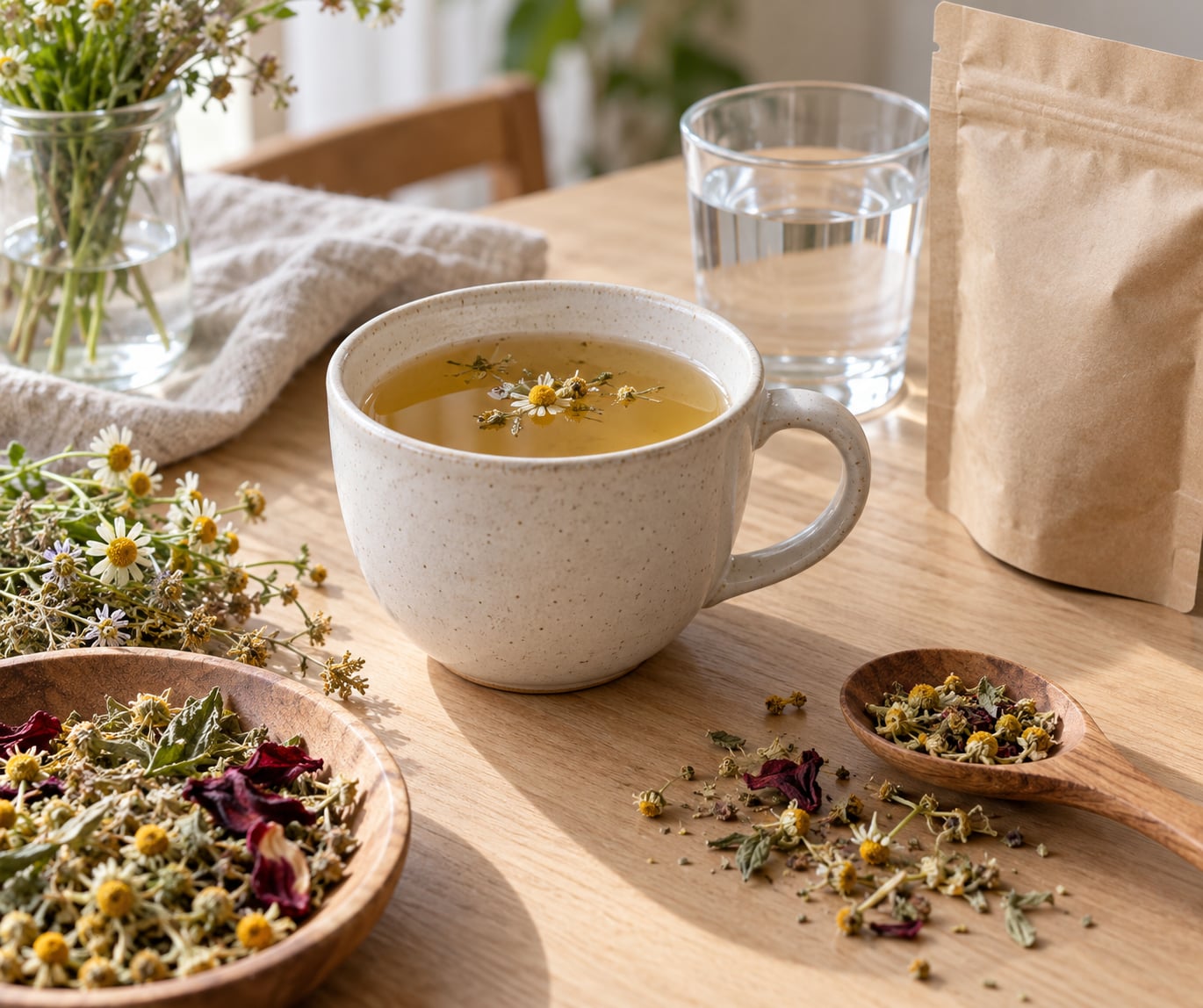
Yes, most mild herbal teas can be drunk while breastfeeding, usually in ordinary food amounts. The catch is that safety depends on the exact plant, the form you buy and the dose, and a cup of chamomile is not the same thing as a fenugreek capsule. This guide walks through the breastfeeding and herbal tea questions parents actually ask, and it is general information rather than personal medical advice.
That distinction gets lost online, where one list calls an herb safe and the next one tells you to avoid it. Much of the confusion comes from mixing three different things under one word, tea: a food-grade infusion, a medicinal-strength brew, and a concentrated supplement. They carry very different risks, and they are not interchangeable.
Everything below is general background. Decisions about your own body belong with a doctor, a pharmacist or an IBCLC, and if your baby is premature or medically fragile, ask before you drink anything other than plain water or a familiar food.
Table of Contents
- 1Can You Drink Herbal Tea While Breastfeeding?
- 2Which Herbal Teas Require the Most Caution?
- 3Herbs with hormonal or prolactin-like effects
- 4Herbs with sedative or stimulant effects
- 5Herbs that act on digestion or the liver
- 6What the table below means
- 7What the research actually shows about milk supply herbs
- 8Key terms you will see on labels and in studies
- 9How Could Caffeine, Stimulants, and Tea Additives Affect Milk Supply?
- 10How much herbal tea while breastfeeding is too much?
- 11Does Drinking Tea Immediately Before Nursing Help?
- 12How Do You Choose a Safer Tea Product?
- 13Tea, tincture, capsule and oil are four different things
- 14Traditional decoctions and packaged teas are not the same product
- 15What Should You Do If You Already Drank an Herbal Tea?
- 16What Breastfeeding and Herbal Tea Questions Deserve Professional Advice?
- 17Frequently Asked Questions
- 18Are chamomile, peppermint, ginger and rooibos different for breastfeeding?
- 19Does herbal tea replace drinking water while breastfeeding?
- 20How often can I drink herbal tea while breastfeeding?
- 21Can my baby react to herbs passed through breast milk?
- 22When should I seek urgent help after drinking a tea?
- 23How do I get reliable answers to breastfeeding and herbal tea questions?
- 24What To Do First
Can You Drink Herbal Tea While Breastfeeding?
Most commercially prepared herbal teas are considered compatible with breastfeeding when drunk in normal food-level amounts, because they are weak infusions of plant material rather than a drug-level dose. What changes the answer is the specific herb, how concentrated the preparation is, and your own health history.
Any substance a nursing parent ingests can reach breast milk in small amounts. The useful question is not whether an herb passes through, since many do, but whether the amount your baby receives from the amount you drink is likely to matter. A weak cup of peppermint tea and a spoonful of concentrated peppermint oil are not the same exposure, even though they come from the same plant.
Herbal tea is also not automatically safe because it is natural. That reasoning runs backwards. Several plants that appear in everyday teas have well-documented pharmacological effects, and some interact with prescription medicines that a new baby may also be exposed to through breast milk.
A useful three-part filter before you drink anything new:
- Which plant is it? Botanical name, not just a marketing name on the front of the box. “Mother’s milk blend” tells you nothing.
- What form is it? Tea bag, loose leaf, tincture, capsule, or essential oil. Only the first two are teas in any meaningful sense.
- What else are you taking? Medicines, supplements, and thyroid or blood-thinning treatment all change the conversation.
When any of those three is unclear, the answer is a quick question to a pharmacist rather than a guess. Pharmacists routinely check herb and medicine interactions, and it takes them minutes.
Which Herbal Teas Require the Most Caution?
Some herbs deserve more caution than others, and the reasons fall into a handful of patterns. Consider these examples as things to raise with a clinician, not as a licence or a prohibition, because dose and preparation change everything.
Herbs with hormonal or prolactin-like effects
Fenugreek, fennel seed, anise, blessed thistle, moringa and goat’s rue are commonly sold as galactagogues, herbs believed to support milk production. Evidence for actual supply increases is limited and inconsistent, and safety data is thinner still. Fenugreek is also a legume, which matters if you or your baby have a legume allergy, and it has a documented effect on thyroid medication, which is why it comes up so often in breastfeeding communities.
Herbs with sedative or stimulant effects
St. John’s wort, passionflower, valerian and hops act on the nervous system, and kava in particular has well-documented liver toxicity at meaningful doses. Sedating herbs are a double concern when you are the person responsible for lifting and feeding a newborn. Unregulated supplements are also the least reliable in terms of dose, and supplement contamination is a documented problem in the herbal product literature.
Herbs that act on digestion or the liver
Senna, cascara, aloe and other stimulant laxatives are not herbs you want in a postpartum body, and concentrated extracts of common culinary herbs such as oregano can irritate the gut badly when swallowed undiluted. Comfrey and aristolochia-containing products carry well-documented toxicity and have no place in a breastfeeding household at all.
What the table below means
Read the right-hand column as a prompt for a conversation, not as a verdict.
| Category | Common examples | Why care is warranted |
|---|---|---|
| Usually fine in food amounts | Chamomile, rooibos, ginger, peppermint, lemon balm | Weak infusions, low toxicity, widely used in food quantities; still check blends and other medicines |
| Use with care and professional input | Fenugreek, fennel, anise, blessed thistle, moringa, ashwagandha, goat’s rue | Limited evidence on both benefit and safety, thyroid and allergy considerations, concentrated forms common |
| Avoid without specific advice | Comfrey, aristolochia, kava, St. John’s wort, stimulant laxatives, essential oils taken internally | Documented toxicity, liver effects, or medicine interactions |
| May reduce milk supply at high doses | Jasmine, high-dose sage, cassia cinnamon, parsley, oregano oil | Reported in community and wellness sources; evidence is limited, so discuss rather than rely on either claim |
Two warnings about the caution list. First, traditional use across many cultures is not the same as modern safety testing, and a plant can be genuinely helpful in a properly prepared decoction and unsuitable as a commercial extract. Second, similar-sounding names hide very different plants. Jasmine tea is not a mild relative of a toxic nightshade, and jasmine and yew are not interchangeable.
What the research actually shows about milk supply herbs
It helps to separate two questions that get merged online: does the herb work, and is it safe. On the first, the honest summary is that high-quality trials are scarce. Most of what circulates is observational, self-reported and shaped by expectation, because it is very hard to blind a breastfeeding parent to the taste of a drink they believe is changing their supply.
One survey of mothers using galactagogues illustrates both sides at once. Fenugreek was the most widely used herb, had the highest perceived effect and also carried the highest reported side-effect rate, at 45 percent. Reported complaints included a maple or curry-like smell in the amniotic fluid, breast milk and the baby’s urine, along with gassiness in the baby and, in some cases, an oversupply that was its own problem. A product can be popular and cause noticeable effects at the same time, and neither fact tells you whether it raised supply.
The practical takeaway is to treat reported effects as real enough to watch for, and to treat claimed benefits as unproven. If a change in supply is what you are chasing, the assessment a clinician can do, involving latch, frequency, pumping and maternal health, is worth more than a cupboard full of teas.
Key terms you will see on labels and in studies
Four words come up constantly in this space, and confusion about them causes most of the bad advice:
- Galactagogue
- A substance believed to increase milk production. The belief is widely held; the clinical evidence is thin and inconsistent.
- Anti-galactagogue
- A substance believed to reduce milk production, usually discussed at high doses. Examples come mainly from community and wellness sources rather than controlled research.
- Prolactin
- The hormone chiefly involved in milk production, which rises during pregnancy and is required for ongoing supply after birth.
- Let-down reflex
- The milk ejection reflex triggered when a baby feeds. It is easily affected by stress, which is why a calming pre-feed routine is a reasonable idea even when the drink in the cup does nothing.
How Could Caffeine, Stimulants, and Tea Additives Affect Milk Supply?
Caffeine is the additive most likely to affect a nursing parent, and the part people miss is the total. Caffeine arrives from black tea, green tea, matcha, energy drinks, cola, coffee, chocolate, pre-workout powders, some pain relievers and a handful of medicines. Counting only the cup of herbal tea in your hand gives you a very incomplete number.
Commonly cited mainstream guidance from bodies such as the CDC and the NHS puts a cautious ceiling of about 200 to 300 mg of caffeine a day for nursing parents, and the widely repeated “3-3-3 rule” is simply a memory aid for that figure: three cups of coffee, three cups of tea, three sodas or energy drinks. It is a rough ceiling, not a target, and it does not account for a tall mug, a double shot or a large energy drink.
Two different questions hide inside the milk supply worry, and keeping them apart helps. One is whether the mother feels jittery, anxious or unable to sleep, which caffeine does at ordinary doses. The other is whether it changes the let-down reflex or the volume of milk produced, which is less well studied. The consistent finding in the literature is that caffeine reaches breast milk, and a fussy or wakeful baby after a high-caffeine day is a pattern many mothers recognise.
How much herbal tea while breastfeeding is too much?
There is no published cup limit for herbal tea as such, because caffeine-free blends have no ceiling from that angle. A reasonable approach is two to three cups a day of a single-ingredient caffeine-free infusion, treated as a swap for another drink rather than an addition to everything you already drink. Watch total fluid intake, since very large amounts of any liquid in a short window can compete with the thirst that nursing actually creates.
Watch the other additives too. Honey is fine for nursing parents over one year old but not for infants under one, and it is worth saying plainly because lactation teas are often sold as soothing and honeyed. Added sugar adds nothing except calories. Highly concentrated extracts, whether taken as drops or capsules, deliver a dose that no cup of tea approximates, and those belong in a conversation with a clinician rather than in a daily routine.
Breastfeeding parents discuss perceived supply drops often. In a 2017 cross-sectional survey of mothers using galactagogues, 76% of respondents felt they were not making enough milk, which tells you how widespread that feeling is and how little it maps onto measured supply. When supply seems to be dropping, a clinician can look at feeding frequency, latch, pumping and health, which are usually the real drivers. Elimination diets and tea bans tend to add stress without answering the question.
Does Drinking Tea Immediately Before Nursing Help?
Probably not in any reliable way, and the honest answer is that timing matters much less than which herb and how much you drink. No dependable evidence shows that a particular herbal tea taken at a particular moment reliably increases milk production.
What warm liquid does do is real, though modest. It adds fluid, and the ritual of sitting down with a warm cup is a genuine calm-down before a feed, which is not nothing when stress is part of what is holding up your let-down reflex. If a cup of tea marks the start of a feed and helps you breathe, that is a good reason to keep doing it.
Two cautions on the timing question. Tea immediately before a feed puts caffeine closest to the feed with the least time between it and the baby, so if you are drinking a caffeinated tea, earlier in the day is a gentler choice. And mint teas straight before nursing are commonly avoided by mothers trying to reduce reflux, since peppermint is a recognised reflux trigger, though the effect is individual rather than universal.
Choose a caffeine-free infusion if the ritual is the point. You get the warmth and the pause without the stimulant attached.
How Do You Choose a Safer Tea Product?
Most of the risk in a cup of tea comes from not knowing what is in it. A short checklist gets you most of the way there.
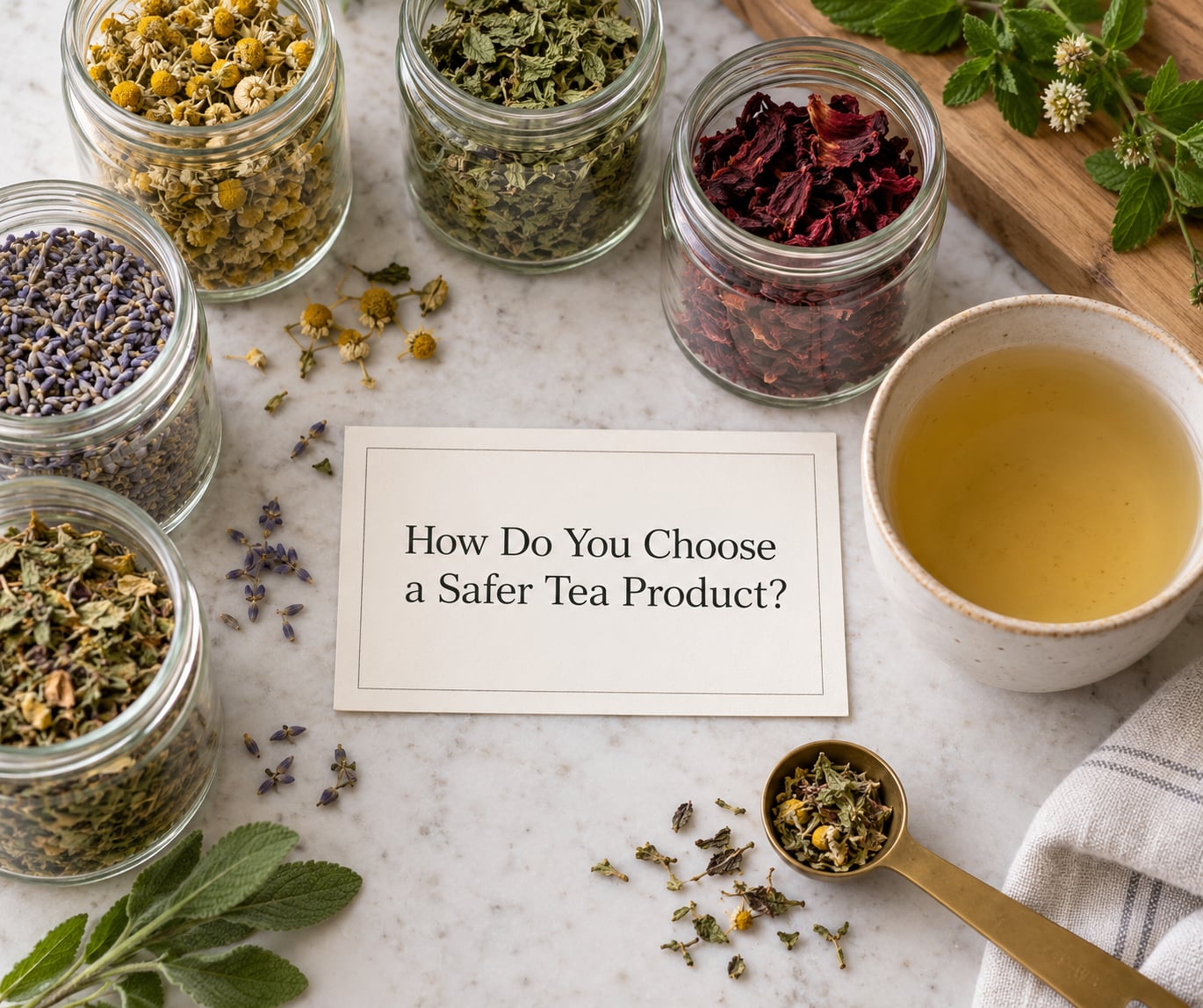
- Name the plant precisely. Look for the botanical name on the label, for example Matricaria chamomilla rather than a friendly blend name.
- Read the whole ingredient list, twice. Blends hide the ingredient you were actually worried about, and blends are harder to assess than a single herb because nobody knows which part is doing what.
- Skip unlabelled loose product. Tea sold by volume from a tin, a market stall or an unlabeled jar has no traceability at all.
- Look for third-party testing. A batch or certificate test from an independent lab tells you the product contains what it says, and that heavy metals, pesticides and microbes are under control.
- Treat “standardised extract” as a warning sign. A standardised extract is deliberately concentrated to a fixed potency, which is closer to a medicine than to a cup of tea.
- Discard sweeping medical claims. A tea that promises to treat reflux, thyroid disease or low supply is selling, not helping.
- Introduce one new thing at a time. One new tea or ingredient, then 24 to 48 hours of watching the baby before adding anything else, so if there is a reaction you know what caused it.
Introducing one at a time is the single most useful habit here, and it comes straight from how experienced mothers describe working out what their babies tolerate. If you want more background on reading plant materials and their traditional preparation, the herbal safety material on this site is worth a look.
Tea, tincture, capsule and oil are four different things
The word “herbal” hides more variation than most product pages admit, and the risk climbs steeply from one form to the next.
| Form | What it is | Relative caution |
|---|---|---|
| Tea bag or loose leaf | Plant material briefly steeped in hot water | Lowest. A genuine food-level infusion |
| Tincture | Extract in alcohol or glycerine, taken as drops | Much higher. Concentration is not comparable to tea |
| Capsule or standardised extract | Dried or extracted plant in a fixed potency dose | Highest of the oral forms, and the least regulated |
| Essential oil | Distilled volatile concentrate | Not a food. Never swallow without explicit professional instruction |
When a postpartum drink is called a decoction, look at what it is made from rather than how traditional the name sounds. A diluted household infusion and a shop-bought blend in a sachet are different products with different amounts of plant material, even when the herbs on the list match.
Traditional decoctions and packaged teas are not the same product
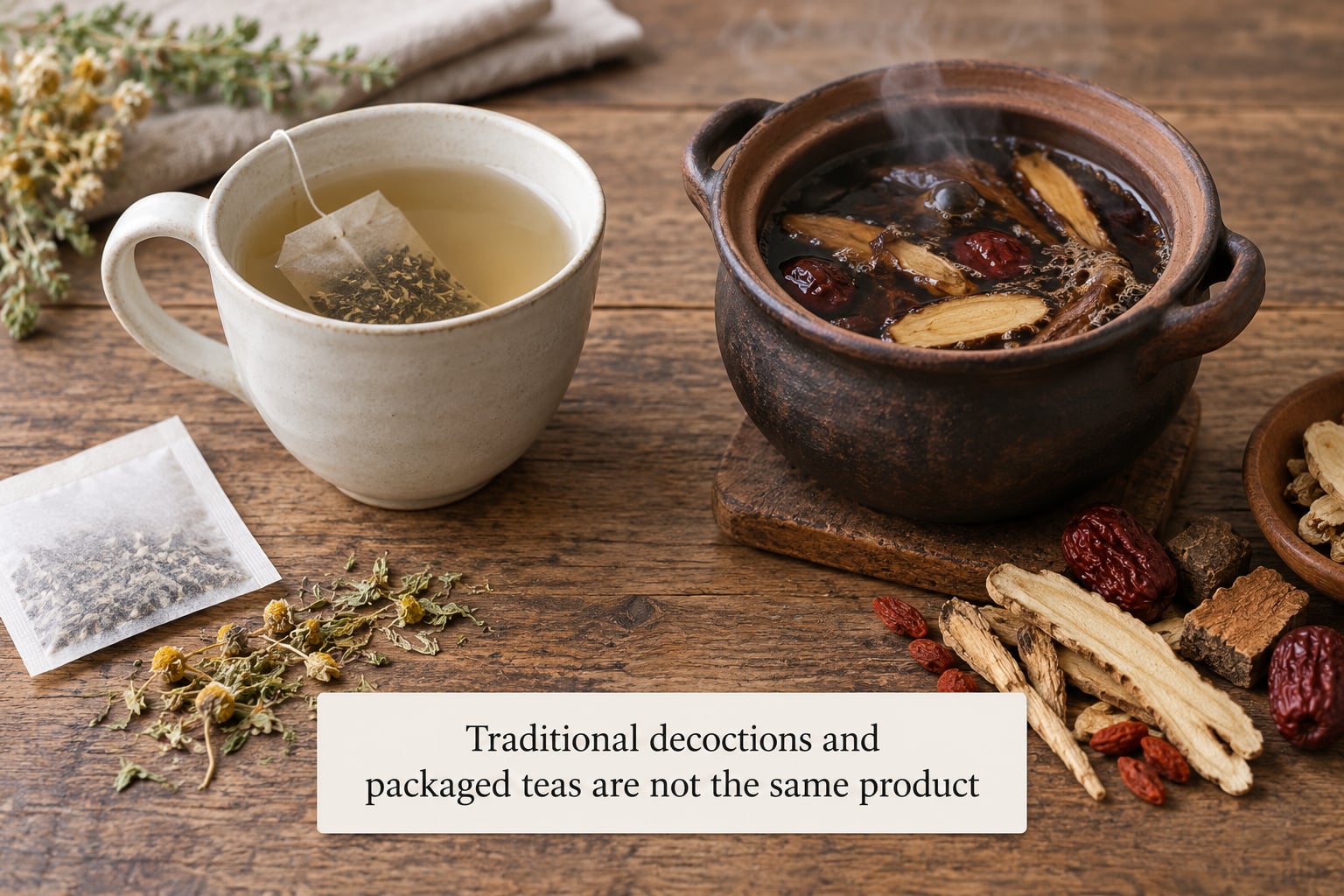
Postpartum infusion traditions exist across African, South Asian, Southeast Asian and Latin American cultures, and they are worth understanding on their own terms rather than through a supplement aisle. A traditional decoction is boiled, which pulls out far more of a plant than a brief infusion, and the recipes are built around a handful of locally available botanicals rather than a blend assembled for retail shelf life.
That difference cuts two ways. A well-prepared traditional infusion can be a gentler, more balanced drink than a stack of capsules. It can also be considerably stronger than a teabag, and a household preparation is rarely tested for contaminants. Where a tradition is part of your postpartum care, the useful move is to ask a clinician about the specific plants in the recipe rather than adopting or abandoning the whole practice on principle.
Regulation varies too. Herbal products sold as supplements in the United States, as foodstuffs in the European Union, and as medicines in other countries are held to different standards of evidence and labelling, so a product’s status in one country tells you little about the identical product elsewhere.
What Should You Do If You Already Drank an Herbal Tea?
First, do not panic. Most tea drinking in the postpartum period involves ingredients that will not cause harm, and a single cup of a food-grade herbal infusion is very unlikely to require any action at all.
Write down what is useful if you need it. Note the product and brand, the ingredient list, roughly how much you drank, when, and any other medicines or supplements you took that day. If your baby shows anything, write down the timing and what you saw.
Then contact the right person. A pharmacist or your doctor can tell you whether the specific product and dose are a concern. For anything more urgent, contact your local poison-control service or urgent medical service. Outside the United States, national poison information services carry equivalent advice lines.
Infants who are premature, under one month old, or medically fragile deserve prompt assessment for any symptom, because their handling of a substance differs from an older baby’s. A baby who is hard to wake, has a marked change in feeding, vomits repeatedly, develops a rash, or seems unusually floppy or difficult to console should be seen without delay. Stop the tea while you get advice, and take the container with you so whoever you speak to can read the actual ingredient list.
What Breastfeeding and Herbal Tea Questions Deserve Professional Advice?
Some situations need individualised advice rather than a general article, and guessing is not worth it. Bring these to a doctor, pharmacist or IBCLC:
- Your baby is premature, under one month, or medically fragile. Drug and herb exposure standards are different for these babies.
- You take any regular medicine. Herbs interact with medicines, and some herbs affect medicines your baby is also exposed to through milk.
- You have a thyroid condition or take thyroid medication. Fenugreek and some other herbs have documented effects here, which is exactly the question that comes up most often in breastfeeding communities.
- You or your baby have allergies, including legume or peanut allergy. Fenugreek is a legume, and some blends contain nut-derived ingredients.
- You are considering a concentrated product. Capsules, tinctures and drops are not tea, and no general article can tell you whether a specific one is right for you.
- Supply is a genuine concern. A perceived drop is usually about latch, frequency, stress or health, and those are assessable rather than guessable.
- You have breast pain, a fever, a hot red area, or cracked or bleeding skin. That needs assessment on its own terms, and tea will not address it.
- Your baby is jaundiced, or you are worried about jaundice. Feeding and infant assessment come before any herbal question.
Being told to ask someone competent is not a brush-off. It is the correct answer to questions about dosing, timing and individual risk, and a pharmacist is usually the fastest person to reach.
Frequently Asked Questions
Are chamomile, peppermint, ginger and rooibos different for breastfeeding?
Yes, they differ mainly in caffeine and in what else they do. Chamomile is a mild calming evening drink and rooibos contains no caffeine, so both suit the hours before sleep. Ginger is a warming digestive and is often chosen for nausea. Peppermint is caffeine-free but is a recognised reflux trigger, so some mothers avoid it near feeds. None of them reliably changes milk supply.
Does herbal tea replace drinking water while breastfeeding?
Tea counts toward your fluid intake, but water is the simplest way to stay ahead of nursing thirst, which is genuine and can be several large glasses a day. Herbal teas are a reasonable swap when plain water becomes boring, not an addition on top of everything else. Caffeinated tea is a poor substitute for hydration because caffeine works against it, and very large amounts of any liquid in a short window can leave you uncomfortable.
How often can I drink herbal tea while breastfeeding?
For a caffeine-free infusion such as chamomile or rooibos, two to three cups a day is a common food-level pattern, and there is no published medical ceiling for tea as such. What matters more is the total across all sources, including coffee, chocolate, cola and energy drinks, which commonly adds up faster than people expect. Caffeinated tea is best kept earlier in the day, and new ingredients are best introduced one at a time.
Can my baby react to herbs passed through breast milk?
They can, though the most commonly reported reactions are fussiness, gassiness, greenish stools and a rash rather than anything dramatic. Fenugreek is associated with a maple or curry-like smell in amniotic fluid, breast milk and baby urine, and fenugreek is a legume, so it needs care if there is a legume allergy. Introduce one tea at a time and watch for 24 to 48 hours so you know what caused any change.
When should I seek urgent help after drinking a tea?
Seek prompt medical attention if your baby is hard to wake, is floppy or difficult to console, vomits repeatedly, stops feeding or develops a rash, particularly if the baby is premature, under one month old or medically fragile. For the exposure itself, contact a pharmacist, your doctor or your local poison-control service. Take the product container with you so the ingredient list can be read while you are on the call.
How do I get reliable answers to breastfeeding and herbal tea questions?
Start with bodies that publish rather than sell: the CDC and NHS on caffeine, professional pharmacy bodies on herb and medicine interactions, and a qualified lactation consultant for anything about supply or your baby’s behaviour. Peer-reviewed work is worth reading, but check what kind of study it is, because survey findings on perceived effects are not the same as trial results. Anything personal deserves a clinician, not a forum thread.
What To Do First
If you want one action today, make it this: pick the tea you drink most, find its botanical name, and read every word on the ingredient label. That single habit catches the majority of avoidable problems, because most surprises in breastfeeding and herbal tea questions come down to an ingredient that was not on the front of the box.
After that, keep caffeinated tea to the earlier part of the day, stay with familiar single-ingredient infusions rather than blends, and bring anything concentrated, anything medicinal, or anything involving a thyroid condition, medication or allergy to a pharmacist or IBCLC before the first cup.
Reviewing this article with a qualified clinician is the safest next step for your own situation, particularly if you are pregnant, planning to breastfeed, or already nursing a premature or medically fragile baby.
Last reviewed for 2026. General information only, and not a substitute for individual medical advice, diagnosis or treatment from a qualified professional.