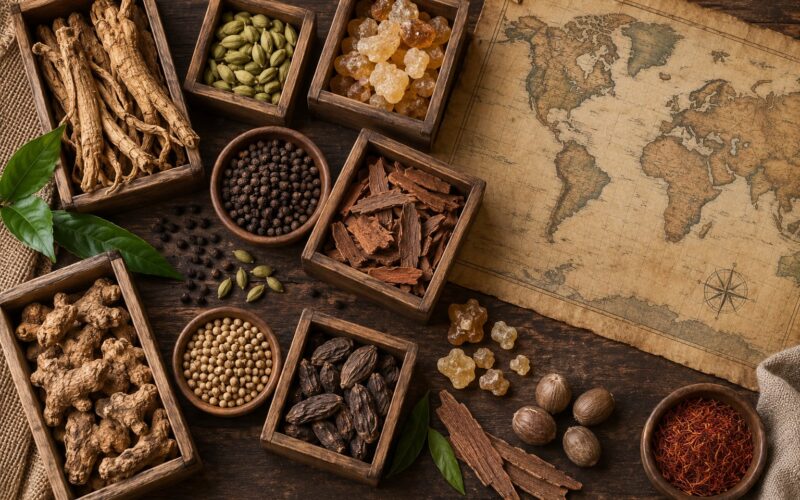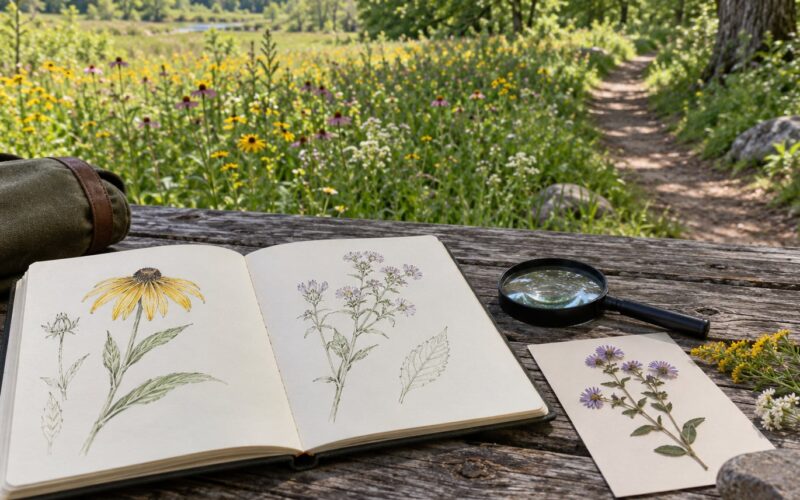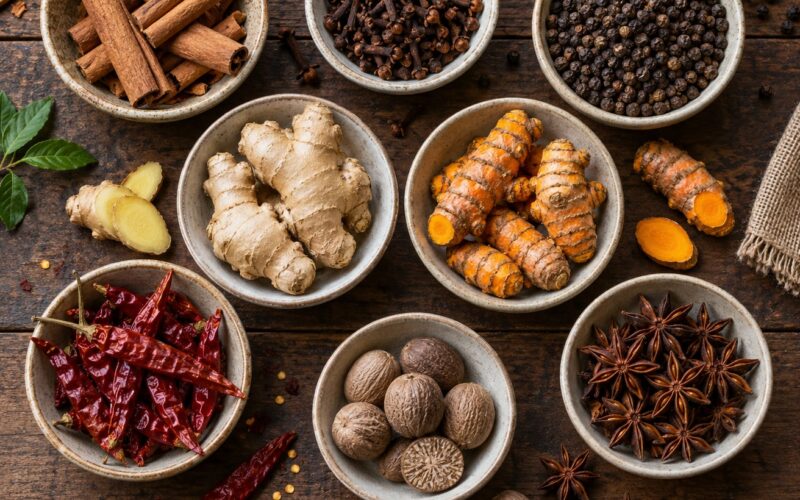
Oral transmission of plant knowledge is the process by which names, identification skills, harvesting rules, preparation methods and healing uses of plants move between people through speech, story, ritual and supervised practice rather than through writing. It usually runs from elders and healers to younger members of the same family or community, and it carries more than facts about species. It carries the rules about who may use a plant, when it may be picked and what must never be mixed with it.
One clarification first, because search engines frequently read this query as plant-to-plant chemical signalling. This article is about people and plants: who knows a plant, how they learned, and what happens to that knowledge. Volatile compounds that make one plant react to another are a different field entirely.
A few things worth holding on to before the detail:
- Oral transmission is a process, not a filing system. It needs listeners, teachers and repeated practice, which is why it disappears faster than a printed list does.
- Most of the practical knowledge in a community’s plant medicine exists nowhere else. A species being well documented does not mean its preparation rules are safe to read off a page.
- Written records and oral knowledge do different jobs. Documentation preserves names and uses; oral tradition carries context, permission and skill.
- Regional variation is normal. The same plant can be treated differently two valleys away, and both traditions can be internally consistent.
Table of Contents
- 1What Is Oral Transmission of Plant Knowledge?
- 2Why Is Plant Knowledge Passed Down Through Stories?
- 3How Do People Learn Which Plants to Use?
- 4How Is Oral Transmission of Plant Knowledge Explained in Research?
- 5What Makes This Knowledge Different From a Written Herb List?
- 6What Are the Limits and Risks of This Knowledge?
- 7Frequently Asked Questions
- 8How is indigenous knowledge passed from generation to generation?
- 9Who are the knowledge holders in ethnobotany?
- 10Is traditional plant knowledge always secret?
- 11How do you document traditional medicinal plant knowledge ethically?
- 12Why is traditional plant knowledge disappearing?
- 13Does traditional use mean a plant is safe and proven to work?
- 14Conclusion: Learn by Listening and Context
What Is Oral Transmission of Plant Knowledge?
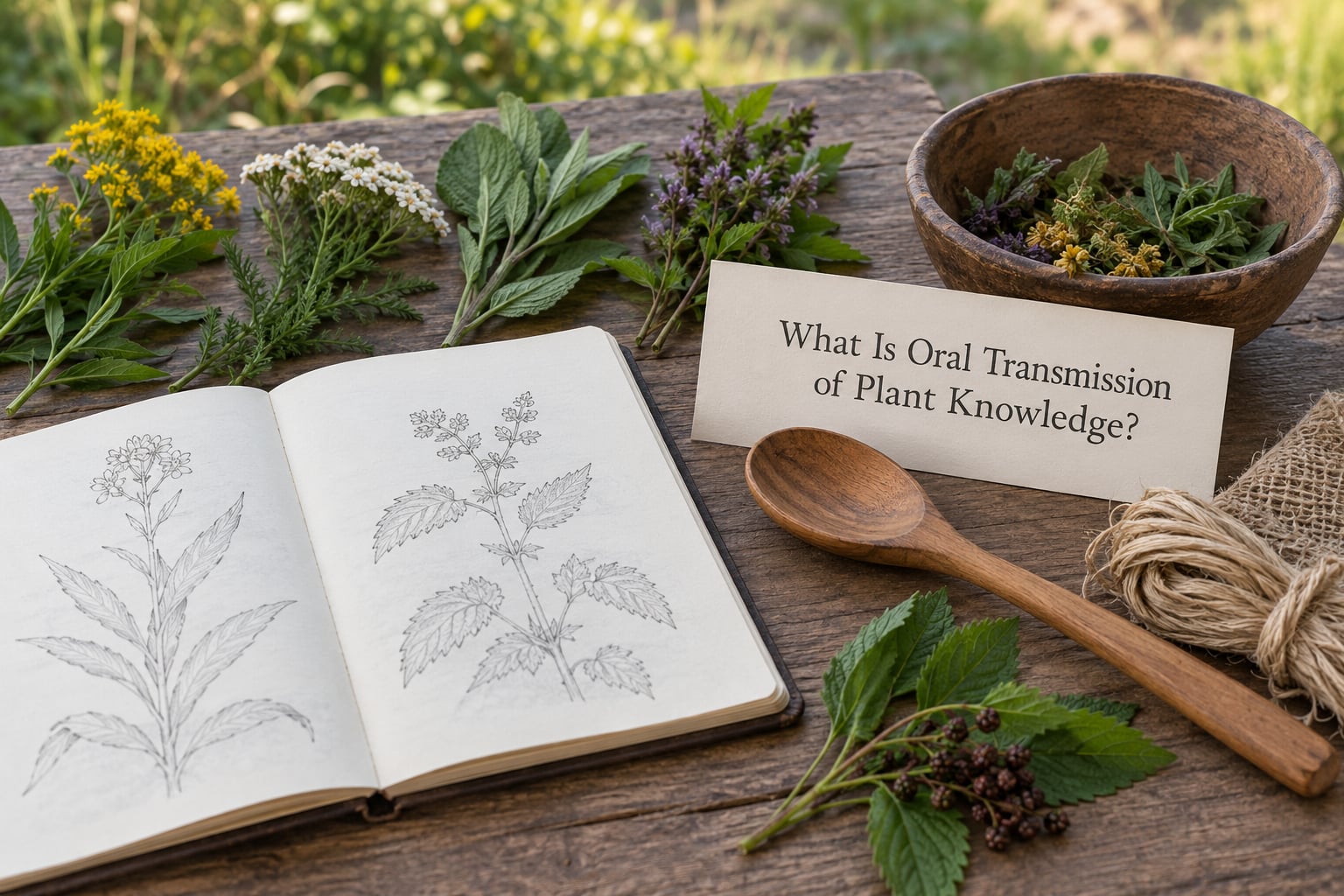
Oral transmission of plant knowledge is the passing of plant names, identification skills, preparation methods and cultural rules between generations by speech, story and supervised practice instead of by writing. It normally moves from elders, healers and experienced harvesters to children and apprentices within a family or community.
What travels with the plant is rarely a single fact. Alongside a name, an apprentice usually absorbs how to recognise the species in the field rather than from a photograph, which part to take, which season it is best picked in, how it is prepared, how strongly it is meant to act, and the taboos that surround it.
Ethnobotany calls this body of knowledge traditional ecological knowledge, usually shortened to TEK. It covers more than medicine: which plants feed people, which ones build materials, which are planted for soil fertility, and how a community reads seasonal change in a landscape it knows closely.
Some of it sits inside story rather than instruction. The Coos, Lower Umpqua and Siuslaw peoples of the Pacific Northwest carried practical detail about skunk cabbage (Lysichiton americanus) inside a First Trickster tale, including the instruction to roast the root until it smells sweet. The recipe survived as a story long after the language around it faded.
Why Is Plant Knowledge Passed Down Through Stories?
Stories are used because they survive. A dry list of plant names needs to be memorised exactly; a story holds a plant in place inside a place, a relationship or a warning, and memory keeps the shape of the story together.
Three features make narrative a good carrier. First, sequence: preparation steps are naturally ordered in a story, so the order is not lost. Second, imagery: a detail like roasting a root until it smells sweet is easier to recall than a temperature. Third, moral weight: a rule attached to a consequence is remembered better than a rule stated on its own.
Ritual plays a similar part. Where a community holds a healing assembly, a harvest rite or a marking ceremony, the knowledge arrives attached to a moment people already value. Repetition through the year is what turns a rule into habit, which is why seasonal practice is more durable than a single lesson.
None of this makes oral transmission more reliable than writing in every respect. It makes it different. A story can carry authority and feeling that a catalogue cannot, and a catalogue can carry detail that a story never intended to hold.
How Do People Learn Which Plants to Use?
People learn by watching, touching and correcting. Identification is taught through habitat and season first, then through repeated encounters over years, with an elder correcting a mistake in the field rather than in a classroom.
Habitat knowledge does much of the work. Knowing that a species grows on the shaded bank of a stream or only after the first rains is often a more reliable identification cue than leaf shape alone. Harvesting seasons are taught the same way, by being shown rather than by being written down.
Vernacular names carry far more information than a label. A local name can encode growth form, habitat, taste, smell, kinship or a myth about origin, and two names for one species may reflect two distinct uses rather than a mistake. Mapping those names onto botanical nomenclature is useful work, but it is a translation, not an identity.
How Is Oral Transmission of Plant Knowledge Explained in Research?
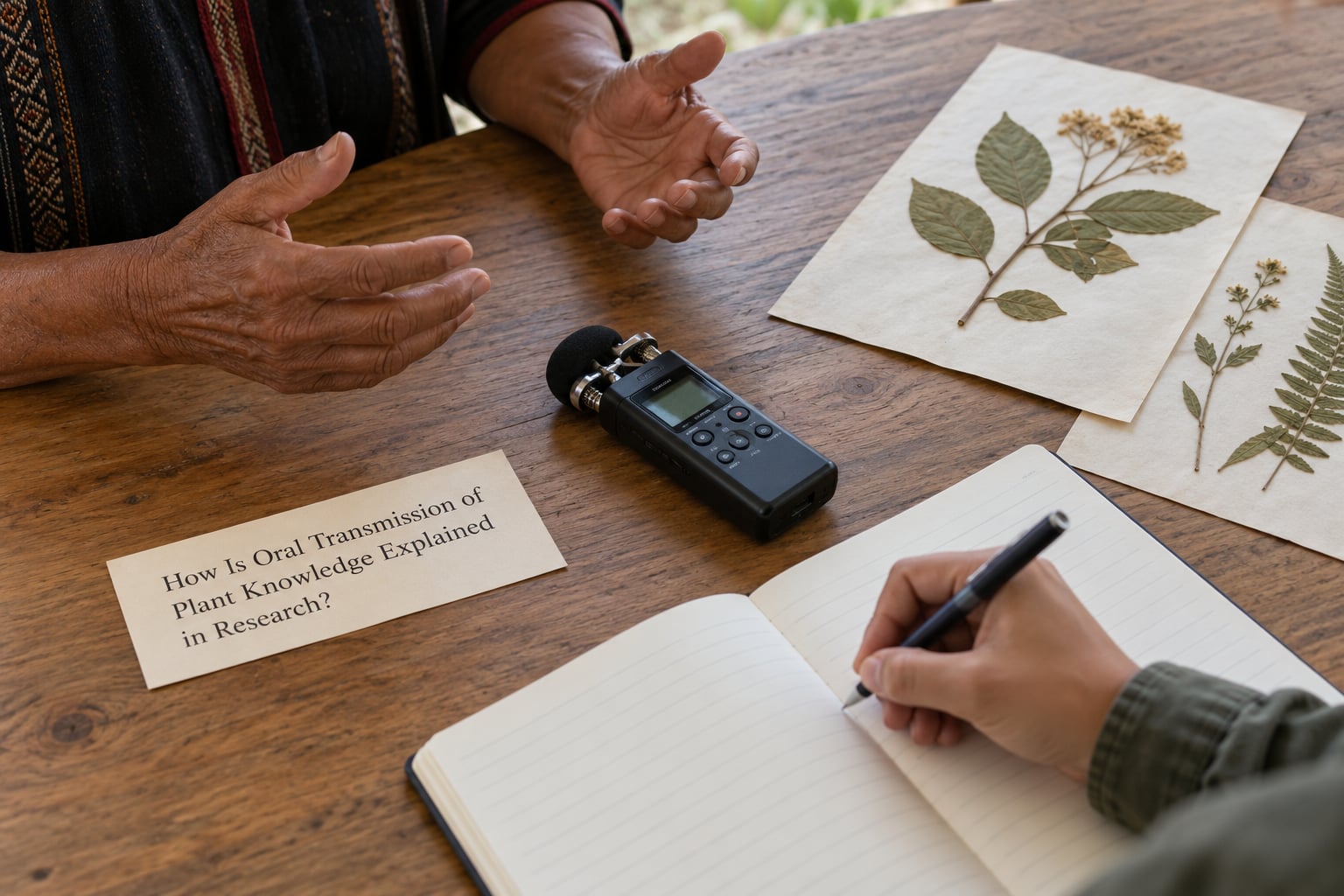
Researchers study this process with methods borrowed from anthropology: semi-structured interviews, participant observation, focus groups and field notes recorded alongside the speaker’s own words. Language documentation adds the vocabulary layer, since plant names are often the densest part of the record.
The quality of the work depends almost entirely on protocol. A careful study records who shared a piece of knowledge, under what conditions, in which language, and whether the speaker considered it appropriate to share at all. Where a community withholds a remedy, that refusal is itself data and belongs in the record.
Consent is not a signature on a form at the start. It is an ongoing agreement that covers who may publish, whether names should be attached, whether commercially useful species may be listed at all, and whether the community shares in any benefit that follows.
Working with communities rather than only about them also changes the outcome. When local practitioners set the agenda, documentation tends to include preparation detail and harvest rules instead of a bare species list, which makes the record far more useful for anyone who later has to grow, conserve or safely handle the plant.
What Makes This Knowledge Different From a Written Herb List?
A written herb list records what a plant is called and how it has been used. Oral transmission records how to recognise it, when it is ready, how the preparation is judged, and what the community considers a misuse. The comparison below sets out the practical differences.
| Aspect | Oral transmission | Written list or catalogue |
|---|---|---|
| Carries | Skill, timing, context, taboos, authority | Names, parts used, reported preparation |
| Identification | Field-based, taught by an expert over time | Specimen and description based |
| Variation | Expected between families, regions and healers | Often flattened into a single entry |
| Authority | Attached to a named teacher and permission | Attached to the author or institution |
| Updating | Continuous, through practice and correction | Periodic, when a new edition appears |
| Language | Vernacular, idiomatic, multilingual | Standardised scientific names |
| Fails when | The language, habitat or teacher disappears | The record is lost or never made |
| Best used for | Learning practice safely and sustainably | Reference, conservation planning, research |
Good documentation sits between the two. It keeps the record in community hands, in community language, and marks what should not be published without permission.
What Are the Limits and Risks of This Knowledge?
The main risk is assuming that traditional use proves safety or effectiveness for everyone. Reported use tells you what a community has done and what they have observed. It does not tell you how a preparation interacts with prescription medicine, pregnancy, liver function or a different body chemistry, and it says nothing about the dose.
Identification is a real hazard. A vernacular name can cover two different species across two districts, and a written entry without a herbarium voucher can point to the wrong plant entirely. Several African and Asian remedies have caused harm precisely where a name was transferred into a text without a verified specimen.
Language change erodes knowledge quietly. When the word for a plant stops being spoken, the distinctions it carried go with it, usually within a single generation. Urban migration breaks the apprenticeship chain for a different reason: nobody has time to gather, prepare and be corrected over years.
Habitat loss removes the other half. A community can hold perfect knowledge of a species that no longer grows within reach, and a well-documented plant that has vanished from the forest is not a usable treatment.
Unequal authority sits inside communities too. Not every family holds the same medicine, and not every holder agrees. Then there is appropriation: a use recorded in a study or patent without consent, with no benefit returning to the people who supplied the knowledge. Instruments such as the Nagoya Protocol exist to require prior informed consent and benefit sharing, though national implementation varies widely.
None of this means traditional knowledge should be dismissed. It means the right response is documentation done properly, plus qualified botanical identification and, for anything you intend to take, advice from a doctor or pharmacist. I am not a clinician, and neither is any website, including this one.
Frequently Asked Questions
How is indigenous knowledge passed from generation to generation?
It moves through layered channels rather than one. Story and myth carry the memory of a plant, demonstration during harvesting carries the skill, ritual and community roles decide who is allowed to learn it, and repeated seasonal practice turns instruction into habit. Elders and healers usually teach younger family members or apprentices directly, correcting mistakes in the field. Because it is taught by people rather than printed, it can disappear within one generation when a language, a habitat or a teacher is lost.
Who are the knowledge holders in ethnobotany?
Knowledge holders are the people a community recognises as authoritative on plants: healers, herbalists, birth attendants, farmers, hunters and elders, plus the craftspeople who use plant materials. Authority is usually specific. A person may hold deep knowledge of one species or one preparation and no general training at all, so researchers are taught to ask who holds a particular piece of knowledge rather than who is the village headman.
Is traditional plant knowledge always secret?
No. Some knowledge is deliberately restricted to particular families, roles or genders, and a community may withhold specific remedies from outsiders. That restriction is a legitimate decision, not an obstacle to work around. Careful research records the limits the community sets, and treats a refusal to share as information rather than as missing data to be filled in by someone else.
How do you document traditional medicinal plant knowledge ethically?
Start with the community, not the plant. Agree in advance who is asked, who is credited, what will be published, whether vernacular or personal names appear, and whether sensitive species are listed at all. Record the speaker’s own words in their own language, note the conditions under which the knowledge was shared, keep the material under agreed access rules, and plan how any benefit returns to the community.
Why is traditional plant knowledge disappearing?
Language loss removes the names that carried fine distinctions. Urban migration breaks the apprenticeship chain because long gathering and preparation sessions no longer fit daily life. When a healer dies without a trained successor, an entire body of practice can go with them. Habitat loss compounds all of this, so even intact knowledge becomes unusable when the species disappears from the surrounding countryside.
Does traditional use mean a plant is safe and proven to work?
No. Traditional use is evidence that a community has used a plant and observed effects; it is not a safety test and not a clinical trial. Reported use does not establish correct identification, appropriate dose, absence of side effects or freedom from interactions with prescription medicine. Treat it as a lead worth investigating. For anything you plan to take, get advice from a doctor or pharmacist and proper botanical identification.
Conclusion: Learn by Listening and Context
The short version: oral transmission of plant knowledge works through speech, story, demonstration and ritual, and it carries the practical and cultural parts of plant use that a written list leaves out. It is also the first thing to go when a language, a habitat or an elder is lost.
Where you are learning, start with listening rather than collecting. Ask who holds a particular piece of knowledge, in their own terms, and treat refusals as answers. Keep a record with the speaker’s consent, including the conditions and the language. If a plant is physically involved, get it identified by someone qualified and confirmed with a herbarium voucher.
And if you are considering a plant for your own health, take that step to a doctor or pharmacist first. Knowledge passed down for thousands of generations deserves more than a quick reading.