Spices became household remedies because, for most of human history, there was no separate pharmacy. The same dried root, seed, bark or flower that seasoned a pot of stew was also the infusion, the poultice and the gurgle, until trade routes and falling prices moved those materials from specialist shelves onto ordinary kitchen shelves.
The story is less a single discovery than a slow handover, and it happened in a fairly predictable order. Understanding that order explains something ethnobotanists find genuinely odd: unrelated peoples on different continents often reached for the same aromatic plant against the same complaint.
Table of Contents
- 1How Spices Became Household Remedies
- 2How spices turned into remedies, stage by stage
- 3What Counts as a Household Spice Remedy?
- 4Why People Used Spices for Health
- 5How Spices Became Household Remedies in Different Regions
- 6From Trade Routes to the Kitchen Shelf
- 7What Did African Traditional Healing Knowledge Contribute?
- 8How Oral Tradition and Written Records Preserved Remedy Knowledge
- 9Why Spice Remedies Look More Effective to Modern Readers
- 10What Are the Safety Risks of Using Spices as Remedies?
- 11How to Explore Spice Traditions Responsibly
- 12Frequently Asked Questions
- 13Are spices the same thing as medicinal plants?
- 14Why did people use spices as household remedies?
- 15Does traditional use prove that a spice treats a disease?
- 16Which spices are commonly discussed in African ethnomedicine?
- 17Can spices interact with medicines or cause health problems?
- 18How can I learn about traditional healing without treating every practice as medical advice?
- 19Conclusion: Start with the History and Use Care
How Spices Became Household Remedies
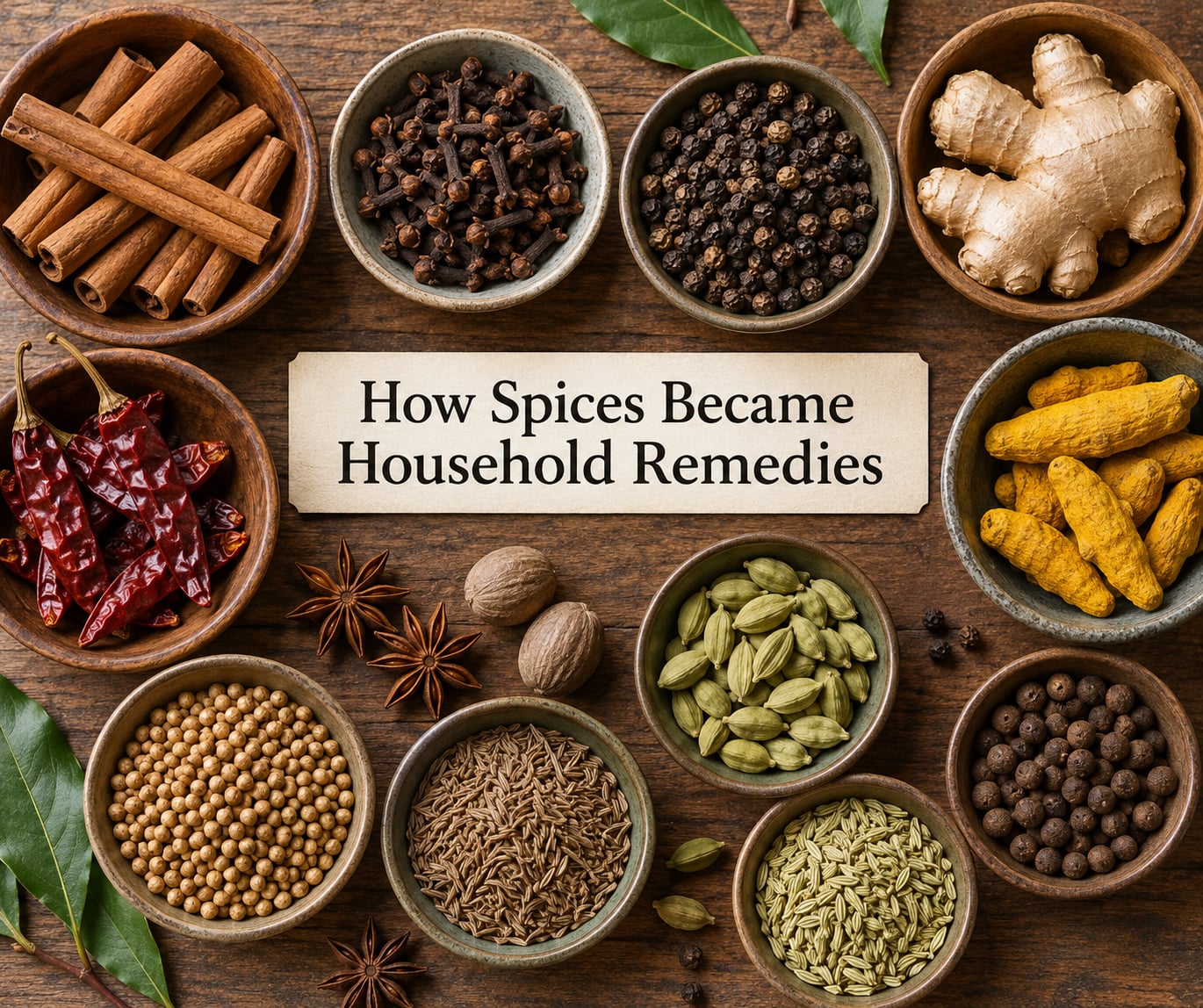
Here is the short answer. Aromatic plants were first used locally, by the same people, for both food and treatment. Writing systems then fixed those uses in pharmacopoeias such as the Ebers Papyrus and Dioscorides’ De Materia Medica. Long-distance trade moved the materials out of their home pharmacopoeias, into merchant and apothecary hands, and finally into domestic kitchens, where they stayed.
Each handover changed the practice. A plant used by a healer with training is not the same thing as the same plant handed to a family with a wooden spoon, and the honest history has to keep those two things apart.
How spices turned into remedies, stage by stage
- Local plant knowledge. Long before any trade network, communities classified aromatic plants by what they did to the body, where they grew, and what they were used alongside. Ginger, chilies and the indigenous peppers of West Africa all entered use this way.
- Written codification. Around 1500 BCE the Ebers Papyrus records remedies made from pepper, cinnamon and cassia. In India, Ayurveda held ginger, black pepper, turmeric and cardamom inside long pharmacological treatises. Dioscorides compiled a Greek and Roman materia medica in the first century CE.
- Trade. Arab and Persian merchants, and the Silk Road networks before them, carried spices out of their regions of origin. What travelled was rarely only a seed. It travelled with a reputation attached, and that reputation was usually medicinal.
- The apothecary. From around the twelfth century in Europe, grocers and apothecaries overlapped. London’s pepperer’s guild of 1180 is usually treated as an ancestor of both the grocery and the pharmacy, which tells you how blurred the two shelves already were.
- The household cupboard. As pepper, cinnamon and ginger became affordable seasonings, the recipes that used them medicinally followed. A decoction that a healer boiled for a cough became a spiced infusion someone at home could make without training.
Stage five is where most people meet the subject, and it is the stage almost every popular history skips. The trade routes matter, but the household is where the practice actually settled.
What Counts as a Household Spice Remedy?
A household spice remedy is any preparation made from an aromatic plant, in a kitchen, for a stated purpose beyond flavor. The categories people use for these plants overlap badly, which is where most confusion starts.
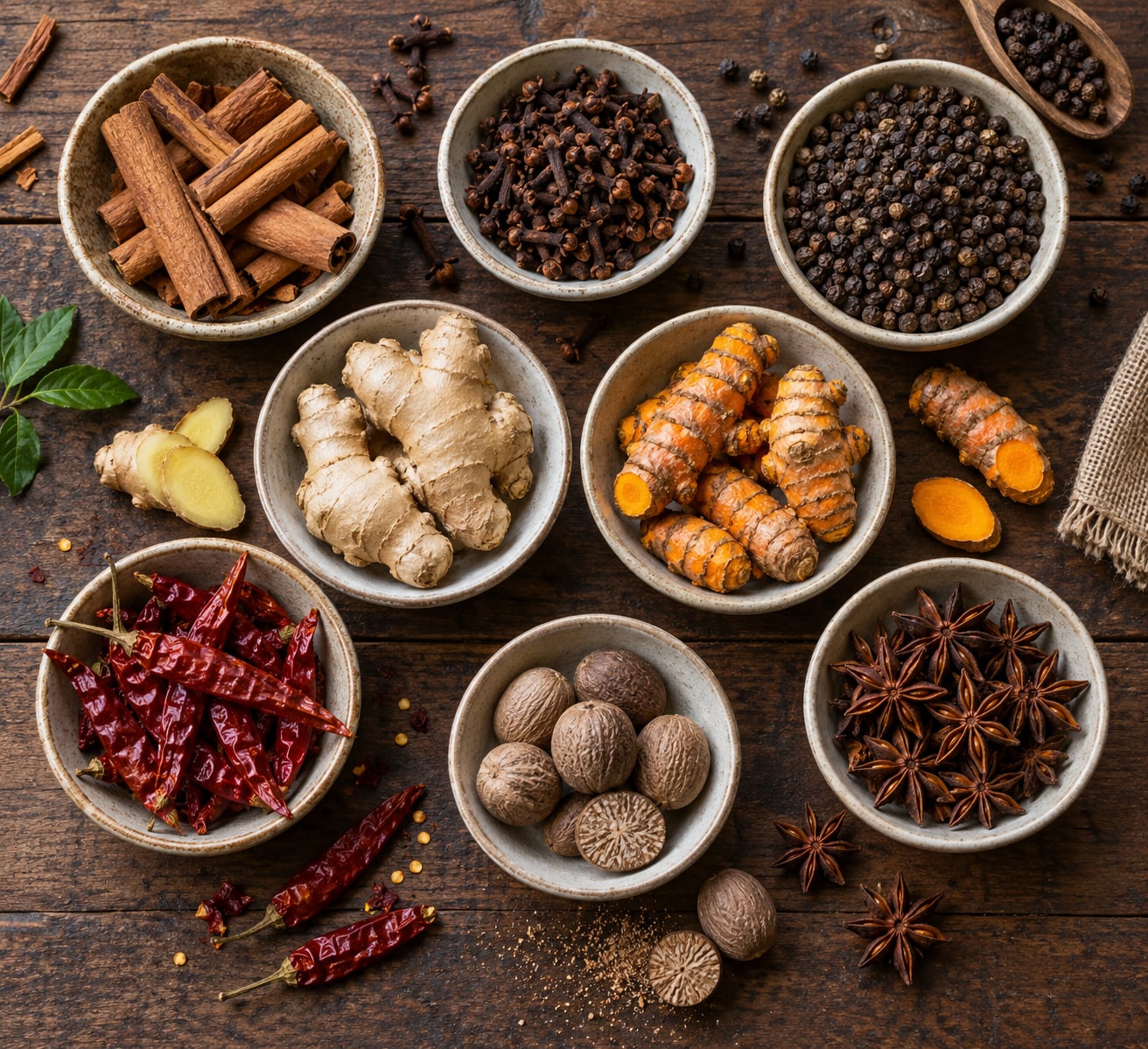
- Spices come from bark, seed, root, bud or fruit and are usually dried. Pepper, cinnamon, cloves, nutmeg and ginger are spices.
- Herbs are the leafy parts of plants, usually used fresh. Basil, mint and parsley sit here, though dried thyme and oregano behave like herbs and are shelved like spices.
- Medicinal plants is a use, not a botanical category. Any of the above can be medicinal, and so can a bark or root that nobody seasons food with.
- Supplements are a modern, standardized category. A turmeric capsule is not a spoonful of turmeric, and the difference in concentration is the single most important fact in this entire article.
Every culture draws these lines differently. In parts of West Africa, a plant used in cooking and a plant used in treatment may come from the same species with only the preparation changing, and outsiders who insist on the European spice-and-herb split tend to misread what they are looking at.
Why People Used Spices for Health
Motives repeated across cultures, and most of them had nothing to do with modern pharmacology.
- Preservation. Aromatic oils do slow some spoilage organisms, though far less effectively than the old claim suggests.
- Flavor under scarcity. Salt, fat and spice are how a cook makes a small quantity of food go further and taste like something.
- Warmth and cooling. Many systems sorted plants by temperature. Chilies and ginger heat; cumin and coriander were treated as cooling. Ayurveda, Unani, Chinese medicine and several African traditions all used this logic, in their own vocabulary.
- Digestion. Carminative use is the most consistent claim in the record. Bitter and aromatic plants were chewed after meals, and ginger and pepper appear in that role from Ayurveda to medieval European cordials.
- Symptom matching. A remedy for a cough, a wound, toothache or menstrual discomfort was judged by whether it helped, and long before trials, repeated family observation was the only evidence anyone had.
- Ritual. Incense, anointing and offering came first in many societies. Frankincense from the Horn of Africa has been used ritually for thousands of years, and a plant handled in ceremony often gets a medicinal role attached later, or at the same time.
The honest summary is that observation, inheritance, availability and meaning all pushed at once. Picking any one of them as the cause is a choice, not a finding.
How Spices Became Household Remedies in Different Regions
A traded spice and a locally adapted remedy are different animals. A peppercorn that arrived in Rome as a precious imported drug and a chili that stayed in the Americas until the sixteenth century, then traveled to Africa and Asia, became two entirely different household practices.
Indian Ayurveda documented ginger, black pepper, turmeric, cardamom and cinnamon within a coherent pharmacological system, and carried that system into Southeast Asia, Tibet, and eventually into Unani medicine and the Malay world. Chinese practice developed a largely separate list, with ginger, cinnamon, pepper and Sichuan pepper appearing in successive materia medica with different indications.
The classical Mediterranean inherited a working set from Egypt, Mesopotamia and Greece, then compounded it enormously. Galen’s antidotes, such as mithridatium and theriac, were multi-ingredient spice formulas built around these aromatics, and they stayed in European official medicine for centuries. A cough syrup of whisky and honey with foraged roots, stirred up in a rural Appalachian kitchen, repeats a formula that is far older than the country it was made in. The same holds for a family gargle, a warm oil rubbed into a stiff joint, or a bitter infusion taken after dinner.
That pattern, an aromatic base plus a sweetener or spirit plus a locally available plant, is the most widely copied remedy formula in the world. It shows up wherever a household has money for one ingredient and access to another.
From Trade Routes to the Kitchen Shelf
Availability decided which remedies spread and which stayed local. That is the practical answer to the question, and it is worth being blunt about it.
Pepper was the great exception. It grew only in South India, was carried through Arab hands into Europe, and was taxed, leased and used as currency. Medieval English accounts include peppercorn rent, paid in pepper, and by 1393 a Nuremberg price table put a pound of nutmeg at the equivalent of seven fat oxen while a pound of saffron was said to fetch a good horse. Those figures come from a culture where spice was a stored asset, not an ingredient.
Then the routes shifted. Portuguese sailing around Africa, followed by Spanish, Dutch, English and French ventures in the East Indies, moved pepper, nutmeg, cloves and cinnamon into colonial plantation systems in places where those plants had never grown naturally. Cultivated, coerced and shipped in bulk, they got cheaper. Cheap enough for a kitchen.
The same trade carried plants in the other direction. Chilies, allspice, vanilla and cacao traveled out of the Americas and reshaped kitchens across Africa and Asia within a generation or two.
One claim needs correcting, because it is repeated far past its evidence: that spices were used to disguise rotten meat. The concentrations of aromatic compounds needed to slow putrefaction would have been unpalatable, and the plants that genuinely preserve food, garlic, onion, mustard seed, salt, oil and honey, were doing that job across every culture that used them. The story is still repeated, and it is still contested, which is a reason to distrust it rather than pass it on. Treat spicing as a flavor and digestive practice, and treat spoilage prevention as a job done by salt, acid and fermentation.
What Did African Traditional Healing Knowledge Contribute?
African societies contributed a great deal to how spices became household remedies, and almost none of it appears in popular accounts of spice history, which tend to run Egypt to Europe and skip everything else.
What these traditions offer is a working classification system. Practitioners sorted plants by taste, temperature, part of the plant used, and the effect sought, and they compounded aromatic plants with others deliberately. A mixture of Aframomum melegueta, known in West Africa as grains of paradise, is recorded in ethnomedicine for digestive complaints, alongside Piper guineense, the African pepper vine, and Xylopia aethiopica, Ethiopian pepper. In East Africa, Monodora myristica and ginger carry comparable roles, and cultivated African chilies and Syzygium species are ordinary kitchen plants with documented household uses rather than exotic imports.
The second contribution is transmission. Knowledge moved through households, through market sellers, and through specialist practitioners with formal training, and the household was never a lesser version of the practice. It was the main way most people ever encountered it.
The third is a warning about flattening. African traditional medicine is not one system. West African, Horn of African, Central African, Southern African and African-diaspora traditions differ in plant lists, in concepts of personhood, in what counts as an illness and in who is allowed to treat it. A generalisation about “African remedies” usually reflects a nineteenth or twentieth century outsider summary rather than any single living practice, and it is the fastest way to say something both inaccurate and disrespectful.
How Oral Tradition and Written Records Preserved Remedy Knowledge
Four layers recorded this knowledge, and they do not agree with each other, because each was built for a different job.
- Oral instruction carries technique, dose-by-experience, timing and diagnosis. It is also lossy. Every retelling drops something, and no one checks.
- Household practice is the sturdiest layer. People keep the remedies that worked on their own family, which is why formulas with a low risk profile and a pleasant taste survive longest.
- Written materia medica, from the Ebers Papyrus through Pen Ts’ao and the Badianus Manuscript, fixes names and indications. It fixes them, which is the problem. A plant name recorded in a fourth century text may not identify the same species today, and a remedy written for one humoral theory will be misread if read through another.
- Modern research isolates compounds and tests single uses. It is the most rigorous layer and the least like the practice it examines, because it removes the combination, the ritual and the dose that the tradition considered inseparable from the remedy.
So documentation quality changes what we can claim. Where a written record names a plant and a symptom, we can trace a practice across centuries. Where a modern study tests an extract in isolation, it tells us about a compound rather than about the household practice that used it.
Why Spice Remedies Look More Effective to Modern Readers
Part of the appeal of a spice remedy is measurable without any study at all. A hot infusion produces heat in the chest, a strong aroma reaches the sinuses, ginger settles an unsettled stomach, and a warm compress on a sore joint feels like something is happening. That sensation is real, and it is also the reason people have kept using these plants for thousands of years.
Ritual adds to it. Preparation has meaning, and meaning changes how a person experiences an outcome. A remedy given by someone you trust, made with words said over it, is a different event from the same drink made on a bad day.
None of this is fraud, and none of it is evidence about a specific disease outcome. Comfort, warmth, placebo effect and genuine mild pharmacologic action are three different things that get reported using the same language. Keeping them apart is the whole point of reading this subject carefully.
What Are the Safety Risks of Using Spices as Remedies?
This is general information, not personal medical advice. If you plan to use any spice as a treatment rather than a seasoning, talk to a doctor or pharmacist first, especially if you take medication, are pregnant, or are treating a child.
- Dose. A culinary amount and a supplement extract can differ by orders of magnitude in active compound. Concentrated turmeric, cinnamon and chili products are the ones to look at first.
- The digestive tract. Chilies, black pepper and cinnamon irritate the stomach lining and can worsen reflux, gastritis and ulcers in people who already have them.
- Liver and gallbladder. Concentrated extracts, especially of turmeric and cinnamon, have been linked to liver injury reports. The liver and gallbladder are the organs most relevant here.
- Allergy and irritation. Cinnamon contact allergy shows up as a skin rash, typically on the hands. Skin preparations with chili or cinnamon can burn.
- Interactions. Cinnamon and ginkgo-type products are commonly flagged for blood-sugar effects alongside medication. Spices high in salicylate content concern some people with aspirin sensitivity.
- Pregnancy and children. Culinary amounts are not the same as concentrated preparations, and traditional use is not a safety test.
- Storage. Whole spices lose volatile oil with age, so an old jar is weak, not dangerous. Ground spices and blends fade fastest because the exposed surface area is greater.
- Delaying care. The real risk in household remedies is not the pinch of pepper. It is treating a persistent symptom for weeks while the cause goes unexamined.
How to Explore Spice Traditions Responsibly
Studying a tradition you did not grow up in is a good deal of work, and a few habits keep it honest.
Identify the plant precisely first, because the same common name covers several species across regions, and the safety profile changes with the plant. Note the preparation next, since raw, roasted, ground, dried, infused and decocted are different products with different potency.
Go to cultural or scholarly sources rather than listicles, and read a modern review alongside a primary text so you can see what each era was claiming. Treat every tradition as internally diverse, because African, Indian, Chinese, Mediterranean and Meso-American practices each contain many distinct schools that disagree with one another.
Most importantly, keep three claim types apart in your own notes: what a cook does, what a tradition believes, and what clinical evidence shows. Merging them is how respectful writing turns into bad history.
Frequently Asked Questions
Are spices the same thing as medicinal plants?
No. Spice, herb and medicinal plant are different categories, and they overlap. A spice is normally a dried bark, seed, root, bud or fruit used for flavor. A medicinal plant is any plant used to treat a complaint, whether or not it is eaten. Cinnamon is both a kitchen spice and a documented traditional medicine, and a root nobody seasons food with can be more important in a household remedy than anything in the spice tin.
Why did people use spices as household remedies?
Mostly because there was no alternative. For centuries, a family facing a cough, toothache, wound or digestive complaint had what the kitchen and garden provided, and aromatic plants were the strongest-tasting and most reliably available of those materials. Warming, carminative and preservative properties gave them real effects, and repeated family observation gave those effects a reputation worth passing on.
Does traditional use prove that a spice treats a disease?
No. A remedy used for centuries shows that people valued it and believed it worked, which is genuine evidence about belief and about the tradition. It is not evidence of a treatment effect for a named disease. Establishing that needs controlled human studies, and those are sparse for most spices. Treat long use as a reason to investigate, not as proof, and check with a clinician before relying on any spice for a real condition.
Which spices are commonly discussed in African ethnomedicine?
Frequently cited aromatic plants include grains of paradise, Piper guineense, Xylopia aethiopica, Monodora myristica, cultivated African chilies, ginger, Syzygium species and frankincense, alongside widely used garlic and onion. Each belongs to a specific local tradition rather than to a single pan-African system, and the lists differ considerably between West African, Horn of African, Central and Southern African practices.
Can spices interact with medicines or cause health problems?
Yes, and the risk is concentrated in concentrated forms rather than in cooking. Cinnamon and related extracts can affect blood sugar and have been flagged for interaction with diabetes medication. Concentrated turmeric and cinnamon products have been linked to rare liver injury. Chilies and cinnamon irritate the stomach and worsen reflux. Ask a doctor or pharmacist before using any spice product alongside medication or during pregnancy.
How can I learn about traditional healing without treating every practice as medical advice?
Read one tradition at a time, from ethnobotanical or scholarly sources, and keep three things separate in your notes: what a household does, what a tradition believes, and what clinical evidence shows. Look for modern reviews from the last few years so the historical record is not the only evidence you have. And when a claim concerns your own health, take it to a clinician rather than to a forum, however well sourced the history is.
Conclusion: Start with the History and Use Care
The short version of how spices became household remedies is a chain of handovers. Communities used local aromatic plants for food and for treatment at the same time. Written cultures fixed those uses in pharmacopoeias. Trade carried the plants, and their reputations, far from home. Apothecaries sold them as medicine, and then, as prices fell through colonial plantation systems, families bought them as seasoning and kept making the remedy themselves.
Where you start depends on what you are after. If you are studying history, begin with a named primary source and a specific plant, then check a recent review so the old text is not your only evidence. If you want to understand a tradition that is not your own, read it from within rather than about it, and resist the tidy phrase “ancient wisdom” that flattens living, diverse practices into a slogan.
If you want to use a spice for a health reason, start by identifying the plant and the preparation, then ask a doctor or pharmacist about dose and interactions. And if a symptom lasts more than a week or two, get it looked at properly first. That is not a small footnote to the history. It is the point of it.