Alcohol is used in herbal extracts because it does three jobs at once: it acts as a solvent that pulls a wide range of plant constituents into solution, it preserves the finished preparation by suppressing microbial growth, and it keeps the extract stable in the bottle for years without refrigeration. That is the short answer to why alcohol is used in herbal extracts, and everything after it comes down to which compounds dissolve in what.
I read botanical labels and trade literature for this site, and this is the question I field most often from students, researchers and health writers. Nothing here is a treatment recommendation. If you take medication, are pregnant, are nursing, or avoid alcohol for personal or religious reasons, talk to a doctor or pharmacist before using a prepared extract.
Table of Contents
- 1What Does Alcohol Do in an Herbal Extract?
- 2Why Is Alcohol Used Instead of Water?
- 3How Alcohol Concentration Changes Extraction
- 4Why Alcohol Is Used in Herbal Extracts: The Main Reasons
- 51. It dissolves plant compounds water cannot reach
- 62. It draws material out without heat
- 73. It preserves the extract in the bottle
- 84. It keeps the preparation stable and scalable
- 9Alcohol, Water, and Glycerin Compared
- 10What Alcohol Cannot Do in an Extract
- 11What Safety Questions to Ask Before Using a Product
- 12Frequently Asked Questions
- 13What percentage of alcohol is normally used for herbal extraction?
- 14Does alcohol extract more plant compounds than water?
- 15Is an alcohol-based herbal extract always stronger?
- 16Does alcohol make a herbal preparation safe to take?
- 17Can glycerin or water be used instead of alcohol?
- 18Why can alcohol-based herbal extracts be hazardous to handle?
What Does Alcohol Do in an Herbal Extract?
Alcohol in a herbal extract works as a solvent, a preservative and a stabilizer. Ethanol dissolves plant constituents across a wide range of polarities, and at sufficient strength it blocks the bacteria, yeasts and moulds that would otherwise break the liquid down.
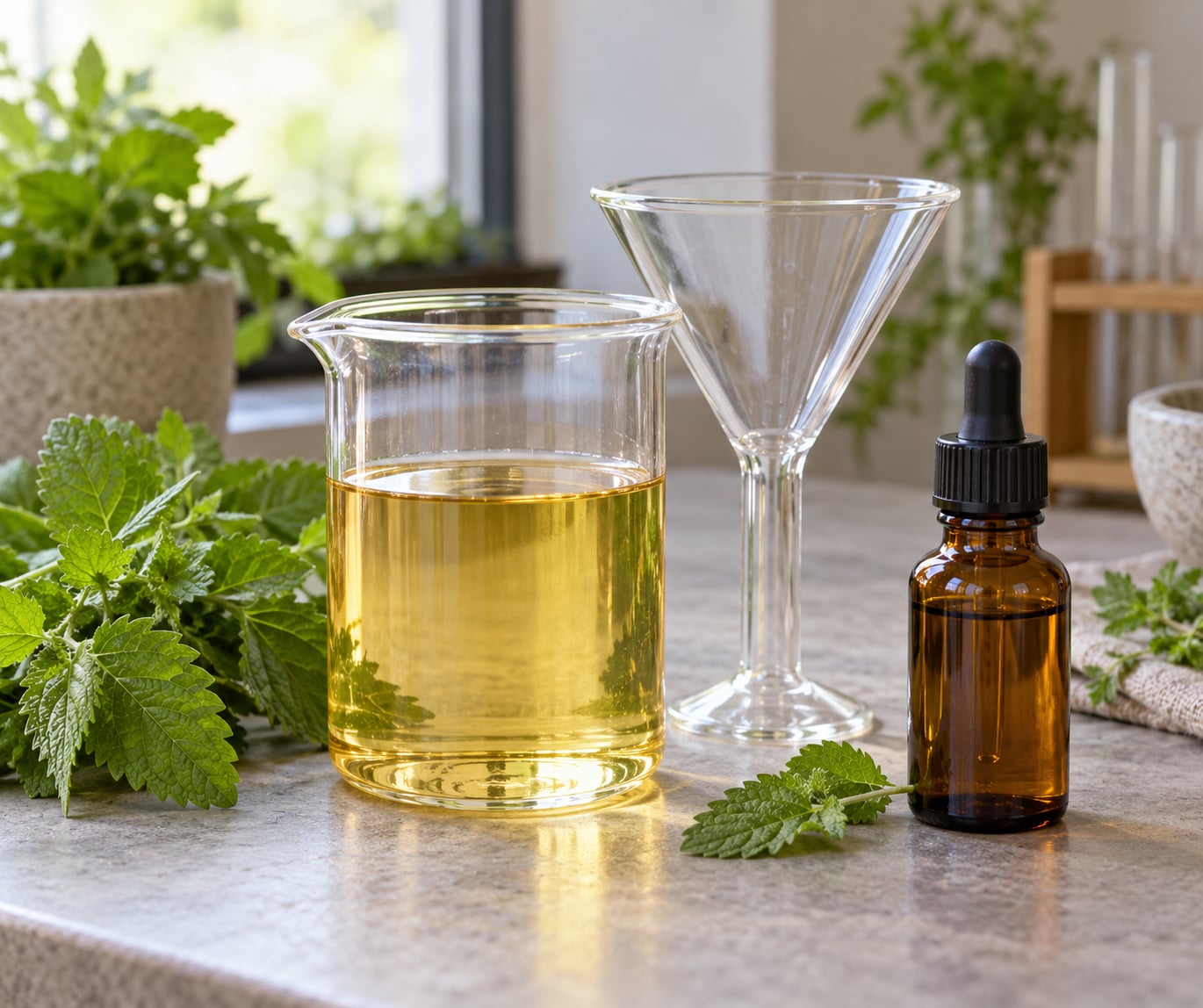
The solvent has its own name in herbalism: the menstruum. Plant material sits in the menstruum during maceration, dissolved constituents pass into the liquid, and the wet spent plant matter strained out afterwards is called the marc. What you pour off is the extract.
The United States Pharmacopeia and the National Formulary define a tincture as an alcoholic or hydro-alcoholic solution of a medicinal substance, commonly at roughly a 1:5 weight-to-volume ratio, while a fluid extract is the more concentrated preparation nearer 1:1. Strength is labelled as ABV or proof, and 80 proof equals 40 percent alcohol by volume.
One detail often missed: the menstruum is rarely neat spirit. Most tinctures use diluted ethanol, because a small amount of water swells plant tissue and releases polar constituents better than pure alcohol can on its own.
Why Is Alcohol Used Instead of Water?
Water pulls out what water can carry: sugars, minerals, mucilage, tannins and other polar compounds. Those are genuine constituents, but they are only part of what a plant contains, and plant tissue is built around waxes, resins and oils that simply will not go into solution in water.
Ethanol bridges that gap. Its molecule is polar enough to carry water-soluble material and small enough to sit comfortably beside oily and resinous material, which is why a mixed ethanol and water solvent can lift several classes of compound in one pass. Extraction also happens cold, so volatile oils and heat-sensitive glycosides survive a process that would damage them under a boiling decoction.
The difference that matters most day to day is shelf life. A water decoction behaves like food: it needs refrigeration and spoils within days. A tincture at a preservable strength does neither.
Alcohol is not automatically the better choice, though. It draws a different set of constituents than water does, and for certain plant parts and preparation goals a water extract is the sensible option.
How Alcohol Concentration Changes Extraction
Strength decides what you get in the bottle, and the ranges below are the ones herbalists and botanical extractors work with most often.
| Ethanol strength | Constituents it tends to draw out | Extraction notes | Flammability |
|---|---|---|---|
| 25 to 35 percent | Tannins, sugars, glycosides, mineral salts, mucilage | Gentle profile, suits flowers, leaves and high-mucilage material | Low |
| 40 to 50 percent | Broad mix, adding some oils and resins to the polar fraction | The common working range for dried roots, bark and leaf | Moderate |
| 60 to 70 percent | Oleoresins, gums, resins, many alkaloids | Needed for sticky material that clogs plant matter at lower strengths | High |
| 75 to 95 percent | Volatile oils, waxes, resins, most alkaloids and bitters | Lab and pharmaceutical scale extraction; little extraction at the extremes | Very high, storage needs care |
Higher strength is not automatically better. The table shows the tradeoff plainly: you gain the resinous and volatile fraction and lose the polar one, and you gain a flammable liquid to store at home.
Why Alcohol Is Used in Herbal Extracts: The Main Reasons
1. It dissolves plant compounds water cannot reach
Alkaloids, resins, volatile oils and much of a plant’s bitter fraction are poorly soluble in water. Ethanol dissolves them readily, so a tincture carries a far wider chemical profile than a cup of tea or a water decoction from the same plant.
2. It draws material out without heat
Maceration works at room temperature, so no boiling step is needed. Labellers who percolate with alcohol report that a solvent passed slowly through plant matter pulls compounds out more evenly than a passive soak, because fresh solvent keeps meeting fresh material as it moves down the column.
3. It preserves the extract in the bottle
This is the reason herbal preparations have survived in bottles for centuries. Ethanol at a preservable concentration denatures microbial proteins, so mould, yeast and bacterial spoilage are held off without heat, without preservatives and without refrigeration. The National Center for Complementary and Integrative Health at the NIH notes that alcohol and glycerin are the solvents most often used because both suppress microbial growth.
4. It keeps the preparation stable and scalable
A hydro-alcoholic extract is repeatable. Concentration, extraction ratio and plant part can be specified, measured and reproduced batch after batch, which is why pharmaceutical and herbal manufacturing practice works in solvent percentages rather than in cups of water. The European Medicines Agency and US supplement manufacturing rules under 21 CFR Part 111 both assume a controlled, documented process rather than a household brew.
Alcohol, Water, and Glycerin Compared
Here is how the common herbal solvents line up on the practical points people actually compare.
| Solvent | Extraction profile | Shelf life | Ease of preparation | Flammability | Main limitation |
|---|---|---|---|---|---|
| Ethanol (hydro-alcoholic tincture) | Widest range: polar and resinous constituents together | Years at a preservable strength | Easy, no heat needed | Yes | Excludes people avoiding alcohol |
| Water (decoction or infusion) | Polar only: sugars, minerals, mucilage, tannins | Days, with refrigeration | Easy, needs heat | No | Misses resins and volatile oils |
| Glycerin (glycerite) | Good on tannins, mucilage and some glycosides | Months to a year | Easy | No | Weaker on volatile oils and resins |
| Vinegar (acetic acid) | Mineral and alkaloid fraction | Months to a year | Easy | No | Strong taste and odour |
| Oxymel (honey and vinegar) | Mild solvent combined with a demulcent base | About a year | Easy | No | Least concentrated of the group |
| Infused oil | Lipophilic fraction only: oils, waxes, fat-soluble material | Months, varies widely | Needs heat or a long steep | No | Poor for water-based constituents |
One point deserves saying plainly: solvent choice tells you what came out of the plant, not whether a preparation works. Whether any herbal product has a clinical effect is a separate question that requires evidence, and reading a label will not answer it.
What Alcohol Cannot Do in an Extract
Alcohol does not make a remedy safe, complete or proven. It does not preserve a preparation indefinitely, because ethanol evaporates from an opened bottle and the preservable concentration slowly falls below the level that blocks microbial growth.
It also does not extract everything. Heat-sensitive constituents and plant material degraded before it reached the bottle stay degraded, no matter how good the solvent was. And it does not convert a traditional preparation into an evidence-based treatment; a long history of use is a record of practice, not proof of clinical effect.
Finally, alcohol does not make a product safe for ingestion. Denatured alcohol, isopropyl alcohol and methanol are not interchangeable with food-grade ethanol, and anything sold without a stated solvent concentration is not something you can evaluate.
What Safety Questions to Ask Before Using a Product
Before using any prepared herbal extract, work through these checks:
- Does the label state the alcohol percentage, the plant part used and the herb-to-solvent ratio? A manufacturer with nothing to hide prints all three.
- Is the botanical name given, not just a common name? Common names are ambiguous across regions.
- Are both the solvent and its concentration disclosed, so you can judge whether alcohol is present for you?
- Are there independent batch or identity testing records?
- Do you react to any of the plant family ingredients, or to alcohol itself?
- Do any of your medications interact with alcohol, including disulfiram, some antibiotics, sedatives and many cold and cough preparations?
Pregnancy and breastfeeding, childhood, liver disease and a personal history of alcohol use disorder are all reasons to speak to a qualified health professional first. People who must avoid alcohol entirely can look at glycerites, vinegars, oxymels or water extracts, understanding that each pulls a narrower range of constituents.
Frequently Asked Questions
What percentage of alcohol is normally used for herbal extraction?
Most herbal tinctures sit between 40 and 60 percent alcohol by volume, which covers the polar and resinous constituents together. Gentler preparations for leaves, flowers and mucilage-rich plants run 25 to 35 percent, while resins, gums and volatile oils generally need 60 percent or higher. Commercial botanical extraction often uses 60 to 95 percent for standardised products. The right figure depends on the plant part and the constituents you are after, not on a single house standard.
Does alcohol extract more plant compounds than water?
It extracts a wider range, though not more of everything. Water is better for sugars, minerals, mucilage and tannins, while ethanol carries alkaloids, resins, volatile oils and bitters that water leaves behind. A diluted ethanol solution often outperforms either pure water or pure spirit because the water fraction swells plant tissue and the ethanol fraction carries the non-polar material. Comparing solvents by total yield alone is misleading; compare what each one holds.
Is an alcohol-based herbal extract always stronger?
No. Strength and solvent are different things. A dilute ethanol tincture may hold more of a plant’s chemistry than a glycerite, but the two are not directly comparable, and neither label tells you anything about clinical effect. Higher alcohol percentages also pull a narrower profile, so pushing to 95 percent can mean losing the polar constituents that water would have captured. Concentration should follow the plant part and the target compounds.
Does alcohol make a herbal preparation safe to take?
It makes the preparation more stable, not more safe. Alcohol inhibits microbial spoilage, but it does not verify botanical identity, screen for contaminants, or confirm that a traditional preparation has any clinical benefit. It can also be genuinely inappropriate for anyone avoiding alcohol, for people taking interacting medication, and for children. Ask a doctor or pharmacist if any of those apply to you before using a prepared extract.
Can glycerin or water be used instead of alcohol?
Both work, and both are common in alcohol-free products. Glycerin is a good solvent for tannins, mucilage and some glycosides, and it is a common choice when alcohol is unsuitable. Water pulls polar constituents and needs refrigeration. Neither matches ethanol across the whole spectrum of plant chemistry, and both can weaken over time. Many people use them as practical alternatives rather than as exact equivalents of a tincture.
Why can alcohol-based herbal extracts be hazardous to handle?
The hazard is flammability. Ethanol at 40 percent and above gives off vapour that ignites readily, so high-strength extracts need to be stored away from heat, flames and sparks, in a closed container, and kept out of reach of children. Direct handling also raises drying and irritation concerns for skin and eyes. During any home preparation, never heat alcohol or work near an open flame, because the vapour is the real hazard rather than the liquid.
Start with the label, not the marketing. Look for the alcohol percentage, the botanical name, the plant part and the extraction ratio; if those are missing, you have no way to judge what you are holding. From there, the solvent question usually answers itself: ethanol when you want the widest range of constituents and the longest shelf life, glycerin, vinegar or oxymel when alcohol is not an option, and a professional consultation whenever medication, pregnancy or children are involved.