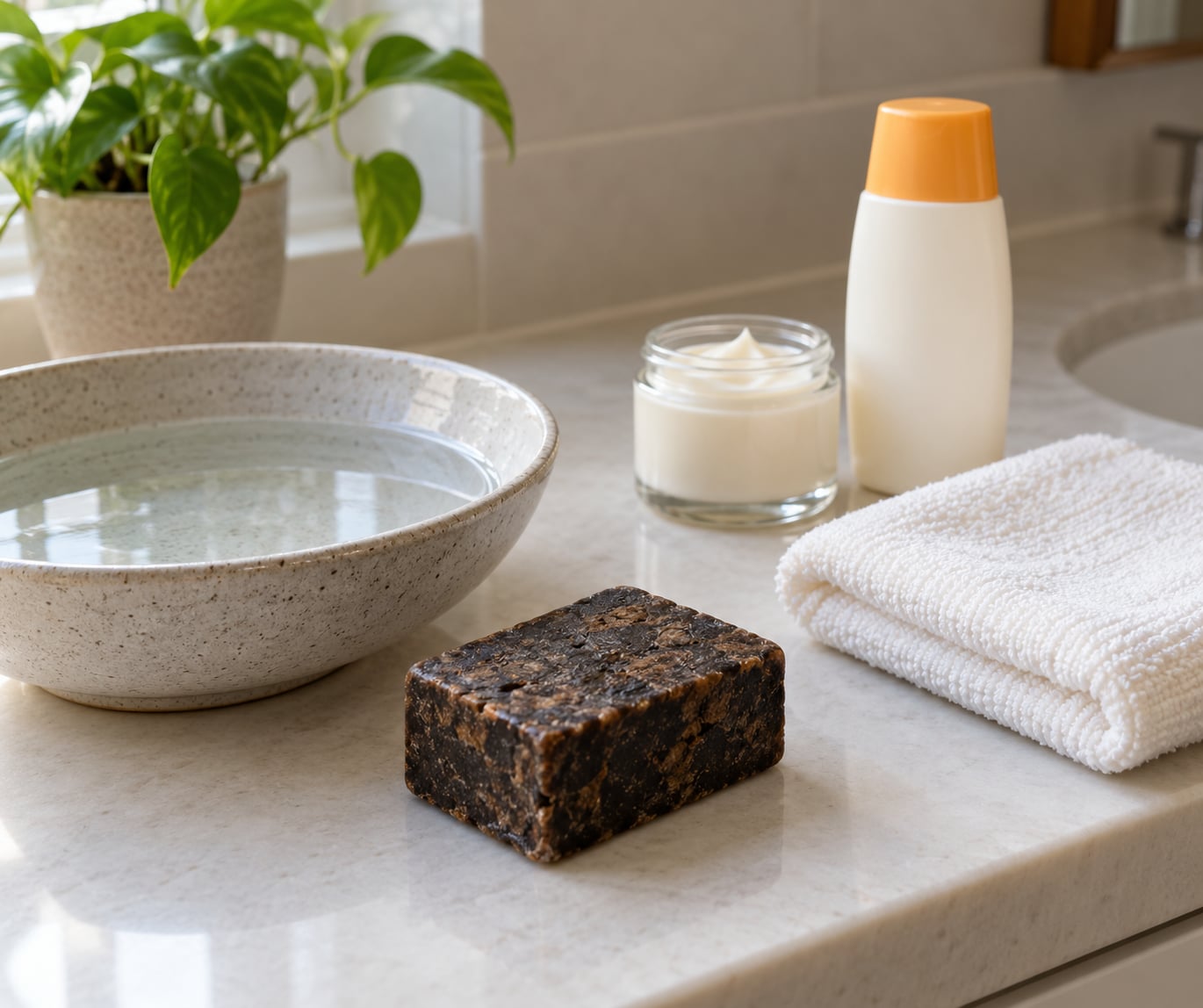
African black soap can help with congested, oily, acne-prone skin, but it works as a cleanser and mild exfoliant, not as an acne treatment. Learn how to use African black soap for acne by diluting it, keeping the contact time short, starting slowly and moisturising straight after. Most of the trouble people have with it comes from using too much, too often.
The soap is not a modern formula. It is saponified from plant ash — cocoa pod ash, plantain skin ash or palm bunch ash — combined with palm kernel oil, coconut oil and often shea butter. In Nigeria it is known as ose dudu, in Ghana as Alata Samina. That ash is where the dark colour, the earthy smell and the alkaline pH all come from.
Set expectations before you lather anything. Traditional use is well documented; clinical proof that it clears acne is not. Nobody has run a controlled trial showing African black soap cures acne, and a soap sold as a cosmetic is not allowed to claim that it does. If you have moderate to severe acne, painful cysts or scarring, a dermatologist is the right person to see, not a bar of soap.
Here is the method that keeps your skin barrier intact: patch test, dilute, lather in your hands, brief contact, lukewarm rinse, moisturise. It takes about five minutes.
Table of Contents
- 1What You Need
- 2Step-by-Step
- 3How to Patch-Test African Black Soap
- 4How to Use African Black Soap on Acne-Prone Skin
- 5How Often Should You Use African Black Soap?
- 6What to Do After Washing
- 7Common Mistakes
- 8Purging or a Bad Reaction?
- 9When African Black Soap Is Not Appropriate
- 10Frequently Asked Questions
- 11Does African black soap cure acne?
- 12Do dermatologists recommend African black soap?
- 13What are the side effects of African black soap?
- 14Why is African black soap breaking me out?
- 15What happens if I use African black soap every day?
- 16Does African black soap fade acne scars and dark spots?
- 17Conclusion
What You Need
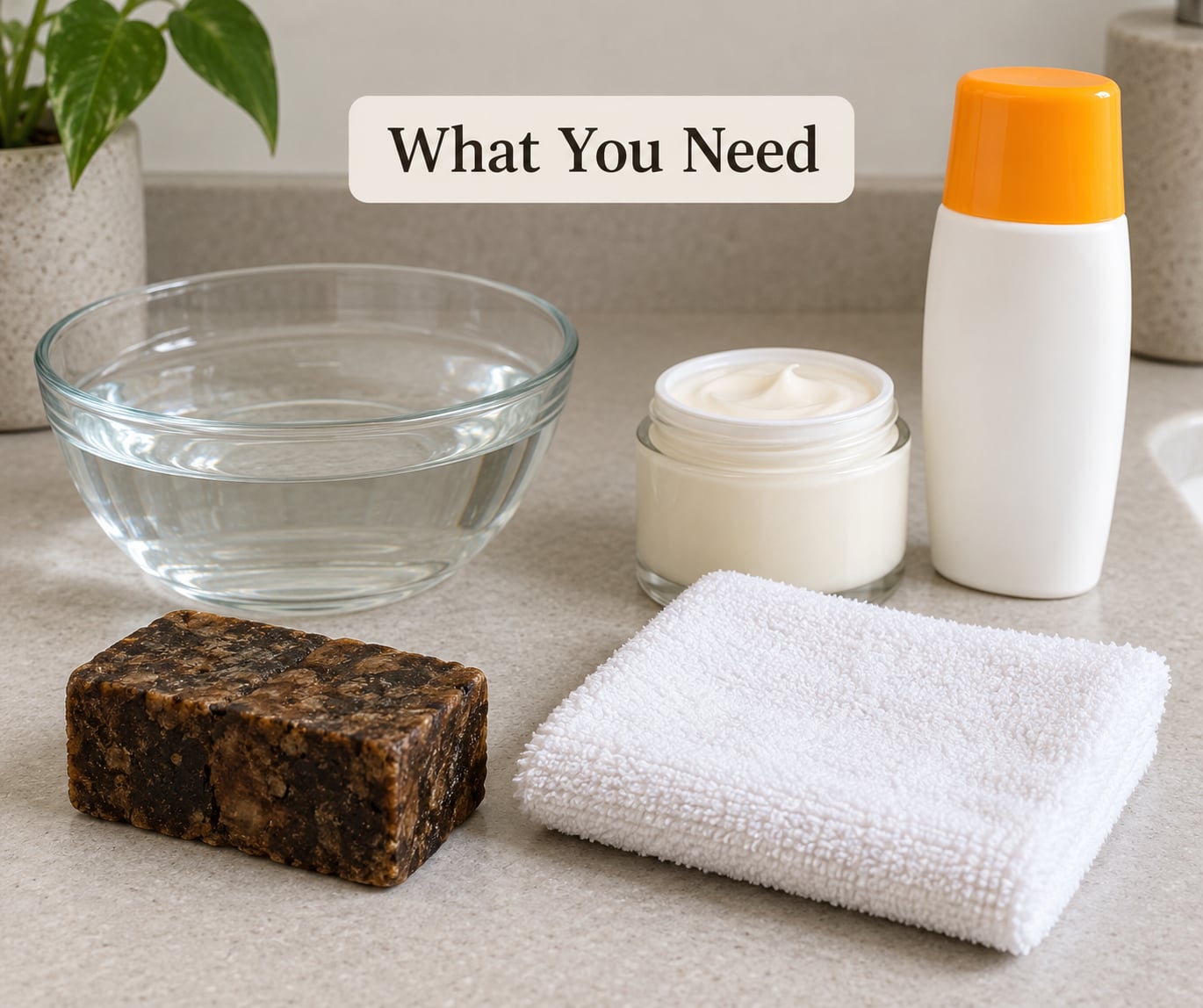
You need very little. Grab a bar that is clearly labelled, with an ingredient list and the ash source named if the maker bothers to say so. Cheap and unlabelled bars sold as “black soap” are sometimes shampoo bars or detergent-grade blocks in dark packaging, and the last thing you want on an acne-prone face is a detergent.
Alongside the soap:
- Lukewarm water. Hot water strips more oil and leaves skin tight.
- A simple, low-foam cleanser for the second cleanse if you wear sunscreen or makeup.
- A clean, soft cloth or muslin, if you prefer it to fingertips.
- A plain, non-comedogenic moisturiser — gel, cream or lotion, fragrance-free if your skin reacts easily.
- A broad-spectrum sunscreen for daytime.
- A timer or your phone, because contact time is the step everyone rushes.
Read the label directions before anything else. They take priority over this guide, because a mass-produced bar with added glycerin behaves differently from a raw ash-made one.
Step-by-Step
The protocol is six moves: patch test, dilute, lather, contact, rinse, moisturise. Here is each one.
How to Patch-Test African Black Soap
Patch testing means a small amount on a discreet spot, then 24 to 48 hours of waiting. Put a coin-sized smear behind your ear or on your inner forearm, leave it unwashed, and go about your day. Look for burning, itching, redness that lingers, swelling or a raised rash. Any of those means you stop and wash it off.
A patch test rules out a lot, not everything. It cannot tell you how your face will behave over weeks, and it cannot predict a reaction to an ingredient you have never met. That is still the cheapest insurance available.
Set a 48-hour window before the first real use. Do not rush it because the bar looked intriguing in the shop.
How to Use African Black Soap on Acne-Prone Skin
Wet your face with lukewarm water and take a small amount of the bar. Lather it fully between your damp palms until you get a soft foam. Skip the bar directly on your face — dragging a solid block across skin is how people end up raw and stripped.
Work the lather onto affected areas with flat fingers, using light circular motions for no more than about 30 to 60 seconds. Then rinse with lukewarm water and pat dry with a clean towel rather than scrubbing.
If your skin stings the moment the lather lands, rinse immediately. That is a pH signal, not a challenge to push through. It is also worth trying the dilution trick that sensitive-skin videos demonstrate: mix a teaspoon of lather into a small bowl of water first, then apply the thinner solution. It reduces the alkalinity hitting your barrier.
Never use it on deep, painful, inflamed or open acne, on weeping skin, or on a fresh wound. Those areas need medical attention, not a cleanser.
For body acne on the back, chest and shoulders, the same steps apply with one change: contact time can run longer, 60 to 90 seconds, since skin on the torso is thicker and less reactive. Rinse in the shower and moisturise within a few minutes, before the water evaporates.
How Often Should You Use African Black Soap?
Start at two or three times a week, no more, and only move up if your skin is comfortable. Using it every day from day one is the single most common mistake, and it is why so many people say it made their acne worse.
| Period | Frequency | What you are watching for |
|---|---|---|
| Weeks 1 to 2 | Every second or third day | Any stinging, tightness or new flaking. Stay at this pace or stop. |
| Weeks 3 to 4 | Alternate days | Slightly less oil by evening. Purging bumps may appear. |
| Week 5 onward | Daily at most, only if needed | Balance. If your skin feels tight after washing, go back down a step. |
More frequent use does not make acne improve faster. If anything, over-cleansing triggers rebound oil production and flaking that people read as new breakouts.
Season matters too. In humid heat, sweat and oil already do a lot; once or twice a week may be plenty. During dry cold air — the Harmattan season in West Africa, or a northern winter — the same routine can feel stripping, so drop to once a week and lean harder on moisturiser.
What to Do After Washing
Pat, don’t rub, and apply your moisturiser while the skin is still slightly damp. That window is short — a minute or two — but it is when moisturiser does the most work, because damp skin holds water better than dry skin.
Look for a non-comedogenic moisturiser with glycerin, ceramides or hyaluronic acid. One r/Blackskincare user builds a face-wash base from African black soap and adds a neutral oil, keeping salicylic acid in the moisturiser to control congestion. That works better than leaving salicylic acid in the wash, where it rinses away before it works.
Sunscreen is non-negotiable the morning after. Oil-removing cleanses leave skin more light-sensitive, and any active treatment you add on top raises that sensitivity further. Post-inflammatory hyperpigmentation — the dark mark left behind after a spot heals — is far easier to prevent than to fade, especially on deeper skin tones.
Common Mistakes
Almost every complaint about African black soap traces back to one of these.
Using it on broken or infected skin. Open, weeping or infected acne is a medical matter. Cleansing it twice a day makes it worse and can spread bacteria.
Scrubbing. The lather does the work. Circular motions should last 30 to 60 seconds, not the two minutes people spend when they think the soap needs to earn its keep.
Over-drying. If your face feels tight and squeaky after rinsing, you stripped it. Use less soap, dilute it, or cut the frequency.
Stacking harsh actives. Combining black soap with a strong exfoliant or a retinoid on the same night stacks irritation from two directions. One change at a time, and never two new products in the same week.
Skipping sunscreen. Unprotected skin after an oil-cleansing wash burns more easily, and marks linger longer.
Quitting in the first fortnight. Users on r/SkincareAddiction report the clearest results after a few consistent weeks. That is not a rule, just a common report. If you are in that window, slow down rather than speed up — but know when to stop.
Purging or a Bad Reaction?
These look similar in week one and call for opposite decisions, so tell them apart.
| Sign | Likely purging | Likely reaction |
|---|---|---|
| Timing | Starts within a few days, eases by 2 to 4 weeks | Starts within hours of the first use |
| What appears | Small whiteheads surfacing, mostly in usual acne areas | Itching, swelling, hives or a red rash spreading beyond where you applied it |
| Sensation | Mild tightness that fades after moisturiser | Burning or stinging that does not settle |
| Action | Slow the frequency, moisturise, watch for a week | Wash it off and stop entirely |
On r/acne, one commenter started black soap before adding tretinoin and had good results, then broke out badly when running both at once. The pattern is familiar: too much active activity in the same window, not a failure of either product.
When African Black Soap Is Not Appropriate
Stop using it and get medical help if you develop swelling of the face or eyes, hives, difficulty breathing, or symptoms that spread and worsen quickly. Soak the area with cool water, do not apply anything else, and seek care.
Signs of infection need a clinician: increasing pain, warmth, pus, red streaks spreading from a spot, or fever. No soap addresses that.
Talk to a dermatologist before using it if you have eczema, psoriasis or dermatitis, if your skin barrier is already damaged from other actives, if you have a chemical peel or laser treatment in the last few weeks, or if you are pregnant and want to use a botanical on your face. And if you are already on tretinoin, adapalene, clindamycin or any prescription topical, do not add a strongly alkaline soap without asking your prescriber — the irritation risk is the issue, not the ingredients.
Hormonal acne, especially along the jaw, usually needs prescription treatment rather than a cleanser change. That is not a failure of the soap; it is the nature of the condition.
Frequently Asked Questions
Does African black soap cure acne?
No. African black soap is a cleanser and mild physical exfoliant, not an acne treatment. Traditional use for oily and congested skin is well documented, but no controlled clinical trial has shown it cures acne. Used diluted and started slowly, it may help clear congestion and excess sebum. For persistent, painful or scarring acne, see a dermatologist.
Do dermatologists recommend African black soap?
Most dermatologists do not recommend it as an acne treatment, largely because no clinical trials support the claim and it is often strongly alkaline, which can strip the skin barrier. Some will accept it as a personal preference cleanser if you use it gently, dilute it and moisturise afterwards. Ask your own dermatologist before adding it alongside prescription topicals.
What are the side effects of African black soap?
The common ones are tightness, dryness, flaking, stinging and redness on contact, especially on sensitive skin or when used daily. Its alkaline pH can disrupt the skin barrier and make skin more sensitive to sun. Some people react to an ingredient such as a plantain or cocoa derivative. Stop if you see swelling, hives or a spreading rash.
Why is African black soap breaking me out?
Two common reasons. Early bumps surfacing in the first one to two weeks are often purging as congestion clears, and they usually settle. Breakouts that continue past that window are more likely over-cleansing, a reaction to an ingredient, or an oily moisturiser applied straight afterwards. Drop to twice a week, switch to a simpler moisturiser, and reassess after two weeks.
What happens if I use African black soap every day?
Most people are fine with daily use once their skin adjusts, but starting there is a mistake. Daily washing with an alkaline soap strips oil and lipids, which can trigger rebound sebum and leave skin tight and flaky. Start every second or third day, moisturise while the skin is still damp, and drop to alternate days whenever it feels tight or irritated.
Does African black soap fade acne scars and dark spots?
It may help with post-inflammatory hyperpigmentation — the flat dark marks left after a spot heals — by reducing ongoing congestion and irritation, and sunscreen is what actually fades them. It will not remove indented or hypertrophic scars, which form deeper in the skin and usually need treatment from a dermatologist. Set that expectation before you start.
Conclusion
Start with the patch test, not the bar. Use a small amount of lather diluted in water, keep contact under a minute, rinse with lukewarm water and moisturise while your skin is damp.
Then wait. Clear congestion takes weeks, and the honest version of how to use African black soap for acne is: it is a support step in a routine, not a cure. If your acne is persistent, painful, spreading or leaving marks, book a dermatologist — that is a short conversation, and it will save you months of guessing with a bar of soap.