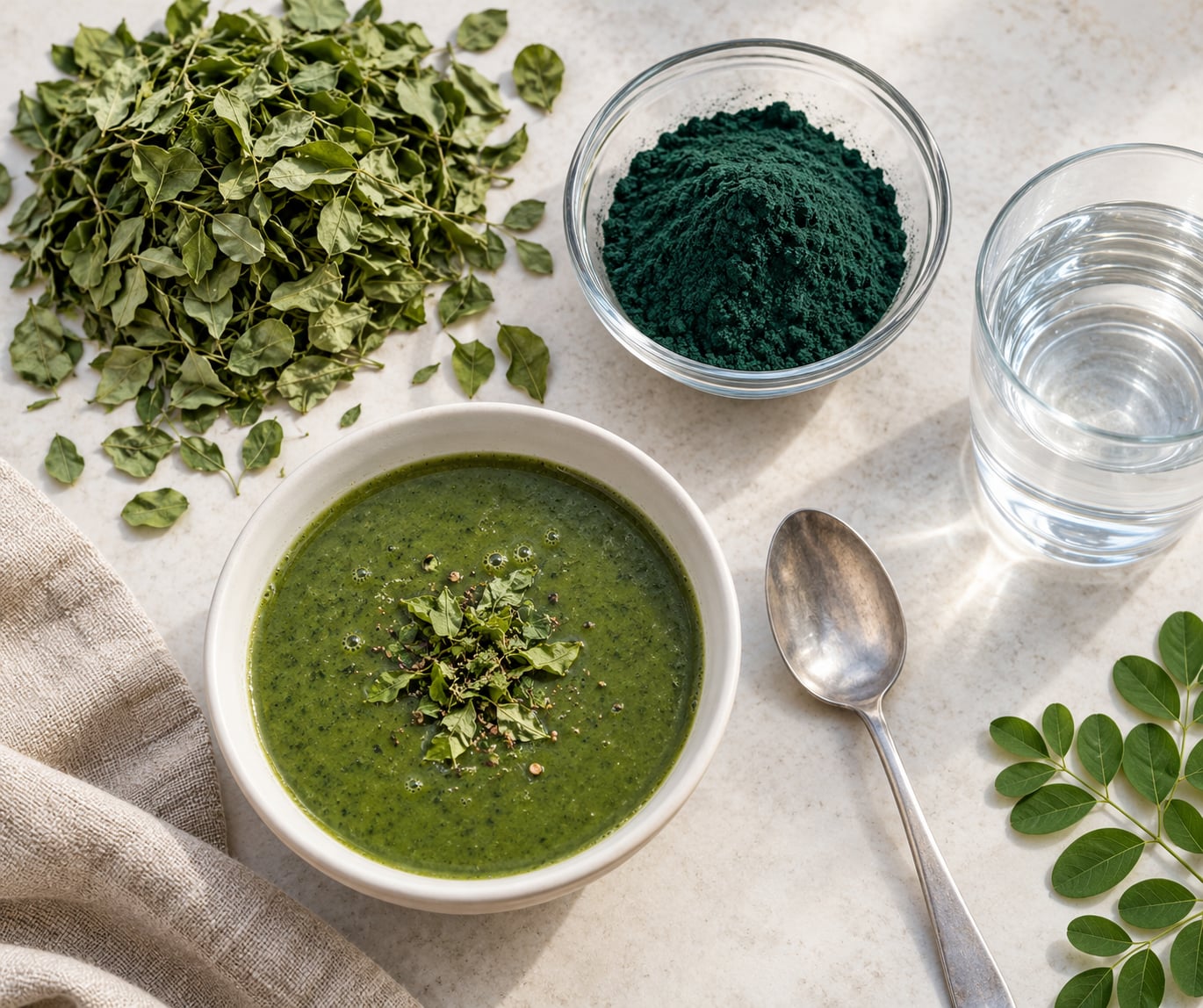
Moringa vs spirulina for nutrition has no all-round winner. Spirulina is the denser protein and iron source per gram of dried powder, while moringa leaf is the better fit when you want calcium, vitamin A and something you can actually cook with. The comparison most websites get wrong is pitting fresh moringa leaves against dried spirulina, which inflates the gap between them.
I have read enough supplement labels and nutrient databases to be wary of the word superfood. Both of these plants carry real nutrients, and both carry marketing attached to them. This guide is about the numbers, the forms, and the safety checks that matter when you decide.
Below is what the comparison actually looks like, what a realistic serving delivers, and where the research is thin.
Table of Contents
- 1Moringa vs Spirulina for Nutrition at a Glance
- 2What Is Moringa?
- 3What Is Spirulina?
- 4Nutritional Profiles: Moringa vs Spirulina
- 5Which Has More Protein and Key Minerals?
- 6Moringa vs spirulina for nutrition: the protein, iron and calcium numbers
- 7Potential Benefits and What the Evidence Does Not Prove
- 8Safety, Side Effects, and Special Precautions
- 9Taste, Texture, and Ease of Use
- 10Moringa vs Spirulina for Everyday Diets
- 11Can you take moringa and spirulina together?
- 12Which Should You Choose?
- 13Frequently Asked Questions
- 14Is moringa or spirulina more nutritious overall?
- 15Can moringa or spirulina replace a multivitamin?
- 16Which is better for protein and iron?
- 17Does moringa or spirulina taste better?
- 18How can I choose a safe and accurately labeled product?
- 19Is it safe to take moringa or spirulina every day?
- 20Bottom Line
Moringa vs Spirulina for Nutrition at a Glance
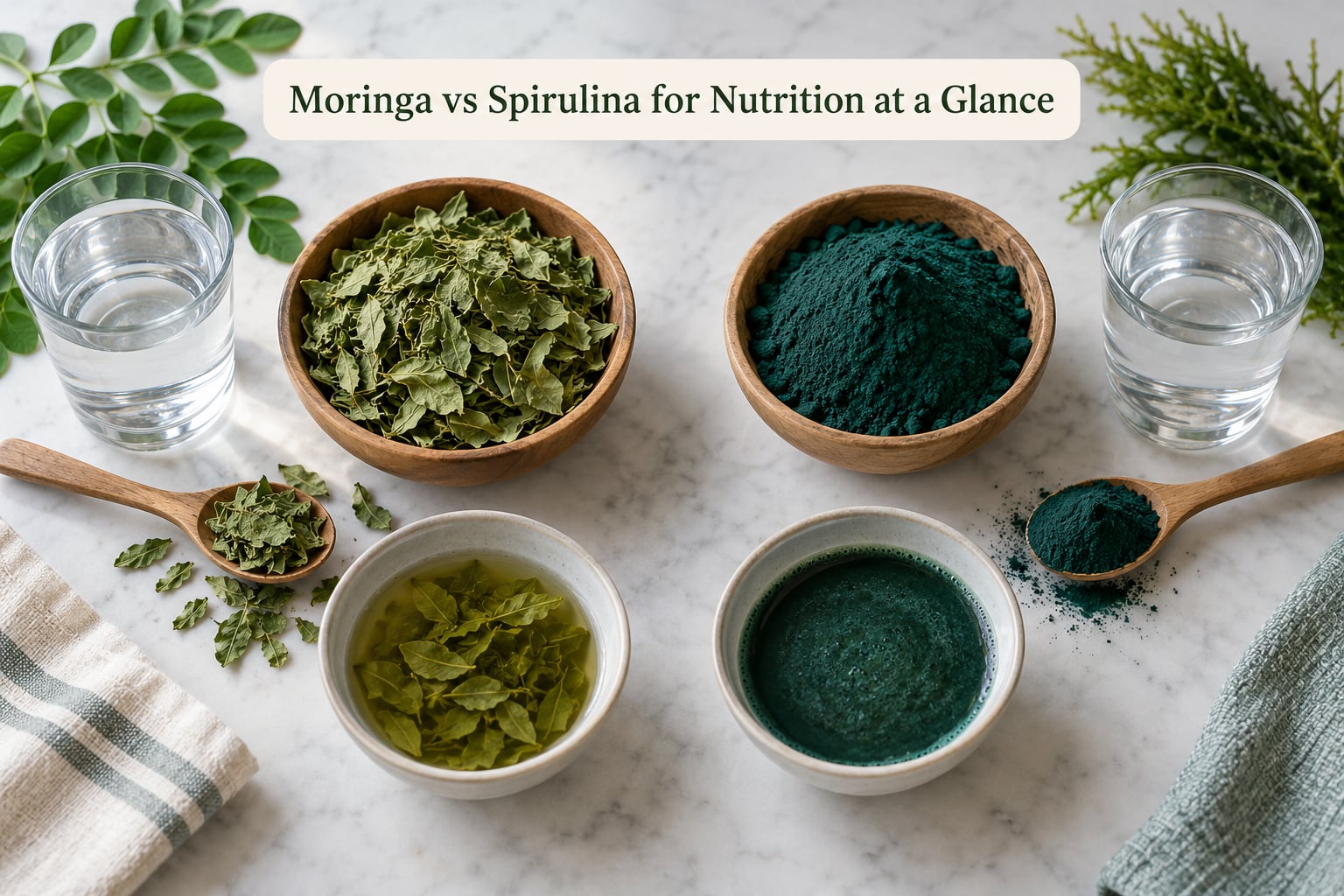
Moringa and spirulina come from completely different kingdoms of life, which is why their nutrient profiles overlap only partly. Moringa is the dried leaf of a tree. Spirulina is a photosynthetic cyanobacterium grown in warm, alkaline, nutrient-enriched water and harvested as a biomass.
| Criterion | Moringa (Moringa oleifera leaf) | Spirulina (Arthrospira platensis) |
|---|---|---|
| What it is | Dried leaf of a fast-growing tropical tree | Blue-green cyanobacterium cultivated in shallow ponds |
| Typical form | Leaf powder, whole leaves, capsules, teas, tinctures | Powder, flakes, tablets, fresh biomass |
| Protein | Moderate; higher when compared as dry weight | High, roughly half to two-thirds of dry weight |
| Iron | Meaningful per 100g fresh leaf, low in a capsule serving | Higher per gram, still modest in a small serving |
| Calcium | Its standout nutrient | Present but far lower than moringa |
| Vitamin A | High as beta-carotene in fresh leaf | High as beta-carotene in dried powder |
| Fats | Mostly unsaponifiable constituents in leaf and seed oil | Very little; a small fraction of essential fatty acids |
| Fibre | Noticeable in whole leaf and powder | Low; cell walls are largely broken down in the biomass |
| Taste | Mild, leafy, slightly peppery or bitter | Strong marine, earthy, sometimes nutty or peppery |
| Best fit | Cooking, soups, teas, filling a micronutrient gap | A concentrated protein and iron powder, smoothies, tablets |
| Key caution | Variable quality; pregnancy and thyroid medication cautions | Microcystin and heavy metal screening; rare liver injury reports |
Values in every nutrition table vary with species, growing conditions, harvest timing, drying temperature and serving size. Treat all figures below as typical, not as a promise about the product in your cupboard.
What Is Moringa?
Moringa is the dried leaf of Moringa oleifera, sometimes called the drumstick tree or ben oil tree, a drought-tolerant tree native to the Indian subcontinent and now cultivated across the tropics. Its pods are eaten as a vegetable in several South Asian cuisines, its seeds yield a stable cooking oil, and its leaves are the part sold as a supplement.
Not all moringa products are the same thing, and the distinction matters more than any brand name. Leaf-only powder concentrates the micronutrients. Whole-plant powder that includes stems and bark dilutes them and brings along a different compound profile. Seed oil is a cooking fat, not a nutrient powder, and root preparations are a separate category entirely with their own cautions.
Moringa carries a long ethnobotanical record. Ayurvedic practice used the leaves, pods, roots and bark in different ways, and across West and Central Africa the leaves have been boiled into soups and sauces while the pods appear in stews. That culinary history is worth remembering, because it tells you the leaf was treated as a vegetable food first and a packaged supplement second.
Moringa’s vitamin A content comes mostly from beta-carotene, which the body converts as needed, and its iron is nonheme, the plant form absorbed less efficiently than iron from meat. Moringa also contains quercetin and kaempferol, two flavonoids that show up in most of the phytochemistry literature on the plant.
What Is Spirulina?
Spirulina is Arthrospira platensis, a photosynthetic cyanobacterium, not an algae in the strict taxonomic sense though the name blue-green algae is still widely used. It is cultivated in warm, shallow, alkaline ponds with a high pH, which is what keeps competing organisms out and what gives harvested biomass its dark colour.
Most commercial spirulina is farm-grown and dried quickly, often on large heated dryers, because the pigment phycocyanin breaks down with heat and moisture. Fresh spirulina biomass, flakes and tablets exist too, and they are not nutritionally identical to a hot-dried powder.
Harvesting spirulina is not a modern invention. Kanemb communities around Lake Chad in West Africa collected surface mats and dried them into cakes, and later Mexican and Central American communities near Lake Texcoco harvested comparable mats from naturally alkaline lakes. Today’s ponds reproduce a process people have used for centuries.
What makes spirulina distinctive nutritionally is protein. It is roughly half to two-thirds protein by dry weight, contains all the essential amino acids in reasonable proportion, and has an unusually high fraction of that protein in the form of phycocyanin, the blue pigment that gives the powder its colour. Iron is higher than in moringa powder on a dry-weight basis, and vitamin A precursor beta-carotene is substantial, though drying cuts carotenoids noticeably.
Nutritional Profiles: Moringa vs Spirulina
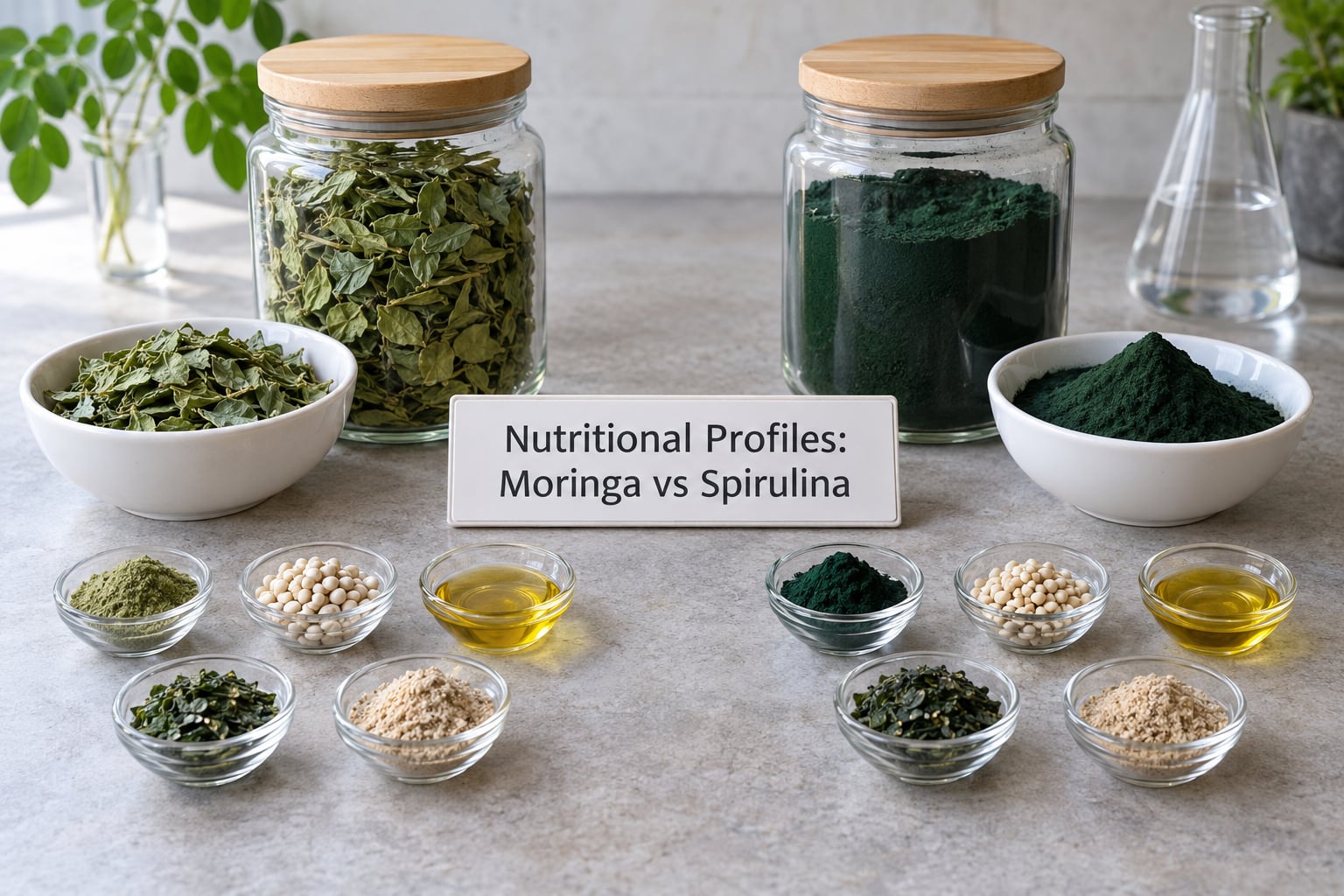
The single most useful thing you can do before comparing any two greens is decide what weight basis you are on. Fresh moringa leaf is roughly 70 to 80 percent water. Dried spirulina powder is essentially all solids. Comparing them is like comparing a cucumber to a tortilla.
| Nutrient (per 100 g) | Spirulina, dried powder | Moringa leaf, fresh | Moringa leaf, dry weight basis |
|---|---|---|---|
| Water | 3 to 7 g | about 78 g | near 0 g |
| Protein | about 57 g | about 9 g | about 27 g |
| Fat | about 1.5 g | about 2 g | about 5 g |
| Fibre | low, about 3 to 5 g | about 8 g | about 19 g |
| Iron | about 28 mg | about 4 mg | about 9 mg |
| Calcium | about 120 mg | about 185 mg | about 2,000 mg |
| Magnesium | about 200 mg | about 40 mg | about 360 mg |
| Potassium | about 1,300 mg | about 350 mg | about 1,500 mg |
| Vitamin A (RAE) | about 3,000 mcg | about 380 mcg | roughly 2,000 mcg |
| Vitamin C | low, under 10 mg | about 140 mg | negligible after drying |
These are representative figures in the range published by USDA FoodData Central and equivalent reference databases, rounded for readability. Real batches drift by a wide margin, and heat drying removes a considerable share of vitamin C and carotenoids from fresh moringa.
Two conclusions follow from the table. Spirulina is genuinely more protein-dense per gram, and that is not a marketing artefact. Moringa’s calcium looks modest only because the fresh leaf is mostly water; on a dry basis its calcium is far higher than spirulina’s.
Vitamin C is the one place fresh moringa clearly beats dried spirulina, and it is a point that most comparisons quietly skip. If vitamin C is what you are after, a fresh leaf or a tea made from it is the better route, and capsules are the worst.
Which Has More Protein and Key Minerals?
Spirulina wins protein decisively per gram of dried powder, at roughly 57 g per 100 g against about 27 g for dried moringa leaf. On a fresh-weight comparison the gap narrows to around 57 g against 9 g, but that comparison is not a fair one to act on.
Moringa vs spirulina for nutrition: the protein, iron and calcium numbers
Iron favours spirulina on dry weight, at roughly 28 mg per 100 g against roughly 9 mg for dried moringa leaf. Calcium favours moringa decisively, and on a dry-weight basis it is not close. Magnesium sits between them, and potassium is high in both.
Here is the part most people miss. A typical 500 mg moringa capsule delivers around 1.4 g of dried leaf, which works out to well under half a gram of protein. A single one-gram scoop of spirulina delivers roughly 0.6 g of protein. Neither serving is doing meaningful work on a daily protein target of 40 to 60 g, and anyone marketing them as a protein source is overselling by an order of magnitude.
Iron needs the same reality check. Both supply nonheme iron, which competes with calcium, polyphenols and phytate for absorption, and which vitamin C improves. Moringa leaf also contains polyphenols, and moringa tea with vitamin C-rich citrus is a more sensible pairing than either powder taken in isolation. If iron status is a real concern for you, a clinician-directed plan beats self-supplementation.
For most readers the honest summary is that both are micronutrient sprinkles rather than macronutrient sources. Use them to close gaps, not to substitute for beans, lentils, nuts, dairy or meat.
Potential Benefits and What the Evidence Does Not Prove
Both foods contribute nutrients and antioxidant compounds, and both have research behind them that is mostly small, short and heterogeneous. The gap between what is well established and what is marketed is wide.
Reasonably well supported: moringa leaf is a nutrient-dense food that contributes calcium, vitamin A precursors, vitamin C when fresh, and nonheme iron. Spirulina is a concentrated source of protein, phycocyanin, beta-carotene and nonheme iron. Both contribute polyphenols and flavonoids. Those are nutritional facts about composition.
Less settled: claims about lowering blood sugar, cholesterol or blood pressure come from a mix of laboratory, animal and small human studies with inconsistent methods. Moringa leaf extracts have been studied for effects on lipid profiles and glucose control, and spirulina has been studied for lipids and exercise recovery, but the trials are generally too small and too short to support treatment claims.
Not established at all: that either one treats disease, detoxifies the body, replaces medication, or meaningfully changes liver or kidney function in humans. Spirulina in particular is often described as good for a specific organ, but no supplement has been shown to treat an organ in the way that phrase implies. If a claim about your liver, kidneys or any other organ is what draws you to a supplement, that is a conversation for a doctor, not a label.
One structural problem runs through all of it. Many moringa studies use concentrated leaf extracts at doses nobody eats as food, and many spirulina studies use much larger doses than a scoop delivers. A result from 500 mg of extract does not transfer neatly to a spoonful of leaf powder.
Safety, Side Effects, and Special Precautions
Both are generally tolerated as foods by most adults, and both carry issues that deserve more than a footnote.
Contamination and mislabelling. Spirulina is the one to be most careful about. It can carry microcystins, the liver-damaging toxins produced by other cyanobacteria that contaminate poorly managed ponds, and it can accumulate heavy metals from the water it grows in. Spirulina has also been among the supplements most frequently involved in mislabelling scandals, including products containing little or no spirulina at all.
Moringa quality variation. Plant part, growing conditions and drying temperature all change what you get. A product listing only a proprietary blend tells you nothing about the dose you are taking, which is a complaint that comes up constantly in supplement forums.
Digestive effects. Both are high in fibre per gram and low in total volume, so they can cause gas, bloating or loose stools, more often in capsules and tablets than in powders taken with food. Spirulina’s pigment can also darken stool, which is harmless and frequently alarming to people who were not warned.
Pregnancy and breastfeeding. Moringa leaf in concentrated supplement form is not recommended during pregnancy or breastfeeding. The root and bark are separately cautioned against. Culinary amounts of leaves in food are a different matter, but ask your provider before anything concentrated.
Medication and thyroid interactions. Moringa may interfere with thyroid medication, antihypertensives and diabetes drugs, and it may increase the effect of some sedatives. Spirulina can affect blood clotting and immunity, which matters alongside anticoagulants and immunosuppressants. If you take any regular medication, a pharmacist can check the interaction in under a minute, and that minute is worth it.
Immune conditions and liver history. Spirulina’s immune-modulating activity makes it a poor casual choice with autoimmune disease, and rare cases of liver injury have been reported in the published literature and in LiverTox material on blue-green algae. Anyone with an existing liver condition should get medical clearance first.
Get urgent medical care rather than a supplement forum post if you develop jaundice, dark urine, persistent nausea, unusual fatigue or rash after starting either.
Taste, Texture, and Ease of Use
Moringa tastes mild and leafy when it is good, with a peppery or slightly bitter note that hides well in savoury dishes. Fresh leaves have a peppery bite, tea is grassy, and capsules remove the taste question entirely by removing the experience.
Spirulina tastes far stronger, usually described as marine, earthy or nutty with a peppery finish, and it will tint anything it touches a deep blue-green. People who buy a green powder expecting a neutral greens taste are usually disappointed by spirulina in particular, and a small trial pouch before a large tub is the sensible move.
Texture matters just as much. Moringa powder is fine but gritty, and it suspends poorly, so a blender or frother helps. Spirulina clumps more and can feel chalky; tablets and capsules solve mixability at the cost of convenience.
Forms are where the two diverge most in practice. Moringa moves between a vegetable, a tea, a cooking powder and a supplement, which gives you several routes into a meal. Spirulina has fewer of those routes and tends to sit in one of three places: a smoothie, a tablet bottle, or a multi-ingredient greens blend.
Moringa vs Spirulina for Everyday Diets
Moringa fits ordinary food more easily than most greens powders because it was food before it was a supplement. A spoonful of leaf powder goes into soups, stews, curries, sauces and scrambled eggs, and whole leaves cook like any other green. In West African kitchens, a handful of fresh leaves stirred into a soup or thickened sauce is the traditional form, not a modern invention.
Spirulina shows up in smoothies, bowls, shots and frozen cubes, and increasingly in breads and energy bars where the colour is treated as a feature. It is harder to hide in savoury food, which is why it tends to stay in the drink and pill categories.
Can you take moringa and spirulina together?
Yes, most healthy adults can combine them, and plenty of people do. The two do not share a mechanism that would make the pairing meaningfully risky, and there is no established reason the combination is better than either alone beyond variety.
The practical caution is the label, not the pairing. A moringa capsule taken alongside a greens powder that already contains spirulina, or a blend with moringa in it, can quietly stack your dose. Two overlapping products that each look modest can add up. Read the ingredient panels of everything you take before you decide a stack is reasonable.
There is also a milder issue: both are strongly flavoured and both tint food, so combining them in one drink can be an unpleasant surprise rather than a nutritional one. Several capsules and a full greens powder in the morning is a lot of powder for very little return.
Which Should You Choose?
If you can only buy one, the answer depends entirely on the gap you are trying to close, and most readers who ask that question in forums want a decision rather than a balanced non-answer.
| If your priority is | Choose | Why |
|---|---|---|
| More protein per gram of powder | Spirulina | Roughly double moringa’s dry-weight protein |
| More iron per serving | Spirulina | Higher on a dry-weight basis, though still nonheme |
| More calcium | Moringa | Its single most distinctive nutrient |
| Fresh vitamin C | Fresh moringa leaves or tea | Drying removes most of it |
| Cooking with it | Moringa | Leaf, powder and pods all work in savoury dishes |
| A neutral, less intense flavour | Moringa | Usually milder and easier to blend in |
| Capsules or tablets only | Either | Moringa is more commonly sold this way |
| Pregnancy or nursing | Neither, without medical advice | Concentrated moringa is specifically cautioned against |
| Liver or immune condition | Neither, without medical advice | Spirulina carries specific cautions here |
| Any condition, or taking medication | Neither, without checking first | Both can interact with common medicines |
Three practical rules keep the decision honest. Check the serving size on the label, not the per-100 g panel, because that is the number you actually swallow. Look for third-party testing that names microcystins and heavy metals for spirulina, and plant part for moringa. And ask whether you need a supplement at all, since a varied diet covers both of these comfortably.
Frequently Asked Questions
Is moringa or spirulina more nutritious overall?
It depends on what you are short of, and the honest answer is that neither is more nutritious in general. Spirulina is denser in protein and iron per gram of dried powder, while moringa leads on calcium and on vitamin C when the leaves are fresh. If you already eat a varied diet, both are optional extras rather than nutritional essentials.
Can moringa or spirulina replace a multivitamin?
No. Neither contains vitamin D, and neither provides vitamin B12 at any meaningful level, which matters most for vegan and vegetarian diets. Both also fall short of a multivitamin on several other vitamins. A clinician can tell you whether a supplement gap exists at all, and it is usually better addressed with a targeted product than a greens powder.
Which is better for protein and iron?
Spirulina, clearly, and by a wide margin on a dry-weight basis. It carries roughly 57 g of protein and 28 mg of iron per 100 g of dried powder, against about 27 g and 9 mg for dried moringa leaf. Keep the serving size in mind though, because one capsule or one scoop of either delivers well under a gram of protein.
Does moringa or spirulina taste better?
Moringa, for most people. Fresh moringa leaves taste mild and peppery, and the powder works well in soups, sauces and eggs, where its flavour disappears. Spirulina is stronger and more marine, and it tints drinks a deep blue-green. Both come as capsules and tablets if taste is the dealbreaker for you.
How can I choose a safe and accurately labeled product?
For spirulina, look for third-party testing that names microcystins and heavy metals, plus a species name such as Arthrospira platensis and a named cultivation source. For moringa, look for leaf-only powder with the plant part stated and no proprietary blend. Avoid blends that hide doses, and buy from makers who publish their test results rather than asking you to trust a badge.
Is it safe to take moringa or spirulina every day?
Daily use is common and generally well tolerated by healthy adults, though long-term data is limited. Spirulina is the one that needs product-level scrutiny because of microcystin and heavy metal contamination risk. Concentrated moringa is not recommended in pregnancy or breastfeeding, and both can interact with thyroid, blood pressure, diabetes and blood-thinning medication.
Bottom Line
Spirulina is the pick if you want protein and iron density per gram and do not mind a strong flavour. Moringa is the pick if you want calcium, fresh vitamin C, and something you can put in a pot of soup. Neither needs to be in your life if your diet already covers those nutrients.
Start by comparing the serving size rather than the per-100 g panel, check where the product was tested, and if you are pregnant, nursing, managing a health condition or taking regular medication, ask your doctor or pharmacist before you start.