Flavonoids are a large family of polyphenolic plant compounds found in almost every fruit, vegetable, herb and tea you eat. They give many foods their red, purple, yellow and orange colour, and they act as antioxidants in the human body. Diets rich in flavonoids are consistently linked with lower rates of heart disease, type II diabetes and some cancers, which is why nutritionists keep telling you to eat a wide range of colourful plants.
If a search for flavonoids explained for beginners sent you here expecting a chemistry lecture, relax. The short answer is that flavonoids are a large and genuinely interesting group of compounds, and the gap between what a laboratory test tube shows and what happens in a human body is bigger than most supplement labels admit. This guide walks through what flavonoids are, how their structure creates the six main types, where they come from in food, what research actually supports, and how to eat more of them safely.
Table of Contents
- 1What Are Flavonoids?
- 2Four words you will meet in other articles
- 3Flavonoids Explained for Beginners: How Their Structure Works
- 4What Are the Main Types of Flavonoids?
- 5Flavonoids explained for beginners: how they differ from other polyphenols
- 6Where Do Flavonoids Come From in Food?
- 7The top flavonoid-rich foods worth building meals around
- 8What Health Roles Are Supported by Research?
- 9Are African Plants Rich in Flavonoids?
- 10How Can You Eat More Flavonoids Safely?
- 11Frequently Asked Questions
- 12Are flavonoids the same as antioxidants?
- 13Which foods contain the most flavonoids?
- 14Does cooking destroy flavonoids in vegetables?
- 15Are flavonoid supplements better than eating fruit?
- 16How much fruit and vegetables should I eat each day?
- 17Can flavonoid supplements interact with medicines?
- 18Conclusion
What Are Flavonoids?
Flavonoids are polyphenolic compounds that plants make as secondary metabolites. “Secondary” simply means the compound is not needed for the plant to grow or make energy. It is made for other jobs.
Those jobs are worth knowing, because they explain the whole category. Flavonoids act as pigments, which is why they are the reason a blueberry is blue and an onion skin is brownish. They work as a UV shield, protecting plant tissue from sunlight damage. And they function as a chemical defence, deterring insects and fungi from eating the plant.
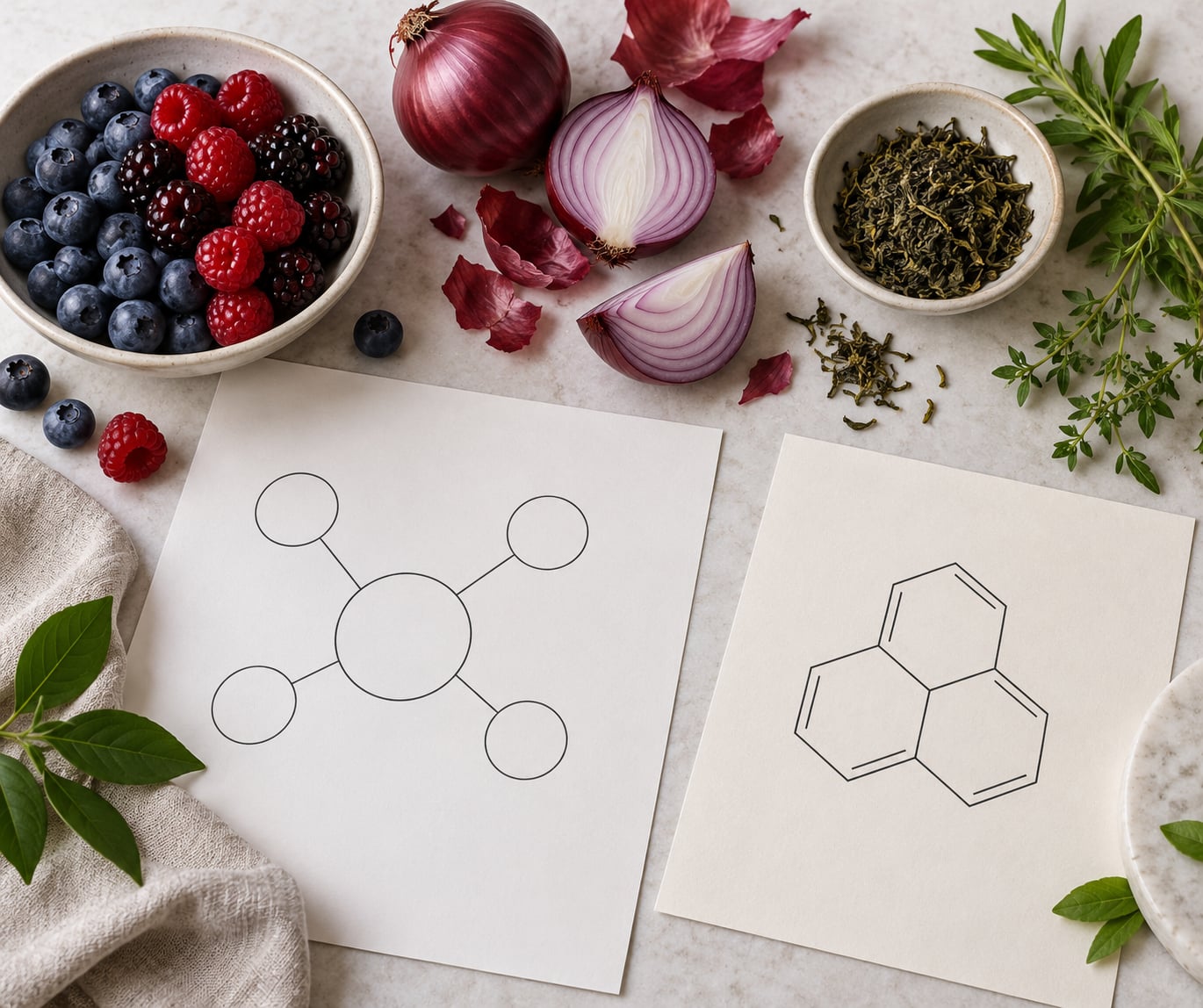
Two familiar examples will carry you a long way. Quercetin is a flavonol found in onions, apples and capers. Anthocyanins are the flavonoid pigments in blueberries, blackberries, cherries and red cabbage.
Four words you will meet in other articles
Phytonutrient or phytochemical means any compound in a plant that is not a macronutrient, so a nutrient. Polyphenol is the broader family that contains flavonoids along with stilbenes, lignans and phenolic acids. Antioxidant describes a molecule that can interact with free radicals and reactive oxygen species. Bioavailability means how much of something you eat survives digestion and reaches the bloodstream in usable form.
Flavonoids Explained for Beginners: How Their Structure Works
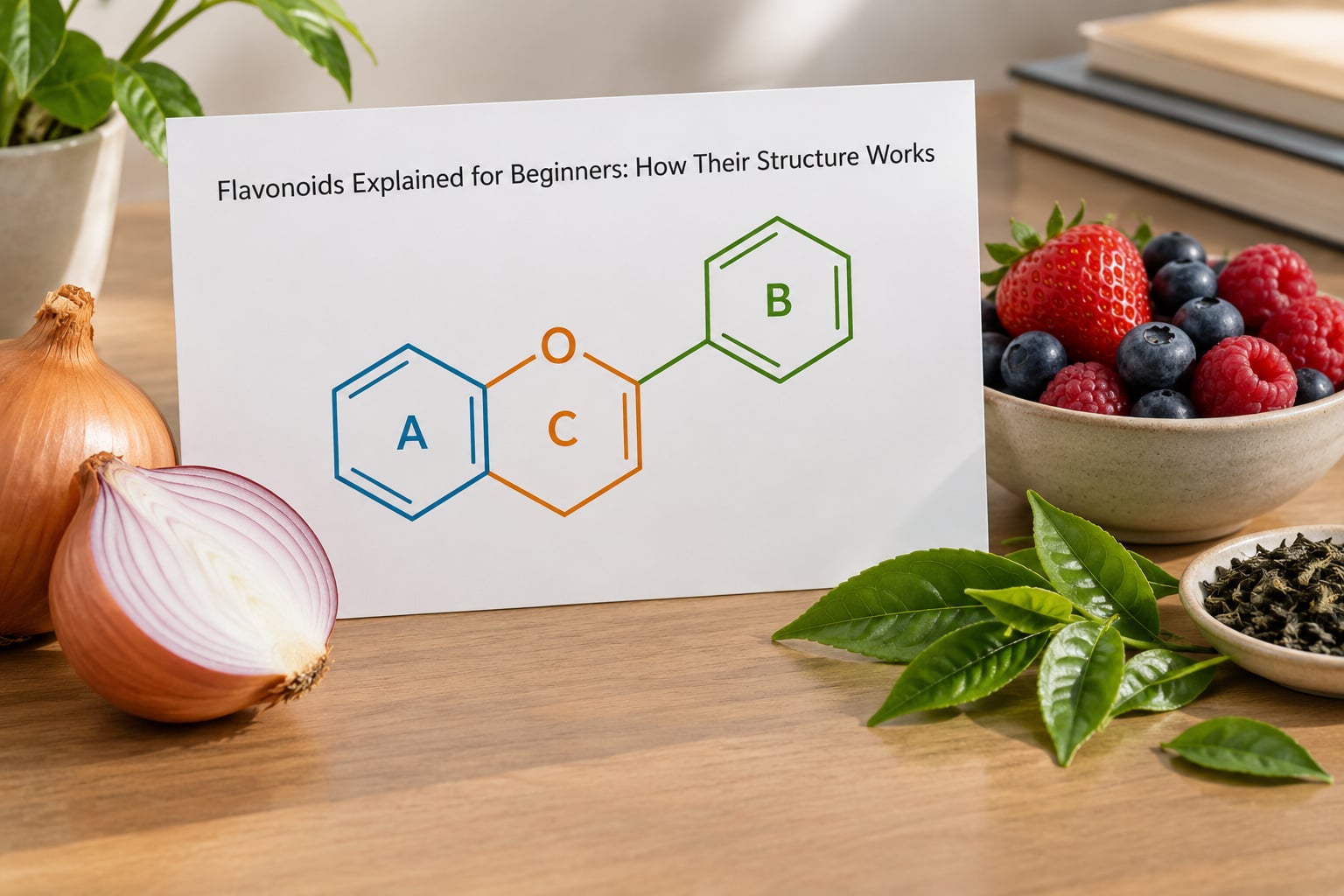
The basic flavonoid skeleton has fifteen carbon atoms arranged as three connected rings. Two of those rings are benzene rings, and the third is a ring containing one oxygen atom. Call it the C15 skeleton and you have the whole idea.
Attach small chemical groups to that skeleton and the molecule changes behaviour. Add double bonds here, a sugar molecule there, or hydroxyl groups at different positions, and you get a different compound with different activity. In flavonoids, sugar attachments are called glycosides, which is how flavonols such as rutin and quercetin glucoside get their names.
This is why structure and colour are linked. Anthocyanins carry conjugated double bonds that react differently depending on the pH around them, so the same anthocyanin can look red in a tart cherry and blue-ish in a blueberry. The pigment is a chemical structure acting as a pH indicator.
The practical takeaway is modest and important. “Flavonoid” is a family label, not a single substance, so claims about one member of the family do not automatically transfer to the others. The difference between subclasses is chemistry, not marketing.
What Are the Main Types of Flavonoids?
Six subclasses cover almost all dietary flavonoids. They are grouped by how the core skeleton is arranged and where hydroxyl groups sit.
| Type | Plant colour | Main sources | Example compound |
|---|---|---|---|
| Anthocyanins | Red, purple, blue | Blueberries, blackberries, cherries, red cabbage, eggplant skin | Cyanidin |
| Flavonols | Yellow and pale colour | Onions, apples, capers, tea, leafy greens | Quercetin, kaempferol, rutin |
| Flavones | Pale yellow | Apples, celery, parsley, chilli peppers, many herbs | Apigenin, luteolin |
| Flavanones | Colourless to pale yellow | Citrus fruit, herbs such as peppermint and oregano | Hesperidin, naringenin |
| Flavan-3-ols | Colourless to pale | Green tea, black tea, cocoa, apples, berries | Catechin, epicatechin, proanthocyanidins |
| Isoflavones | Colourless | Soybeans, chickpeas, lentils, kidney beans, clover | Genistein, daidzein |
Blueberries do count as a flavonoid food, and this is the most common beginner confusion. The word “flavonoid” describes a family, not a single ingredient, so a blueberry contains anthocyanins and flavan-3-ols at once. Many foods carry two or more subclasses at the same time.
Flavonoids explained for beginners: how they differ from other polyphenols
No, flavonoids are not all plant polyphenols. Polyphenols is the umbrella. Flavonoids are one branch of it, distinguished by the three-ring oxygen-containing skeleton described above. Other branches you will hear about include stilbenes (resveratrol in grapes), phenolic acids (chlorogenic acid in coffee, ferulic acid in many herbs) and lignans (flaxseed). All are worth eating, but only one branch is called flavonoids.
Where Do Flavonoids Come From in Food?
Flavonoids concentrate in specific plant parts, and knowing where saves you guessing. Skins and peels are rich, so an unpeeled apple beats a peeled one. Leaves and stems carry plenty, so herbs and green tea are worth more than the seed oil. Berries are dense in skin and flesh together. Seeds and sprouts hold moderate amounts, while the stems and stalk fibre of many vegetables carry less.
Colour is a decent shortcut. Deeply coloured fruits and vegetables usually mean anthocyanins, while yellow-white vegetables such as onions and leeks mean flavonols. Dark cocoa and tea are flavanol-rich even though neither looks colourful.
Processing matters too, and the pattern is consistent. Heat and long storage break flavonoids down, so overcooked vegetables and stale dried herbs hold less. Dry or over-roasted cocoa loses a good share of its flavanols. Light and oxygen also work against them, which is one reason whole fresh produce usually edges out processed versions of the same plant.
Cooking is not uniformly bad. Short steaming and sautéing keep more flavonoids than hours of boiling, and the water-soluble flavonoids that do leach out often stay in the cooking liquid. If you boil onion soup, drink the broth.
The top flavonoid-rich foods worth building meals around
Amounts vary widely by variety, soil, season and preparation, so treat the ranges below as a rough guide rather than lab precision.
- Green and black tea — the single most reliable everyday source of flavan-3-ols, typically tens of milligrams of catechins per cup.
- Dark cocoa and dark chocolate — rich in flavanols; the more cocoa solids, the higher the flavanol content.
- Onions and leeks — among the top dietary sources of quercetin, much of it in the outer layers.
- Apples — a mix of flavanols, flavonols and flavan-3-ols, mostly in the skin.
- Berries — blueberries, blackberries, elderberries and raspberries are anthocyanin workhorses.
- Citrus fruit — flavanones such as hesperidin, concentrated in the white pith and the juice.
- Soybeans and other legumes — the main dietary home of isoflavones such as genistein.
- Leafy greens and herbs — kale, parsley, thyme, oregano and rosemary contribute flavones and flavanones.
- Capers and small fruit — surprisingly dense in flavonols for the serving size.
- Buckwheat, broccoli and other green vegetables — modest but reliable contributors when eaten daily.
Bananas are a fair question and the honest answer is that they are not a top source. They carry small amounts of flavanones and some flavonols, but they are usually called out for potassium and starch rather than flavonoid content.
What Health Roles Are Supported by Research?
Flavonoids reach your body partly intact and partly after gut bacteria have rewritten them, so what arrives in the blood differs from what you ate. Once there, the most replicated effects are on cell signalling rather than on neutralising free radicals one at a time.
Review work such as the 2013 overview from Lu and colleagues on PubMed (PMID 23624504) summarises the mechanistic picture: flavonoids influence enzymes, cell receptors and gene expression, including pathways involved in inflammation and in the function of the blood vessel lining. That review also makes the correlation point that higher dietary flavonoid intake tracks with lower incidence of several chronic diseases, while stopping short of proving cause.
| Claimed benefit | Strength of human evidence |
|---|---|
| Supporting blood vessel function | Moderate in trials; cocoa flavanols are the best studied |
| Reducing markers of inflammation | Mixed to moderate; effects are small and often food-specific |
| Lower LDL cholesterol oxidation | Moderate mechanistic support, weaker for clinical outcomes |
| Blood pressure | Small average reductions in some flavanol and isoflavone trials |
| Blood sugar control | Promising in type II diabetes studies, not established as a treatment |
| Cancer prevention | Preliminary; laboratory and animal evidence dominates |
| Cognitive decline | Observational associations, weak intervention data |
| Bone and menopausal symptoms | Suggestive for soy isoflavones; results vary widely by product and dose |
Two honest caveats belong next to that table. Most flavonoid research runs in cell cultures, where concentrations used would be hard to reach by eating food. And the old antioxidant framing oversells things: the human body handles free radicals with enzymes that flavonoids may help switch on, rather than by catching radicals one by one. Reviewers often describe their effect as supporting the body’s own antioxidant systems instead.
Are African Plants Rich in Flavonoids?
Yes, and this is a gap in mainstream nutrition writing. Many plants used across African traditional medicine contain flavonoids according to laboratory analysis, which makes them interesting for anyone reading plant-based health claims.
Vernonia amygdalina, the bitter leaf known as olugoyo in parts of Yoruba-speaking West Africa, has been analysed repeatedly for luteolin and apigenin. Prosopis africana, whose roots and bark appear in decoctions across the Sahel and southern Africa, shows flavonoids in laboratory screening. Momordica charantia, Bidens pilosa, Ziziphus species, Sutherlandia frutescens and Ocimum gratissimum all have published flavonoid reports. Ethnobotanical use and chemical composition are separate questions: a plant appearing in a traditional decoction tells you about history and culture, not about safety or effectiveness in a given dose.
Preparation matters more than people expect. A decoction concentrates water-soluble compounds, including flavonoids, and different plant parts carry very different concentrations. Dose can shift by orders of magnitude depending on how much plant material went into the pot. That is exactly the reasoning why traditional use alone is not a safety test, and why anyone combining a traditional preparation with medication should ask a pharmacist or doctor first.
If you want a starting point for understanding the plants themselves rather than the claims, read through the site’s medicinal plants and herbal safety categories before preparing anything.
How Can You Eat More Flavonoids Safely?
Start with variety, because no single food delivers the full range. A day that includes tea, a handful of berries, an unpeeled apple, some onion or garlic and a handful of herbs already covers five or six subclasses.
- Eat the skin. Apple, tomato, eggplant and pepper skins hold flavonoids concentrated near the surface.
- Use herbs as seasoning, not garnish. Parsley, oregano, thyme and rosemary add flavones and flavanones in spoon-sized amounts.
- Do not overcook. Short steaming and stir-frying retain more than long boiling.
- Choose darker chocolate. Flavanols rise with cocoa solids, so a high-percentage bar beats a milk chocolate bar.
- Keep the cooking liquid. Soups and stews hold flavonoids that leached into the water.
- Eat legumes weekly. Soy, chickpeas and beans are the practical route to isoflavones.
On supplements, the honest position is that whole foods win. Concentrated extracts deliver a far higher single dose, and high-dose single flavanols can interfere with enzymes and drug metabolism in ways that dietary amounts generally do not. Grapefruit is the classic warning everyone already knows; related citrus flavonoid and furanocoumarin interactions are the reason pharmacists ask about grapefruit with certain medications.
People on anticoagulants, blood pressure medicines, diabetes drugs or immunosuppressants should talk to a doctor or pharmacist before starting any flavonoid supplement, and again before combining several. Anyone with a health condition, pregnant, or preparing herbal preparations should do the same. This article is general information, not medical advice.
Frequently Asked Questions
Are flavonoids the same as antioxidants?
No. Antioxidants describe what a molecule does, flavonoids describe what a molecule is. Flavonoids have antioxidant activity in laboratory tests, but many of their effects in the body come from switching enzymes and genes on or off rather than from catching free radicals directly. Many other compounds, including vitamin C and polyphenols outside the flavonoid family, are also antioxidants. So every flavonoid is treated as an antioxidant, and not every antioxidant is a flavonoid.
Which foods contain the most flavonoids?
Tea, dark cocoa, onions, apples and citrus are the everyday standouts, with green and black tea the most reliable daily source of flavan-3-ols. Among fruits, berries such as blackberries and blueberries lead for anthocyanins. Onions sit near the top for the flavonol quercetin, and soy leads for isoflavones. Amounts vary by variety, soil and cooking method, so treat any published figure as a range rather than an exact number.
Does cooking destroy flavonoids in vegetables?
It reduces some of them, and the losses are worth knowing about. Prolonged boiling and frying break down flavonoids, while short steaming and sautéing retain more. Water-soluble flavonoids leach into cooking water, which is why soups and stews still count. You do not need to avoid cooking vegetables to keep their flavonoids, but a quick, lightly cooked vegetable generally holds more than one boiled for an hour.
Are flavonoid supplements better than eating fruit?
No, and the reason is biological rather than marketing. Fruit and vegetables deliver many flavonoids at once, in doses the gut has handled for thousands of years of human eating. Concentrated supplements deliver one compound at a dose far above dietary levels, which can disturb enzyme systems and interact with prescription medicines. If you eat a varied diet, a supplement adds little. If your doctor has suggested one for a specific reason, that advice outranks this page.
How much fruit and vegetables should I eat each day?
Most mainstream dietary guidance, including American Heart Association advice, points to about five servings of fruit and vegetables a day, roughly four cups in total. No flavonoid-specific figure exists because flavonoids are not a nutrient with a recommended daily allowance. Cohort studies that track health outcomes tend to see the most benefit at fairly modest intakes, in the range of a few hundred milligrams a day, which most people reach simply by eating a varied diet.
Can flavonoid supplements interact with medicines?
Yes, which is the main safety argument for food-first habits. High-dose flavonoid and flavanone concentrates, including grapefruit and related extracts, can affect drug-metabolising enzymes and transporters in the gut and liver. The same interactions can matter with anticoagulants, blood pressure medicines and diabetes drugs. Food-level intakes of whole foods rarely cause the problem, but a concentrated supplement is a different proposition. Ask a pharmacist before starting one.
Conclusion
Flavonoids explained for beginners should end in one idea: these compounds are a large, chemically diverse family of plant molecules, not one ingredient and not one benefit claim. Six subclasses, a fifteen-carbon skeleton, and a set of foods that overlap far more than most people realise.
So the sensible first step is unglamorous. Add one daily source you are not currently eating: a cup of tea, a handful of berries, or a few more handfuls of onion, herbs and legumes across the week. Keep the food whole, keep the cooking time short, and let a registered dietitian or your doctor handle anything involving supplements or medication.