Careers in medicinal plant research are wider than most people picture. The work spans fieldwork with traditional healers, laboratory analysis of plant extracts, conservation planning, statistics, publishing, regulation and science communication, and it is open to people who arrive through botany, chemistry, pharmacy, anthropology or ecology.
The honest version: this is a field where funding shapes careers as much as qualifications do, and where the laboratory jobs pay more than the fieldwork jobs. What follows is a map of the roles, what each one involves day to day, and how a beginner actually gets in.
One thing to keep in mind throughout. Studying medicinal plants is scientific work, and it is not the same thing as treating illness. Nobody working in this field should tell you what to take for a condition. If you have a health question, that belongs with a doctor or a pharmacist.
Table of Contents
- 1What Is Medicinal Plant Research?
- 2Can traditional use be treated as proof?
- 3How does this differ from clinical practice or product marketing?
- 4Careers in Medicinal Plant Research at a Glance
- 5Which Research Career Paths Can You Build?
- 6How Do You Become an Ethnobotanist?
- 7What Does a Medicinal Plant Lab Scientist Do?
- 8How Do Pharmacology and Biochemistry Roles Differ?
- 9Can Field and Conservation Research Lead to a Career?
- 10Where Do Data, Policy, and Publishing Careers Fit?
- 11What Skills and Qualifications Do Employers Look For?
- 12Which degrees lead to careers in medicinal plant research?
- 13What technical skills are actually used?
- 14Which soft skills get people hired?
- 15How Can You Start in Medicinal Plant Research?
- 16How Do You Handle Ethics, Intellectual Property, and Safety?
- 17Frequently Asked Questions
- 18What degree do I need for a career in medicinal plant research?
- 19Can I work in medicinal plant research without a laboratory science degree?
- 20Are there entry-level or remote jobs in medicinal plant research?
- 21Do I need a masteru0026rsquo;s or doctorate to become an ethnobotanist?
- 22Is traditional African medicine already proven to treat disease?
- 23Conclusion
What Is Medicinal Plant Research?
Medicinal plant research is the scientific study of plants used for health purposes: how they grow and are identified, what chemical compounds they contain, what those compounds do in laboratory tests, how they are traditionally prepared and used, and how to protect the species that supply them.
That last part matters. A researcher is not only looking for a drug lead. Many spend their careers on authentication, quality control, conservation and sustainable harvesting, because a plant that cures people in one village can be gone from a hillside within a decade.
Can traditional use be treated as proof?
No, and anyone who tells you otherwise is overselling. Long use by a community is valuable evidence and a good place to start, but it is a hypothesis, not a clinical result. A remedy that works reliably in practice still needs chemical characterisation, controlled testing and, for most treatments, human trials before it can be called a treatment.
Researchers in countries with rich medicinal plant traditions, including most of Africa, are usually careful on this point. They record what a healer says, test it, and report what they find, including when nothing works. Traditional knowledge is treated as something to be documented and respected, not as a shortcut around the evidence.
How does this differ from clinical practice or product marketing?
Clinical work treats patients. Product marketing sells a product. Research generates the evidence that sits underneath both, and its deliverable is a paper, a database entry, a standard, a patent or a conservation plan, not a prescription or a sales page.
Careers in Medicinal Plant Research at a Glance
Here is the short version: most roles fall into eight families, and each one has a different daily rhythm, a different qualification background, and a different door into it.
| Pathway | Where you work | Typical background | Main daily tasks | Usual entry point |
|---|---|---|---|---|
| Ethnobotanist | University, field sites, herbarium | BSc/MSc botany, anthropology or pharmacology | Field interviews, species identification, documentation, community meetings | MSc project or field assistant post |
| Laboratory scientist | Analytical chemistry or pharmacology lab | BSc/MSc chemistry, pharmacy or pharmacognosy | Extraction, chromatography, screening assays, quality control | Research assistant or technician post |
| Phytochemist | University, research institute, natural products unit | MSc/PhD chemistry | Isolating and identifying compounds, structural interpretation | PhD or postdoc |
| Field botanist | Herbarium, botanic garden, survey agency | BSc/MSc botany or ecology | Collection, pressing, georeferencing, curation | Herbarium technician or expedition assistant |
| Conservation researcher | Conservation agency, university, NGO | BSc/MSc ecology, forestry or botany | Population surveys, habitat mapping, harvest monitoring | Field assistant or graduate fellowship |
| Data specialist | Same lab, but at the computer | Statistics, bioinformatics or data science | Analysis, databases, GIS, reproducible pipelines | Data analyst or research software post |
| Science writer or editor | Journal, society, science media, NGO | Science degree plus writing portfolio | Editing manuscripts, reporting, public outreach | Editorial assistant or science writing work |
| Policy or research administrator | Government agency, funding body, university | Science degree plus project management | Grant administration, ethics review, regulatory liaison | Research officer or administrator |
Two patterns stand out. The laboratory roles demand more analytical training and pay better. The field and documentation roles are easier to enter and depend more on people skills, language ability and patience.
Which Research Career Paths Can You Build?
There are eight main paths, and the honest way to look at them is by what they produce rather than by their names. An ethnobotanist produces documented knowledge about plants and people. A laboratory scientist produces chemical and biological data. A conservation researcher produces population and habitat data that determines whether harvesting is sustainable.
A pharmacologist tests how compounds affect living systems. A field botanist produces verified, georeferenced specimen records. A data specialist turns all of the above into something analysable. A science writer turns it into something a public audience can understand, and a research administrator makes sure the money, ethics approvals and timelines hold together.
These overlap constantly. Plenty of working researchers carry two or three of these labels depending on the project, and plenty have moved between them, which is worth knowing before you commit.
How Do You Become an Ethnobotanist?
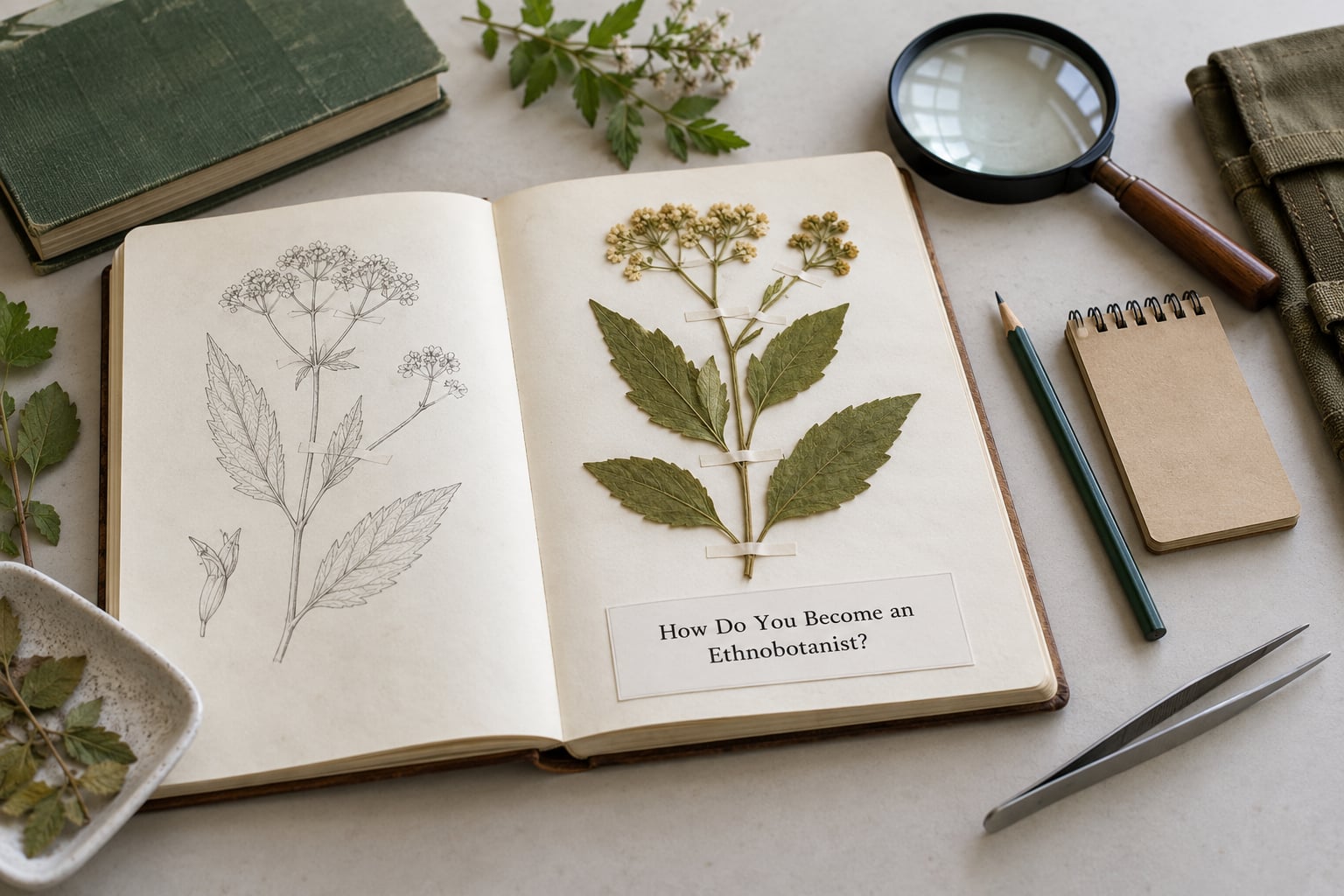
You become an ethnobotanist by learning to identify plants reliably, interview people respectfully, and document both in a way another researcher can use. A degree helps, but the skill that actually gets you hired is the combination of plant competence and the ability to hold a conversation with a healer or a community leader without taking over.
Most ethnobotanists arrive through a bachelor’s degree in botany, biology, anthropology, pharmacy or a related subject, and many add a master’s in ethnobotany, ethnopharmacology or ethnobiology. Where the degree does not exist by that name, a supervised project on plant use usually does the same job.
What the work actually involves:
- Identification. Confirming species in the field, often with a specialist, because a wrong identification invalidates every result that follows.
- Ethnographic interviewing. Structured conversations about preparation, dosage, season and part of plant used, recorded with consent rather than from memory.
- Documentation. Voucher specimens, photographs, GPS coordinates, audio recordings and databases that survive after the field trip ends.
- Community engagement. Meetings before and after the research, and being willing to share results in a language people actually speak.
Language ability matters more than most job ads admit. A researcher who can hold an interview in the local language gets better data and better trust, and in several countries that is the difference between a project that runs and one that stalls.
On the ethics side, the rule is simple to state and demanding to practise: prior informed consent before you record anything, agreement on what happens to the knowledge afterward, and a benefit the community can actually see. More on that below.
What Does a Medicinal Plant Lab Scientist Do?
A medicinal plant lab scientist turns plant material into evidence. The cycle is: authenticate the species, extract its compounds, profile them, test them, and interpret what the numbers mean without overstating them.
Authentication comes first because everything downstream depends on it. Dried material bought from a market is frequently a different species, or a mixture, and the mistake surfaces only when the results fail to reproduce. Morphological comparison against a herbarium reference, microscopy, and increasingly DNA barcoding are the tools used.
After that, extraction and profiling. Solvents of different polarity pull different classes of compound out, and high-performance liquid chromatography with mass spectrometry separates and identifies them. A phytochemical profile becomes the plant’s chemical fingerprint, which later supports authentication and quality control.
Screening follows. Extracts go into in vitro assays for antimicrobial, anti-inflammatory, antioxidant or cytotoxic activity. These are cheap and fast, and they produce preliminary findings only. An extract that inhibits a bacterium in a dish has not been shown to treat an infection in a person, and a scientist who writes that conclusion has overstepped the evidence.
Quality control is the quieter half of the job. Herbal products need batch-to-batch consistency, marker compound thresholds and contaminant testing, and much of the hiring in this area is for people who can run and defend those methods.
How Do Pharmacology and Biochemistry Roles Differ?
The four related paths differ mainly in what they measure. Pharmacology measures the response of a living system to a compound. Phytochemistry measures the chemical identity and quantity of what is in the plant. Biochemistry measures the reactions and enzymes inside cells. Molecular biology measures genes and their expression.
| Path | Core question | Typical output | Analytical pressure | Common background |
|---|---|---|---|---|
| Pharmacology | What does this compound do to a system? | Dose-response data, mechanism studies, safety margins | High; animal and human study design matter | Pharmacy, pharmacology, medicine |
| Phytochemistry | What is actually in the plant? | Isolated compounds, structural data, profiles | High; instrument time and interpretation | Chemistry, pharmacognosy |
| Biochemistry | Which reactions build the compounds? | Enzyme characterisation, pathway maps | High; purification and assay development | Biochemistry, molecular biology |
| Molecular biology | Which genes drive those reactions? | Sequenced genomes, expression profiles, transformed lines | High; computing and bioinformatics | Biology, genetics, biotechnology |
In practice, phytochemistry and biochemistry often share a lab, and the person who can do both is unusually employable. Molecular skills now sit close to the centre of the field because species identification and biosynthetic pathway work both depend on sequence data.
Can Field and Conservation Research Lead to a Career?
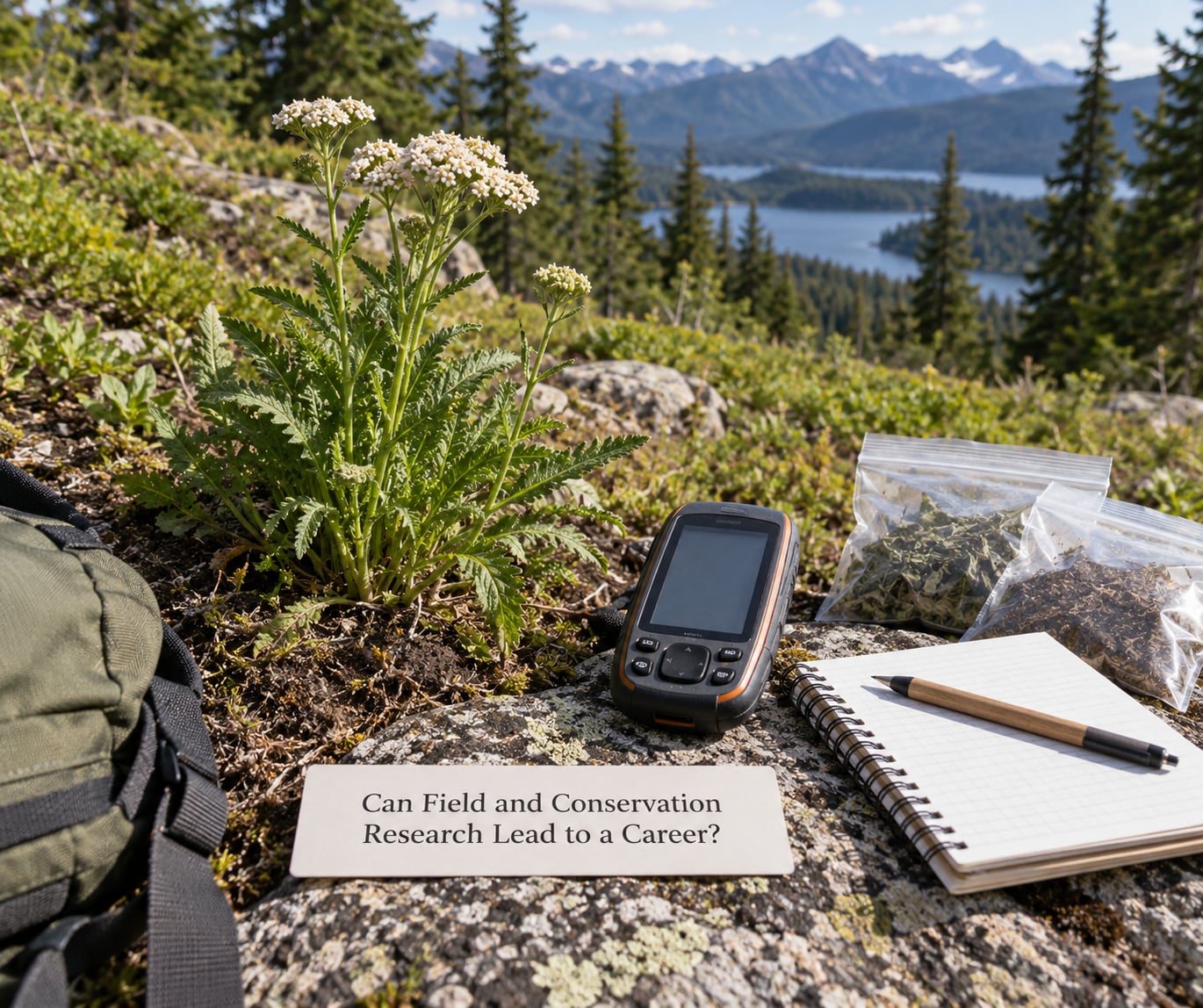
Yes, and for many people it is the most accessible way into medicinal plant research. Conservation work answers a question the laboratory cannot: will there be any of this plant left to study, and can it be harvested without destroying the population?
A field botanist produces verified, georeferenced specimen records, presses and curates samples, and maintains a database. A herbarium technician does the same work in a collection rather than in the field, and that job is a genuine career with a steady employer, often a university or a national museum.
An ecological monitor repeats surveys over time to track population size and distribution. A conservation scientist turns that into management: which species need protection, which harvest levels are sustainable, what a community should collect from and when.
The skills that make you employable here are less glamorous than instrument lists. You need reliable survey design, GPS and GIS competence, careful specimen preparation, and the judgement to know when a site has been disturbed too often to count properly.
One practical note. Climate change is already altering where several widely used species grow, which makes this work less optional than it was twenty years ago. The demand for people who can map and monitor that movement is steady.
Where Do Data, Policy, and Publishing Careers Fit?
Medicinal plant research generates more data than most projects can analyse, which is why the field needs people who never touch a plant. A statistician designing a sampling plan and a research software specialist building a reproducible pipeline are doing research, not supporting it.
Science writing is a real career path too. Societies, journals, museums, NGOs and the media employ people who can explain what a study found and, just as importantly, what it did not find. A writing portfolio built from published pieces is usually a stronger entry ticket than a certificate.
Policy and regulation roles sit close to the science. Policy analysts work on biodiversity law, protected species listings and national medicinal plant strategies. Intellectual-property professionals handle patenting, plant breeders’ rights and benefit-sharing agreements. Ethics or regulatory coordinators run the approvals that any study touching human participants or genetic resources requires.
Research administration is the quiet one: managing budgets, timelines, ethics paperwork and reporting for a funded project. If you are organised and want to stay close to the science without running the experiments, it pays reasonably and is consistently in demand.
What Skills and Qualifications Do Employers Look For?
Employers screen for a small number of specific things, and they are usually listed plainly in the job advert. The pattern below covers most roles in the field.
Which degrees lead to careers in medicinal plant research?
A bachelor’s in botany, biology, chemistry, pharmacy, pharmacology, ecology, anthropology or a related field is the usual starting point. A master’s opens laboratory and research-officer posts. A doctorate is required for principal investigator roles and is close to mandatory in pure taxonomic work, which is also the hardest area to enter.
Pharmacy and pharmacology graduates are often more competitive in laboratory roles than botanists, because they arrive with assay training already done. Anthropology graduates are often better at the interview and consent work that field projects depend on. Choosing the degree that matches the role you want, rather than the one that sounds closest to the topic, is the practical move.
What technical skills are actually used?
- Plant identification, taxonomy and specimen curation
- Extraction and phytochemical profiling
- Chromatography and mass spectrometry
- In vitro bioactivity screening
- Plant tissue culture, micropropagation and meristem-tip culture
- DNA barcoding and basic bioinformatics
- GIS, GPS and biodiversity survey methods
- Statistics and reproducible data analysis
Which soft skills get people hired?
Write clearly. Most of this field runs on documentation, and a researcher who cannot write a usable methods section struggles everywhere. Work with people whose knowledge you need and whose status you do not, which is the daily reality of community-based research. Budget a project. Manage your own time through a field season. Teach — supervising students is usually part of the job, not an extra.
Language and intercultural communication sit alongside these, and they are the two most underrated requirements in the whole field.
How Can You Start in Medicinal Plant Research?
The route most people take is not a single application. It is a sequence of small, evidence-building steps, and you can start the first one while you are still an undergraduate.
1. Get the science foundation. Plant biology, chemistry and statistics are the three subjects that appear in almost every job advert in the field. If you missed one, take it as an evening course or a short programme; it is the fastest fix available.
2. Volunteer where plants are. A herbarium, botanical garden, nursery or university lab will teach you specimen handling and give you references. One forum regular described exactly this path: no plant coursework at all, so they took a community college botany course and volunteered at a garden and herbarium before applying for anything.
3. Assist a funded project. Field assistants, laboratory technicians and data entry roles on active grants are the most common openings for newcomers, and they are frequently advertised locally rather than nationally.
4. Get into conferences and society networks. The Society for Economic Botany, the International Society of Ethnobiology and national botanical societies are where assistants meet the people who hire them. Poster presentations count, even small ones.
5. Build a portfolio you can show. Photographs of specimens you have pressed, a map you produced, a reproducible analysis script, a conference abstract. For writing roles, published articles. A portfolio beats an assertion on a CV.
6. Apply for grants and fellowships early. Small travel and field grants, doctoral scholarships and postdoctoral fellowships are the normal way into the field, and the application itself teaches you how proposals are written.
A last piece of practical advice from the forums: the shortage of PhD positions in taxonomy is real, so if that is your goal, apply widely and treat the master’s as a deliberate step rather than a consolation prize. Plenty of successful ethnobotanists hold an MSc and published work, not a doctorate.
How Do You Handle Ethics, Intellectual Property, and Safety?
Ethics in this field is a professional requirement, not paperwork to be filed later. A study that documents a community’s medicinal knowledge without consent and agreement on its use can do real harm, and researchers who skip this step damage their own field as well as the community.
Prior informed consent. Agreement must be sought before interviews, recordings or collections, in a language the participant understands, and it must cover what happens to the information later. Consent to be interviewed is not automatically consent to publish, patent or commercialise.
Access and benefit sharing. The Nagoya Protocol, adopted under the Convention on Biological Diversity, sets rules for access to genetic resources and the fair sharing of benefits from their use. A national law or policy will apply where you work, so check your country’s implementation rather than assuming. Benefits can be non-monetary, but they must be real and agreed in advance, not promised vaguely at the end.
Documentation and intellectual property. The sequence of your records matters. Who collected what, when, with whose permission, and where is it deposited. Depositing voucher specimens in a recognised herbarium protects the work and the community’s claim to it at the same time.
Safety of specimens and people. Field work carries real risks: toxic or irritant plants, venomous animals, heat, malaria and other local disease, and unstable terrain. Standard protective equipment, a trained first-aider and a documented field safety plan are expected, not optional.
Endangered species. Collect only what a permit allows, and never collect a rare species for a project where a common substitute would answer the question. Removing the last population of a plant for one study is a permanent act.
Health claims. Public communication is where most of the trouble happens. Say what was tested and in what system. A dish assay is not a treatment. Any claim about human health needs appropriately reviewed clinical evidence, and where that evidence does not exist, say so plainly.
Frequently Asked Questions
What degree do I need for a career in medicinal plant research?
A bacheloru0026rsquo;s in botany, biology, chemistry, pharmacy, pharmacology, ecology or anthropology is the usual entry requirement. A masteru0026rsquo;s opens laboratory scientist and research officer posts, and a doctorate is required for principal investigator and taxonomic roles. Pharmacy and chemistry graduates are often stronger in lab work, while anthropology graduates bring the interview and consent skills that field projects need.
Can I work in medicinal plant research without a laboratory science degree?
Yes, and several pathways do not require one. Ethnobotany, conservation biology, herbarium curation, data analysis, science writing and research administration are all open to anthropology, ecology and social science backgrounds. You will still need enough plant biology to identify species confidently, which you can build through coursework, volunteering and supervised fieldwork.
Are there entry-level or remote jobs in medicinal plant research?
Entry-level roles exist as research assistant, laboratory technician, field assistant, herbarium assistant and data entry posts, though they are usually advertised locally near universities and research institutes. Remote work is mostly limited to data analysis, database curation, writing and editing. Specimen authentication, screening assays and field surveys cannot be done from a desk.
Do I need a masteru0026rsquo;s or doctorate to become an ethnobotanist?
For fieldwork and documentation roles, an MSc in ethnobotany, ethnopharmacology or a related field is usually enough, and many ethnobotanists publish without a doctorate. A PhD is expected for independent research leadership and is close to mandatory in taxonomic and curatorial posts. It also opens grant funding, which in this field depends heavily on being the named lead on an application.
Is traditional African medicine already proven to treat disease?
No. Long traditional use is valuable evidence of a starting point, and it guides what researchers test, but it is not proof of efficacy under controlled conditions. Most traditional remedies have not been through chemical characterisation, laboratory screening and human clinical trials. Researchers document traditional use, test it rigorously and report both the results and the failures, and anyone claiming otherwise is overselling.
Conclusion
Careers in medicinal plant research run from the herbarium bench to the policy office, and the roles differ far more in their daily work than their names suggest. Laboratory scientists need analytical depth, field and conservation researchers need survey and mapping skills, and the data, writing and policy routes need almost no plant handling at all.
Start by picking one role, then look at the degree and the specific methods that role actually requires. Volunteer somewhere plants are handled, take one methods course to close your weakest gap, and approach an active project as a field or laboratory assistant. That first supervised experience is what every other step in the field is built on.