Knowing how to dilute essential oils safely comes down to three things: mix the concentrate into a carrier oil at a fixed percentage before it touches skin, patch-test a small area, and follow the directions on your specific bottle. The everyday math is simple: carrier oil in millilitres multiplied by your target percentage, multiplied by 20 for approximate drops of essential oil. A 10 ml roller bottle at a 2% dilution works out to about 4 drops.
Essential oils are concentrated, lipophilic extracts. A whole leaf, bark or root used in traditional practice is a very different material from the steam-distilled concentrate that comes out of a bottle today, which is why the handling rules differ so much from older herbal practice. Undiluted contact can cause irritation, chemical burns, or sensitisation that shows up a day or two later and does not always go away quickly.
This guide covers dilution arithmetic, carrier oil choice, patch testing and storage. It is general information, not medical advice, and nothing here replaces the directions on your specific bottle or a conversation with a doctor or pharmacist. When a label and general guidance disagree, follow the label, because oils differ in chemistry and a clinician may know something about your skin that a general chart cannot.
Table of Contents
- 1What You Need
- 2How to Dilute Essential Oils Safely: Step-by-Step
- 3Step 1: Check the Oil and Intended Use
- 4Step 2: Choose a Suitable Carrier Oil
- 5Step 3: Measure and Mix
- 6Step 4: Patch-Test Before Broader Use
- 7Step 5: Label and Store the Mixture
- 8Common Mistakes
- 9Frequently Asked Questions
- 10Do I need to dilute every essential oil?
- 11Which carrier oil is best for dilution?
- 12How should I store a diluted essential oil mixture?
- 13Can I use diluted essential oils around children or pets?
- 14What should I do if a diluted oil causes irritation?
- 15How to Dilute Essential Oils Safely: Start Here
What You Need
Gather these before you start, and the process takes about five minutes plus drying time for the patch test.
- The essential oil in its original bottle, with the label intact so you can check the plant name, the part of the plant used, and the manufacturer’s directions.
- A carrier oil that suits the body area and your skin.
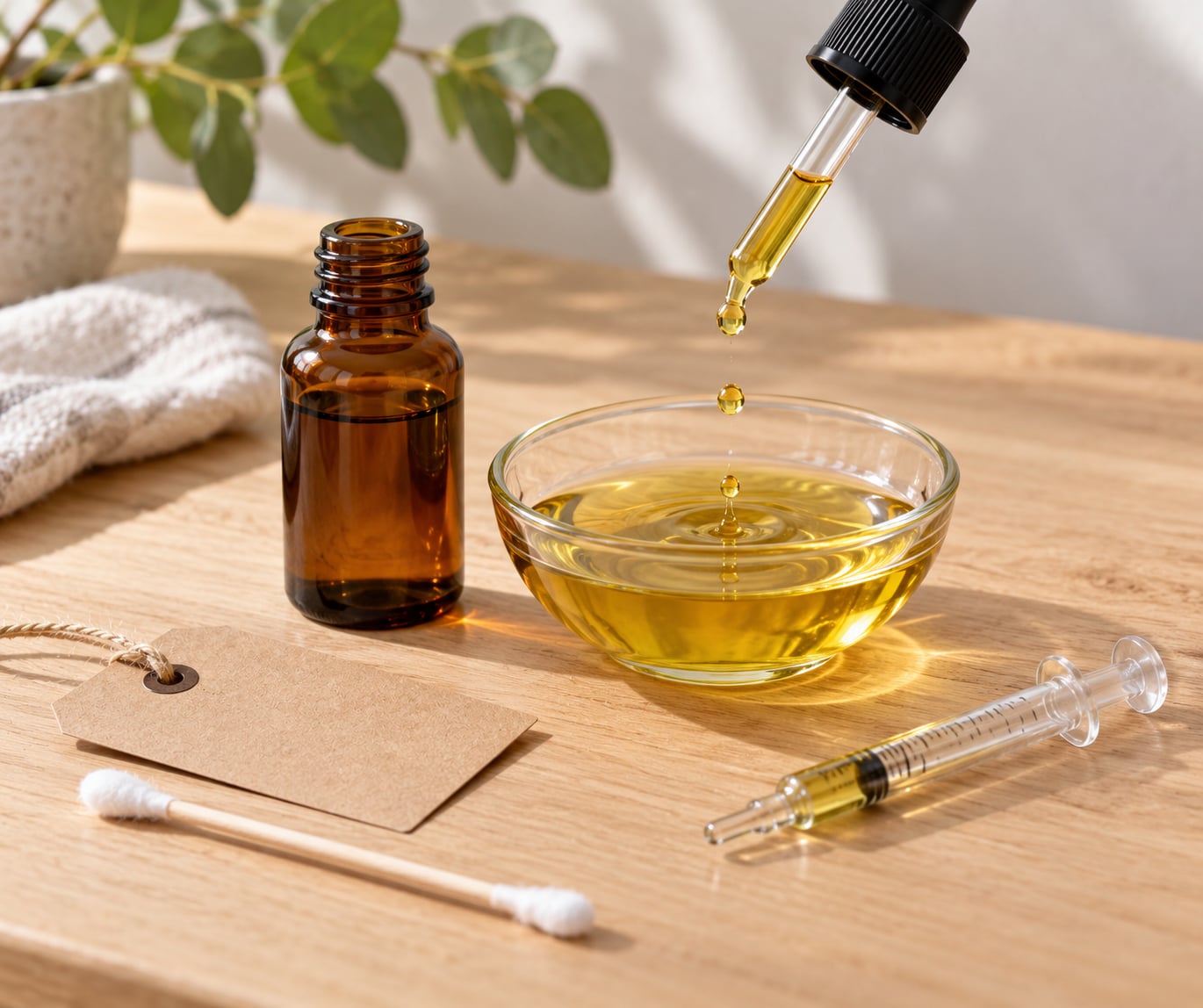
- A clean container — an amber glass dropper bottle for a room-temperature blend, or a roller bottle if you want it portable.
- Accurate measuring tools: a 1 ml or 5 ml syringe, a graduated mini vessel, or a proper dropper. Kitchen spoons measure badly enough to double your concentration without you noticing.
- A written calculation, so you are not doing percentage maths half full of carrier oil.
- A cotton swab or small patch of cloth for the patch test, plus a washable cloth for spills.
- Gloves if you are working with high-phenol oils such as clove or cinnamon bark, or if you have cuts on your hands.
On carrier oil selection, the useful criteria are texture, odour, expiry date and your own sensitivities. None of the options below is universally safe; a nut oil is a poor match for anyone with a nut allergy, and a strongly scented oil can be unpleasant on the face.
If you are unsure which carrier suits you, or if you have eczema, a skin condition or are pregnant, ask a pharmacist or clinician before mixing. That conversation is quick and it replaces guesswork.
How to Dilute Essential Oils Safely: Step-by-Step
The formula is: carrier oil in ml × target percentage × 20 = drops of essential oil. The 20 multiplier comes from the common approximation that 20 drops fill roughly 1 ml, so it is a guideline rather than a laboratory measurement.
Step 1: Check the Oil and Intended Use
Start by confirming exactly which oil you have and whether it is meant for the use you have in mind. Read the botanical name rather than the common name, because several unrelated plants share friendly labels, and check whether the bottle says topical use, aromatic use only, or something else entirely.
Look at the oil itself. Cloudiness, a muddy colour, a smell that has turned sharp or paint-like, or a swollen or leaking cap all point to a problem. If the bottle has no batch number, no expiry indication and no manufacturer contact details, you have no way to trace a reaction later, so treat that as a reason to buy something better labelled.
One rule is absolute: essential oils are not food and not medicine. Do not swallow them, do not add them to drinks or food, and do not use them in a way the label does not support. Many serious poisonings in the literature are from ingestion, not from skin use, and a household dropper makes that mistake very easy to make.
Step 2: Choose a Suitable Carrier Oil
Choose the carrier oil by where the blend goes and how your skin behaves. Jojoba oil is chemically close to skin’s own sebum and absorbs readily, which suits facial and scalp use. Fractionated coconut oil is light, odourless and stays fluid in warm rooms, so it works well for body and massage blends. Sweet almond oil is smooth and widely available; grapeseed oil is thin and finishes matte; rosehip seed oil is richer and often chosen for scar or mature skin work.
Check two things every time: the expiry date on the carrier, and whether it smells rancid. Oxidised carrier oil goes bitter and off, and it will not improve a blend.
| What you can use | What happens |
|---|---|
| Carrier oil (jojoba, fractionated coconut, sweet almond, grapeseed, rosehip) | Disperses the essential oil evenly and slows evaporation. The standard choice. |
| Unscented lotion or cream | Already an emulsion, so it will not separate, but the active concentration is unknown and lower than your calculation. |
| Aloe vera gel | Water-based, so it does not carry lipophilic oils well; they sit on top or separate. |
| Water | Does not work. Oils float, and water can increase irritation by carrying the concentrate to wider skin contact. |
| Ethanol or fragrance alcohol (perfumery) | Fine for scent, wrong for skin. Solvent blends are made for fragrance throw, not skin contact. |
| Honey, glycerine | Water-based and not a real diluent for an oil concentrate. |
| Emulsifier or dispersant (bath blends) | Required for baths and any water-based product, so the oil disperses instead of pooling on the surface. |
Step 3: Measure and Mix
Measure before you pour, and keep the two liquids clearly identified. Add the essential oil to the carrier, not the other way around, close the container, and roll or shake gently until the blend looks uniform.
Three worked examples. A 10 ml roller bottle at 2%: 10 × 0.02 × 20 = 4 drops. A 30 ml bottle at 1%: 30 × 0.01 × 20 = 6 drops. A 60 ml bottle at 2.5%: 60 × 0.025 × 20 = 30 drops.
Here is the drop count for common bottle sizes, rounded to whole drops:
| Carrier volume | 0.5% | 1% | 2% | 3% | 5% |
|---|---|---|---|---|---|
| 10 ml | 1 drop | 2 drops | 4 drops | 6 drops | 10 drops |
| 15 ml | 2 drops | 3 drops | 6 drops | 9 drops | 15 drops |
| 30 ml | 3 drops | 6 drops | 12 drops | 18 drops | 30 drops |
| 60 ml | 6 drops | 12 drops | 24 drops | 36 drops | 60 drops |
For multi-oil blends, decide the total concentration first, then split it between oils. Four oils at 2% total means the drops of all four together must add up to 24 in a 60 ml bottle, not 24 each.
If you want to work out the percentage of a blend you already made, divide the drops of essential oil by the total drops of everything in the container, then multiply by 100. Nine drops of oil in a 180-drop bottle is 5%.
When the calculation lands under a single drop, make a bigger batch. A 2% facial batch in 5 ml would need roughly 2 drops, which is imprecise enough to double your concentration by accident; making 30 ml instead gives you about 12 drops to work with and a mix you can actually use up before it oxidises.
| Use case | Commonly cited working percentage |
|---|---|
| Adult body and massage | 2% is the everyday default |
| Face, neck, sensitive or reactive skin | 1% or lower |
| Targeted spot use, short term | Up to 3%, never above |
| Children and teenagers | Lower than adult body figures; check current guidance |
| Infants and toddlers | A great deal more caution; many clinicians advise avoiding routine topical use altogether |
| Diffusers and nebulising diffusers | No dilution; the oils are dispersed in water or air rather than touching skin |
That table is a set of commonly cited figures, not a permission slip. Robert Tisserand’s reference ranges and your bottle’s label are better authorities than any web chart, and oils vary widely — a 2% blend of lavender and a 2% blend of cinnamon bark are not the same proposition at all.
Step 4: Patch-Test Before Broader Use
Apply a small amount of the diluted mixture to a limited area — the inner forearm or behind the ear works well — and wait as the product instructions direct, commonly 24 hours. Then check again the following day, because sensitisation is often delayed.
Stop immediately if you notice burning, stinging, swelling, itching, redness, blistering or a rash. Wash the area with soap and lukewarm water, and do not reapply. A reaction that spreads, involves the face or eyes, or comes with swelling or difficulty breathing needs prompt medical care; contact a poison control centre for ingestion or for a significant undiluted exposure.
A patch test reduces risk, it does not remove it. Skin that has tolerated one oil at one percentage for months can still react to a new blend, a new carrier, or a change in season. Treat a passed patch test as permission for one careful use, not a general clearance.
Step 5: Label and Store the Mixture
Write on the container: the full botanical names of every oil in the blend, the dilution percentage, the intended use if it matters, and the date you mixed it. Use a waterproof label or masking tape and a pen that will not smear with oil. This is the step people skip, and it is the one that tells you six months later whether a bottle is still usable.
Store in a cool, dark place away from heat, direct sunlight and air, out of reach of children and pets. A bathroom shelf is a poor location, because humidity and temperature swings shorten shelf life. Amber glass helps, though a tightly closed container matters just as much.
Discard a mixture that has changed smell, separated and will not remix, darkened noticeably, or gone past the date you wrote on it. If you are unsure whether an oil itself has oxidised, contact the manufacturer and ask about that specific batch.
Common Mistakes
Most skin problems from essential oils come down to one of a handful of avoidable errors.
- Applying the oil neat. “Pure” on the label describes concentration, not readiness to use. Fix: dilute every time, even for a spot application.
- Guessing amounts. Counting drops into a bottle that is already full produces a concentration nobody can calculate. Fix: calculate first, measure second, top up last.
- Using an expired or unsuitable carrier. Fix: check the date and smell it before every batch, and avoid nut oils if you have a nut allergy.
- Skipping the patch test. Fix: inner forearm, 24 hours, checked again the next day.
- Storing in heat or direct sunlight. Fix: a cool dark cupboard or drawer, container closed tightly.
- Mixing unrelated products without checking compatibility. Fix: keep fragrance, cosmetic and medicinal products separate unless a manufacturer states they are compatible, and never combine a blend with a prescription topical.
- Treating it as something to ingest. Fix: no drops in tea, water, food or supplements.
- Using it on broken skin or near the eyes. Fix: keep to intact skin, and stay well away from the eye area.
What to do after an undiluted exposure. Do not reach for water. Oils are lipophilic, and water can spread the concentrate across the skin and drive it deeper. Instead, apply a vegetable or carrier oil to the area to dilute and lift it, then wash with soap and lukewarm water. Persistent burning, blistering, or any eye involvement means a poison control centre or urgent care, not another home remedy.
Phototoxic citrus oils. Some citrus oils, and the expressed oils in particular, can cause photosensitivity, where skin burns under sunlight after application. In hot, high-UV climates this is not a theoretical concern. Check the oil’s guidance, keep the percentage modest, avoid application before sun exposure, and stay out of direct sun for a suitable period afterwards.
Pets. Cats in particular metabolise several common essential oils differently from humans, and tea tree and eucalyptus are commonly flagged as dangerous for them. Keep blend bottles closed and stored where an animal cannot reach them, and ask your veterinarian before diffusing or applying anything around a pet.
On fragrance blending ratios. You will see ratios like 30/70 or a fragrance formula of 30 top, 50 heart, 20 base in perfumery circles. Those describe scent composition for a perfumer’s alcohol or DPG base, and they have nothing to do with skin contact. A 30% essential oil blend would be dangerously strong on skin.
Frequently Asked Questions
Do I need to dilute every essential oil?
For skin use, yes. Essential oils are concentrated plant extracts, and neat application is the most common cause of irritation, burns and delayed sensitisation. The only routine cases where no dilution is needed are diffusers and nebulising diffusers, where the oil is dispersed into air or water rather than touching skin. Follow the manufacturer label for any specific product.
Which carrier oil is best for dilution?
There is no single best option. Jojoba suits facial and scalp use because it absorbs readily, fractionated coconut works well for body and massage blends, and sweet almond or grapeseed are common everyday choices. Check the expiry date, avoid anything you are allergic to, and skip oils that smell rancid. If you are unsure, a pharmacist can tell you what suits your skin.
How should I store a diluted essential oil mixture?
Keep the container tightly closed in a cool, dark place away from heat and direct sunlight, and out of reach of children and pets. Label it with the oil names, the dilution percentage and the date you mixed it. Discard a blend that has changed smell, darkened, separated and will not remix, or that has passed the date on the label.
Can I use diluted essential oils around children or pets?
Use far lower percentages than adults and check current guidance first. Many clinicians advise against routine topical essential oils for infants and toddlers, and hydrosols are sometimes suggested as a gentler alternative. Cats metabolise certain oils, including tea tree and eucalyptus, differently from humans. Ask your pediatrician or veterinarian before use around either group.
What should I do if a diluted oil causes irritation?
Stop using the product and wash the area with soap and lukewarm water. Do not apply anything else to the skin unless a clinician tells you to. Seek medical care if redness or burning spreads, if skin blisters or swells, if the reaction involves the eyes, or if you have trouble breathing. Contact a poison control centre for ingestion or a significant undiluted exposure.
How to Dilute Essential Oils Safely: Start Here
Start with the bottle in front of you. Read its label, decide where the blend will go, pick the percentage that matches that body area, and calculate the drops before you open the carrier oil. Then patch-test and write the date on the container.
Everyday adult body use at 2%, faces and sensitive skin at 1%, and extra caution around children and animals will keep most people out of trouble. If your situation involves a health condition, pregnancy, an infant or a pet, ask a doctor, pharmacist or veterinarian rather than following a chart, including this one.