Reading an herbal supplement label takes about five minutes once you know the order to read it in. Start on the front panel for the claim, move to the supplement facts panel for the plant part and the amount per serving, check the other ingredients, then confirm warnings, quality marks and the lot number before you decide. This is general reading information, not medical advice, and it does not replace a question to your doctor or pharmacist about what suits you.
Most labels are not hiding anything. They are just laid out for the manufacturer, not for you, so the useful details sit on the back panel in type you need to zoom in on.
Table of Contents
- 1What You Need
- 2Step-by-Step: How to Read an Herbal Supplement Label
- 31. Identify the product, the plant and the plant part
- 42. Read the supplement facts panel and do the amount math
- 53. Check the other ingredients
- 64. Look for directions, warnings and interactions
- 75. Verify claims, quality and traceability
- 8Common Mistakes
- 9Frequently Asked Questions
- 10What should I look for first on an herbal supplement label?
- 11How can I tell how much active ingredient is in one serving?
- 12Does a proprietary blend show the amount of each herb?
- 13What is the difference between an extract and a dried herb powder?
- 14Are natural herbal supplements automatically safe?
- 15What quality marks or batch information should I look for?
- 16Conclusion
What You Need
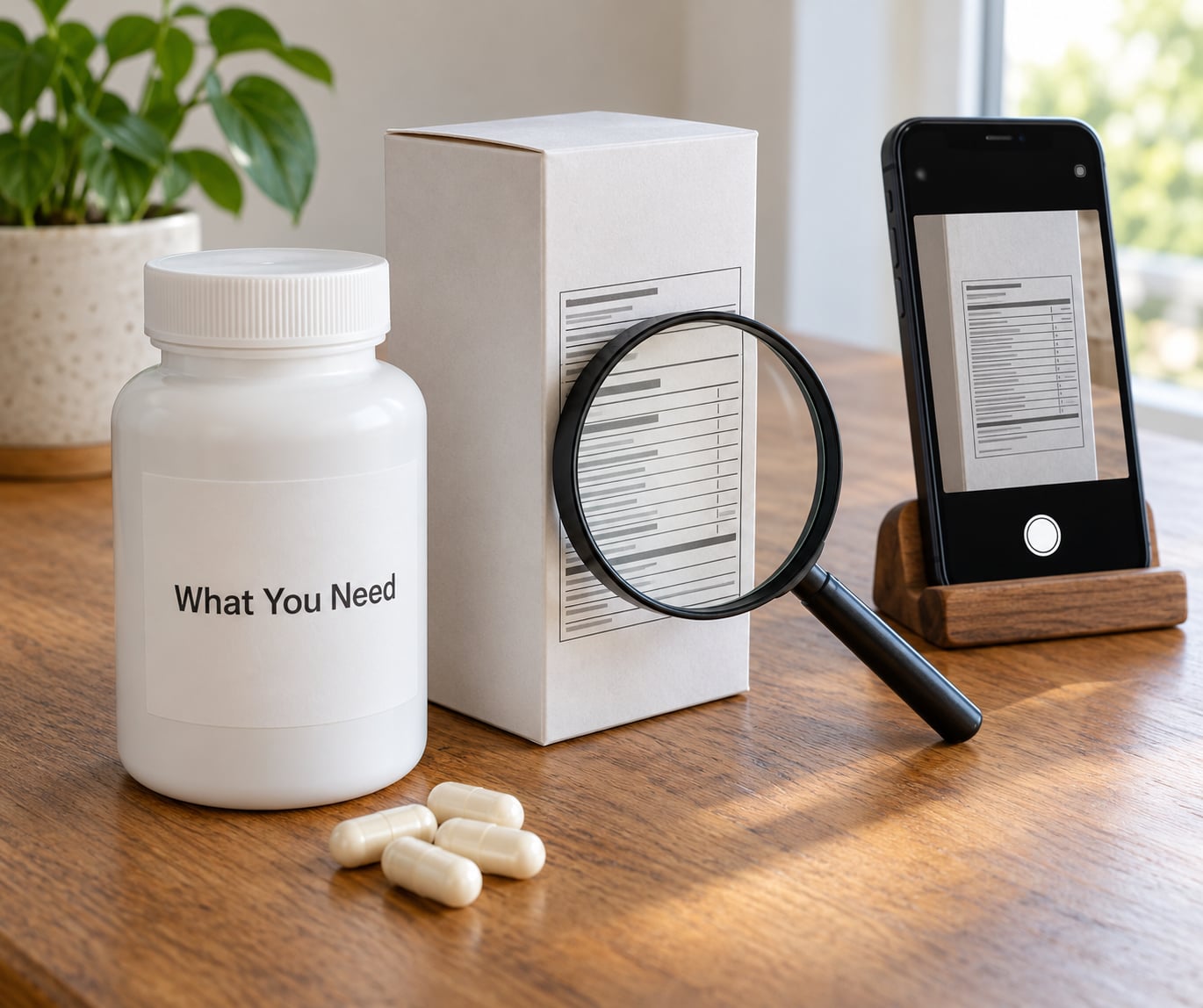
Three things make this fast: the physical bottle or carton, a magnifier or your phone camera for the small print, and somewhere to record what you find.
Keep the outer carton, not just the bottle. Many herbal products print the Latin plant name, the extract ratio and the lot number on the carton only, and the bottle label carries a shortened version.
Have something to write on. A phone note works fine. Record these in order: serving size, plant name and plant part, amount, extract type and standardization, other ingredients, warnings, lot number and the manufacturer contact.
Compare two bottles side by side whenever you can. Ten minutes with two products in front of you teaches more about label literacy than an hour of reading about labels.
Step-by-Step: How to Read an Herbal Supplement Label
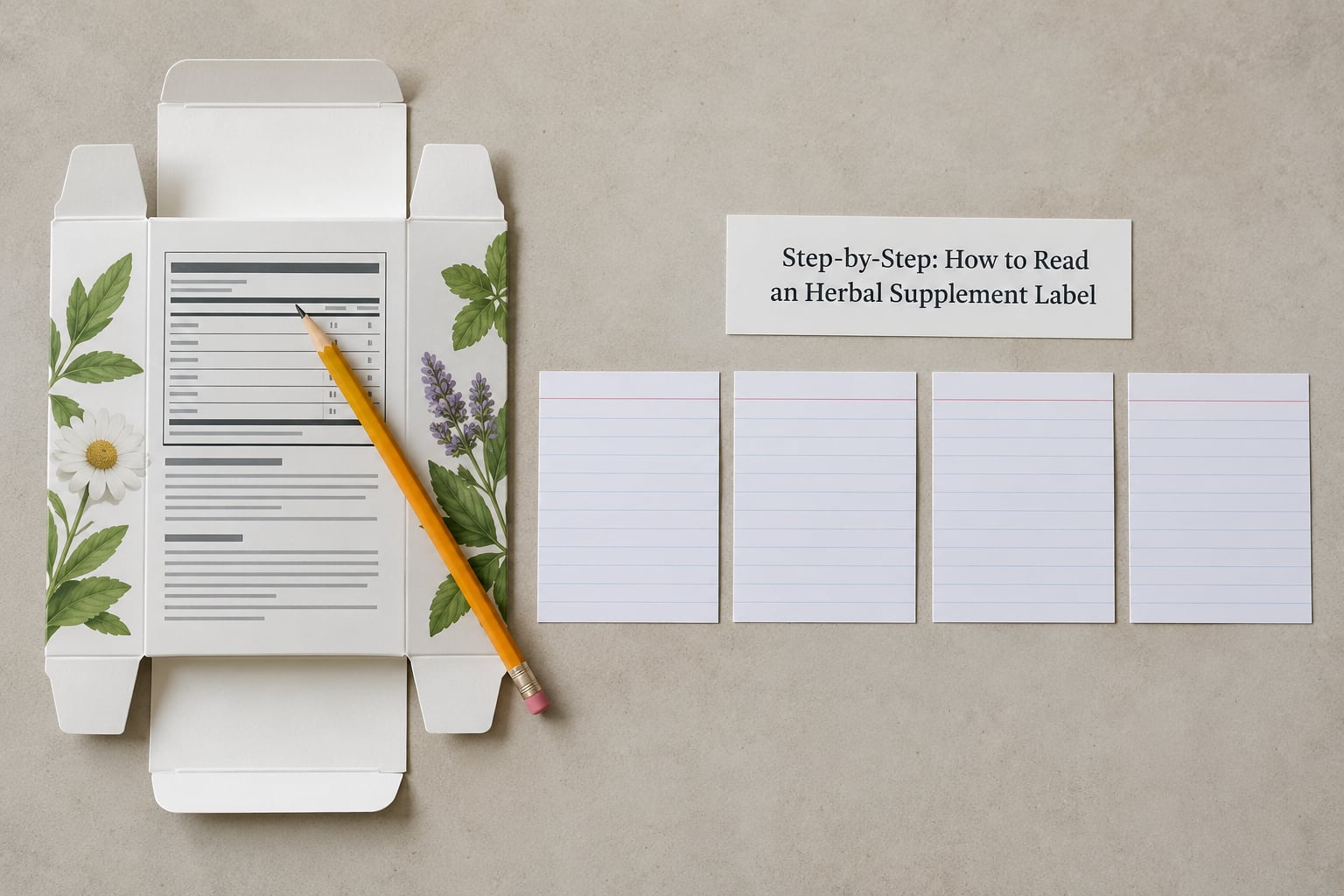
Work in a fixed order so you never skip a line. The steps below run from the front panel down to the small print in the footer.
1. Identify the product, the plant and the plant part
Start with the plant itself, because the front panel is marketing. It tells you what a product is meant to do, not what is inside the capsule.
Look for the Latin binomial. Names like Sutherlandia frutescens or Pelargonium sidoides are unambiguous, which matters because common names collide across regions. African and diaspora herbal markets often carry local plant names that no international database will match, so the binomial is the cross-check that keeps you oriented.
Then find the plant part. Root, bark, rhizome, leaf, seed and whole plant can carry different compounds in different amounts. Two products built from the same species are not interchangeable when one uses the root and the other uses the leaf.
Next, check the preparation form. Extract, dried powder, tincture and standardized extract describe different products from the same plant, and so do single herb and blend. A tincture also states its solvent and extraction ratio, which tells you how concentrated it is compared with a capsule.
2. Read the supplement facts panel and do the amount math
The supplement facts panel is the regulated part of the label. It should state the serving size, the servings per container, the amount per serving and, where one applies, a percent daily value.
Herbs usually have no established daily value, so a blank DV column is normal and says nothing about quality. What you can still do is convert units: 1 gram equals 1,000 milligrams, and 1 milligram equals 1,000 micrograms.
Serving math is where most readers go wrong. Labels frequently state amounts per two or three capsules, or per scoop, rather than per capsule. If a serving is two capsules and the panel lists 400 milligrams of extract per serving, each capsule contains 200 milligrams.
Multiply that per-capsule amount by the number of servings the directions suggest to get the daily total. That is arithmetic on a printed label, not dosing advice, and the directions on the panel are the manufacturer’s suggestion rather than a personal prescription.
Check for standardization wording too. A statement such as “standardized to 5 percent” tells you the amount of a named compound per serving, which is more useful than a total weight that can be mostly plant fibre.
3. Check the other ingredients
The other ingredients list covers everything that is not the active plant. Read it for fillers, binders, coatings, capsule type, sweeteners, artificial colours and allergens.
Capsule material matters to some readers, and a vegetable or cellulose capsule does not suit everyone who is fine with gelatin. Ingredients are listed in descending order by weight, so the first one is the heaviest by mass.
A short ingredient list is not proof that a product is effective or safe, and a long one is not proof that it is bad. Read it for what you personally react to, then move on.
If the panel shows a proprietary blend, the amounts of the individual herbs inside it are usually not disclosed. That is legal under US rules, and it is the single biggest gap on many herbal labels, because you cannot compare a blend against a single-ingredient product without knowing the ratios.
4. Look for directions, warnings and interactions
Directions, warnings and interaction cautions sit at the bottom of the back panel, often in smaller type than the ingredient list, and they are the part most readers skip.
Look for pregnancy and breastfeeding cautions, allergy statements, cautions about people with existing medical conditions, and any mention of drug interactions. Botanical labels are required to carry a statement advising consultation with a health professional when the user has a health condition, is pregnant or breastfeeding, or is taking medication.
Some labels list specific warning symptoms that mean stop and get medical help. Chest pain, breathing difficulty, swelling or fainting after a dose are reasons to seek care rather than to try a different brand.
Photograph this block. It is the part you will want to read aloud to a pharmacist or doctor, and it is the part most likely to be missing from a marketplace listing.
5. Verify claims, quality and traceability
Structure and function claims mean a product may support a structure or function in the body; they are not permission to claim it treats or cures a disease. A label that says it cures, reverses or prevents illness is making a drug claim, and that is the claim to walk away from.
Look for GMP compliance, which means the manufacturer follows good manufacturing practices, and check whether a third-party testing mark appears, along with a way to look up the test results for the batch rather than for the brand as a whole. A generic GMP badge with no certificate number tells you less than a certificate listing the actual plant and its marker compounds.
Find the lot or batch number and the expiration or best-by date. A lot number is how a company traces one production run, so it is what makes a recall or a complaint meaningful.
Finally, read the footer. A manufacturer address, a phone number and a website that matches the label are basic signs that someone answers questions about what they made. In 2026, these basics still separate a careful manufacturer from a label you cannot trace at all.
Common Mistakes
These are the errors I see most often, and each has a straight correction.
- Confusing serving size with pill count. The number of capsules is not the dose. Read the gram or milligram amount and divide it by the number of capsules in the serving.
- Treating the front-panel claim as proof. Marketing language tells you intent, not content. The facts panel is the regulated part.
- Skipping the plant part. Root, bark and leaf are not interchangeable. Look for the part name in the ingredient list, not just the plant name on the front.
- Ignoring allergens in other ingredients. Fillers, coatings and capsule material sit in this list, and this is where common reactions come from.
- Assuming natural means risk-free. Herbs contain active compounds that act on the body, which is exactly why the warnings section matters.
- Reading a proprietary blend as if it were itemised. A blend without disclosed amounts cannot be compared gram for gram against a single-ingredient product.
- Not recording the lot number before opening the bottle. Once the seal is broken, matching your bottle to a batch becomes guesswork.
- Treating a GMP badge as third-party test results. GMP describes how the manufacturer makes the product. Independent test results are a separate document, and they should be retrievable for your lot.
Two habits cover most of the above. Read the label before you buy, not after the bottle is open, and read it while the product is in front of you so you can check each line instead of guessing what it probably says.
Frequently Asked Questions
What should I look for first on an herbal supplement label?
Look at the supplement facts panel first, and start with the serving size and the plant part. Everything else on the label depends on those two lines. The serving size tells you how many capsules the listed amount covers, and the plant part tells you whether you are getting root, bark, leaf or seed. Read the front panel afterwards, because the claim there depends on what the facts panel actually lists.
How can I tell how much active ingredient is in one serving?
The amount printed beside the ingredient is per serving, not per capsule. Divide that figure by the number of capsules, tablets or scoops that make up one serving to get the amount your serving size actually delivers. Watch the units too, since labels switch between grams, milligrams and micrograms without warning. Standardized products add the percentage of the named compound, which tells you the amount of that compound specifically.
Does a proprietary blend show the amount of each herb?
Usually it does not. A proprietary blend lists the herbs that are included but leaves the individual amounts undisclosed, even though the total weight of the blend is stated. That makes precise comparison impossible, because the total could be mostly one cheap filler herb with a small amount of an expensive one. When a blend matters to you, look for a certificate of analysis or contact the manufacturer and ask for the ratios in writing.
What is the difference between an extract and a dried herb powder?
A dried powder is the whole plant material, dried and milled, so it carries everything in that plant part including fibre. An extract concentrates certain compounds, often using water or alcohol, and labels give an extraction ratio such as 10 to 1 to show how much plant went into the amount in the capsule. A tincture is a liquid extract. The three are not equivalent, so compare the compound amount rather than the capsule weight.
Are natural herbal supplements automatically safe?
No. Natural describes the source, not the risk. Herbs contain active compounds that can affect the body, so a supplement can interact with prescription medicines, be unsuitable during pregnancy or breastfeeding, or cause a reaction in someone with a plant allergy. Read the warnings block, check the other ingredients for allergens, and ask a doctor or pharmacist before starting anything if you take medication or manage a health condition.
What quality marks or batch information should I look for?
Look for three separate things: a GMP statement showing the manufacturer follows good manufacturing practices, a third-party testing mark with test results retrievable for your specific batch rather than the brand overall, and a printed lot or batch number with an expiration date. The lot number is what ties your bottle to one production run and makes a recall or complaint traceable. A manufacturer address and phone number in the footer is a small but useful sign.
Conclusion
Start with the facts panel, not the front of the bottle. Compare the plant name, the plant part, the preparation form, the active amount per serving, the other ingredients, the warnings and the quality information across the products you are considering, and then take the label to a doctor or pharmacist and ask whether it suits you specifically.
Ten minutes with a magnifier and two bottles in front of you is enough to do all of that. It is the fastest way to tell a careful label from a persuasive one.