Sustainable wild harvesting rules explained in plain terms come down to this: collect a plant only where you have permission, only from a population that can replace what you take, only in the season and at the intensity the species can survive, and only with the consent of the people who hold the knowledge about it. Anything less is extraction with a nicer name.
This matters more in African ethnomedicine than almost anywhere, because a large share of medicinal material still comes from wild plants and much of the knowledge about which plant does what sits with healers and community elders rather than in a herbarium. The IPBES figures usually quoted put wild plants, algae and fungi at roughly one in five people worldwide depending directly on them for food, medicine and income, so the supply chain and the cultural practice fail together when a stand is stripped.
What follows is a framework, not a licence. It covers how to identify a species, how to judge a population’s condition, how far to limit a harvest, which plant parts are ecologically destructive, and what obligations attach to consent and benefit sharing. It does not cover preparation, dosage or treatment, and none of it should replace the advice of a qualified health professional about your own health.
Table of Contents
- 1What Are Sustainable Wild Harvesting Rules?
- 2What Should You Know Before Collecting a Medicinal Plant?
- 3How Do You Set a Safe Harvest Limit?
- 4Which Parts of Plants May Be Collected?
- 5How Do You Collect Plants Without Damaging the Population?
- 6How Are Community Rights and Benefits Protected?
- 7How Do Harvesters Prevent Unsafe or Unsustainable Practices?
- 8Frequently Asked Questions
- 9How do I know whether a medicinal plant is safe to harvest?
- 10Is collecting a few leaves from a wild plant ever sustainable?
- 11What is the difference between wild harvesting and cultivation?
- 12Who should decide how much of a plant community may be collected?
- 13Can traditional or commercial harvesting rules conflict?
- 14What documentation should a responsible research harvester keep?
- 15Conclusion: Where to Start With These Rules
What Are Sustainable Wild Harvesting Rules?
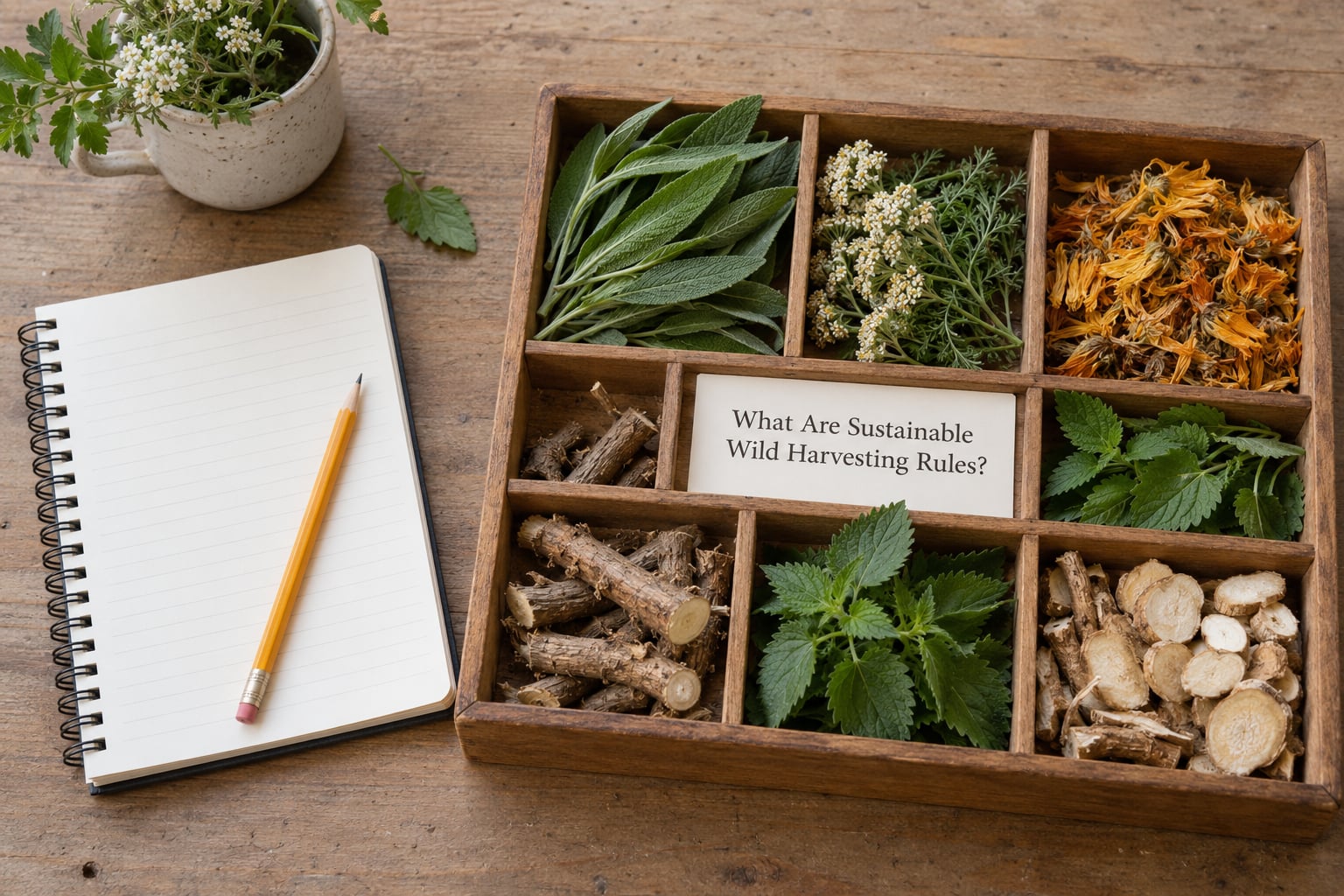
Wild harvesting rules are the ecological, legal and social limits that govern the collection of plants from places where they grow naturally. They cover how much you take, when you take it, which part you take, who must agree to the taking, and what the people living alongside that resource receive in return.
It helps to separate four kinds of use, because the FAO policy guidelines on non-wood forest products treat them as different activities with different expectations. Subsistence collection is a household gathering enough for its own use. Commercial collection is supplying a market, including a herbal wholesaler, a clinic dispensary or an export buyer. Recreational use is gathering for pleasure. Ecological collection is gathering that is itself part of a management or restoration programme, such as selective thinning of an invasive stand.
Responsibility also depends on the method. Selective collection from a healthy population, leaving seed-bearing and juvenile plants behind, is the opposite end of the scale from strip harvesting, where every plant in a patch is taken for a single shipment.
Three interests sit behind every rule. The ecological interest is population survival and the food web around it. The legal interest covers protected species, permits and land access. The social interest covers ownership, consent and fair return to the community that depends on the resource. A harvester who follows only the first two can still exhaust a stand socially, because the people who know when and where to collect lose the income and the practice.
Two words cause confusion here. A wild species is one that occurs naturally in its range, as opposed to one planted or introduced for production; that definition says nothing about whether harvesting it is legal. Sustainable yield is the amount a population can give in a period and still hold its size, structure and reproductive capacity, so it moves with rainfall, fire, browsing and pressure from other collectors rather than sitting at a fixed number.
What Should You Know Before Collecting a Medicinal Plant?
Know the species, and know it in the field. A common name, a photograph on a phone or a description handed over by a supplier is not identification, and several African medicinal plants have close look-alikes with different chemistry. If identification is uncertain, the correct harvest is none. For research collections the bar is higher still: a voucher specimen and a determination by a botanist, ideally someone working on the flora of that region.
Know the population before you touch it. The IUCN Red List status of the species, whether it is listed on a national protected species schedule, and whether it is already known locally as scarce or slow to return all matter. Note how many individuals you can count in the patch, whether young plants and mature seed-bearers are present, and whether the ground cover and soil look disturbed.
Know the biology. When does it flower, when does it set seed, does it reshoot after cutting, does it spread by seed or by rhizome, how old must a root be before it is worth digging, and how many years does the stand need to come back? A plant that regenerates from a shallow rhizome can take a light cut every season, while a tap-rooted perennial that is dug out whole may never come back on a harvest timescale that matters to the people using it.
Know the site and the season. Collect in the right window for the part you need, avoid active nests and breeding areas, and stay out of ground treated with herbicides, sewage sludge, refuse dumps or sprayed roadside verges. Material from contaminated land is not usable for medicine no matter how well the harvesting is otherwise managed.
Know who controls the land and the knowledge. Written permission from the landholder is the floor, not the ceiling; a customary authority or community may have to approve as well, and some knowledge is not freely shared. Know the purpose and the quantity before you start, because research collection, a small dispensary order and a bulk commercial shipment have different rules attached to them.
Know when to stop and call someone better. Anything involving a species you cannot identify, a protected or listed plant, a large commercial volume, or land under dispute belongs with a trained botanist, a conservation officer or the relevant community authority rather than with an improvised trip.
How Do You Set a Safe Harvest Limit?
A harvest limit comes from the weakest of five numbers, and it is usually smaller than intuition suggests. Population density tells you how much material is standing there. Growth and regeneration rate tells you how fast it comes back. Reproductive biology tells you whether removing an individual costs the stand a seed source. Habitat pressure tells you how much slack the site has. And customary rules tell you what the community has already decided is fair, which may be stricter than anything an ecologist would write.
| Population condition | Signals in the field | What harvesting is appropriate |
|---|---|---|
| Healthy population | Many individuals across all age classes, dense natural spacing, seed-bearers present, no visible gaps | Selective collection allowed within a written plan, leaving mature plants, juveniles and enough seed to regenerate; monitor between visits |
| Stressed or recovering population | Few juveniles, wide spacing, only mature individuals, soil exposed or compacted, signs of prior collection | No commercial or research collection. Passive monitoring and, where appropriate, assisted propagation or cultivation instead |
| Threatened, protected or listed population | National listing, IUCN status, community-declared scarcity, CITES appendix listing | Do not harvest from the wild. Collect only from documented cultivated or managed sources |
Common sense still needs a number. Foragers and practitioners asking for a realistic volume often get the general advice to take only what you need, which is correct and useless on its own. A workable approach is to set a ceiling per stand and per season, record what was actually taken, and compare the recorded take with the count of regrowth the following season; if regrowth is not keeping pace, the take was too high regardless of the intention behind it.
For commercial volumes, the World Wildlife Fund’s guide to sustainable use of wild medicinal plants recommends a simple formula: harvest no more than a set percentage of what is available in a season, split collection across multiple sites rather than concentrating on one stand, and leave a portion uncollected entirely. Standards such as the FairWild Standard and the Global Biodiversity Standard turn this into auditable conditions, and a collection plan with mapping, quotas and monitoring records is what a buyer or auditor will ask to see.
Where a formal limit does not exist, the community’s own rule applies first. Under the Nagoya Protocol on access and benefit sharing, countries must have a framework for accessing genetic resources and associated traditional knowledge, so a national permit, a recognised research access permit or a signed community agreement is often the legal form that a local rule takes.
Which Parts of Plants May Be Collected?
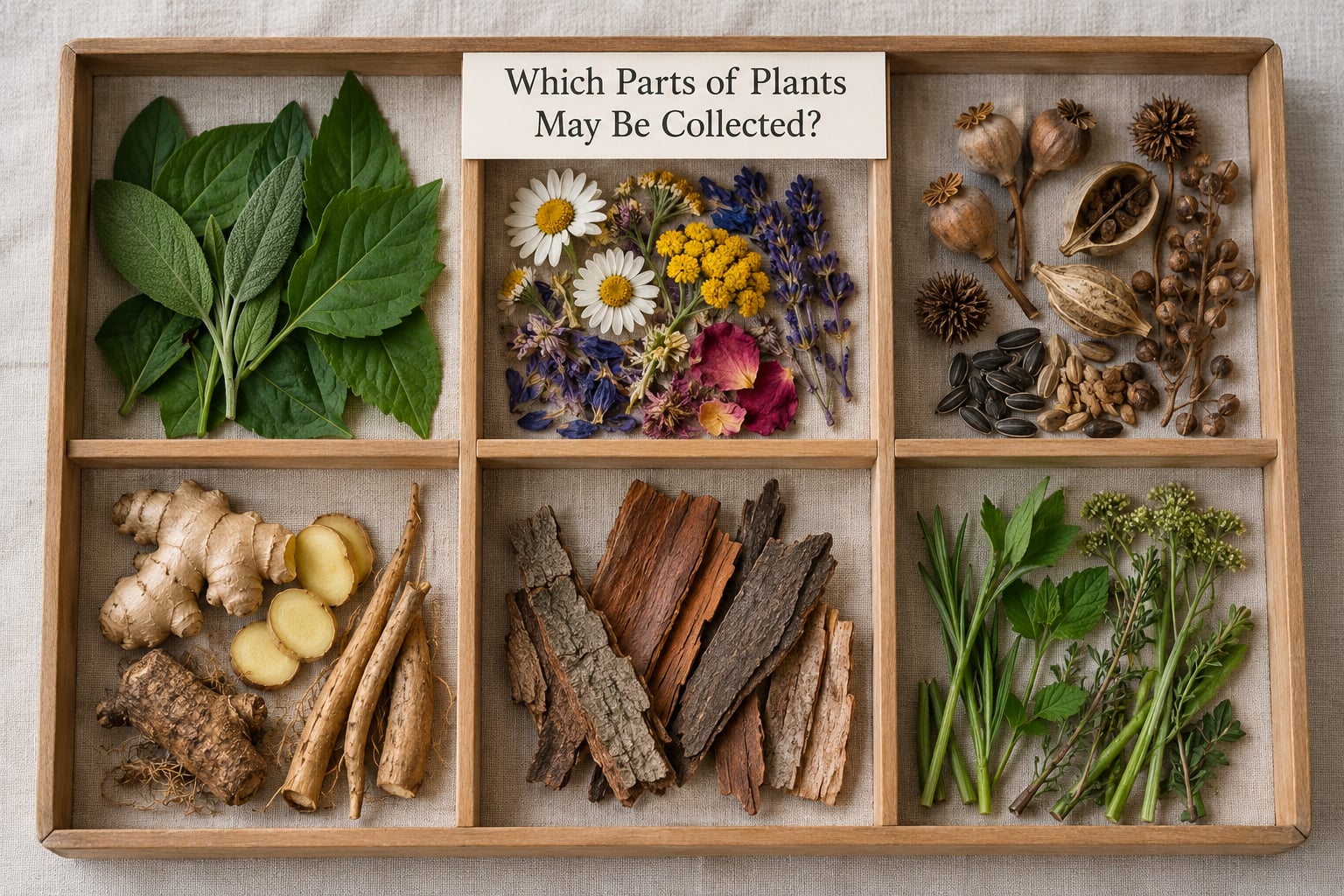
Part matters more than volume. Taking leaves from a plant that has plenty of leaves is a very different event from taking its root, and the recovery time can differ by years. The table below is ecological only; it says nothing about which parts are used medicinally in any tradition, and it is not guidance for personal use.
| Plant part | Ecological effect of collection | Practice that limits the damage |
|---|---|---|
| Leaves and flowering tops | Low if the plant reshoots and keeps flowering | Take upper growth from outer plants, skip immature plants and flowering individuals, leave lower leaves intact so the plant can photosynthesise at full rate |
| Fruit and seed | Variable; often high because it removes the next generation | Collect only ripe seed from a population with abundant seed and strong seedling density; never strip a stand of all its seed |
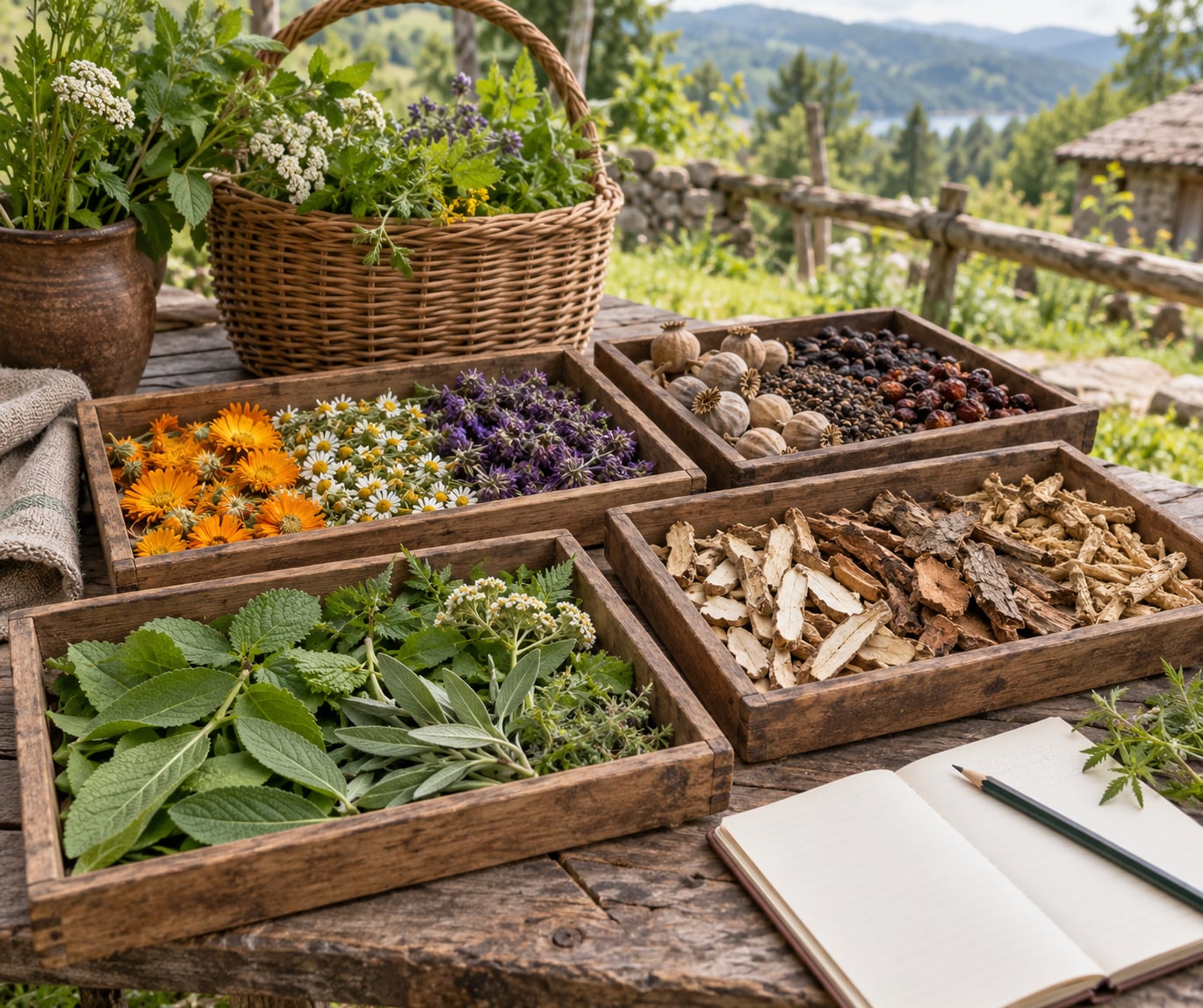
| Roots, bulbs, tubers | High; often removes the whole individual and its vegetative spread | Harvest mature plants only, dig selectively and leave the majority of a clump intact, replant pieces, and allow long rotations measured in years between visits |
| Bark | High if taken in strips or over large areas | Use patch selection rather than ring-stripping, keep gaps between harvest areas, and avoid taking bark from the same stem twice |
| Whole plant | Usually the most damaging, and often illegal for listed species | Not appropriate from wild populations of slow-regenerating plants; obtain material from cultivation or a managed collection plan |
The general principle most practitioners already know from their own gardens is the right one in the field: take a third, leave two thirds. Applied consistently and spread across a stand rather than concentrated, it allows regrowth and keeps the population’s age structure intact.
How Do You Collect Plants Without Damaging the Population?
Move through the stand rather than stripping it edge to edge, and change route each time so the same plants are not repeatedly hit. Selective thinning that removes the largest or oldest individuals while leaving seedlings and seed-bearers is generally closer to what a wild collection plan calls for than a mass cut, though the correct method depends on how the species regenerates.
Keep field technique out of the population’s way. Do not compact wet soil by working it repeatedly; trampling kills more young plants in some sites than the harvest does. Do not cut indiscriminately across a slope or along a single line, because that creates a permanent cleared corridor. Clean cutting tools between sites and species, and keep out of wet conditions that spread root and foliar disease through a stand.
Leave behind everything that is not the target part: healthy mature plants, juveniles, ground cover between plants, and litter that protects the soil. Skipping flowering and fruiting individuals removes seed for the next season, and for the wildlife that feeds on the plant as well as for the plant itself.
For the part you are taking, use a clean sharp cut and leave the stump able to close over. Do not take plants with low regeneration, and do not harvest a spot that has already been harvested that season. That last point comes up constantly in forager communities and is not a formality: repeated collection of the same patch is the mechanism behind most overharvesting.
Take your lead from local practice rather than from a general guide. Where a community has a protocol, a trained harvester or a locally agreed rotation period, that protocol is the one to follow, and it may require supervision by someone experienced with that species. Practising ecological field collection on your own initiative, without the knowledge holders’ involvement, is not the same activity as collecting within their system.
How Are Community Rights and Benefits Protected?
Wild harvesting is not only an ecological question. In many communities, plant knowledge, the right to gather, and the land itself are held collectively under customary law that predates and operates alongside national conservation law. A collection that is ecologically conservative but ignores those rights can still be an appropriation.
Prior informed consent comes first. It means the people who hold the knowledge understand what you plan to collect, why, how much and for what purpose, and they have a genuine choice to agree or refuse, without pressure from an employer or buyer. It should be reached before any collection, not retrofitted before publication or shipment.
Customary and cultural restrictions matter. Some knowledge is shared only with particular people, for particular uses, and in particular seasons. Some species or parts are not collected at all, or not by anyone outside a specific role. Publishing or commercialising material collected in breach of those conditions harms the community even where the ecology is intact.
Benefit sharing should be written down and verifiable. Agreements commonly cover a share of revenue, local employment in collection and processing, training and equipment, and support for community priorities such as schools, nurseries or habitat restoration. Local employment is worth taking seriously: it keeps harvesting knowledge where it belongs and gives the people who watch the population the reason to report a decline early.
Community-based monitoring closes the loop. Local harvesters and elders are the people who see a stand thin out before any survey does, so agreements generally include them in the monitoring, the record-keeping and the decision to pause collection. Projects that consult a community once at the start and never again during implementation tend to lose the consent they were granted.
How Do Harvesters Prevent Unsafe or Unsustainable Practices?
Lay these sustainable wild harvesting rules explained out as a sequence and they become something you can work through rather than a statement to agree with. Run them in order, and do not start collecting until the pre-harvest list is complete.
Before you go, hold a written collection plan that names the species, the sites, the parts to be taken, the quantities, the season and the method. Confirm the permit, the landholder’s consent and any community agreement, and check the national protected species list. Record the conservation status of the species and set the quantity ceiling per site and per season. Inspect the site for herbicide or biosolids treatment, refuse, dumping and recent cutting, and note where nests and breeding areas are. Carry identification references for the target species and its look-alikes, a field notebook, a camera for record photographs, clean cutting tools, sealed containers or bags for separate lots, and gloves and a first aid kit.
While you collect, collect only from the sites in the plan and only the agreed parts. Work across the whole population rather than concentrating on one corner. Skip mature plants, juveniles, flowering and fruiting individuals and anything damaged or diseased. Do not uproot unless the method calls for it and the species and site allow it. Replug holes, spread displaced soil, and pack out everything you carried in. Watch for the moment the stand stops being comfortable to walk through without bending, and stop when you reach it.
After you leave, label each lot at the point of collection with species, site, date, collector and part taken. Keep lots separate so nothing from a contaminated or misidentified site can be mixed with clean material. Complete the field notes the same day while the details are accurate, including quantities and the condition of the population you observed. Enter the lot into the traceability record so the material can be followed through drying, processing and sale, with certificates of analysis for material bought in rather than collected by you.
Refuse collection, without negotiating, from a site that is sprayed or treated, inaccessible or unstable, already over-harvested, on legally protected land without a permit, or inside a customary exclusion area. Being asked to break one of these is itself information about how the rest of the work will be done.
Frequently Asked Questions
How do I know whether a medicinal plant is safe to harvest?
Identification is the first gate, and it has to be a real one: a specimen checked by a botanist, not a photo or a common name. Then check the population for juveniles and seed-bearers, confirm the species is not on a national protected list or in a threatened IUCN category, and confirm you have permission from the landholder and any relevant community authority. Avoid treated, sprayed or dumped ground. If any of that is uncertain, do not collect.
Is collecting a few leaves from a wild plant ever sustainable?
Small amounts from a healthy, abundant population usually are, provided the plant can reshoot and you leave flowering and juvenile plants untouched. Quantity alone is not the measure; concentration in one patch is what causes harm. The reliable habits are taking upper growth only, spreading collection across many sites, never returning to a spot already harvested that season, and staying away from listed or scarce species entirely.
What is the difference between wild harvesting and cultivation?
Wild harvesting collects material from plants growing naturally in their range, subject to ecological limits and access rights. Cultivation grows the species under management, which removes the population pressure and usually the contamination risk. Cultivation does not remove the need for correct identification, traceability or consent when traditional knowledge is used, and it still needs suitable growing conditions to produce material of usable quality.
Who should decide how much of a plant community may be collected?
Whichever authority holds the resource and the knowledge, which is often both the landholder or community and the relevant legal body. In practice that means the community’s own harvesters and elders set customary rules, a collection plan sets the ecological ceiling, and national law sets the legal ceiling. Where these differ, the most restrictive applies, and CITES or national protected species listings can override a local agreement.
Can traditional or commercial harvesting rules conflict?
Yes, and it is a common source of dispute. Communities may restrict collection to particular seasons, parts or people, while a buyer wants volume and a fixed delivery date. Resolving it means a written benefit-sharing agreement, a realistic quantity based on what the stand can regenerate, and the willingness to reduce or pause the order. Standard schemes such as FairWild treat both ecological performance and fair benefit as conditions, not alternatives.
What documentation should a responsible research harvester keep?
A collection permit or access permit, a signed community agreement where traditional knowledge is involved, a written collection plan naming species, sites and quantities, dated field notes with location and observer, and voucher specimens deposited with a recognised herbarium. Record quantities taken per site and season, the population condition observed, and the processing history of each lot. Chain-of-custody records make the material traceable from stand to result.
Conclusion: Where to Start With These Rules
Start with identification and permission, in that order, and do not collect until both are settled beyond doubt. Everything after that follows: judge the population, set a quantity ceiling before you go, take the least destructive part available, spread the take across many sites, label and record each lot, and keep the community who holds the knowledge involved from the first conversation to the final report.
Documentation is what turns good intentions into defensible practice, and it is also what buyers, auditors and researchers ask for first. The organisations doing this work in the field, from TRAFFIC and the FairWild Foundation to IUCN specialist groups, BGCI and FAO, all publish frameworks worth working through before a season starts rather than after a problem appears.
On the health side of this subject, keep it separate: nothing in these rules says how any plant should be prepared or used, and questions about your own treatment belong with a qualified health professional.