If you make herbal remedies at home, the shelf life of homemade herbal products is the single most important thing you track, and no single number covers it. A fresh water infusion kept on the counter might be usable for a day, a properly dried and stored herb can keep for years, and an alcohol tincture sits somewhere in between. The deciding factors are water, alcohol or oil, light, heat and cleanliness.
The honest starting point: homemade batches carry no printed expiration date and usually no lab validation behind them. You are estimating, not confirming. Treat every time range below as a conservative planning figure, and when in doubt, discard.
That matters more for ethnobotanical work than for most hobbies. A prepared remedy is often the only physical record of a plant’s preparation knowledge, and a batch spoiled by a warm cupboard or a wet spoon can be lost with no way to remake it from the same material. Good shelf-life discipline is what lets a remedy keep working as a working remedy rather than a museum piece.
This guide is general information about storage and spoilage. It is not medical advice, and it cannot tell you whether a specific preparation is safe for you. For anything ingested or applied to broken skin, talk to a clinician, pharmacist or qualified health professional first.
Table of Contents
- 1What Determines the Shelf Life of Homemade Herbal Products?
- 2How Long Do Common Homemade Herbal Preparations Last?
- 3Shelf Life by Preparation Method
- 4Water-Based Preparations
- 5Alcohol and Glycerin Preparations
- 6Oils, Salves, and Balms
- 7Dried Herbs, Powders, and Resins
- 8How to Store Homemade Herbal Products Safely
- 9What Signs Mean a Homemade Herbal Product Should Be Discarded?
- 10Can You Extend the Shelf Life of Homemade Herbal Products?
- 11How to Label and Date Your Preparations
- 12Frequently Asked Questions
- 13Can you tell if homemade herbal products are safe only by checking the expiration date?
- 14What should I do if my homemade herbal product smells or looks different?
- 15Is a homemade herbal product safer because it contains natural ingredients?
- 16Can refrigeration make a homemade herbal product last indefinitely?
- 17How should I store homemade herbal products when I do not know the recommended shelf life?
- 18Conclusion
What Determines the Shelf Life of Homemade Herbal Products?
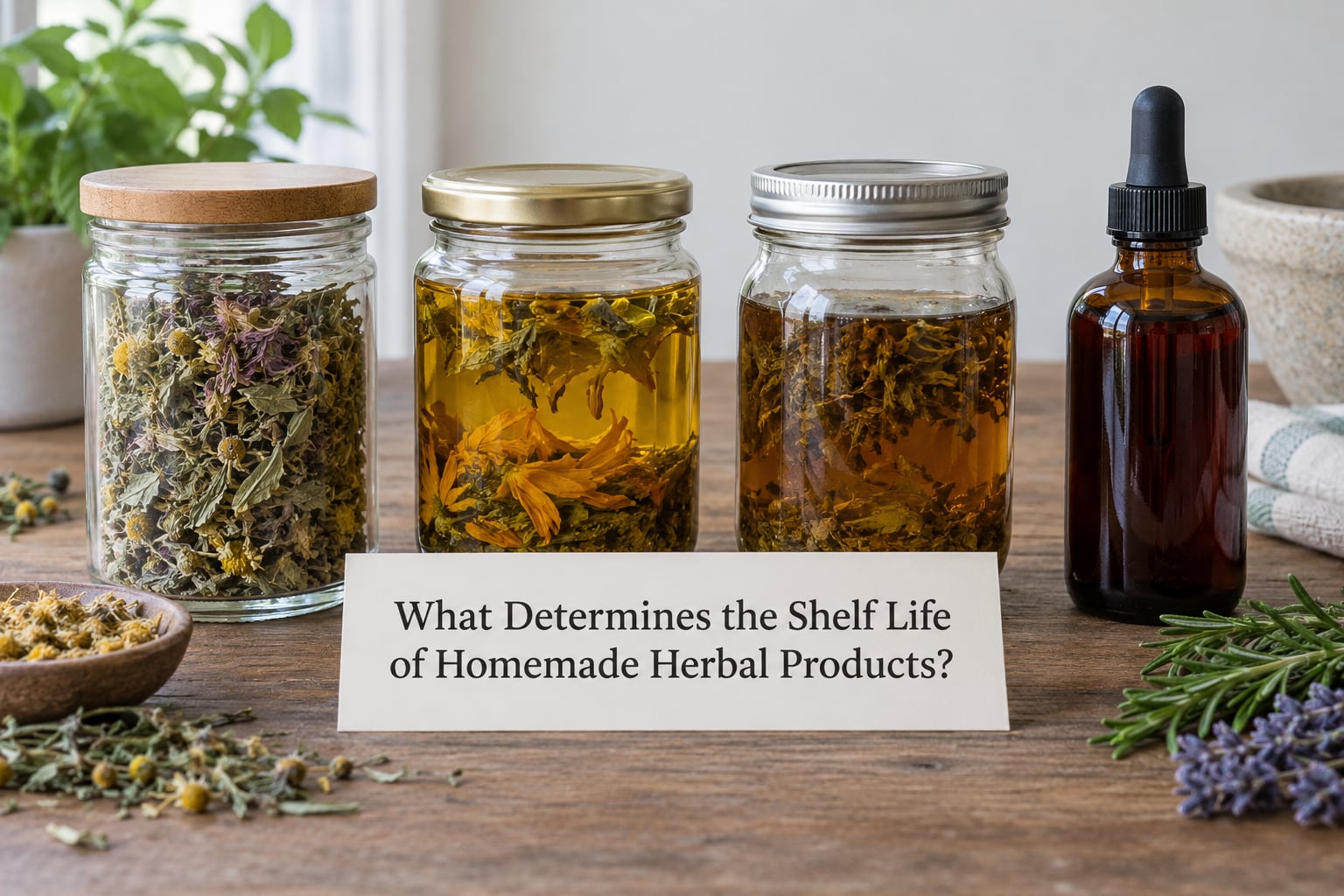
Shelf life is set by formulation and storage, not by the plant itself. Eight variables do most of the work, and changing any one of them can move a preparation by months.
- Moisture and water activity. Water is what mold, yeast and bacteria feed on. A water-based preparation can support visible and invisible growth within a day, while the same material extracted into alcohol sits for years.
- pH. Acidic and alkaline preparations resist different organisms. A preparation whose pH you have never measured is one you cannot reason about confidently.
- Oxygen exposure. Headspace in a partly filled jar, a loose lid or repeated opening pushes oxidation of both plant constituents and carrier oil.
- Light. Ultraviolet light breaks down volatile oils, chlorophyll and colour compounds, so a clear bottle on a sunny windowsill ages far faster than an amber one in a cupboard.
- Temperature. Every chemical and microbiological rate rises with heat. A shelf ten degrees warmer is not a marginal difference.
- Container compatibility. Some plastics and metals interact with plant constituents or leach into an oil phase. Amber glass with a tight lid is the conservative default.
- Preservatives present in the recipe. Alcohol, glycerin, honey and sugar all slow growth to different degrees and under different conditions.
- Sanitation and ingredient quality. A clean spoon, washed plant material and a sterilised jar matter more than any storage trick. Dry material dropped into a wet jar brings its own moisture with it.
One thing all of this adds up to: a homemade product usually has no validated expiration date. The numbers people repeat online, including the ones here, are estimates drawn from formulation logic and reported practice, not from stability testing on your batch. The materials you used, the technique you used and the cupboard you stored them in are all unknown variables.
How Long Do Common Homemade Herbal Preparations Last?
These are cautious planning ranges for well-made batches in good storage, not guarantees. Recipe composition, ingredient quality, batch size and storage conditions can shorten them considerably or make them unreliable.
| Preparation | Typical planning range | Main spoilage risk | Best storage |
|---|---|---|---|
| Fresh water infusion or tea, unrefrigerated | Same day, up to about 10 hours | Bacteria, then mold and yeast | Use fresh, discard leftovers |
| Water infusion or decoction, refrigerated | 24 to 48 hours | Microbial growth in low-acid liquid | Airtight glass, back of the fridge |
| Herbal syrup with honey or sugar | Several months | Fermentation, dilution, mold at the surface | Refrigerated in sterilised glass |
| Alcohol tincture, high proof | Several years | Solvent evaporation, dilution, light damage | Dark glass, cool, tightly sealed |
| Glycerite or vinegar extract | Roughly 6 to 8 months | Mold and yeast, water content, dilution | Refrigerated, dated label |
| Herbal infused oil, culinary | 6 to 9 months, sometimes up to a year | Rancidity, mould if damp material stayed in | Dark bottle, cool cupboard, strained clean |
| Infused oil used on skin | Shorter and less certain than culinary oil | Microbial growth from residual moisture | Refrigerated, small batch, discard early |
| Salve or balm in tins | About a year | Rancidity of the oil, separation, mould | Cool dark place, clean dry hands on lids |
| Dried herbs, whole or cut | 1 to 3 years | Moisture take-up, volatile oil loss, mould | Airtight, dark, low humidity, cool |
| Ground powders and resins | Often shorter than whole dried material | Greater surface area, clumping, oxidation | Airtight, dark, used quickly |
| Fresh herbs and roots | Days to a couple of weeks | Wilting, rot, microbial growth | Refrigerated in a breathable bag |
Read the water rows together. A water-based preparation is not a slightly shorter version of a tincture; it is a different category with a completely different risk profile. The gap between 10 hours on a counter and 48 hours in a fridge is the gap between a water extract and everything else on this list.
Shelf Life by Preparation Method
Water-Based Preparations
Water extracts, decoctions, cold infusions and plain teas are the most perishable preparations you can make at home. Water activity is high, acidity is often low enough for organisms to thrive, and nothing in the recipe stops them. The planning range is short by design.
Refrigeration slows growth but does not stop it, so a decoction still has a real chance of carrying bacteria after two days in the fridge. This is also the preparation type where home technique matters most, because the difference between a clean pour and a jar contaminated by a wet spoon is the difference between a usable liquid and a culture.
Serious herbalists treat unpreserved water products as short-lived intermediates rather than stored remedies. If you need something that keeps, either make it in smaller quantities and use it up quickly, or add a genuine preservative such as alcohol, honey or sugar in a proper ratio, or take it to a lab for microbial testing. Recipes that skip the preservative and skip the testing are relying on hope.
Alcohol and Glycerin Preparations
Alcohol is the most reliable preservative available to a home maker, because it dehydrates the environment organisms need. That protection depends heavily on the alcohol percentage by volume and on how much water remains in the finished extract, including water carried in by fresh plant material and water produced in reactions involving plant constituents.
A tincture made with high-proof spirit and dried material is a very different product from one made with a lower-proof spirit and fresh material, even when the plant and the ratio are identical. Fresh plant matter in a lower-proof menstruum can pull the finished tincture below the concentration needed to keep it stable, which is why high-proof alcohol extracts are preferred when the goal is keeping quality rather than flavour.
Glycerin and vinegar extracts are gentler and often preferred for people avoiding alcohol, but they are not self-stabilising. Glycerites are frequently estimated at roughly 6 to 8 months and usually need refrigeration, and vinegar extracts carry the same caution. Neither should be assumed shelf-stable on the strength of containing a preservative-sounding ingredient.
Container integrity matters here too. A tincture that evaporates down over a year has quietly changed concentration, so store it tightly sealed in dark glass and check the fill level each time you use it.
Oils, Salves, and Balms
Oil preparations fail in two separate ways, and confusing them is the most common error on herbal forums. Rancidity is oxidation of the carrier oil, and microbial growth is contamination carried in with moisture or plant material. Solving one does not solve the other.
Rancid oil smells crayon-like, stale or paint-like, and it can also taste off in culinary oils. That smell is a late signal, which is why a preventive antioxidant such as tocopherol, commonly sold as vitamin E oil, is added to some batches at small amounts. It slows oxidation; it does not rescue an oil that has already turned.
The microbial risk is the one people underestimate. Plant material carries water and organisms, and leaving that material sitting in warm oil creates conditions that favour growth, including the botulism risk that makes low-acid, low-oxygen preparations genuinely hazardous. A dry-looking oil is not a tested product. For anything applied to skin, treat the microbial question as unresolved unless a lab has looked at it.
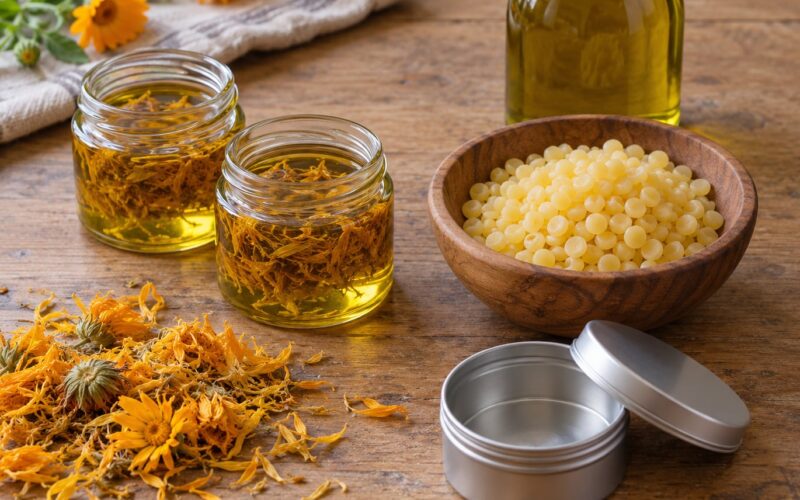
Salves and balms inherit whatever the infused oil did, then add a wax. Beeswax-based salves are commonly dated at about a year, and vegan wax alternatives behave similarly in storage but differ in melting point and how hard the finished balm is to handle. Potency also fades before spoilage appears, so a salve can still be safe while being noticeably weaker than the batch you made last autumn.
Dried Herbs, Powders, and Resins
Drying removes the water that made spoilage fast, which is why dried material is the most forgiving preparation in the home herbal practice. Whole or cut dried herbs stored airtight in the dark in a cool, low-humidity place are commonly estimated at 1 to 3 years.
Moisture is the enemy, so packaging and humidity do most of the work. Airtight containers, dark glass, and a cupboard away from the stove or a steamy bathroom make a real difference over a year of storage. Material that was not fully dry when it went into the jar can mould in storage, which is a drying problem rather than a storage problem.
Powders have more exposed surface area than whole material, so they take up moisture faster and lose aroma sooner. Ground material is best used soon after drying, and any powder that clumps into a hard mass or smells musty at opening should be discarded rather than broken up and used. Resins need the same dry, dark, airtight treatment and can soften or stick together in heat.
How to Store Homemade Herbal Products Safely
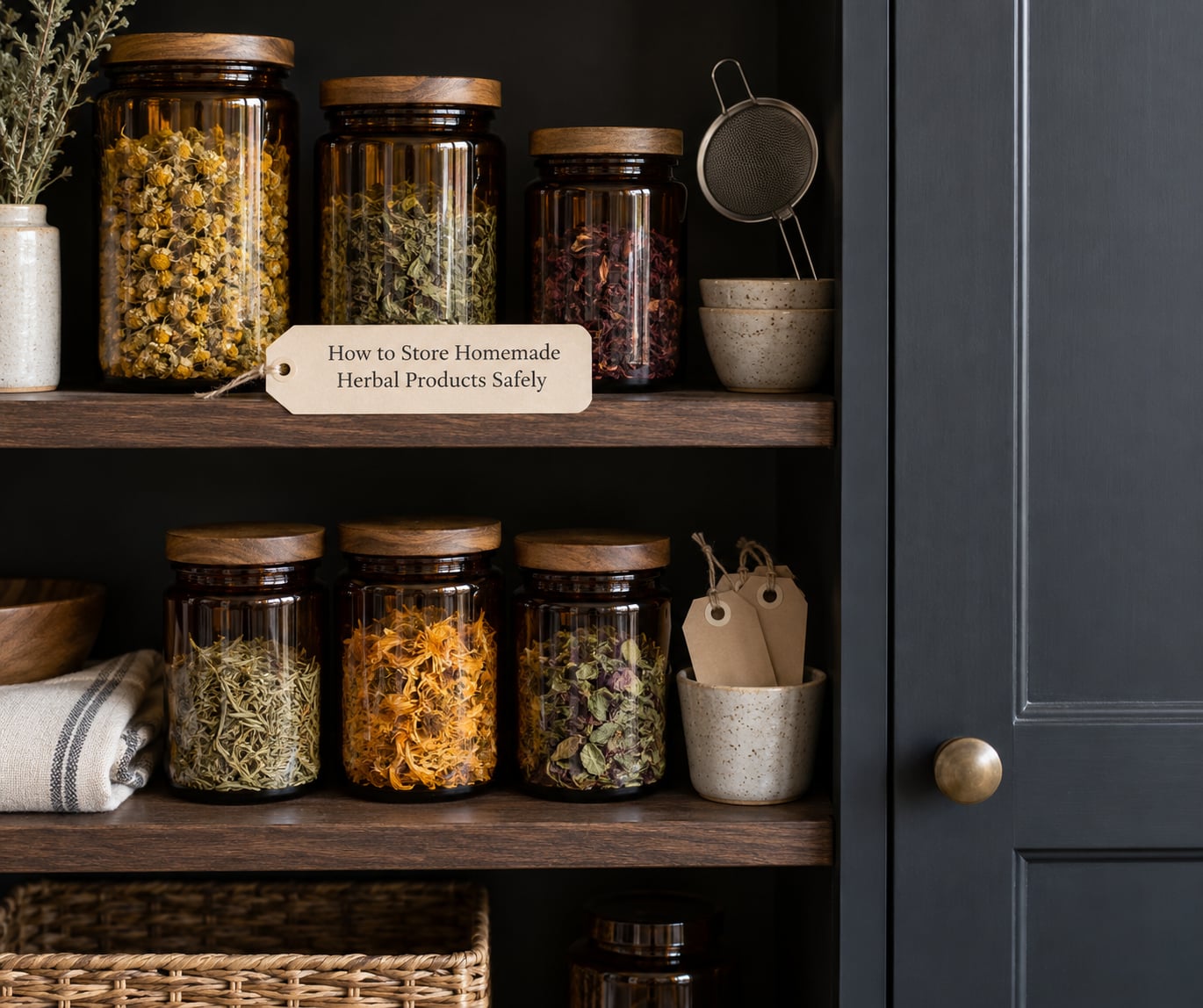
Storage advice is simple to state and easy to get wrong in practice. Work through these steps in order when you finish a batch.
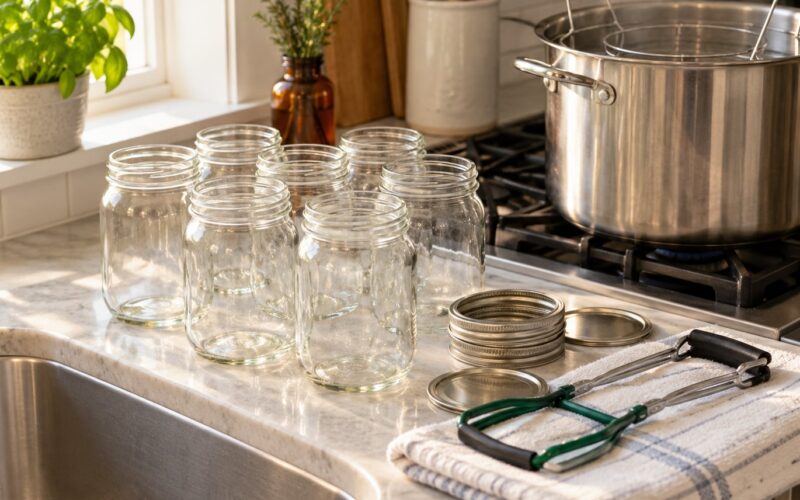
- Use clean containers. Wash jars and lids, sterilise them if you can, and dry them completely. Residual water in a supposedly clean jar starts the process you are trying to avoid.
- Choose the right material. Dark amber glass is the conservative default for light-sensitive preparations. Match the container to the product, and avoid any container that reacts with an oil or alcohol phase.
- Label at the moment of filling. Write the product name, plant identity, part used, ratio, method, date made and your discard date while the batch is in front of you, not a month later from memory.
- Fill to reduce headspace. Oxygen in the empty part of the jar works on the contents. Smaller containers also force smaller batches, which is a feature.
- Refrigerate what needs it. Water extracts, decoctions, syrups, glycerites and skin-use oils belong in the back of the fridge in sealed containers, away from raw meat.
- Freeze only what suits freezing. Water-based preparations and honeys freeze well and are often better off that way. Oils can be stored in a cool place, and freezing them adds risk from condensation rather than removing it, so only do it with a product you are already prepared to use soon after thawing.
- Keep light, heat and humidity out. A closed cupboard beats a shelf. Keep batches away from windows, radiators, ovens and kettles, and out of a bathroom where humidity is high.
- Strain plant material out of oils and syrups. Leaving botanical matter submerged prolongs contact with water and organisms, and it makes the final product harder to assess.
- Keep wet plant material out of the carrier oil. Wash and dry material thoroughly, and never tip a jar of freshly drained wet herbs into oil.
- Rotate stock first in, first out. Put older batches at the front. Most home herbal waste is simply a forgotten jar at the back of a shelf.
What Signs Mean a Homemade Herbal Product Should Be Discarded?
Any of the signs below means the batch is finished, regardless of how recently you made it. Smell and look catch the obvious cases; they do not clear a product that looks normal.
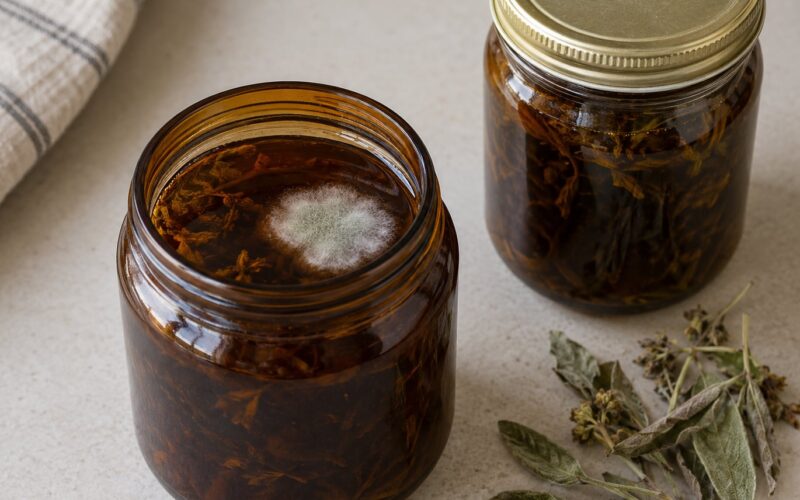
- Visible mould on the surface, on a lid, at the rim, or as specks in a dried herb jar.
- Sliminess or a sticky film on plant material, in a decoction, or on a salve that was previously firm.
- Unexpected gas or fizzing, a bulging lid, or a sealed jar that opens with a hiss. Fermentation in a product you did not intend to ferment is a discard.
- Cloudiness that does not clear after standing, or a haze that forms where none was before. Slight sediment from plant material is different from diffuse cloudiness, and cloudiness alone is not always spoilage, which is why it needs the company of the other signs.
- A foul, sour, sulphurous or paint-like odour, or a crayon-like smell from a carrier oil. This is the classic rancid signal.
- Off or bitter taste in a culinary oil or preparation you would normally taste.
- Severe or unexpected colour change, including darkening in a preparation that should stay bright.
- Separation that will not remix in an oil or salve, particularly with a watery layer on top.
- Damaged packaging, a leaking or cracked jar, a corroded lid, or a seal that has failed.
- Unclear history. If you cannot say when it was made or what went in it, treat it as a discard rather than a guess.
Be clear about the limit of your senses. Normal appearance, a normal smell and a normal texture do not certify a water-based preparation as free of pathogens, because dangerous growth in a low-acid liquid is often invisible and odourless. Absence of signs is not evidence of safety.
If anyone has swallowed a preparation that showed these signs, or used one on broken skin and developed fever, vomiting, swelling, spreading redness or pain, contact a clinician or a poison control centre straight away. Take the container and the label with you so they know what was in it. Do not induce vomiting unless a clinician tells you to.
Can You Extend the Shelf Life of Homemade Herbal Products?
Most of what helps works by removing one of the four drivers of spoilage: moisture, oxygen, heat, or available nutrients for organisms. It is worth separating what genuinely slows decay from what only feels official.
Reduce water. Dry plant material, strained oil free of water pockets, and a properly set wax salve all deny organisms what they need. This is the single biggest lever you control.
Add a real preservative in a real ratio. Alcohol, honey and sugar preserve because they lower water availability, and they only work when the ratio is genuinely high. A spoonful of honey in a cup of tea is a pleasant drink, not a preserved extract. Household recipes vary widely, so treat any ratio you find as something to verify rather than trust.
Keep oxygen out. A tight lid, minimal headspace, dark glass and fewer openings each reduce oxidation of oils and light-sensitive constituents.
Keep heat out. Storage away from heat is free, and it works for every category from dried herbs to salves.
Work clean. Sterilised jars and utensils, dried material, and a habit of never dipping a wet spoon into a finished product remove the contamination people blame on the recipe afterwards.
Make smaller batches. A batch you will finish in six weeks beats a large batch that sits for a year. This is the most effective habit change available and it costs nothing.
Add an antioxidant where it fits. Tocopherol, sold as vitamin E oil, is added to some infused oils at small amounts to slow oxidation of the carrier oil. It addresses rancidity only, does nothing about microbial growth, and does not extend the life of a water-based preparation. Cosmetic-grade and food-grade products differ in what they are labelled for, so match the grade to the use.
What no home method can do is substitute for testing. Water activity measurement, microbial challenge testing, peroxide value checks for oils and formal stability studies are laboratory procedures, and they are the only way to convert an estimate into a real expiration date. If a preparation is used on skin, given to someone vulnerable, or made in quantity, that is the point where professional testing starts to be worth the cost.
How to Label and Date Your Preparations
Labelling is the cheapest safety system you have, and it is the one most home makers skip. A label cannot tell you whether a batch is safe, but it can tell you whether you know anything about it at all.
A useful record includes the product name, the plant identity and the part used, the preparation method, the carrier or solvent with its percentage where relevant, the batch number, the date made, the storage instructions, and your own use-by estimate. Add the intended use, such as culinary or skin use, because that sets a different level of caution for the same liquid.
Write your estimate as what it is. A line that says this is a conservative home estimate, reassess at six months, discard by a specific date is honest. A line that says best before looks like a validated claim, and it is not one. If a batch has ever been carried over into a new jar or had material added to it, note that too, because the original date stops being meaningful the moment a batch is opened and rebuilt.
For dried herbs, the drying date and the storage conditions matter as much as the discard date. A first-in, first-out system, whether that is a written list or simply a row of jars with the oldest at the front, prevents the common failure of finding a two-year-old jar at the back of a shelf and using it out of habit.
Frequently Asked Questions
Can you tell if homemade herbal products are safe only by checking the expiration date?
Homemade batches usually have no expiration date at all, because no stability testing has been done. A printed date on a commercial product reflects tested shelf life under defined conditions, not a guarantee for a product made in a home kitchen. For homemade batches, treat the preparation date, the method and the storage conditions as the only record you have, and use conservative planning ranges instead of a date you can rely on.
What should I do if my homemade herbal product smells or looks different?
Stop using it. A paint-like or crayon-like smell usually means the carrier oil has gone rancid, while fuzz, slime, fizzing or a bulging lid points to microbial growth or unintended fermentation. Smell and appearance only reveal what has already changed, and a water-based preparation can carry harmful growth with no visible sign. Discard the batch rather than trying to strain it, boil it or mask the taste.
Is a homemade herbal product safer because it contains natural ingredients?
Natural does not mean safe, either to make or to use. A home preparation has no preservatives unless you added one, no verified concentration, and often no microbial testing, so the main risk is the preparation method rather than the plant. A dried herb in an airtight jar is low risk and stable, while a water-based mixture kept warm for a day is not the same product at all.
Can refrigeration make a homemade herbal product last indefinitely?
No. Refrigeration slows microbial growth and slows oil oxidation, but neither stops them, and nothing in a home fridge is cold enough to halt spoilage. Water-based decoctions are commonly limited to 24 to 48 hours refrigerated, and glycerites are usually given a short refrigerated life as well. Use the shorter range, keep the container sealed and dated, and discard on schedule.
How should I store homemade herbal products when I do not know the recommended shelf life?
Store the product according to its category, then set a short use-by date for yourself. Water-based preparations go straight into the fridge in airtight glass and get used within a couple of days. Oils and salves go into dark glass in a cool closed cupboard. Dried herbs go into airtight containers away from light, heat and humidity, used oldest first. If history is unclear, discard.
Conclusion
Start by identifying what you actually made, because the category decides everything else. Water-based preparations are short-lived and refrigerated, and used in a day or two. Tinctures in high-proof alcohol keep the longest. Oils and salves sit in the middle and fail through rancidity or contamination. Dried herbs in airtight dark storage keep the best of all.
Then label the batch while it is in front of you, store it according to its category, and set a conservative discard date you will actually honour. If anything shows a warning sign, or if you cannot say when the batch was made and what went into it, discard it. Poison control or a clinician is the right first call after any ingestion of a questionable preparation or a reaction on skin.