Herbal dosing is hard because a plant is a variable whole, not a purified molecule. The same species can differ in chemistry depending on soil, harvest time and storage, and the preparation method decides how much of that chemistry you end up swallowing. Add individual variation in digestion, liver and kidney function and medication use, and a label number stops being a reliable guide. Why dosing herbs is harder than it looks comes down to that chain of variables, none of which the label accounts for.
This is general information, not medical advice. Anyone considering a concentrated or unfamiliar product, and anyone taking herbs alongside prescription medicines, should talk to a doctor or pharmacist first. A few herbs have a narrow safety margin where small overshoots matter, and those are not a self-experiment topic.
Table of Contents
- 1What Makes Herbal Dosing So Complicated?
- 2Why Dosing Herbs Is Harder Than It Looks
- 3Plant, Part, and Harvest Time
- 4Preparation Methods Change the Concentration
- 5Why the Same Label Can Lead to Different Exposure
- 6Dose Is Not the Only Dose Decision
- 7Interactions, Additive Effects, and Overlapping Products
- 8What Research Can and Cannot Tell Us
- 9A Safer Way to Think About Herbal Products
- 10Frequently Asked Questions
- 11Can two herbal products with the same plant name be treated as equivalent?
- 12Is a stronger herbal extract always more effective?
- 13Why can traditional recipes and modern product labels be difficult to compare?
- 14Should someone use an herbal product without asking a doctor or pharmacist?
- 15What information should I look for on an herbal product label?
- 16Can combining several herbs reduce the need for medical advice?
- 17Conclusion
What Makes Herbal Dosing So Complicated?
Complicated means the dose sits at the end of a chain. The plant changes, the preparation changes what it pulls out of the plant, and the person changes what happens next. Miss any one link and the number on the bottle stops describing the exposure.
Why Dosing Herbs Is Harder Than It Looks
Five things drive most of the difficulty, and they stack:
- The plant is not a fixed substance. Two batches of the same species from the same region can carry different levels of the compounds people rely on.
- The plant name covers more than one thing. Different species, genera and even chemotypes share common names, and prepared material is often only labelled with the common name.
- The preparation method changes the concentration. An infusion, a decoction, a tincture, a dried powder and a granule extract deliver very different amounts from the same plant.
- The plant carries many active constituents at once. There is rarely one measurable molecule to count, so a milligram figure describes potency rather than effect.
- People respond differently. Age, body size, digestive capacity, organ function, other medicines and individual sensitivity all shift what a given amount does.
The clash is between two systems. Traditional practice set dose by experience, plant part, season and the person in front of you, and it never claimed the numbers were transferable. Modern product labels print a single figure that implies transferability across people, batches and preparations. Neither assumption survives contact with a growing season.
Plant, Part, and Harvest Time
Botanical identity is the first variable and the easiest to get wrong. Common names move between species and sometimes between families, so a product labelled with a folk name may contain an entirely different plant from the one a traditional text describes.
Plant part matters just as much. Roots, bark, leaves, seeds and flowers hold different compounds in different proportions, and within one part the useful constituents shift through the year. Harvesting the wrong part, or the right part at the wrong stage, changes the material before anyone weighs it.
Growing conditions matter too. Soil, rainfall, altitude, temperature and how a crop was treated all show up in the phytochemical profile. So do harvest season and post-harvest handling. Drying can drive off volatile constituents that are present in the fresh plant, storage degrades unstable compounds over time, and heat during drying can alter others.
That answers one search question directly. Dried herbs are not automatically stronger than fresh ones, and fresh material is not automatically better; the direction of the difference depends on which constituents are heat-sensitive, water-soluble or volatile, and on how each was handled after picking. For aromatic herbs with a lot of volatile oil, drying done carelessly can leave very little of the intended chemistry behind.
Then there is quality control. Adulteration, substitution with a cheaper lookalike species, heavy metal contamination from soil or processing, and pesticide residue all change the material you receive. Nobody using a shop product is dosing a known quantity. They are dosing a range whose width depends on the supplier’s controls.
Preparation Methods Change the Concentration
Preparation decides which compounds end up in the liquid, the powder or the capsule, and at what strength. Infusions use hot water on delicate material and favour water-soluble constituents. Decoctions simmer tougher parts such as roots, bark and seeds and pull a different fraction out. A dried powder is whole plant in concentrated physical form, so a small volume carries a lot of material but nothing has been selectively removed. Capsules are usually a powder in a fixed unit, which makes dosing easy and variation invisible.
A tincture is plant material extracted into alcohol or glycerine, usually at a stated ratio. A fluid extract is a more concentrated tincture. Concentrated granules are dried extracts, and they carry a ratio number that describes the starting ratio rather than the final strength.
The table below compares the common forms. The figures describe how each preparation is typically expressed and where its weakness lies, not a dose to take.
| Preparation | How it is usually expressed | What it tends to concentrate | Main caveat |
|---|---|---|---|
| Infusion (tea) | Volume of liquid, loose material by spoonful or weight | Water-soluble constituents from delicate parts | Weakest concentration, weakest reproducibility |
| Decoction | Volume of simmered liquid plus the weight of raw material | Denser extraction from roots, bark and seeds | Time and simmer strength drive the result |
| Dried powder | Weight in grams, often scooped | Whole plant, nothing selectively removed | A household scoop can vary widely in weight |
| Capsule | Milligrams of powder per unit | Whatever the powder contains, fixed per unit | Convenient but hides batch variation |
| Tincture | Millilitres, with a ratio such as 1:5 | Alcohol- or glycerine-soluble constituents | Ratios are not always comparable between makers |
| Fluid extract | Millilitres, more concentrated than a tincture | A larger share of extractable material | Small volume differences are large dose differences |
| Concentrated granule | Grams or milligrams per sachet | Dried extract at a stated starting ratio | The ratio number hides final concentration |
That table is why labels cannot be compared directly. A spoonful of powder, a millilitre of tincture and a sachet of granule are three different units of a moving target, and forum discussions on herbal dosing forums keep circling the same frustration: nobody can say which bottle is stronger without lab data.
Household measures add their own error on top. A “pinch” of dried material commonly lands somewhere between 0.3 g and 0.6 g depending on the grind and how full the fingers are, so the same instruction can mean twice the intended amount. One reader on a popular herbalism forum described tracking herb, amount, time, food and effect in a spreadsheet, essentially building a measurement system from scratch because the packaging offered none.
Why the Same Label Can Lead to Different Exposure
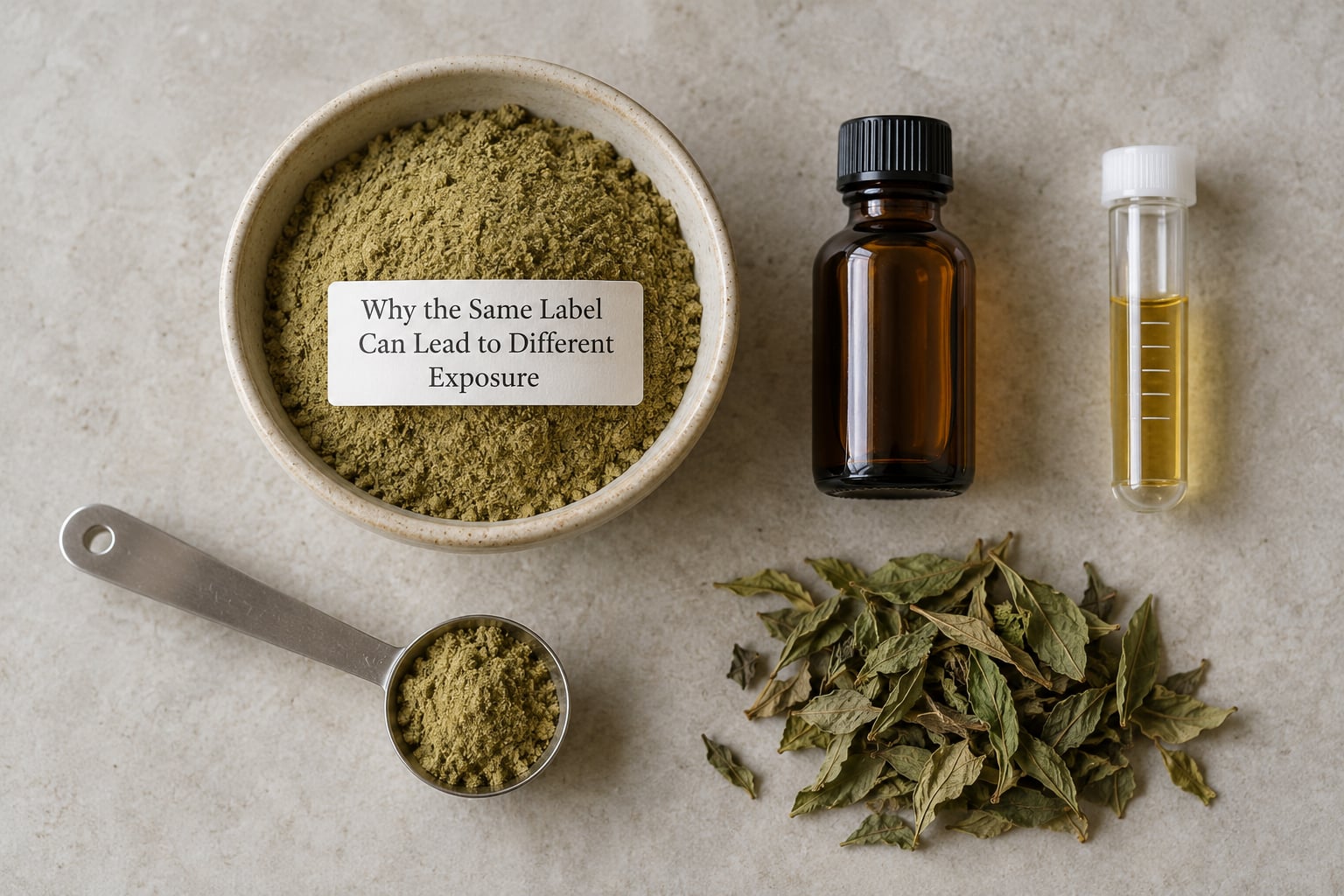
Four different quantities get confused on herbal labels, and each one answers a different question. The nominal plant weight is the weight of raw material that went in. The extracted material is what came out of it. The dry extract is that material dried down, which removes solvent. The active-compound content is the marker compound a manufacturer chose to measure, often just one of many constituents present.
A typical extract ratio reads 1:5 or 10:1. In the 1:5 case it usually means one part plant by weight extracted into five parts of final liquid, though some makers label it the other way round and some use weight-to-weight rather than weight-to-volume, which is why readers argue about the notation.
A 10:1 label usually means ten parts of plant material to one part of finished extract. It reads like a promise of ten times the strength and rarely delivers that, because the final extraction yield depends on the solvent, the time, the temperature and how much of the plant is actually soluble. Two products with the same 10:1 on the label can differ substantially in what they deliver.
Standardisation to a marker compound helps consistency within one manufacturer and does not guarantee a clinical effect, because the marker may not be the constituent doing the work. That is the honest limit of most label potency claims, and it is worth knowing before reading a high number as a strong product.
Dose Is Not the Only Dose Decision
Even a perfectly prepared product reaches a person whose handling of it differs. Digestive capacity affects how much of an oral preparation is available at all. Liver and kidney function govern how compounds are processed and cleared, which matters most for herbs with a narrow safety margin. Body size and age shift both the volume of distribution and the sensitivity of the target system.
Other variables stack on top. Pregnancy and breastfeeding change the whole calculation. Concurrent medicines can raise exposure to a compound or change how fast it is cleared. A history of sensitivity, an existing condition, or a previous reaction to a related plant changes what counts as cautious. Alcohol interacts with some herbs, including those that affect judgement, blood sugar, blood pressure or sedation, and with any tincture that carries meaningful alcohol content.
Duration matters as well. Patterns that people expect to act within hours are treated differently from patterns that build over weeks, and a preparation intended for one kind of problem is often carried over to another for months. Someone titrating a herb on their own is making decisions that really belong with a clinician, especially with an herb that has a narrow therapeutic index, where the gap between too little and too much is narrow by definition.
Interactions, Additive Effects, and Overlapping Products
One herb can change how a prescription medicine works, and it does this in a few recognisable ways. It can speed up or slow down the enzymes and transporters that clear a drug. It can add to a drug’s effect, which is how something that felt mild on its own becomes dizzy or sedated alongside another tablet. It can reduce absorption or binding, which quietly lowers how much medicine reaches the blood.
That last one matters for the complaint that the dose is not working. People often treat a herb-drug interaction as a dosing failure and respond by taking more of the herb, which is the wrong move. An interaction can blunt an effect at any amount, and increasing the amount can simply increase the risk.
Stacking raises the same issue with fewer moving parts. Several products can carry the same plant under different names, or stack several herbs that act on the same system. Nobody calculates the combined amount when the products sit in different cupboards, and the labels are rarely comparable enough to allow it. Blending several herbs in one formula is a practice with real tradition behind it, but the combined exposure still has to be understood by someone qualified, not guessed at by the person taking them.
Alcohol and sedating herbs deserve a specific mention because the effect looks ordinary. A drowsy evening after a day of herbal tea is easy to write off as tiredness, until it happens repeatedly with a drink or two involved.
What Research Can and Cannot Tell Us
Evidence about herbs comes in layers, and each layer answers a narrower question than readers assume.
Traditional knowledge records repeated human use with consistency of effect. It is real evidence about usefulness, and it is weak evidence about dose because it was never recorded in units that can be reproduced across plants, harvests and people.
Laboratory work on isolated compounds describes mechanisms under controlled conditions. It usually studies one constituent at a concentration that no whole-plant preparation reproduces. Animal studies sit between mechanism and human relevance. Observational studies reflect real-world use but struggle to separate the herb from everything else a person was doing at the same time.
Randomised controlled trials sit at the top and still carry a specific weakness here: a trial tests one preparation, from one manufacturer, at one dose, for one duration. A result for a standardised extract does not transfer automatically to a home infusion of the same plant, and it certainly does not transfer to a different supplier’s product. That single limitation explains why two well-researched herbs can give people opposite experiences.
Quality control makes the whole picture murkier. Where a plant is grown, harvested and processed under documented conditions, the material in a study is identifiable. Where it is not, the study describes something close to an unknown, and reproducing it becomes guesswork. If you want to know how much of this is relevant to your own product, that is a question worth putting to a pharmacist who can look at the specific batch.
A Safer Way to Think About Herbal Products
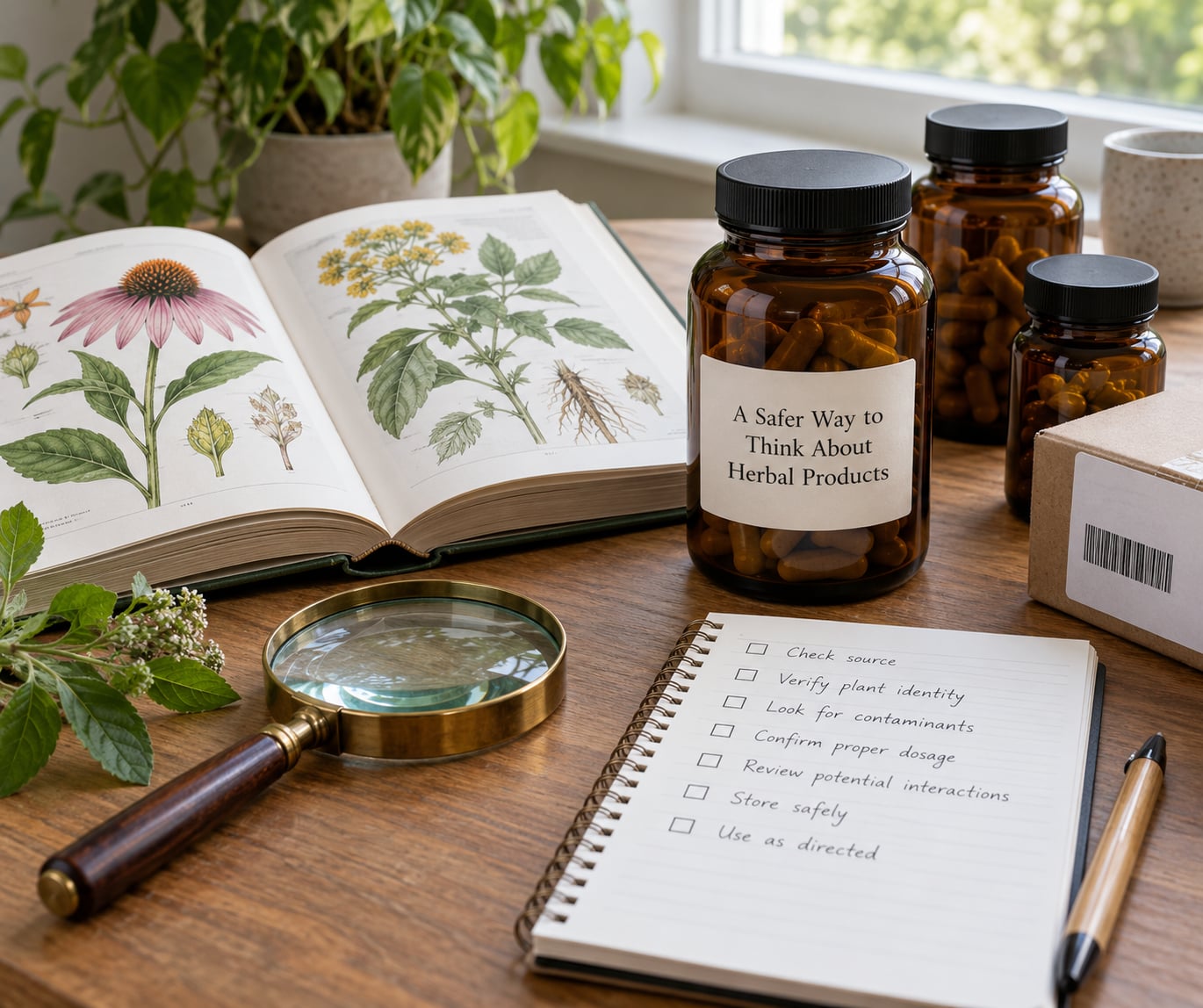
Evaluating a product comes down to a handful of questions you can actually answer from the packaging.
- Which species, and which part? The Latin binomial, or at least a botanical name rather than only a folk name. If the plant part is missing, treat the material as unidentified.
- How was it prepared, and what does the ratio refer to? A stated ratio beats no ratio, but read it as a starting description rather than a strength guarantee.
- Is there a batch or lot number? A manufacturer willing to print one usually has traceability behind it.
- Is there independent testing? Contamination and adulteration checks are a dosing question, not only a safety one, because they change what is in the material.
- What are the stated contraindications and drug interactions? If the label is silent on both, that is information too.
- Who is this not for? Pregnancy, breastfeeding, children, liver or kidney conditions and prescription medicines all change the answer.
For anyone titrating without a practitioner, the community version of a protocol is simple. Change one thing at a time, start at the lower end, set a trial period before judging anything, and write down what happened. That last habit is what the spreadsheet-tracking reader above was doing, and it is the only way to separate a genuine response from a good week. Escalating more than one variable at once makes the whole exercise unreadable.
Two warning signals deserve their own attention. Signs the dose is not doing enough usually look like no change at all after a fair trial period, or progress that stalls early. Signs of too much tend to show up as digestive discomfort, headache, nausea, agitation, or a symptom that briefly worsens before settling, and the sensible response to those is to stop and get advice rather than push through or reduce on your own.
And if you are taking anything else, stop reading and ask someone who can see your full list. A pharmacist can check a specific product against your medicines in a few minutes, and that conversation is worth more than any amount of label-reading.
Frequently Asked Questions
Can two herbal products with the same plant name be treated as equivalent?
No. A shared common name can cover different species or even different families, and two products may use different plant parts and preparation methods from the same species. Look for the botanical name, the plant part and the preparation before assuming anything matches. If the label carries only a folk name, the material is not identifiable to a useful standard.
Is a stronger herbal extract always more effective?
No. A higher ratio number describes the starting relationship between plant material and finished extract, not how much active constituent the finished product contains. Extraction yield depends on solvent, time and temperature, so two 10:1 products can deliver very different amounts. Stronger also means more of everything, including compounds you did not want, and a narrower margin for error.
Why can traditional recipes and modern product labels be difficult to compare?
Traditional practice recorded dose by part, season, preparation and the person in front of the practitioner, not by weight, so those instructions were never meant to transfer between plants or people. Modern labels print one figure and imply it transfers. Converting a household measure such as a handful or a pinch into grams also adds error, since a pinch of dried material can span roughly 0.3 g to 0.6 g depending on grind.
Should someone use an herbal product without asking a doctor or pharmacist?
If you take any prescription or over-the-counter medicine, are pregnant or breastfeeding, have a liver or kidney condition, or are considering a concentrated extract, ask first. Interactions can alter how a medicine is cleared or add to its effects, and some herbs have a narrow safety margin where the difference between too much and too little is small. General information cannot account for your specific situation.
What information should I look for on an herbal product label?
Start with the botanical name and the plant part, then the preparation method and any stated ratio, a batch or lot number, and evidence of independent testing. Check for stated contraindications and known drug interactions, and note whether the label stays silent on them. A label that gives you species, part and batch is telling you far more than one that gives only a folk name and a capsule count.
Can combining several herbs reduce the need for medical advice?
No, and the reason is arithmetic rather than traditional theory. Products can contain the same plant under different names, or different herbs that act on the same system, so total exposure is often uncalculated and unmeasurable from the labels. A practitioner may deliberately combine herbs, but they do it knowing the amounts involved. Doing it at home means guessing, which is exactly when a pharmacist’s review is worth having.
Conclusion
Dosing herbs is hard because the plant varies, the preparation decides what you get from it, the label describes the starting material rather than the exposure, and people respond differently on top of that. The first practical step is narrow and simple: establish the exact species and plant part, find out how the product was prepared, look for batch and independent testing information, then take the whole list to a doctor or pharmacist before using anything concentrated or unfamiliar.