Traditional healing systems are organized into six layers: a shared theory of what causes illness, defined practitioner roles, a diagnostic stage, a treatment stage built on plants, minerals, animal materials and ritual, a knowledge transmission layer built on apprenticeship and lineage, and a community layer that regulates who is recognized as a healer. That is the whole architecture, and once you can see it, the rest is detail.
The word “organized” is doing real work in that answer. It means a system has parts that fit together, roles people fill, rules about who may do what, and a way of passing knowledge on. It does not mean standardized, centralized, or written down. Most of these systems are held in memory, practice and protocol rather than in clinics or curricula.
I have read a lot of material that reduces these traditions to a shopping list of plants. That framing does a disservice to readers and misrepresents the practitioners, so this guide works outward from structure instead. If you are new to the subject, read the first two sections carefully; they carry most of the weight.
Table of Contents
- 1what traditional healing systems include
- 2how traditional healing systems are organized around practitioners
- 3Diviners
- 4Spiritual and ritual healers
- 5Herbalists and herbalist-priests
- 6Manual specialists
- 7Elders and household knowledge holders
- 8How knowledge is classified and passed between generations
- 9Observation and household learning
- 10Apprenticeship
- 11Lineage and initiation
- 12Taboos, protocol and permission
- 13Oral teaching and demonstration
- 14How plants, medicines, and healing practices are organized
- 15The role of families, communities, and cultural specialists
- 16How diagnosis, treatment, and prevention fit into the system
- 17Regional and methodological differences
- 18Frequently Asked Questions
- 19Are all African traditional healing systems organized in the same way?
- 20Who usually carries traditional healing knowledge?
- 21How is medicinal plant knowledge traditionally classified?
- 22How is traditional medicine knowledge passed down?
- 23Can traditional healers work alongside hospitals and clinics?
- 24Do herbal medicines actually work for treating health problems?
- 25Start by understanding the whole system
what traditional healing systems include
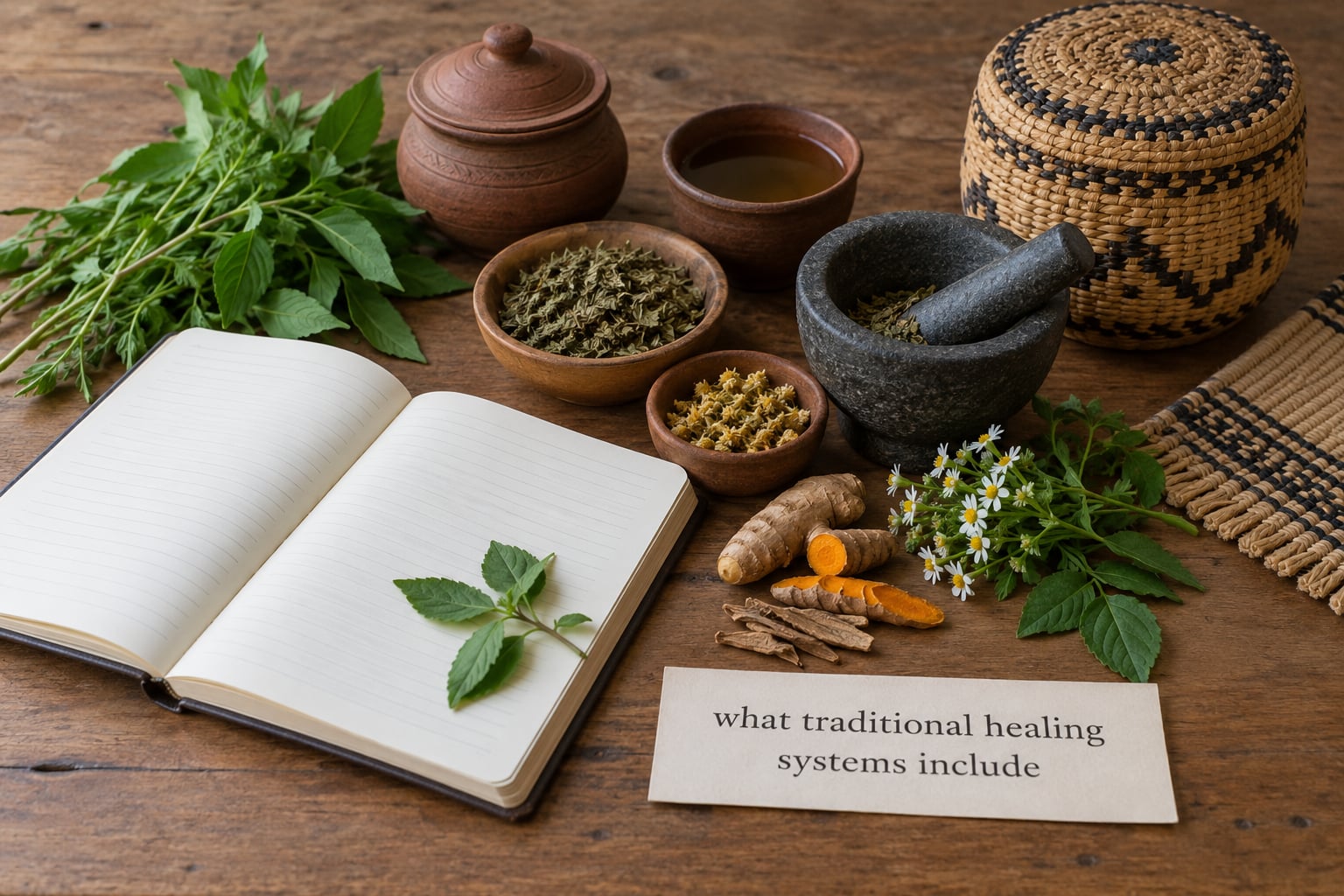
A traditional healing system is a complete social, cultural and knowledge arrangement, not only herbal treatment. It includes beliefs about health and illness, trained specialists, diagnostic methods, medicines and manual techniques, ceremonies and rituals, rules about conduct, and mechanisms for teaching the next generation.
The World Health Organization defines traditional medicine as the totality of knowledge and practices based on the beliefs and experiences of indigenous cultures, used to maintain and restore health and to diagnose, treat and prevent illness. That definition matters because it puts knowledge and practice at the centre, not a shelf of products.
What does that leave out? Nothing important. Traditional care in many communities is described as holistic, meaning a person is treated as a whole: body, social position, family relationships and spiritual life are treated as connected, and a problem in one area is assumed to show in another.
It helps to separate this from biomedical healthcare. Biomedical care is built on standardized pathology, laboratory confirmation and clinical trials. Traditional systems are built on local observation, inherited authority and community sanction. Many people use both, often referring a serious problem to a clinic while continuing traditional care for chronic or spiritual concerns. The overlap is normal, not a contradiction.
One African academic framing, widely taught, organizes the tradition into three levels of specialty: divination, spiritualism and herbalism. Most real communities split the work more finely than three, but the three-level model is a useful first grid because it separates the work of finding out what is wrong, the work of addressing spiritual or social causes, and the work of preparing medicines.
how traditional healing systems are organized around practitioners
Practitioner roles are the clearest layer of the structure. Communities usually divide healing labour into a small number of specialties, and a person may hold more than one or may be known mainly by one.
Diviners
Diviners (or diagnosticians) work out what is behind a problem rather than treating it directly. They read signs: the pattern of a divination arrangement, the throw of bones or shells, the behaviour of a client, the interpretation of a dream, or the reasoning attached to an unusual event. The output is a statement about cause, such as a strained relationship with an ancestor or a neighbour, a boundary crossed at a burial, or an environmental offense.
Spiritual and ritual healers
These practitioners treat problems understood to have a spiritual or ritual dimension. Their work may include prayer, purification ceremonies, counselling, family reconciliation, and instruction about how to live correctly in relation to the ancestors and the community. Ritual healing is often as much social repair as physical treatment, because the diagnosis and the remedy both point at relationships.
Herbalists and herbalist-priests
Herbalists specialize in materia medica: knowing which plants, minerals or animal materials are used, in what part and what form, how they are prepared and given, and what each is understood to do. In some communities the herbalist is a priest whose practice includes divination and ritual; in others the two roles are held by different people. A practitioner who holds both is sometimes called an herbalist-priest.
Manual specialists
Bone setters and traditional birth attendants (the latter often trained as midwives) are specialists in their own right. Bone setters handle fractures and joint injuries through manipulation, binding and controlled movement, and they often train formally over years because the work demands precise knowledge of anatomy. Traditional birth attendants manage pregnancy, delivery and postnatal care, and in many rural communities they are the primary maternity service, not a fallback.
Elders and household knowledge holders
Not everyone carrying healing knowledge is a professional. Grandparents, family heads and community elders hold practical, everyday knowledge: which plant grows where, how a household illness was handled last time, what protocol is expected at a funeral, which neighbour must be appeased. This layer feeds the professional layer and often outlasts interruptions to it.
Regional names for these roles vary widely. In southern Africa, an inyanga is typically a herbalist working with medicines, while an isangoma or sangoma works primarily through divination and spirit work, and the two categories often overlap. West African traditions use terms such as babalawo, a divination specialist, and other names that shift by language and region. English-language sources flatten these into “medicine man”, which loses the distinctions that matter. If you meet a role named in a source you are reading, look for which of the six functions it actually performs.
How knowledge is classified and passed between generations
Knowledge transmission is the mechanism that literally organizes the system, and it is the layer most often skipped. A practice that is not passed on does not survive; a practice passed on badly becomes something else. Communities use several channels at once.
Observation and household learning
The earliest knowledge arrives without ceremony. Children learn which plants are dangerous, which are common in the family kitchen or the medicine pot, and how people in the household respond when someone is ill. This kind of learning is diffuse and rarely written down, which is exactly why it fades when a generation moves away from home.
Apprenticeship
Formal apprenticeship is the core channel. An aspiring practitioner attaches themselves to an established healer for a defined period, often several years, and learns by doing: collecting plants at the right time, preparing medicines, assisting in consultations, learning the songs and formulae, and observing how the healer handles a frightened or difficult client. The apprentice serves the practitioner, and the arrangement is usually reciprocal rather than a paid course.
Lineage and initiation
Some knowledge comes with lineage, passed within a family of practitioners across generations. Elsewhere it arrives through initiation, a ceremony that marks a transition in status and may formally install a person in the role. Initiation frequently includes its own instruction, an extended period of retreat or seclusion, and gifts of tools or medicines. Fees and obligations are part of it too: initiation often carries a financial or labour commitment that binds the initiatee to the practitioner, and that obligation is a real reason systems stay stable over generations.
Taboos, protocol and permission
Every system has rules about what may be taught to whom, when, and how. Some knowledge is openly shared. Some is restricted to initiates. Some is held by one family and never taught at all. A visitor who ignores the boundaries does not just cause offence; they invalidate the trust relationship on which the transmission depends. Forum discussions about Indigenous knowledge practices come back to this again and again: lineage and community endorsement, not titles or marketing, are what people treat as real credentials.
Oral teaching and demonstration
Teaching happens through telling, doing and watching, in that order and often all at once. A formula is recited while the medicine is prepared, so the words and the hands teach the same thing. Much of this material is preserved in living practitioners rather than in books, which is why oral-tradition cultures describe knowledge as stored in people, particularly elders.
How plants, medicines, and healing practices are organized
The medicine side of a system is a materia medica: the materials a community uses and the logic that orders them. That materia medica usually includes whole plants (leaves, roots, bark, flowers, seeds and fruit in various combinations), minerals and clays, and animal materials such as fats, bones, honey and honey-derivatives. Remedies may also include foods, and preparing a medicine may involve smoking, steaming, washing, burning or making preparations rather than a single infusion.
Communities group this material in ways that suit how they actually think. Common grouping principles:
- Habitat — plants are sorted by where they grow, such as riverbank, forest edge, roadside or cultivated garden.
- Plant family and structure — grouping by botanical family, or by the part used such as root or bark.
- Taste and sensation — bitter, sweet, astringent, hot, cold or slippery properties carry real diagnostic weight in many systems.
- Preparation method — decoction, infusion, powder, juice, smoke, tincture or ointment.
- Therapeutic use — grouped by the complaint or condition for which they are normally prepared.
- Ritual role — some materials are used for ceremony and protection rather than taken as medicine at all.
- Local name — local naming systems are functional classifications, not confusion, and they encode information about habitat and use.
The important caveat is that none of these systems is universal. Taste and temperature categories in one culture say nothing about another, and importing a classification scheme from elsewhere will misrepresent the plant. The correct move is to learn each grouping inside the culture that uses it. If you are doing research, local names are the key to literature, and local names shift between regions even when the plant is the same.
The role of families, communities, and cultural specialists
No individual healer runs a private practice in isolation. The community is what authorizes it, and the community is also where most healing outcomes are actually lived out, because recovery involves family support, explanation and reintegration rather than only treatment.
Several functions sit with the community. Families transmit the everyday layer of knowledge. Elders and ritual institutions interpret protocol and settle disputes about conduct. Religious and cultural specialists officiate the ceremonies that treatment depends on. Communities recognize practitioners informally, long before any state body does, and that informal recognition through reputation and peer referral is what functions in practice.
Privacy and permission deserve emphasis. Knowledge of who sought treatment, and why, may be treated as community property rather than personal information. Research, photography, publication and commercialization all have to respect rules that are not obvious from outside. Consent from an individual healer is not the same as consent from the community that authorizes them.
Two structural forces shaped the last two centuries. Colonial authorities and missionary campaigns criminalized or ridiculed many practitioners and suppressed public practice, which broke many transmission chains. From the 2026 onward, alongside national recognition and registration of traditional practitioners in a number of countries, there has been a substantial revival, partly driven by concern that knowledge held only in elders could disappear unrecorded.
Social position shapes the system too. Women are central to it as traditional birth attendants, herbal sellers and household healers, and they often carry the heaviest daily workload, while formal authority in the male-dominated institutions of state registration may sit elsewhere. Any account that describes these systems as uniformly male leadership is describing the visible tip, not the working structure.
How diagnosis, treatment, and prevention fit into the system
A typical consultation follows a recognizable pathway, though every community sequences it differently and a healer may combine roles. What follows is a description of how a traditional consultation is generally structured, for orientation only. It is not a clinical method, and it is not a substitute for assessment by a qualified health professional.
- Complaint and history — the client describes what is happening, in their own terms, and the practitioner takes a detailed account, including the family’s history and recent events.
- Physical assessment — inspection, palpation, checking eyes and tongue, and in some systems pulse or urine analysis. The scope of what is examined varies.
- Divination or spiritual consultation — where the framework calls for it, the practitioner identifies the cause behind the complaint, such as a social or spiritual offense.
- Diagnosis — the complaint is named within the system’s own categories, which may be a named condition, an imbalance, or a relational cause.
- Advice, remedy or ceremony — dietary and behavioural guidance, a prepared remedy, a manual technique, a ritual, or some combination.
- Administration and follow-up — the practitioner supervises preparation and use, reviews progress, and adjusts or refers.
Prevention is treated as ordinary practice rather than an extra. Guidance on diet, rest and seasonal work, care during pregnancy, hygiene, and obligations to the ancestors or community shows up in routine advice, not only in ceremonies.
On safety, be plain about the boundary. Some traditional medicines contain active compounds with real effects and real interactions, and natural does not mean safe during pregnancy, alongside prescription medicines, or for children and older adults. Serious, urgent, or worsening symptoms belong with a doctor or clinic. Where you have a choice, keep traditional care as complementary to clinical care rather than a replacement for it, and tell both practitioners what you are using.
Regional and methodological differences
There is no single African model, and any article that offers one should be treated with suspicion. Systems differ by ecology, language, religion, family structure, political history and local history of contact with other medical systems. A practitioner role in a semi-arid region may not have a direct equivalent in a coastal one.
Even within southern Africa, the division between an inyanga (herbalist) and an isangoma (diviner and spirit worker) is recognized, but practice varies by community and the categories overlap constantly. In West Africa, divination roles such as babalawo carry their own training lineages and their own divination systems. Comparable structures appear elsewhere — a bone setter in one culture may correspond to a manipulative specialist in another — but the correspondence is rough, and a translation flattens far more than it conveys.
Method matters too. Research on these systems is strongest when it uses interviews and oral history, participant observation, literature review and careful comparison, and when local researchers hold the interpretive authority. Weaker work does the reverse: it lifts categories from one culture and audits another against them. If you are reading research on African traditional medicine, check who conducted it, who held the language, and who approved access.
One recurring theme deserves naming because it affects readers directly. Communities have had reasons to be cautious about outside interest, from colonial suppression to more recent commercialization of practices by people outside the culture. Lineage, community endorsement and transparency about training are what practitioners themselves treat as meaningful.
Frequently Asked Questions
Are all African traditional healing systems organized in the same way?
No. Systems vary considerably by region, language, religion, ecology, family structure and local history. Some emphasize herbal knowledge held by specialists, others give the central role to divination and ritual work, and others balance both. Most share broad layers such as a theory of illness, practitioner roles, a consultation pathway, and a transmission process, but the content of each layer differs. Treat any single model as a teaching framework, not a description of a continent.
Who usually carries traditional healing knowledge?
Knowledge sits with several kinds of people at once. Diviners, herbalists, spiritual and ritual healers, bone setters and traditional birth attendants hold trained specialist knowledge. Elders and households carry practical everyday knowledge about plants, protocol and family remedies. In many communities the two layers overlap, since a practicing healer is also a parent and a neighbour. Knowledge is often partly restricted, with some held only within a family or taught to initiates.
How is medicinal plant knowledge traditionally classified?
Communities sort plants by local names, habitat, plant family, taste and temperature, preparation method, the condition they are sought for, and ritual role. These are functional classifications that encode real information about a plant and its use, not disorganized confusion. The problem is that each culture’s categories mean something specific and do not transfer. Applying a scheme borrowed from another tradition to a plant from a different community will usually misrepresent it.
How is traditional medicine knowledge passed down?
Mostly through people. Children pick up practical knowledge at home, then an aspiring practitioner usually spends years apprenticed to an established healer, learning by watching and by doing. Some knowledge follows a family lineage. Some arrives through initiation, a ceremony that may install a person in the role and carry obligations and costs. Taboos and protocols govern who may learn what, which is why respectful outside study means asking rather than assuming access.
Can traditional healers work alongside hospitals and clinics?
Yes, and many people do. The relationship depends on the country, community and health circumstance. Some people use traditional care alongside biomedical services for a chronic condition while following clinic guidance for everything else. Others choose one approach for a particular problem. Where state registration systems exist, recognized practitioners may also refer patients to clinics. Whichever path a person takes, telling each practitioner about everything being used avoids harmful interactions.
Do herbal medicines actually work for treating health problems?
Some plant preparations have effects that modern analysis can identify, and some traditional practices for supporting wellbeing have been studied. Evidence varies a lot by preparation and by condition, and traditional use is not the same as proven efficacy. More importantly, natural does not mean safe. Some remedies interact with prescription medicines or are unsafe in pregnancy. For any personal health decision, talk to a doctor or pharmacist before starting or stopping treatment.
Start by understanding the whole system
If you take one thing from this guide, take the structure: a theory of what causes illness, practitioner roles, a diagnostic stage, a treatment stage, a transmission layer, and a community layer that decides who is recognized. Everything else attaches to those six.
Your first practical step is unglamorous and it matters more than any plant list. Learn the local names of the healer roles in the specific community you are interested in, find out who is recognized there and by whom, and understand how that community passes knowledge to the next generation. Do that first, and everything you read afterwards will land in the right place.
Then keep the boundary clear. This article explains how these systems are built and who holds them. It does not diagnose anything, and it is not a substitute for a doctor or pharmacist when you have a health question of your own.