If you collect, buy or ship plants across a border, CITES is the system that decides whether the paperwork travels with your specimen. CITES explained for plant collectors comes down to four things: whether the species is listed, which appendix it sits in, where the plant was collected or propagated, and which country is issuing and accepting the documents. Getting those four right before you travel usually means a routine border inspection. Getting one of them wrong can mean a detained plant and a very long conversation with an enforcement officer.
Last reviewed against the current CITES Appendices. Listings change at each Conference of the Parties, so treat what follows as the shape of the system rather than the current legal text for your plant.
Table of Contents
- 1CITES Explained for Plant Collectors: Rules and Permits
- 2What Does CITES regulate?
- 3How do I check whether my plant is CITES-listed?
- 4Do I need a CITES permit to collect plants?
- 5What documents should a plant collector prepare?
- 6What is the difference between collecting, exporting, and importing?
- 7Is a CITES permit the same as a plant import permit?
- 8Are seeds, cuttings, and plant medicines treated differently?
- 9What common mistakes cause CITES problems?
- 10How can plant collectors build a safer compliance record?
- 11Frequently Asked Questions
- 12How much does a CITES permit cost?
- 13Are all orchids protected by CITES?
- 14Can I bring plants back from a trip without a permit?
- 15What is a CITES tag and when is it required?
- 16What are the criticisms of CITES?
- 17Conclusion
CITES Explained for Plant Collectors: Rules and Permits
CITES, the Convention on International Trade in Endangered Species of Wild Fauna and Flora, is an international treaty that controls cross-border trade in threatened plants and animals by regulating the permits needed to move specimens. It does not ban owning or growing a listed plant, and it is not a national conservation law. It governs the paperwork attached to a shipment when it crosses a border.
That distinction matters more than most hobby guides admit. A country may ban the wild collection of a species outright, list it on a national endangered species register, or restrict harvesting inside a national park, and none of that comes from CITES. CITES only becomes relevant at the moment a specimen, live or dead, moves between countries.
The treaty uses three lists, called the Appendices. The appendix a species sits in tells you what documents the shipment needs.
| Appendix | What it means | What a collector normally needs |
|---|---|---|
| Appendix I | Threatened with extinction; commercial trade is generally prohibited | Very rarely available; usually no legal export permit at all, with narrow exceptions for scientific or conservation use |
| Appendix II | Threatened but trade may continue under controls | Export permit from the origin country plus, in many cases, an import permit from the destination country and a certificate of legal origin |
| Appendix III | Listed by a particular country to monitor how much of its own flora and fauna leaves | Export permit from the listing country and certificates from other countries; the listing country must be identified |
Orchids are the example most collectors meet first. The entire family Orchidaceae sits in Appendix II, with a small number of species in Appendix I, so a Phalaenopsis bought in Thailand and a Paphiopedilum taken from the wild are governed very differently. Cycads (Cycadaceae) work the same way, with several genera in Appendix I. Cactaceae is entirely in Appendix II, which surprises people who assume all cacti are unrestricted.
Other listings are narrower and easier to trip over: Disa species, Aloe other than a small set, Dioscorea species, and certain Pachypodium and Nepenthes. Listing can also be genus-wide, family-wide or species-specific, so the level matters as much as the plant name.
What Does CITES regulate?
CITES regulates international trade in specimens of listed species, and that includes far more than a live plant in a pot. A single seed, a cutting, a leaf pressed for a herbarium sheet, a slab of orchid wood, a dried root and a bottle of traditional medicine can all be specimens under the treaty. Plants that are entirely exempt in trade are rare; what varies is the paperwork, not the coverage.
Two things CITES deliberately does not do. It does not set national conservation policy, so a species being CITES-listed says nothing about whether you may collect it on private land in its home country. And it does not manage plant health, so a CITES permit says nothing about whether the plant may enter your country at all. That second gap is where most collector trouble starts.
| Group | Typical coverage | Example genera |
|---|---|---|
| Orchidaceae | Family-wide in Appendix II, some species in Appendix I | Phalaenopsis, Paphiopedilum, Dendrobium, Cypripedium |
| Cycadaceae | Mixed, with several Appendix I genera | Encephalartos, Dioon, Cycas, Zamia |
| Cactaceae | Family-wide in Appendix II | Ariocarpus, Discocactus, Mammillaria, Stenocactus |
| Disa | Listed species in Appendix II | Disa |
| Aloe | Listed species only, not the whole genus | Aloe |
| Dioscorea | Selected species in Appendix II | Dioscorea |
| Miscellaneous | Single species or genus listings | Nepenthes, Pachypodium, Welwitschia |
How do I check whether my plant is CITES-listed?
Use the official CITES Species+ database rather than a seller’s photo or a forum answer. The lookup takes about a minute once you have the right name.
- Get the scientific name. Search the genus first, then narrow down. Trade often moves plants under labels that omit the species entirely.
- Open CITES Species+ and search the taxon. The listing shows the appendix, the annotation, and the listing history with the date each change took effect.
- Read the annotation. Notes such as artificially propagated specimens being treated differently, or a zero export quota for wild specimens, sit in this field and often decide your case.
- Check the Appendices themselves on the CITES site. Some listings are limited to specific populations, which Species+ will show but a general summary will not.
- Confirm with the national authority. The Management Authority in your destination country applies the treaty as domestic law, and domestic rules can be stricter than the treaty text.
Common names are the worst guide. There is no single common name for an orchid, and sellers frequently use names that belong to entirely different species. If a plant is being offered as something rare without a Latin name attached, that is itself a reason to slow down.
Do I need a CITES permit to collect plants?
Usually not for the collecting itself. CITES permits attach to export and import, not to picking a plant in a field. The permission to collect comes from a different set of instruments that you handle before any paperwork under CITES begins.
What you may need for collection itself includes a national collecting permit or research permit, written landowner consent, a protected-area entry permit from the park or reserve manager, and a local licence for harvesting commercial quantities of any species.
None of those replace CITES, and a CITES export permit does not replace them either. A common misconception is that an export permit protects you from local law. It does not; the export permit certifies that a legal harvest was already authorised.
There is a special case worth knowing about. For Appendix I species and for a few Appendix II populations, harvesting for trade is not allowed at all, so no amount of paperwork will make a wild-collected specimen legal. Section-by-section details on who is exempt can be found in the national CITES regulation itself, which is always the final word in your destination country.
What documents should a plant collector prepare?
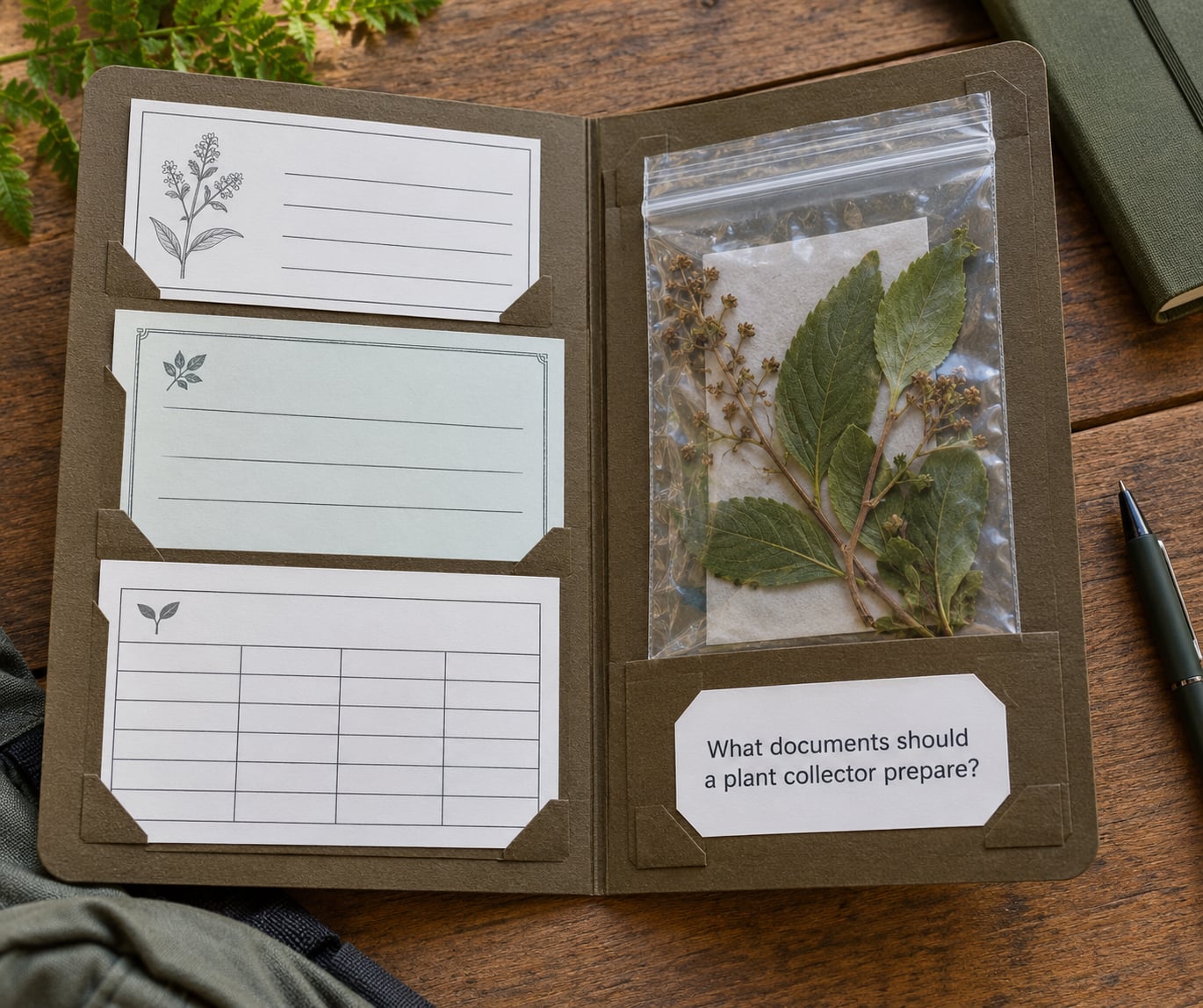
A collector who cannot produce records after the fact has no way to prove a plant was legal. Build the file as you go, because reconstructing locality and provenance two years later is close to impossible.
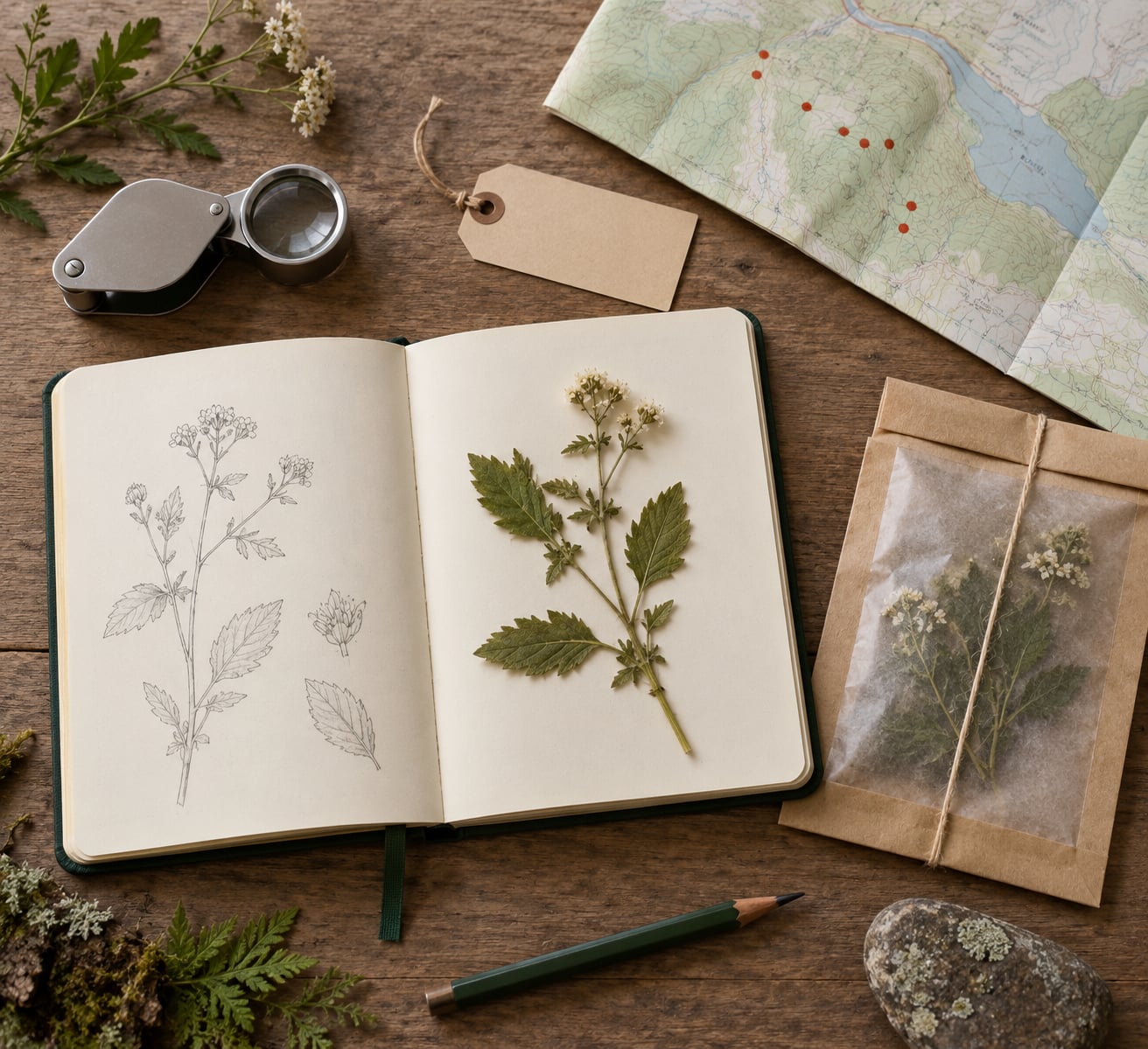
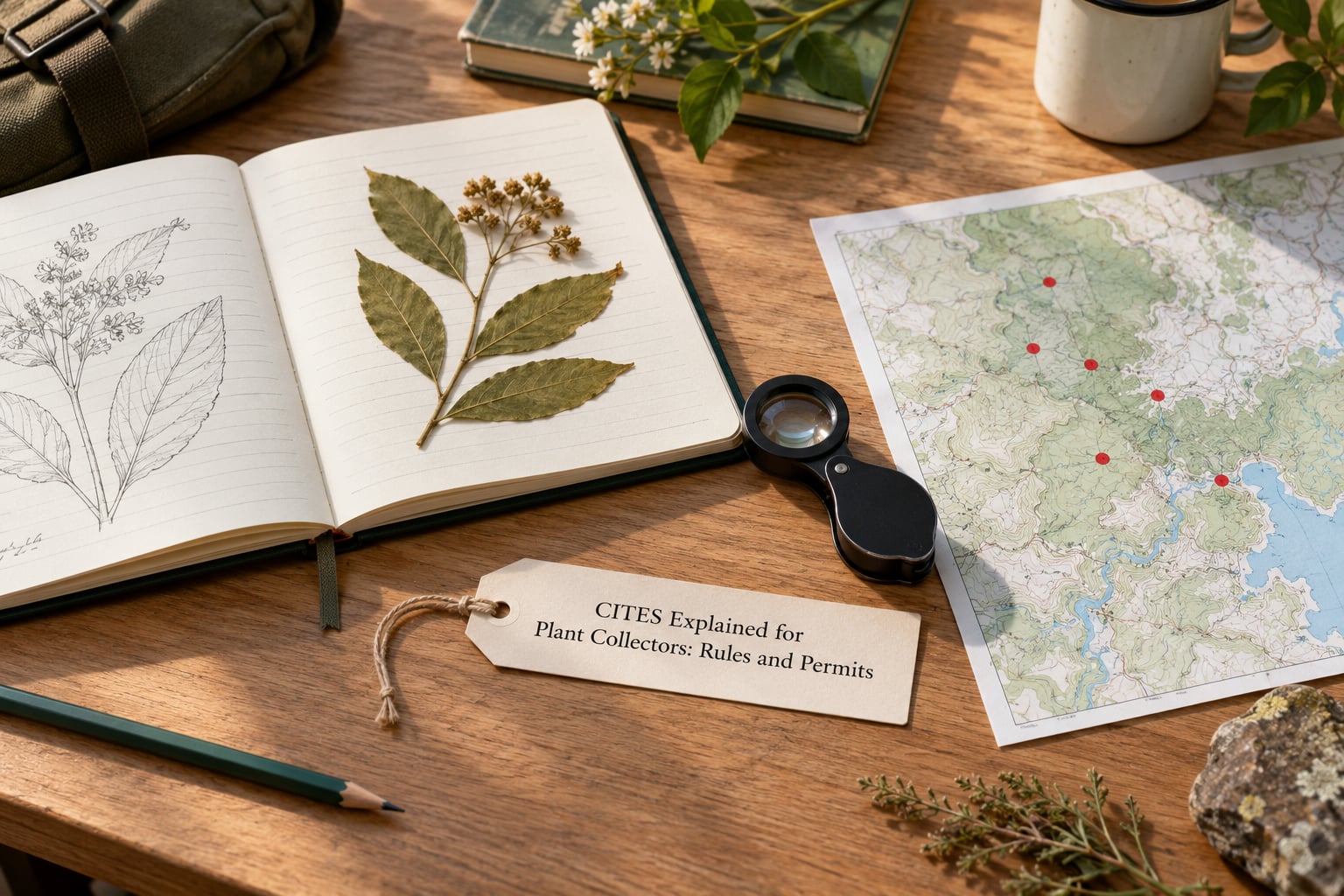
The core record for every specimen or batch includes the scientific name and who identified it, the exact locality down to coordinates where permission allows, the date, the collector’s name, the quantity, the habitat or elevation, and any permits relied on at the site.
For anything leaving the country you add a photograph of the labelled material before packing, a packing list matching the certificate exactly, and copies of every CITES document involved. For propagated material, add the propagation record showing the parent plants, the seed or pollen source, the date, and the quantities produced at each stage. Artificial propagation is treated far more favourably than wild collection, and in some cases the two are treated completely differently under the treaty.
Keep the file for as long as the plant lives. When you later sell it, breed from it, or give an offset to another collector, that record is the only thing proving your specimen has a lawful origin.
What is the difference between collecting, exporting, and importing?
These are three separate legal events in two separate countries, and confusing them is the most common reason collectors get caught out. Collecting happens in the origin country and is governed by local law. Export is authorised by the origin country’s CITES Management Authority. Import is authorised by the destination country’s Management Authority, and it is the only stage you control once you are home.
Personal and commercial use are also treated differently. Personal use generally means the plant stays with you and is not sold. Once you sell, trade, or ship to a client, the transaction looks commercial, quotas and reporting kick in, and the paperwork burden rises sharply. A collector who buys a dozen plants and sells six of them has crossed that line, whatever the intent.
| Document | Issued by | What it confirms |
|---|---|---|
| Export permit | Management Authority of the origin country | A listed specimen may lawfully leave that country, and in what quantity |
| Import permit | Management Authority of the destination country | The destination agrees to accept that specimen in that quantity |
| Re-export certificate | Management Authority of a transit country | A legal shipment is passing through without being re-imported |
| Certificate of legal origin | Authority of the country where the specimen was taken | The material came from a non-nature source, such as a cultivated stock farm |
| Pre-Convention proof | Owner, plus supporting documents | The specimen was legally acquired before the treaty applied, which matters for antique and inheritance material |
Because permits are issued by two different authorities in two different countries, they cannot be downloaded online in one step. The import permit normally comes first, because the exporting country wants evidence that the receiving country will accept the material, and because the destination authority needs the scientific name and quantity to decide.
Is a CITES permit the same as a plant import permit?
No, and confusing the two is the single biggest problem collector forums describe. A CITES permit answers “may this threatened species cross a border”. A plant import permit answers “may this living plant enter this country for plant health reasons”. Both can be required for the same plant, and one does not substitute for the other.
In the United States, plant quarantine is administered by the plant protection and quarantine side of the Department of Agriculture, with its own import permit and phytosanitary certificate requirements, soil restrictions and inspection points. CITES is enforced separately, through the Department of the Interior’s wildlife authority. Other countries divide the same two functions differently, and the European Union adds its own wildlife trade rules alongside CITES.
Practically, that means four checks rather than one: CITES listing, CITES documentation, plant health permit, and phytosanitary certificate. Collectors who treat the soil-free rule they have heard about as covering everything are still missing the CITES step entirely.
Are seeds, cuttings, and plant medicines treated differently?
The species decides the rules, not the form the plant arrives in. Seeds, cuttings, offsets, dried flowers, roots and finished preparations are all specimens, and for a listed species each one needs documentation that travels with it. A packet of seeds from an Appendix I orchid is not a loophole because nothing is alive in it.
Where differences do appear is in annotation. Artificially propagated material is often exempted from export permits or given a simpler certificate, particularly for Appendix II plants. The definition has a technical standard: propagation must be under the control of a holder of stock that is itself documented and traceable, and the seed must come from a documented source. A plant grown from seed scraped off a roadside in its native range does not meet that standard, however successful the germination was.
Plant medicines and traditional preparations sit on the same list as the source plant. This matters for anyone working with ethnobotanical material or traditional remedies, where a dried root, a bark extract and a whole bark sheet can all be treated as specimens of a listed species.
What common mistakes cause CITES problems?
Most enforcement cases trace back to a small number of avoidable errors, and they cluster.
- Wrong identification. A plant assumed to be one species turns out at the border to be a listed relative, and the paperwork was written for the wrong name.
- Assuming one permit covers everything. A plant health permit obtained online does not satisfy CITES, and a CITES export permit does not satisfy plant quarantine.
- Sending to a country that was never named on the permit. Import permits are issued for a specific destination. A parcel rerouted through a third country creates a customs problem.
- Mixed, unlabelled shipments. Several species packed together without individual documentation cannot be verified at the port, and inspectors will not sort them out for you.
- Buying from a supplier who cannot produce documents. If a nursery cannot say whether its plants are wild-collected or propagated, cannot name the source, or offers to skip paperwork, treat that as a warning rather than a bargain.
- Believing a nursery label settles everything. A plant raised in a nursery is not automatically documented as artificially propagated under the treaty, and rare species in a collection are not automatically legal to sell.
- Relying on the circulating “twelve plants” belief. This claim circulates widely in collector forums and is not a general rule. Quantity thresholds differ by country, by species and by whether the entry is personal or commercial, and any quantity limit sits alongside permit requirements rather than replacing them.
The last point deserves emphasis because the advice is passed around with real confidence. Personal allowances exist in many jurisdictions, but they apply to personal effects of species that are not listed. Once a listed orchid or cycad is involved, the allowance does not apply in the way people assume.
How can plant collectors build a safer compliance record?
A workable routine has three moments: before you buy, before you travel, and at the point of sale again later.
Before you buy. Confirm the scientific name, run it through CITES Species+, and ask the supplier in writing for the propagation or collection record and the documents that will travel with the plant. Put the answer in a file, not a chat log.
Before you travel. Apply for the import permit from your destination country’s Management Authority well ahead of the trip, since the export permit depends on it. Check whether the material is allowed into your country for plant health reasons at the same time, and remember that the two applications are separate. For a field trip, add collection permits, landowner consent and protected-area permissions to the same folder.
At the border. Declare everything, keep the documents together in your hand luggage, and expect to be asked where each plant came from and what it is. Refusing inspection usually produces a worse outcome than answering honestly.
Afterwards. File the permits with your collection records and keep them for as long as the plant is in your care. If you ever sell, multiply or gift a listed plant, that paperwork is the value of the specimen.
None of this makes collecting listed plants impossible. It makes them predictable, which is a better position to be in when an officer at a port asks a question you cannot answer.
Frequently Asked Questions
How much does a CITES permit cost?
There is no single international fee, because each country’s CITES Management Authority sets its own charges and timeframes. Some authorities charge a modest administrative fee and others charge nothing beyond handling. The cost that matters more for a collector is the delay, since an import permit can take weeks. Ask your destination authority directly rather than relying on a forum answer.
Are all orchids protected by CITES?
Nearly all of them, in one form or another. The family Orchidaceae is listed in Appendix II as a whole, with certain species such as some Paphiopedilum and Cypripedium placed in Appendix I. A specimen that is legally propagated with documented stock and seed is treated far more favourably than a wild-collected plant of the same species.
Can I bring plants back from a trip without a permit?
Only if the species is not listed and your country permits personal import. Listed plants need CITES documentation regardless of quantity, and the personal allowances that circulate online usually exclude listed species. You also need to satisfy plant health rules separately, often including a soil-free requirement and an inspection at the point of entry. Check both systems before you travel.
What is a CITES tag and when is it required?
CITES tagging was a physical plastic label scheme applied to specimens in commercial consignments. Many Parties have moved to electronic marking, so you may now see a database reference, a microchip, or no mark at all where a prior marking is not required. Ask the exporting authority what marking standard it uses, and keep the packaging clean so any mark stays intact.
What are the criticisms of CITES?
Critics argue the treaty measures declared trade rather than the actual pressure on wild populations, that paperwork is easy to obtain for material that was originally wild collected, and that regulated trade can be used to disguise illegal supply. Others point to the cost and complexity for small nurseries and to the difficulty of auditing paperwork at a busy port. Supporters reply that without CITES the legal, documented trade chain would not exist at all.
Conclusion
CITES explained for plant collectors is simpler than the paperwork suggests. Confirm the species and its appendix, decide whether the plant is wild-collected or artificially propagated, identify which country is exporting and which is importing, and apply to the destination Management Authority early. Keep the collection record, the propagation proof and every permit in one file that travels with the plant. Where the rules are genuinely unclear, ask the competent authority directly rather than a forum, because the forum advice you get is usually confident and usually incomplete.