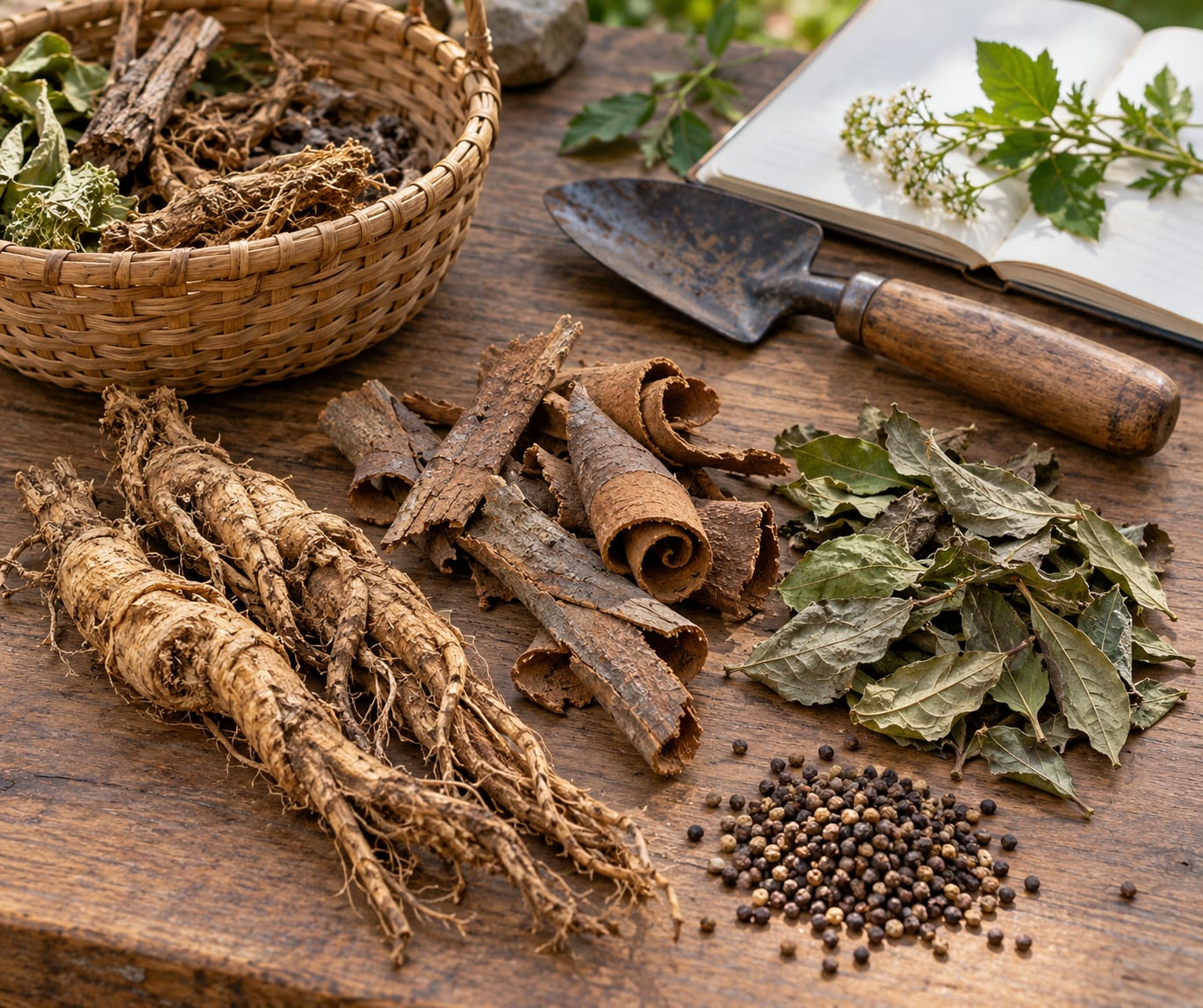
Overharvesting threatens medicinal plants in Africa because harvesters take more plants, roots and bark than wild populations can replace in a season. Uprooting a whole specimen, stripping bark from more than half a trunk’s circumference, or digging up roots and rhizomes destroys the individual outright. Do that on the same stand year after year and the population loses both its biomass and its seed source, which is why the question is really about regeneration, not volume.
Updated for 2026
Table of Contents
- 1What Is Overharvesting of Medicinal Plants?
- 2Examples of overharvesting
- 3Why Are Demand and Harvesting Increasing?
- 4How Overharvesting Threatens Medicinal Plant Populations
- 5How overharvesting threatens a population, step by step
- 6Why slow-growing perennials recover last
- 7What Ecological Effects Follow Unsustainable Collection?
- 8What Happens to Traditional Healing and Local Livelihoods?
- 9Why Are Some Species Especially Vulnerable?
- 10Which Solutions Can Reduce Overharvesting?
- 11Cultivation and nurseries
- 12Community-managed harvest zones
- 13Improved storage and processing
- 14Species substitution and education
- 15Enforcement, benefit sharing and better data
- 16What Can Readers Do to Help Protect Medicinal Plants?
- 17Frequently Asked Questions
- 18Are all African medicinal plants endangered by overharvesting?
- 19Can growing medicinal plants replace wild harvesting?
- 20Which parts of medicinal plants are most often overharvested?
- 21How can a consumer tell whether a herbal product was responsibly sourced?
- 22Does protecting medicinal plants mean people should stop using traditional medicines?
- 23What is the first step communities can take to address overharvesting?
- 24Conclusion
What Is Overharvesting of Medicinal Plants?
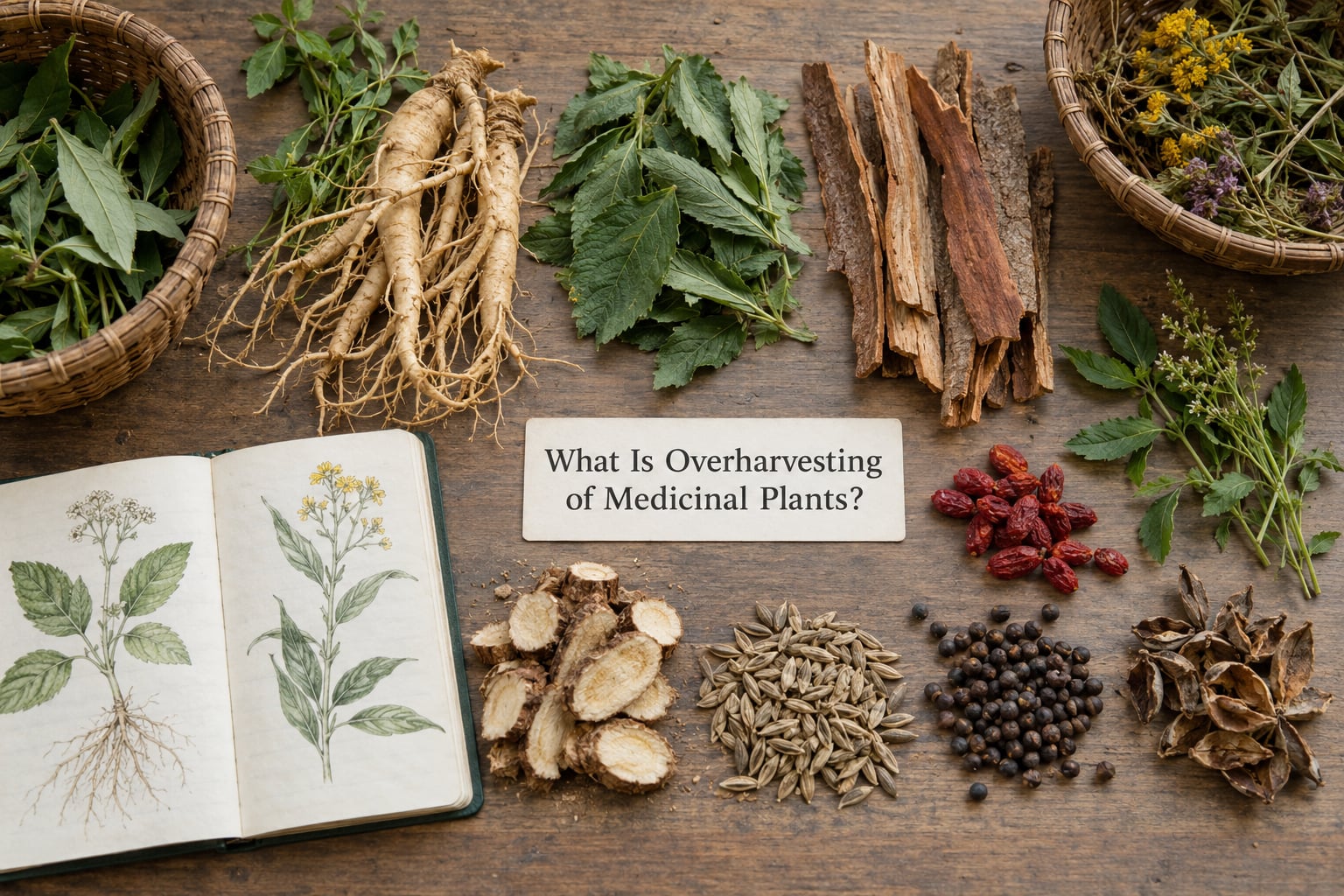
Overharvesting is the removal of medicinal plants from the wild faster than their populations can regenerate. It happens when collectors uproot whole plants, strip bark, excavate roots, or return to the same stand every season without rest. The result is falling abundance, shrinking genetic diversity, and eventually local extinction from the woods, hillsides and grassland a community still relies on.
High demand alone does not make a harvest unsustainable. A large, wide-ranging species that seeds freely can support heavy collection if gathering is selective and spread out. Overharvesting is a supply problem: what comes out of a patch each year exceeds what new plants can add.
Examples of overharvesting
Concretely, overharvesting looks like this:
- Uprooting whole plants to get the root, or the entire herb, for home use or sale.
- Stripping bark from more than half the circumference of a trunk, which girdles the tree and kills it.
- Excavating rhizomes and tubers, taking the entire underground network with the harvest.
- Collecting the same stand every season with no rotation and no rest period.
- Harvesting before seed set, cutting down the reproductive season along with the plant.
- Pressing seed across a whole population in a single season for essential oil.
- Taking the largest and oldest individuals first, removing the deepest reserves and the biggest seed producers.
- Pulling seedlings and saplings instead of mature plants, cutting off the next generation before it exists.
- Lifting whole trees for planting or fuel, then selling the young plants on as medicinal stock.
- Selling roots and bark through supply chains that record no collection site, so nobody can tell which stand was hit or how hard.
Item nine and item ten are worth separating. A one-off destructive take is bad; a supply chain that cannot trace its raw material is worse, because the pressure repeats invisibly year after year.
Why Are Demand and Harvesting Increasing?
Several pressures push in the same direction. A growing population draws more remedies from the same woodlands and grasslands, and rural households moving into towns still carry their healing habits with them.
Commercial demand adds a second layer. Export buyers pay for consistent volume, so a buyer who needs 200 kg of the same root every month will work the same accessible stands until they thin out. That kind of industrial pressure is what tips a species past the point of recovery. Household gathering, which accounts for far more plants by weight, is usually spread thinly across many sites.
Habitat loss concentrates the problem. When farmland, mining and settlement remove most of a species’ range, what remains is a smaller patch carrying the full collection pressure of the former range. A plant that was common and hard to damage becomes rare and easy to strip.
Regulation rarely keeps up. Land tenure is often unclear, harvest permits are thinly enforced, and most traded species have no listing that obliges a buyer to prove where material came from. Species are also misidentified in the field, so protected material is collected by mistake and legal material is sold under the wrong name.
None of this is uniform across the continent. Pressure concentrates where harvest zones are accessible, where populations are already small, and where a species is worth enough to pay for the trip to reach it.
How Overharvesting Threatens Medicinal Plant Populations
The chain runs from collection intensity to abundance, then to diversity, then to regeneration, then to loss. Break any link and the population can recover; break three at once and it usually cannot.
How overharvesting threatens a population, step by step
- Abundance falls. Mature individuals disappear from the harvestable stands first.
- Genetic diversity narrows. Taking the oldest, biggest plants removes the genotypes that survived the most droughts, fires and grazing.
- Recruitment fails. With fewer seed producers left, fewer seedlings establish, and clonal species that depend on the mother plant lose their only route to replacement.
- Local extinction follows. The species vanishes from one forest or catchment while remaining common elsewhere.
- Global extinction is the last step, not the first. A plant can be abundant in one country and functionally gone from the place a particular healer practises.
That last distinction matters more than it sounds. Zettlemoyer and colleagues have documented local extinctions happening well ahead of any Red List change, because Red List assessments track global status. A community can lose its resource decades before the species is called threatened anywhere.
Why slow-growing perennials recover last
A weedy annual that seeds within weeks can absorb heavy collection and bounce back. Roots, rhizomes, alpine herbs and forest trees cannot. They take years to reach harvestable size, and the individuals still standing are the ones that set the seed for the next generation. Take both in the same visit and recovery slows dramatically, or stops.
What Ecological Effects Follow Unsustainable Collection?
Individual plants are only part of it. Removing the same species repeatedly changes the shape of the vegetation around it, and those changes spread beyond the harvested patch.
| Collection pressure | What happens in the population | Likely knock-on effect |
|---|---|---|
| Whole-plant uprooting | Seed bank and young plants removed with the adult | Patchy bare ground, wind erosion, weed invasion |
| Bark stripping over half the circumference | Girdled trees die while still standing | Canopy gaps, changed shade and humidity for understorey species |
| Root and rhizome excavation | Vegetative spread route destroyed | Declining plant cover on slopes, dustier dry-season soils |
| Collection before seed set | No seed produced that season | Pollinators lose their resource, later-fruiting plants lose seed sources |
| Removal of seedlings and saplings | Next generation never enters the stand | Ageing stand, eventual die-off with nothing replacing it |
| Repeat harvesting of one patch | Genetic diversity concentrated in a few survivors | Weak response to drought, disease and pests |
Wildlife feels it too. Shrubs and small trees are nesting and browsing habitat for birds and small mammals, and the insects that move pollen between plants disappear when their host plant does. On dryland slopes, loss of rooted perennials shows up first as soil movement once the rains come.
What Happens to Traditional Healing and Local Livelihoods?
The plant is often both medicine and income. A healer who can no longer find a remedy has no substitute to offer, and a household that sold roots loses a cash flow that rarely has a replacement.
Documented effects cluster around scarcity and substitution. Practitioners travel further for less material, or switch to a related species that is easier to find but studied less. Remedies with deep cultural weight, used in ceremony or for specific community illnesses, tend to have the fewest alternatives.
Knowledge transmission suffers quietly. Apprentices learn a plant by watching it being collected. If the stand empties, that practical lesson is lost even when the written record survives.
Effects differ by community, and saying otherwise would be dishonest. Some villages hold community harvest rules and manage their stands well; others face tenure disputes or lose the forest entirely. The harvesters most often criminalised for collecting are household practitioners, while commercial chains face less scrutiny for taking far more.
Why Are Some Species Especially Vulnerable?
Vulnerability is a combination of life history and demand, and the worst cases stack several risks at once.
- Slow growth and long life cycles. Alpine and montane herbs such as Rhodiola rosea take years to reach harvestable size.
- Restricted ranges. A species confined to one mountain range cannot shift its range as the climate moves.
- Bark and root harvest. Bark kills the individual and root digging removes the whole plant. Prunus africana, the African cherry, is the textbook case: repeated stripping of more than half the circumference pushed stands into decline before the practice was curtailed.
- Low seed output or propagation difficulty. Commiphora wightii (guggul) and many succulents regenerate slowly after resin tapping or cutting.
- Several medicinal uses at once. Asparagus racemosus (shatavari) is dug for its root and cut for its shoots.
- A commercial price spike. Hoodia gordonii in southern Africa and Panax ginseng in East Asia show what an export market can do to a slow-renewing plant.
- Taxonomic confusion. Related species look alike, so collectors take the wrong plant and buyers receive the wrong one.
Climate change adds pressure rather than a new mechanism. Groner and colleagues found that shifting suitable ranges in South Africa shift where harvesters go, sometimes away from populations that were not previously under pressure.
Which Solutions Can Reduce Overharvesting?
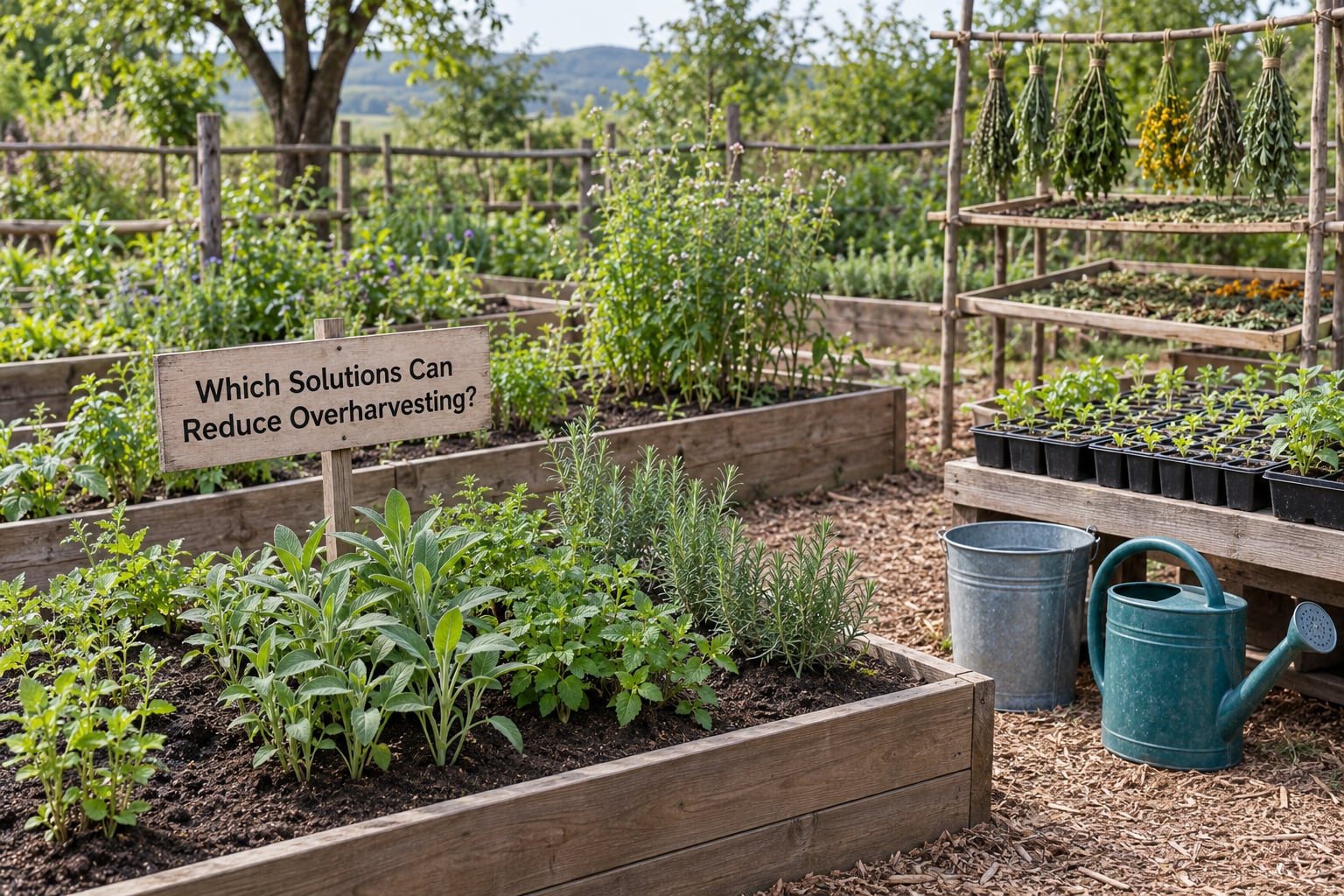
No single fix works on its own. Each approach below solves part of the problem and leaves the rest.
Cultivation and nurseries
Growing the species takes pressure off wild stands and gives traders a predictable supply. It cannot protect habitat, it needs land and water, and it works best where buyers pay enough for cultivated material to be competitive.
Community-managed harvest zones
Agreed collection areas, closed seasons and rest periods put the rules where the harvesting happens. These work far better than distant prohibitions, and they need a committee with real authority and a way to measure standing stock.
Improved storage and processing
Better drying cuts the weight shipped, so fewer plants are picked for the same output. Shorter supply chains and bulk sales ahead of price spikes reduce the incentive to strip a stand in one visit.
Species substitution and education
Where a plant is under pressure, a verified substitute with a similar use takes some demand. This needs practitioner and regulatory support, since substitution without verification is a safety problem of its own.
Enforcement, benefit sharing and better data
Trade rules matter, but CITES Appendix listings cover only around 2.4% of the medicinal species in international trade, so listing alone leaves most species unprotected. Sharing benefits with the people doing the harvesting gives them a reason to protect the stand. Reliable inventories tell everyone when a species is genuinely becoming scarce rather than merely hard to find.
What Can Readers Do to Help Protect Medicinal Plants?
If you use herbal remedies or write about them, a few habits matter more than they look.
Do not repeat cure claims that no one has tested. Demand for miracle results is a large part of what drives collection pressure.
Never collect a wild plant you cannot identify with certainty, and never uproot anything. Foragers consistently over-collect unfamiliar species. If you gather, take only what you need from a healthy, well-populated stand, rotate sites, leave part of every stand untouched, and leave roots in the ground.
Ask suppliers where material comes from, whether it is wild or cultivated, and who collected it. FairWild certification is the closest thing to a credible standard for wild collection. Organic certification says something about inputs, not about how much was taken from a wild population.
Support credible field research, cultivation projects and community harvest groups, which are chronically underfunded. And for anything to do with your own health, ask a doctor or pharmacist rather than a forum.
Frequently Asked Questions
Are all African medicinal plants endangered by overharvesting?
No. Most medicinal species are not threatened, and many are common, widely distributed and fast to regenerate. Concern concentrates on a minority that combine slow growth, restricted range, destructive parts such as bark or roots, and strong commercial demand. A recent Plants, People, Planet analysis found 68.1% of medicinal species in the UK trade had never been IUCN-assessed at all, so unassessed is not the same as safe.
Can growing medicinal plants replace wild harvesting?
Cultivation helps a great deal and cannot replace wild harvest on its own. Some species grow well on farms and this is the most practical fix for traded volume, but many are hard to propagate, need specific soils or shade, and take years to reach harvestable size. Cultivation also does nothing for the wild populations already thin, and it needs land, water and a buyer willing to pay for a certified farmed product.
Which parts of medicinal plants are most often overharvested?
Roots and rhizomes are the most damaging, because digging them out removes the entire plant. Bark stripping comes next, especially where more than half the circumference is taken, which girdles and kills the tree. Whole-plant uprooting for herbs is destructive in a different way, since it deletes the seed source. Leaves and flowers are usually the least harmful parts to remove, though collection before seed set still costs the population a season.
How can a consumer tell whether a herbal product was responsibly sourced?
Ask three things: is the material wild or cultivated, what species is it, and who collected it and where. Traceability is the real test, and most retail labelling does not provide it. FairWild certification is currently the strongest widely recognised standard for wild collection. Organic certification covers inputs and growing methods, not harvest intensity, so it is not evidence that a wild population was left intact.
Does protecting medicinal plants mean people should stop using traditional medicines?
No, and the argument is backwards. Traditional medicine depends on those plants continuing to exist, so protecting them protects the practice. The realistic goal is sustainable use rather than either total harvest or total abstinence. That means collection rules set with the people who actually gather, cultivation to take pressure off wild stands, and honest labelling about origin. For personal medical questions, talk to a doctor or pharmacist.
What is the first step communities can take to address overharvesting?
Know what is actually in the forest. A simple seasonal inventory of the local species people use, with rough quantities, tells a community whether a stand is shrinking and which plants are already scarce. Without that baseline, harvest rules are guesses and enforcement has nothing to measure. Once the picture is clear, agreed collection zones, closed seasons and rest periods are the next step.
Conclusion
Overharvesting threatens medicinal plants because it removes the plants that produce both the harvest and the next generation. Slow-growing species with narrow ranges and destructive harvest parts lose their stands long before any Red List changes, and the loss lands hardest on the healers and households that depend on them.
The first practical priority is measurement joined to local control: reliable data on demand and standing populations, and harvest rules written and enforced by the people who live next to the stand. Cultivation, habitat protection and honest sourcing follow from that. None of it is quick, and the 2026 funding picture for field work remains thin, but the plants that survive are the ones somebody agreed to leave standing.