Artemisinin was discovered in 1971 and 1972 by Tu Youyou and her colleagues at the Institute of Chinese Materia Medica in Beijing, who isolated it from the leaves of sweet wormwood (Artemisia annua) after abandoning boiling-water extraction in favour of a cold ether method. Knowing how artemisinin was discovered means following one failed laboratory technique, one very old Chinese text, and a short window of field testing in the early 1970s.
The story matters beyond pharmacology. It is the clearest modern case of a documented traditional preparation method pointing a research team toward a compound that screening programmes had missed for decades, and it changed how Chinese state research treated old medical texts.
The date needs a small clarification up front. Tu’s team produced a neutral extract of sweet wormwood that cured malaria in 1971, and the pure compound artemisinin (qinghaosu) was isolated and characterised in 1972. Many sources say simply “1972”, and both dates refer to the same project at different stages.
Table of Contents
- 1What Is Artemisinin and Why Does Its Discovery Matter?
- 2How Artemisinin Was Discovered in Sweet Wormwood
- 3The Traditional Knowledge Behind the Discovery
- 4What Traditional Harvesters Already Knew About the Plant
- 5How Artemisinin Was Discovered: Inside the Chinese Research Project
- 6Why Mass Screening Alone Had Not Found It
- 7How Did Researchers Prove Artemisinin Worked?
- 8Why Did the Discovery Lead to Artemisinin-Based Medicines?
- 9Who Should Receive Credit for Discovering Artemisinin?
- 10Frequently Asked Questions
- 11Who discovered artemisinin?
- 12What is the difference between artemisinin and Artemisia?
- 13What is the difference between artemisinin and artesunate?
- 14How does artemisinin kill malaria parasites?
- 15Is artemisinin the same as ivermectin?
- 16Is artemisinin still used today?
- 17Conclusion
What Is Artemisinin and Why Does Its Discovery Matter?
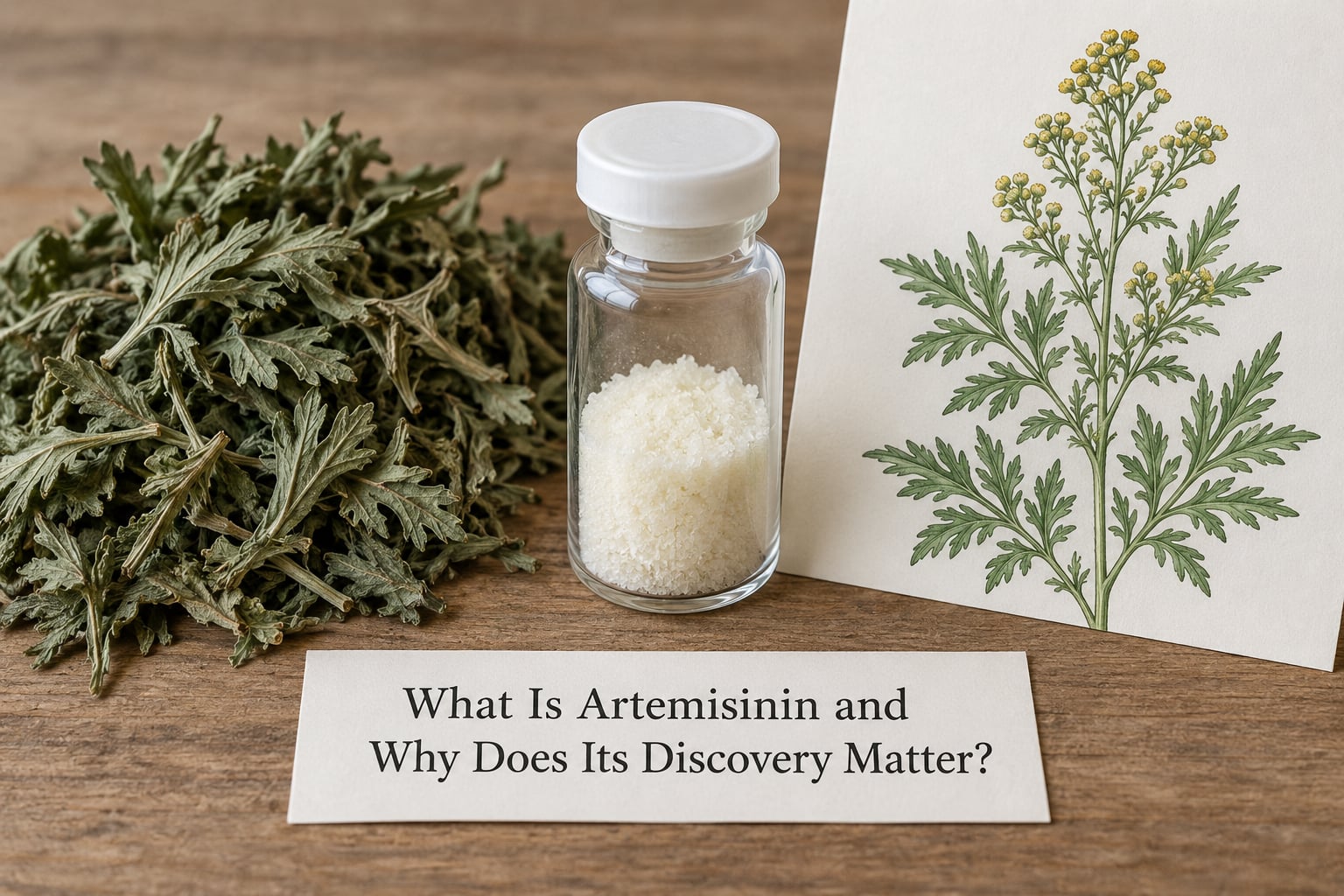
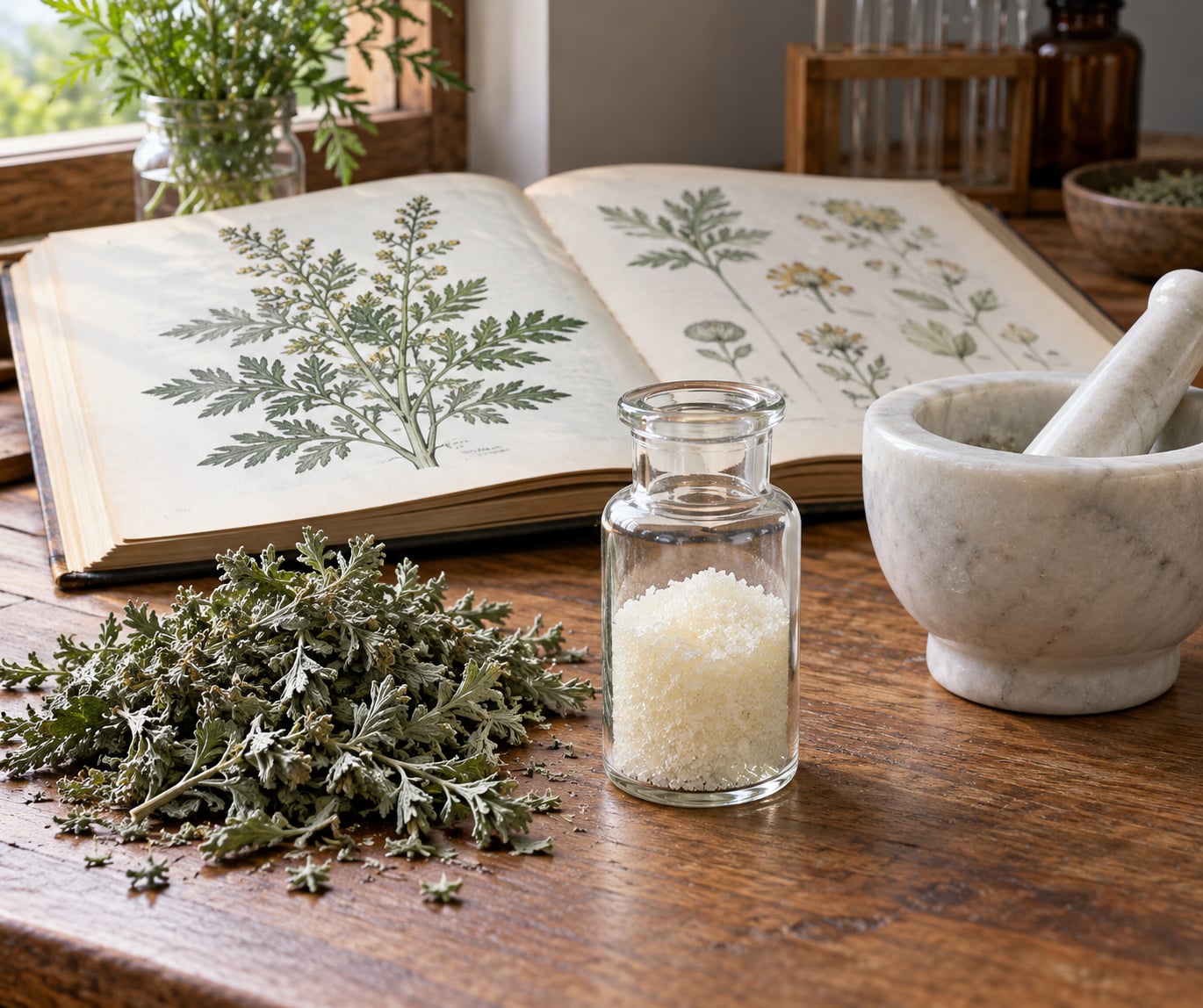
Artemisinin is a chemical compound, not a plant. It is a sesquiterpene lactone with an unusual endoperoxide bridge, and it is extracted from the leaves of Artemisia annua, a member of the daisy family and a close relative of ragweed, chamomile and tarragon.
Its importance comes from what it does. Artemisinin clears blood-stage malaria parasites faster than any earlier antimalarial, including chloroquine, which is why the World Health Organization places artemisinin-based combination therapies at the front of its treatment guidance. The discovery turned a plant remedy that had been described for roughly sixteen centuries into a modern medicine.
Because the name gets mixed up constantly, here is a quick disambiguation:
| Term | What it is | Role |
|---|---|---|
| Artemisia annua | A plant, also called sweet wormwood or qinghao | The botanical source; the leaves contain artemisinin |
| Artemisinin (qinghaosu) | A single purified molecule | The active ingredient; the compound discovered in 1972 |
| Dihydroartemisinin | A derivative made from artemisinin | Base chemical for the semi-synthetic medicines |
| Artesunate | A water-soluble derivative | Oral and intravenous treatment, including severe malaria |
| Artemether | A more fat-soluble derivative | Oral and injectable formulations, widely used in Africa |
| Ivermectin | An unrelated anti-parasitic drug from Streptomyces bacteria | Antiviral claims around it were never supported; no connection to artemisinin |
That relationship between plant and molecule is not unusual in drug history. Quinine came from cinchona bark, salicylic acid from willow bark, and morphine from the opium poppy, all long before a laboratory understood what it was holding. Artemisinin is the most recent and by some measures the most successful of that list, and it is the clearest case where a traditional preparation detail, not a screening programme, set the research direction.
How Artemisinin Was Discovered in Sweet Wormwood
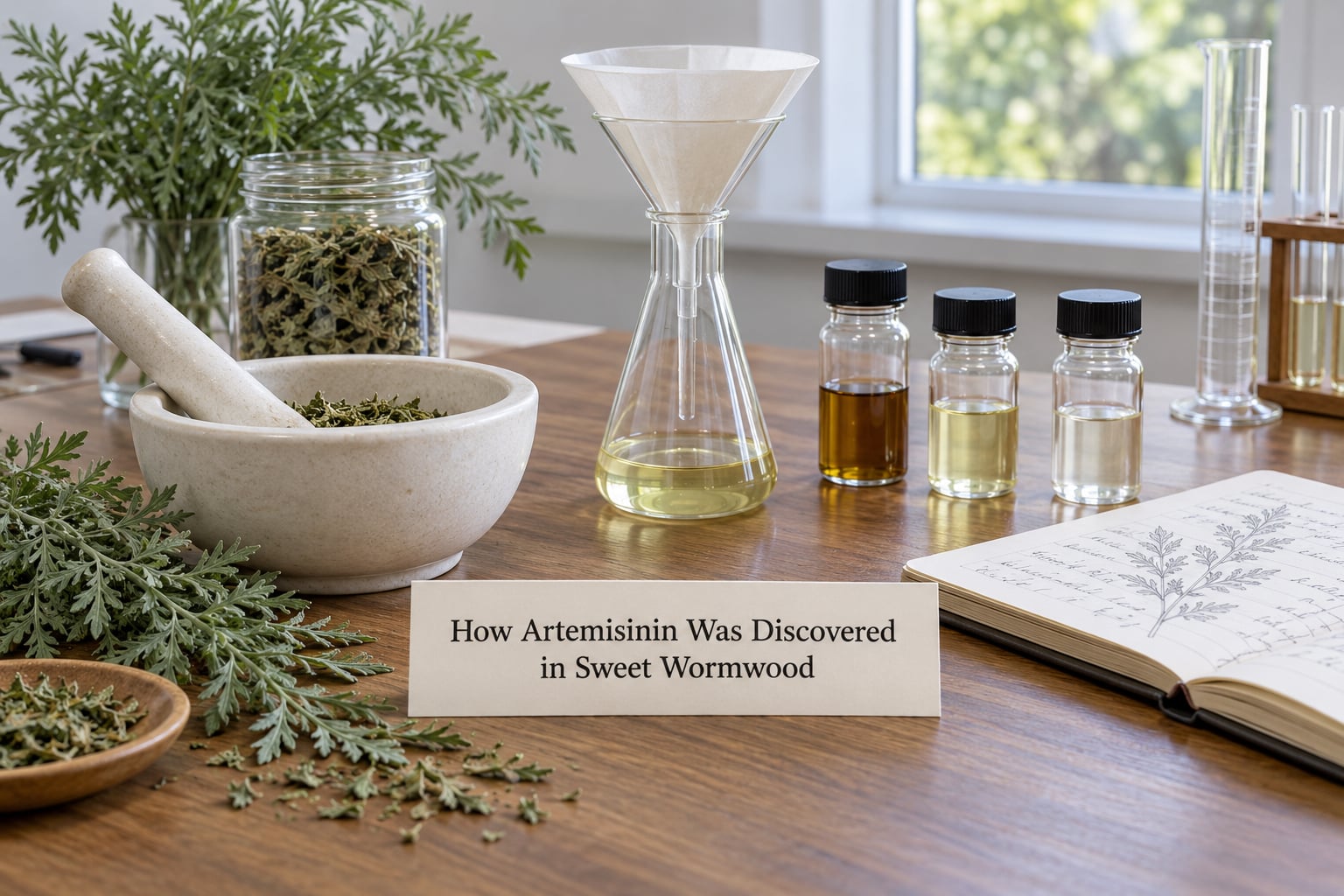
The discovery came out of a state research programme, not a single laboratory hunch. China launched Project 523 on 23 May 1967 to find a treatment for chloroquine-resistant malaria spreading through the Vietnam War. Tu Youyou, then 39, took over the malaria group in 1969 and inherited a screening effort that had already tested hundreds of thousands of compounds without success.
She spent time in the field on Hainan Island, watching malaria cases directly, and in 1971 she re-read the classical Chinese medical literature. The decisive passage was in Ge Hong’s Handbook of Prescriptions for Emergencies, compiled around the fourth century, which described taking sweet wormwood in a cup of water and drinking the juice.
The first extraction attempt used the lab’s normal method: boil the plant in water. It failed. The team then tried diethyl ether, which boils at about 35 degrees Celsius and dissolves the compound without destroying it. That low-temperature extract wiped out malaria parasites in mice and monkeys, then in people.
Tu and two colleagues tested the neutral extract on themselves first. It worked. The same extract was then given to patients on Hainan, and 21 recovered, which is the clinical result most often cited from that period.
The Traditional Knowledge Behind the Discovery
What made the breakthrough possible was a detail in the old text that read like a footnote. Ge Hong’s instruction was to wring out the juice of one handful of fresh plant in a cup of water and drink it all. That is an unheated preparation, not a simmered decoction, and the twentieth-century laboratory assumption was that every plant extract had to be decocted in boiling water.
The researchers were not verifying an ancient claim wholesale. They took one specific preparation instruction as a lead, tested it properly, and discarded the rest. That distinction matters, because broad claims about traditional remedies rarely survive laboratory scrutiny, while a single well-recorded preparation detail sometimes points directly at the right molecule.
What Traditional Harvesters Already Knew About the Plant
Harvesters who used qinghao long before modern laboratories existed also carried practical knowledge that never appeared in pharmacopoeias. Collectors reported that artemisinin content varies sharply between plants in the same field, between young and mature leaves, and between morning and afternoon harvests.
Seasonality and flowering stage matter too. This is exactly the kind of local, plant-specific knowledge ethnobotanical work tries to document, and it explains why a plant can be useless in one harvest and potent in the next. It also explains why commercial production today relies on controlled cultivation rather than wild collection.
How Artemisinin Was Discovered: Inside the Chinese Research Project
Project 523 ran through one of the most disruptive political periods in modern Chinese history, and its secrecy shaped how quickly results reached the outside world. The sequence below is the documented path from state priority to global medicine.
| Year | Event | Why it mattered |
|---|---|---|
| 1959 to 1962 | Tu Youyou trained full time in traditional Chinese medicine alongside her pharmacology degree | Gave her the ability to read classical sources critically |
| 1967 | China launched Project 523 on 23 May | A national effort against chloroquine-resistant malaria |
| 1969 | Tu appointed to lead the malaria research group at age 39 | Put a pharmacologist with TCM training in charge |
| 1969 to 1970 | Field research on Hainan Island | Direct observation of patients and local plant use |
| Before 1971 | Large-scale screening of synthetic and plant candidates | Widely cited as more than 240,000 compounds with no result |
| 1971 | Re-reading Ge Hong’s text, then cold ether extraction | A neutral extract cured malaria in animals and humans |
| 1972 | Pure artemisinin isolated and characterised | The active compound was finally identified |
| 1977 and 1979 | Chinese-language publications | Results circulated mainly inside China |
| 1979 | English-language publication | The wider scientific world could evaluate the work |
| 1981 | WHO, World Bank and UN meeting in Beijing | International bodies assessed the compound formally |
| 2000s | WHO recommends artemisinin-based combination therapy | ACT became first-line treatment worldwide |
| 2015 | Nobel Prize in Physiology or Medicine awarded to Tu Youyou | Formal recognition, 43 years after the isolation |
Why Mass Screening Alone Had Not Found It
The failure before the success is the part most summaries skip. Screening programmes across several countries had tested a very large number of compounds, and the Chinese effort alone is commonly credited with more than 240,000. Randomised screening of plant extracts had produced nothing usable, because the active compound is present at low concentration and unstable under the standard extraction conditions.
That is the wider lesson about plant drugs, and the reason summaries of how artemisinin was discovered so often skip past the failed boiling pot and go straight to mass screening: a plant can hold a powerful molecule and still look useless to a laboratory using the wrong solvent or the wrong temperature.
How Did Researchers Prove Artemisinin Worked?
Evidence accumulated in stages, each one ruling out a simpler explanation. In laboratory testing, the extract killed blood-stage Plasmodium parasites at concentrations that were not toxic to the host cells, which is what separated a real antimalarial from a general toxin.
Animal work followed in mice and monkeys, where the treatment cleared parasites and animals recovered. Human evidence came next, beginning with Tu and two colleagues dosing themselves, then with hospital patients on Hainan Island who recovered after treatment with the neutral extract.
The chemical work then explained the effect. Inside the parasite’s digestive vacuole, haemoglobin is broken down and the released iron sits in a toxic heme-ferriprotoporphyrin IX complex that the parasite normally converts to harmless haemozoin. Artemisinin appears to interfere with this process, generating reactive species that damage the parasite from inside. Because it acts inside the parasite’s own digestive vacuole rather than on a human target, artemisinin clears blood-stage parasites far faster than chloroquine did.
Tu Youyou described her own first full clinical course in two patients at the start of 1972, using the pure compound rather than the extract. Their fevers broke within days and their blood films cleared.
Why Did the Discovery Lead to Artemisinin-Based Medicines?
Artemisinin on its own was not the finished medicine. It is poorly soluble, it breaks down quickly in the body, and used alone it selects for resistance. The short clearance window, roughly two to three days, is exactly the setting in which resistant parasites can survive and spread, and resistance markers have since been confirmed in the Greater Mekong subregion.
Chemists fixed the first problem by making derivatives. Dihydroartemisinin, artesunate and artemether are semi-synthetic modifications of artemisinin that are more stable and can be formulated for oral, injectable or intravenous use. Intravenous artesunate became the standard treatment for severe malaria in hospital.
The second problem was solved with combination therapy. Pairing an artemisinin derivative with a longer-acting partner drug from a different chemical class means any parasite surviving the fast artemisinin phase is still exposed to the partner. Two drugs acting by different mechanisms cut the probability that a single resistant mutant survives to repopulate, and WHO now recommends artemisinin-based combination therapy for uncomplicated falciparum malaria.
Today artemisinin is not only used as a medicine. Artesunate and other derivatives are being studied for conditions far from malaria, including schistosomiasis and cardiac fibrosis, work that owes its head start entirely to a drug that was already approved and stocked worldwide.
Who Should Receive Credit for Discovering Artemisinin?
Tu Youyou received the 2015 Nobel Prize in Physiology or Medicine, and she was the central figure. She led the group that chose the cold extraction, ran the tests, and published the results. The award itself is unusual in recognising only one scientist for a discovery made inside a state programme.
The wider credit matters too. Project 523 involved close to 200 researchers across the Academy of Traditional Chinese Medicine, provincial institutes in Shandong and Yunnan, and the Shanghai Institute of Organic Chemistry, where the chemical characterisation work happened. Ge Hong, writing around the fourth century, supplied the observation that unlocked the search. And farmers and herbal collectors had sustained the plant’s use in a far corner of tropical China for centuries.
A second, quieter contribution came from North Vietnamese scientists and from Chinese military medicine, who shared traditional plant remedies such as Artemisia apiacea and A. anomala during the war effort. Not all of those leads produced artemisinin, but the collaboration pointed Chinese researchers at the right genus.
For further reading, the primary sources are Tu Youyou’s own 2011 account in Nature Medicine, “The discovery of artemisinin (qinghaosu) and gifts from Chinese medicine”; Su and colleagues’ 2015 review on the discovery and the Nobel Prize in the same journal’s family of PMC articles; Louis Miller’s 2011 narrative in Cell; and the Nobel Foundation’s Tu Youyou biography.
Frequently Asked Questions
Who discovered artemisinin?
Artemisinin was discovered by Tu Youyou and her research group at the Institute of Chinese Materia Medica in Beijing. They produced an effective neutral extract of sweet wormwood in 1971 and isolated the pure compound, also called qinghaosu, in 1972. Tu was working within China’s Project 523, a state programme launched in 1967 to treat chloroquine-resistant malaria. She shared the 2015 Nobel Prize in Physiology or Medicine for the work.
What is the difference between artemisinin and Artemisia?
Artemisia annua is the plant, also called sweet wormwood or qinghao, and it belongs to the daisy family alongside chamomile and ragweed. Artemisinin is a single chemical compound purified from that plant’s leaves. The confusion is easy because the names sound alike, but one is a living plant and the other is a molecule used as a drug. You cannot take artemisinin from the garden without extracting it in a laboratory.
What is the difference between artemisinin and artesunate?
Artemisinin is the original compound isolated from sweet wormwood in 1972. Artesunate is a derivative made from it in a laboratory, which makes it far more stable in the body and much easier to dissolve. Artesunate is also available intravenously, which makes it the standard hospital treatment for severe malaria. Today’s malaria medicines are almost entirely derivatives rather than raw artemisinin.
How does artemisinin kill malaria parasites?
Inside the malaria parasite, digested haemoglobin leaves free iron trapped in a toxic heme complex. Artemisinin interferes with that process and generates reactive chemical species that damage the parasite from within. The result is faster clearance of blood-stage parasites than chloroquine achieved, which is why artemisinin-based combination therapy became first-line treatment and why the drug must always be paired with a longer-acting partner.
Is artemisinin the same as ivermectin?
No. Ivermectin comes from Streptomyces bacteria and acts against parasites by disrupting nerve and muscle signalling. Artemisinin comes from a plant and acts on the malaria parasite’s haem digestion. Claims that the two drugs were similar or interchangeable were never supported by any trial, and researchers working on cardiac fibrosis said plainly that they tested existing drugs because artemisinin derivatives were already on the market.
Is artemisinin still used today?
Yes. Artemisinin-based combination therapy is still the first-line treatment for uncomplicated falciparum malaria in most of the world, including sub-Saharan Africa, and intravenous artesunate is standard care for severe cases. Derivatives rather than the original compound are used. Researchers are also repurposing these drugs for conditions including schistosomiasis and cardiac fibrosis, and resistance markers have been reported in parts of Southeast Asia.
Conclusion
The discovery of artemisinin moved through five stages: a plant remedy recorded in a fourth-century Chinese medical text, a national research programme that failed at scale, a switch from boiling water to cold ether, animal and human proof, and finally a pure compound that became the parent of today’s antimalarial derivatives.
What a reader can take from it is straightforward. Traditional knowledge is often dismissed as noise, and here it supplied the one observation that hundreds of thousands of screened compounds could not. The right next step for a suspected malaria infection is a diagnostic test and current WHO-recommended treatment from a clinician, never sweet wormwood tea or juice brewed at home.