If you have read the text of the Nagoya Protocol and still cannot tell what it asks of you, the drafting is to blame, not you. In plain terms, the Nagoya Protocol is an international agreement that sets rules for accessing genetic resources and the traditional knowledge attached to them, and it says the people and communities providing those materials must consent to their use and share in the benefits. For anyone working with medicinal plants, that turns an ordinary field trip into a negotiated partnership.
This guide is the Nagoya Protocol explained simply, without the legal register. Reviewed for accuracy in October 2026.
Table of Contents
- 1Nagoya Protocol Explained Simply: What It Is
- 2Why Was the Nagoya Protocol Created?
- 3What Are Genetic Resources and Traditional Knowledge?
- 4How Does the Nagoya Protocol Work Step by Step?
- 5Nagoya Protocol Explained Simply: Access and Prior Consent
- 6What Is Benefit-Sharing?
- 7Why Does It Matter for African Traditional Medicine?
- 8Who Must Follow the Nagoya Protocol?
- 9Does It Require Every Research Project to Get the Same Permit?
- 10Common Misunderstandings About the Nagoya Protocol
- 11A Simple Example of Access and Benefit-Sharing
- 12Frequently Asked Questions
- 13Do I need a permit under the Nagoya Protocol for medicinal-plant research?
- 14Is the Nagoya Protocol specifically about traditional medicine?
- 15What does prior informed consent mean under the protocol?
- 16Can I use a medicinal plant after finding it described in a paper?
- 17Does the Nagoya Protocol automatically mean communities receive royalties?
- 18Where should researchers start before collecting plant samples?
- 19Conclusion
Nagoya Protocol Explained Simply: What It Is
The Nagoya Protocol is an international legally binding agreement, adopted in 2010 under the Convention on Biological Diversity and in force since October 2014. Its whole subject is access and benefit sharing: getting biological material, agreeing on terms with whoever holds it, and sharing what comes of it fairly.
Two limits are worth stating up front. It is not a global register of medicinal plants, and it does not certify any herb as safe or effective. It is a rules framework, and countries turn it into their own laws and permit systems.
It sits under the Convention on Biological Diversity, which has three objectives: conserving biological diversity, using its components sustainably, and sharing the benefits of that use fairly and equitably. The Nagoya Protocol is the instrument written to deliver the third objective.
Why Was the Nagoya Protocol Created?
For most of the twentieth century, plant material and knowledge moved freely out of biodiversity-rich countries and into laboratories, collections and commercial products elsewhere. The communities that had identified, tended and named those plants for generations were rarely told, and rarely paid.
Countries that host the greatest plant diversity are frequently the poorest, and they noticed the imbalance first. African, South American and South-East Asian governments argued that genetic resources sit inside their sovereignty rather than in a global commons, and that biological knowledge deserves recognition on equal terms with the material itself.
The result is the split between access and benefit sharing that shapes the protocol. Access is permission to collect and use. Benefit sharing is what flows back when that use produces something of value. The problem this addresses is usually called biopiracy: taking a resource or a traditional use and commercialising it without the knowledge holders involved or compensated.
Careers of traditional medicine sat awkwardly in that old arrangement. A remedy recorded in a paper, then isolated, patented and sold, could trace straight back to a community practice with no line of credit anywhere in the chain.
What Are Genetic Resources and Traditional Knowledge?
The vocabulary is compact once you split it into who, what and when. These are the definitions you meet most often.
| Term | Plain meaning | Medicinal-plant example |
|---|---|---|
| Genetic resources | Material of actual or potential value, such as seeds, roots, leaves or tissue, and the information they carry | A bagged and labelled root sample collected for a screening study |
| Traditional knowledge | Knowledge passed between generations, held by Indigenous peoples and local communities | Which plant is used for a particular ailment, and how it is prepared |
| Associated traditional knowledge (aTK) | Traditional knowledge that is specifically tied to the genetic resources in question | Preparation knowledge supplied by the community that hosts the plant |
| Holder | The community or individual who owns or controls the resource or knowledge | A traditional healers’ association in the collection area |
| User | Anyone who accesses and then uses the material or knowledge in research or product development | A university screening programme, or a cosmetics manufacturer |
| Utilisation | Research and development carried out on the material after access, including breeding, chemistry and product testing | Isolating a candidate compound and testing it in cells |
| Derivative | A compound or product developed from the material, whether or not it still contains the original material | A purified extract or a standardised capsule sold commercially |
One caution about the table. Not every piece of traditional knowledge sits inside the protocol’s protection. What counts as associated traditional knowledge for legal purposes depends on the country involved, and several African countries have their own narrower or broader definitions.
How Does the Nagoya Protocol Work Step by Step?
The protocol sets the sequence; national law supplies the paperwork. For a typical project the order runs like this.
- Identify the resource. Work out exactly what material and what knowledge are involved, and which country they come from. The source country, not the country you work in, decides the rules.
- Find the authority and the knowledge holders. The country’s competent national authority handles permits. Indigenous and local communities hold their own consent, which is a separate requirement.
- Obtain prior informed consent. The authority, and the relevant knowledge holders, give clear consent after being told what you plan to do.
- Negotiate mutually agreed terms. You and the provider settle the conditions of use in a written agreement, usually a material transfer agreement.
- Collect and document. Access happens under those terms, with permits, records and permits numbers kept for the file.
- Use the material, and track it. Utilization includes breeding, chemistry and product development. Downstream users, including anyone a sample is passed to, take on the terms.
- Share benefits and report. Benefits are delivered as agreed, and the compliance checkpoint happens at the point where a product needs an official approval or a patent.
The international framework is deliberately thin. What a researcher must actually file, and which office reviews it, changes from country to country and shifts as laws are amended.
Nagoya Protocol Explained Simply: Access and Prior Consent
Prior informed consent means the provider says yes, freely, after being told in their own language what the material will be used for, who will handle it, and what the outcome might be. Consent is specific rather than open-ended, and it can be withdrawn under the terms you agreed.
Two distinctions trip people up. A research permit from a government office is not the same as community consent, and a permit covering collecting is not automatically permission to develop a product. Ask whoever issued the permit what it covers and what it does not.
For traditional medicine the second point matters most. Where a community recognises prior use of a plant, a national permit alone may leave community rights untouched, and a company that assumes otherwise has a problem it cannot fix later.
What Is Benefit-Sharing?
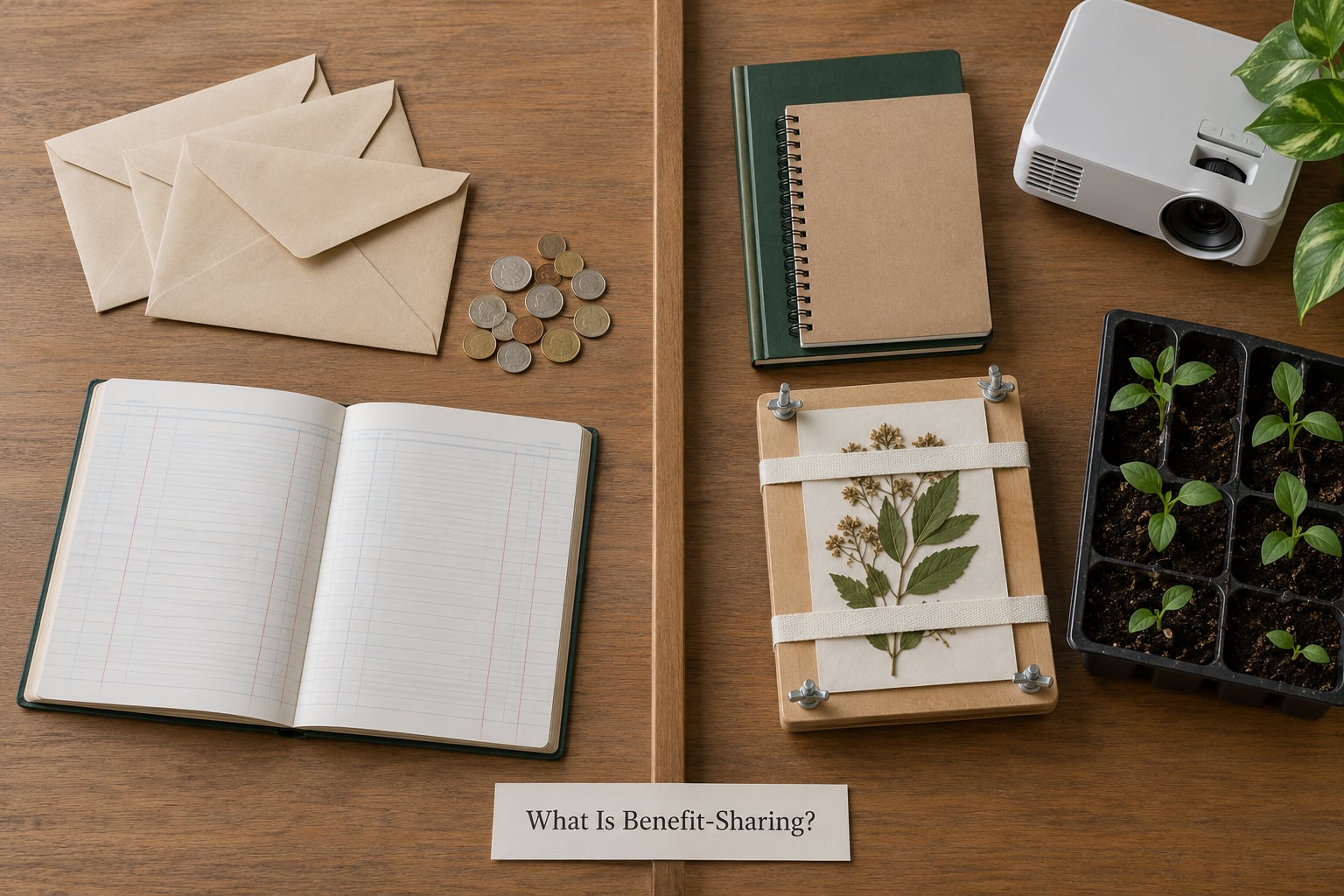
Benefit-sharing is the half of the deal that runs after access. Benefits fall into two broad families, and most agreements use both.
Monetary benefits include up-front access payments, milestone payments tied to a research stage, royalties on a commercialised product, licence fees, and funding conservation work on site. Amounts and triggers are negotiated between the parties and shaped by national law.
Non-monetary benefits cover things like training students from the source country, joint research and co-authorship, transferring equipment or techniques, restocking degraded collecting areas, restoring habitat, and supporting community health programmes.
What the protocol does not do is set a royalty percentage or name a recipient. There is no worldwide figure. Percentages, eligible products and payment timing come from the country’s own rules and from the agreement you sign.
Why Does It Matter for African Traditional Medicine?
African countries hold a large share of global plant diversity, and most medicinal-plant research still starts as ethnobotanical field work: talking to healers and collectors, recording uses, and taking specimens back for analysis. That is exactly the activity the protocol was written about.
The practical case for complying is straightforward. Communities that see benefit-sharing agreements arrive with funding, training and conservation support tend to keep participating across years rather than closing off access after one collection. Agreements also tend to produce better research, because the preparation knowledge comes with the specimen.
Ethnobotanical publications carry their own weight. Publishing a remedy list without recording how the community wants that knowledge handled, and without acknowledging who supplied it, can expose a practice that a community treats as private. Some knowledge is meant to stay with the people who hold it.
Equitable authorship, community authorship rules, joint internships and conservation funding all count as benefit-sharing in most frameworks. The strongest arrangements also go past the legal minimum and respect community protocols that no document requires.
Who Must Follow the Nagoya Protocol?
The trigger is access to covered genetic resources or associated traditional knowledge within, or from, a country that is a Party, followed by research and development. Everything after that point is utilization, and utilization carries duties.
In practice the people who feel this are universities and field research teams, pharmaceutical and biotechnology companies, cosmetics and nutraceutical brands, seed and crop companies, herbaria, museums, botanical gardens, biobanks, and hobbyist collectors working across borders. Public research agencies fund projects that fall under it too.
Whether a specific duty applies depends on three things: the law of the source country, the law of the country you are operating from, and what you actually did with the material. Two researchers with identical samples can end up with completely different obligations.
Does It Require Every Research Project to Get the Same Permit?
No, and this is where most confusion lives. The differences come from the material, the purpose and the date.
| Situation | Likely path | What to check |
|---|---|---|
| A university field study collecting specimens | National permit plus community agreement where relevant | Whether collection only, or use for research, is covered |
| Commercial research for a product | Permit, prior informed consent, and a material transfer agreement with benefit-sharing terms | Which downstream and derivative uses the terms allow |
| A repeat visit to material already collected | Existing terms usually govern, but scope matters | Whether the original agreement covers new species, new sites or new uses |
| A published non-living compound, such as a purified molecule from a chemical catalogue | Often outside the protocol’s scope, though national law can differ | Whether the material had living origin and any recorded conditions |
| Samples held in an older collection, collected before 2014 | National rules on legacy collections vary widely | What documentation exists and what your funder or journal requires |
The reliable answer for any specific project comes from the competent national authority in the source country, asked early. Researchers describe months of negotiation for simple academic studies, which is why starting after collection has already happened is the expensive route.
Common Misunderstandings About the Nagoya Protocol
- It bans ethnobotany. It does not. It sets conditions on how material and knowledge are used, agreed with those who hold them.
- Communities automatically get royalties. They do not. Monetary terms are negotiated within national rules, and plenty of agreements rely on non-monetary benefits instead.
- It only applies to companies. Academic teams, herbaria and biobanks can hold the same duties, particularly when samples move downstream.
- Every plant is a genetic resource. Plants as living organisms are not automatically in scope, and how definitions are applied differs by country. Ask rather than assume.
- Consent is a one-time signature. Consent attaches to agreed uses. A new purpose, a new site or a new product usually needs fresh terms.
Almost every confusion here traces back to one point: the protocol is an international framework, and the enforceable rules are national.
A Simple Example of Access and Benefit-Sharing
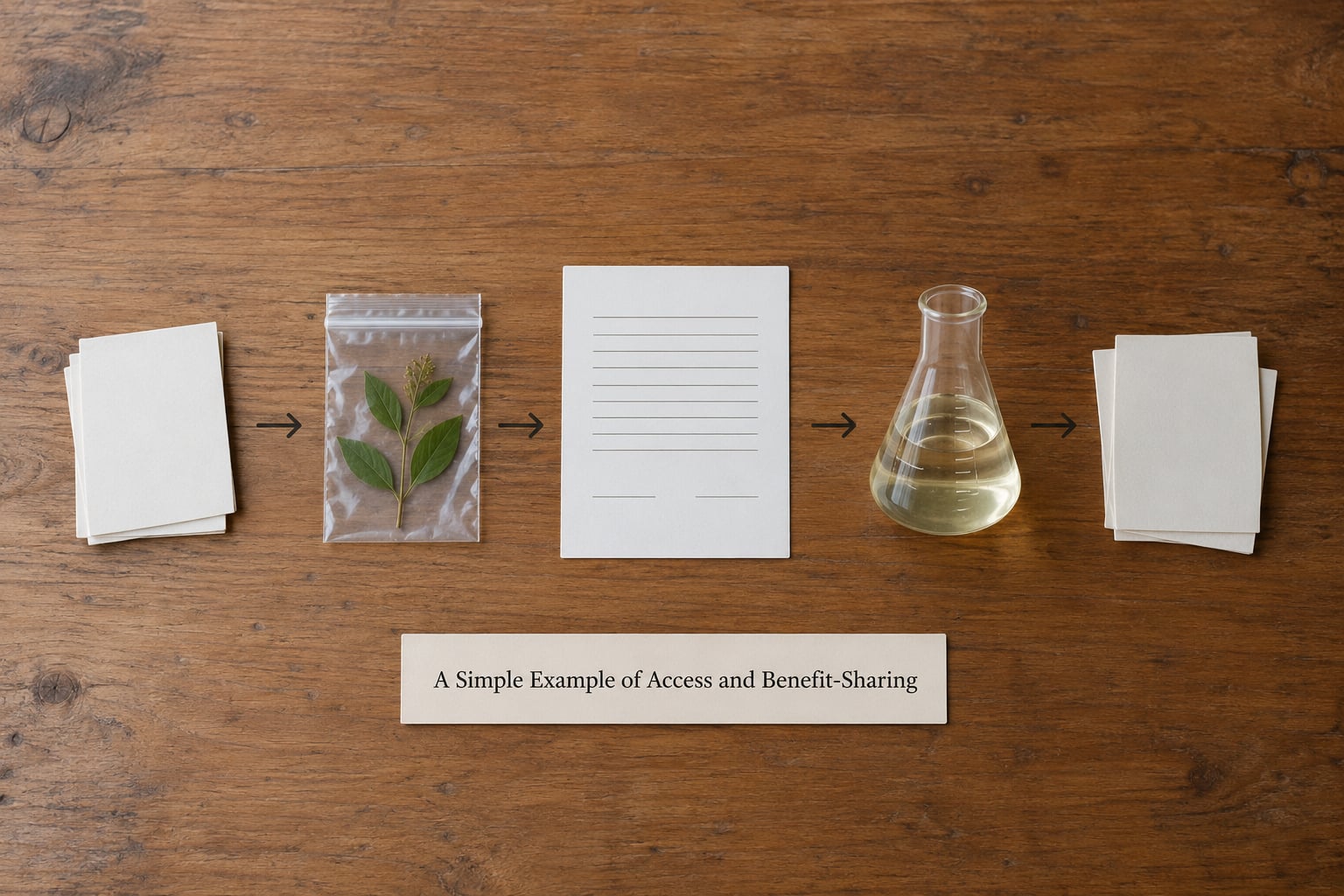
Take an illustrative case. A university wants to test a locally used root for one plant-based product line. Treat it as a sequence of decisions rather than a rulebook, and as an illustration rather than legal advice.
Step one. The team identifies the plant, the traditional use and the source country before travelling. It checks with the national authority and discovers the country requires a permit and community engagement.
Step two. They meet the healers’ association three times, in the local language, with a plain explanation of the research. They also explain what the study will not do, which matters as much as what it will.
Step three. Consent is recorded, and a material transfer agreement is signed covering collection, chemical work, storage, and any later transfer to a partner laboratory.
Step four. Benefits are written down rather than promised loosely: an up-front access payment, training for two students from the community, a restored plot at the collection site, joint authorship of any resulting paper, and a share of royalties if a product is commercialised.
Step five. The team keeps permits, consent records and the agreement in one file, so that any later collaborator inherits clear conditions and can demonstrate compliance.
What made this workable was not a clever legal structure. It was deciding early, agreeing early, and writing the benefits down before the first sample was pressed.
Frequently Asked Questions
Do I need a permit under the Nagoya Protocol for medicinal-plant research?
Usually yes, when you collect material from a country that is a Party. The rules come from that country’s national legislation, not directly from the protocol itself. Early field studies typically need a national research permit, and often an agreement with the community holding the knowledge. Ask the competent national authority in the source country before you travel, because the permit list and application timelines differ widely between countries.
Is the Nagoya Protocol specifically about traditional medicine?
No. It covers access to genetic resources and associated traditional knowledge in general, including agriculture, industry and scientific research. Traditional medicine simply falls inside that scope. Much of the public discussion concerns medicinal plants because bioprospecting is one field where the gap between commercial use and local recognition has been most visible, not because herbal practice is treated separately.
What does prior informed consent mean under the protocol?
It means the provider agrees freely, and after being properly informed, to a specific use. Consent covers particular activities rather than everything in perpetuity, and it may be withdrawn under agreed terms. In practice it means telling the authority and the knowledge holders, in their own language, what you will do with the material, who else will handle it, and what benefits are on offer before anything is collected.
Can I use a medicinal plant after finding it described in a paper?
A published description does not free the material from the rules. A paper records somebody else’s earlier work; it does not give you consent to access the plant yourself. Some national laws also restrict use of genetic material collected before October 2014, and rules on non-living compounds vary between countries. Treat published information as background, then check the current national position before you collect anything.
Does the Nagoya Protocol automatically mean communities receive royalties?
No automatic royalty exists anywhere in the text. Monetary terms, including up-front payments, milestone payments and royalties on commercialised products, are negotiated between the provider and the user within the rules the source country sets. Many agreements deliberately lean on non-monetary benefits such as training, joint research and conservation support instead, because those are often more useful to the communities involved.
Where should researchers start before collecting plant samples?
Start with the competent national authority in the source country, and with the community that holds the traditional knowledge. Confirm which permit covers collecting only versus collecting and later research, and ask what the authority requires for downstream transfer. Speak to your own institution’s compliance office as well, since funders and journals increasingly require documented proof of compliance before they release money or accept a paper.
Conclusion
Four things to do first, in this order. Know exactly what plant material and what knowledge your project involves. Identify the source country, since its law governs access rather than the law of the country you are based in. Contact the competent national authority there, and the knowledge holders, before anything is collected. Then agree and write down the terms, including benefits, before the first specimen leaves the ground.
Requirements change as national laws are amended, and country-specific advice matters more here than almost anywhere else in research. Get it right at the start, while collecting is still a plan rather than a problem.