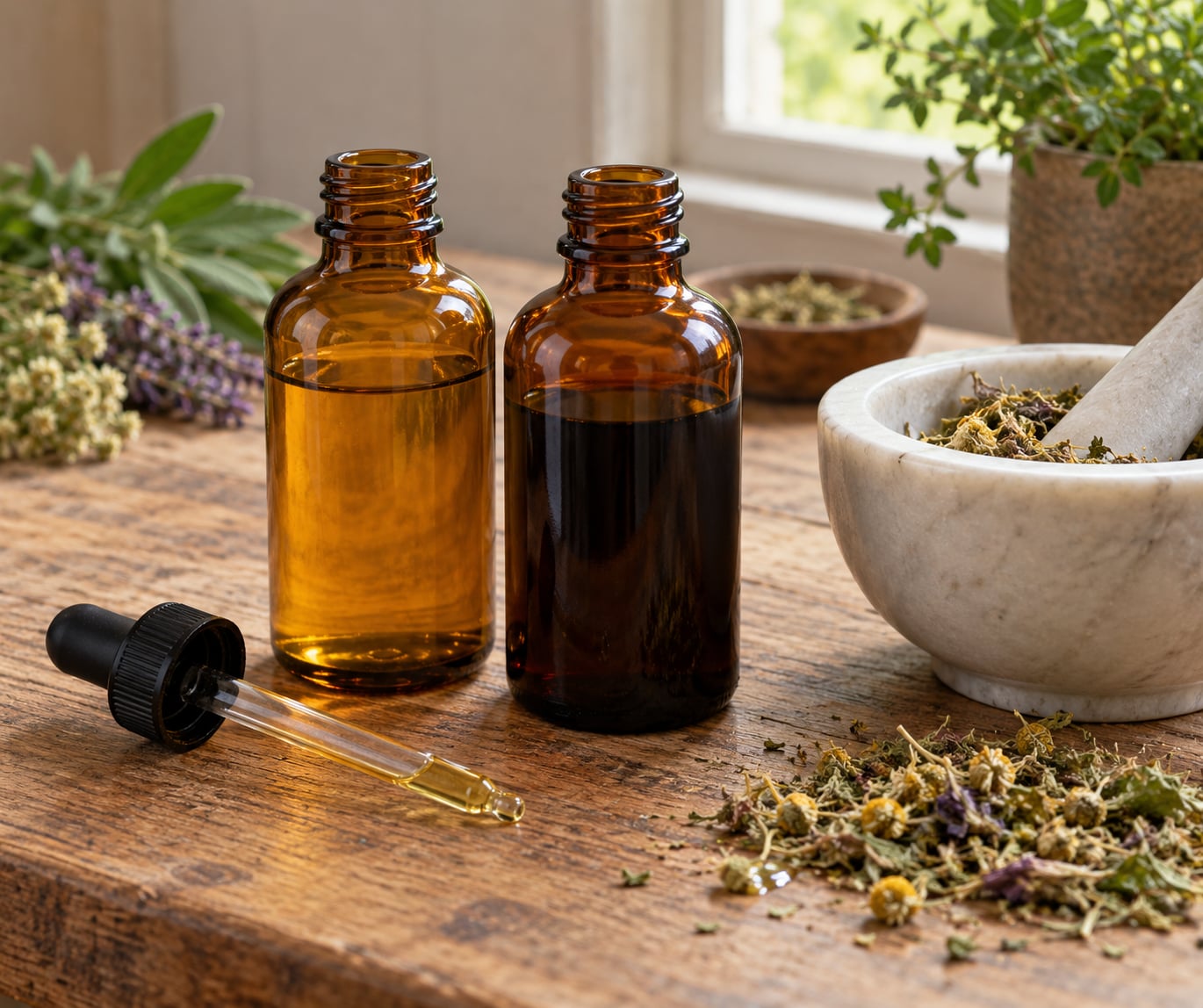
Alcohol tinctures pull a broader range of plant compounds and keep for years, so they are the stronger, more durable choice for adults. Glycerin extracts taste sweeter and carry no alcohol, which makes them the practical option for children, pregnant or nursing people, and anyone avoiding alcohol. Neither wins outright — the herb decides more than the format.
The word people get wrong here is tincture. Strictly, a tincture uses alcohol as its menstruum, the liquid that carries compounds out of plant tissue. If you swap that liquid for vegetable glycerin, you are making an extract, not a tincture, even though shop shelves rarely make the distinction.
Table of Contents
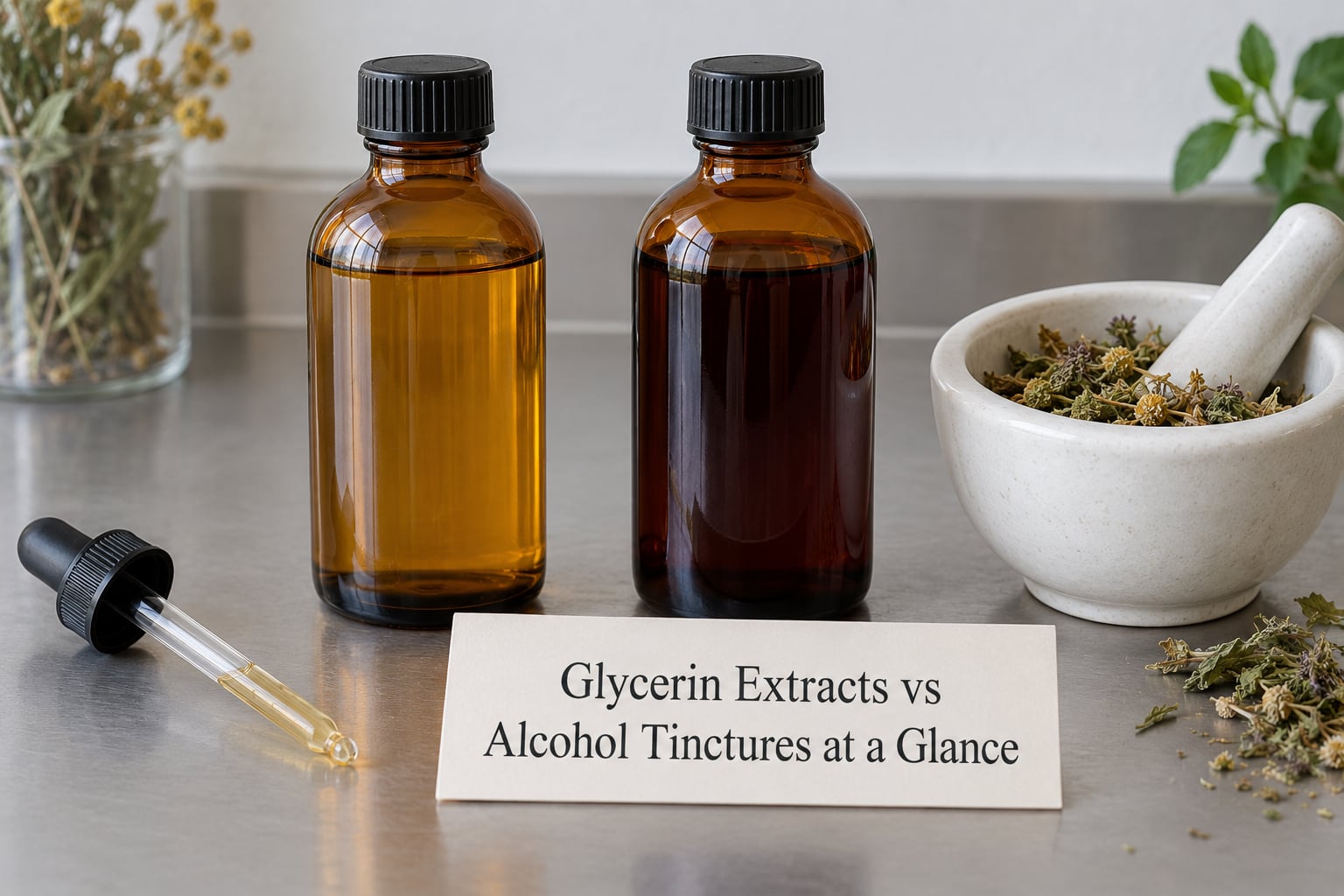
- 1Glycerin Extracts vs Alcohol Tinctures at a Glance
- 2What Is a Glycerin Extract?
- 3What Is an Alcohol Tincture?
- 4How Do Glycerin Extracts and Alcohol Tinctures Compare?
- 5Glycerin Extracts and Alcohol Tinctures Extract Different Constituents
- 6Which Plants Are Better Suited to Each Method?
- 7Shelf Life, Storage, and Labeling
- 8Safety, Alcohol Content, and Special Considerations
- 9Which Should You Choose?
- 10Frequently Asked Questions
- 11What is a glycerite?
- 12Are glycerin extracts as strong as alcohol tinctures?
- 13How long do glycerin extracts last compared with alcohol tinctures?
- 14Is alcohol in a tincture safe for children?
- 15Can you mix alcohol and glycerin in the same extract?
- 16Which herbs extract best in glycerin?
- 17Conclusion: Choose Based on the Herb and the Purpose
Glycerin Extracts vs Alcohol Tinctures at a Glance
| Factor | Alcohol tincture | Glycerin extract (glycerite) |
|---|---|---|
| Menstruum (solvent) | Ethanol, usually 40 to 60 percent with water | Vegetable glycerin, typically 55 percent or higher diluted with water |
| Polarity | Amphiphilic — dissolves polar and nonpolar compounds | Highly polar — mostly water-soluble constituents |
| Extraction range | Alkaloids, glycosides, resins, phenolics, tannins, volatile oils | Polysaccharides, mucilages, sugars, some tannins and flavonoids |
| Typical shelf life | 3 to 5 years or longer when stored dark and cool | Around 1 to 2 years |
| Taste and mouthfeel | Sharp, bitter, sometimes burning; thin liquid | Sweet, mild, slightly viscous |
| Alcohol per typical adult dose | About 0.8 mL of pure ethanol in a 2 mL dropperful at 50 percent proof | None, unless a small amount of alcohol is included in the recipe |
| Sublingual use | Common and fast | Possible, but thicker and slower |
| Best suited to | Resinous, oily, woody, and strongly aromatic materials; long-term storage | Berries, flowers, aromatic leaves, mucilage-rich roots and barks |
| Who it suits | Adults with no alcohol contraindication | Children and pets, pregnant or nursing people, alcohol recovery, liver conditions, taste intolerance |
The single most useful row is extraction range. Everything else — strength, dose size, how long it keeps — follows from which compounds the solvent can actually reach.
What Is a Glycerin Extract?
A glycerin extract, usually called a glycerite, is plant material macerated in vegetable glycerin diluted with water. The glycerin dissolves water-soluble constituents out of the plant, and the finished liquid is thin, sweet, and slightly viscous.
Home makers usually work with a 75/25 glycerin-to-water blend and roughly a 1:2 herb-to-liquid ratio by weight, then let the jar sit in a dark place for four to six weeks, shaking it now and then. Diluting more heavily with water extracts well but weakens preservation, which is why 55 percent glycerin is treated as the practical floor for a self-stable preparation.
Two other facts matter. Glycerin is only preservative above that roughly 55 percent threshold, so a heavily watered-down glycerite needs refrigeration. And glycerin extracts well from aromatic leaves, flowers, berries and soft roots, but poorly from resins, dry bark and non-aromatic seeds.
What Is an Alcohol Tincture?
An alcohol tincture is plant material macerated in ethanol, normally at 40 to 60 percent alcohol by volume with water making up the balance. That range is the traditional sweet spot: high enough to preserve and pull resins and alkaloids, low enough to keep the liquid drinkable.
Most home tinctures use a 1:2 or 1:5 herb-to-alcohol ratio by weight, macerated for two to six weeks before being strained and pressed. Because ethanol both extracts and preserves, a properly made tincture keeps three to five years or longer in a dark bottle, which makes it the format most herbalists reach for when they want something to sit in a cabinet for years.
Concentration does the work. A 40 to 50 percent tincture suits fresh material and watery herbs, while 60 to 90 percent suits dried roots, barks, seeds and anything resinous, because high-proof alcohol pulls lipophilic constituents that dilute spirit cannot.
How Do Glycerin Extracts and Alcohol Tinctures Compare?
Alcohol extracts more; glycerin extracts a narrower but still useful range. That is the honest headline, and it is why practitioners on herb forums keep repeating the same correction when someone calls a glycerite a tincture.
Glycerin Extracts and Alcohol Tinctures Extract Different Constituents
Ethanol is amphiphilic, meaning it is partly polar and partly nonpolar, so it reaches both water-friendly compounds and oily, resinous ones in a single pass. Glycerin is strongly polar, so it favours polysaccharides, mucilages, sugars and the more water-soluble tannins and flavonoids.
Industry estimates put glycerite extraction efficiency at roughly 60 to 70 percent of an alcohol baseline for suitable herbs, a figure worth holding loosely. For a mucilage-rich or berry-based preparation the gap is small. For a resin or an alkaloid-heavy root it is very large, and no amount of maceration time closes it.
Three more differences follow from the solvent. Glycerin extracts are viscous and slower under the tongue, while a thin alcohol tincture absorbs quickly and then passes through first-pass metabolism in the liver. Alcohol also carries volatile aromatic compounds that a glycerin maceration largely leaves behind, which is why a glycerite of the same plant can taste like a different herb entirely.
Many makers now use a dual extraction — first a high-alcohol maceration, then a glycerin pass on the spent marc — to capture both ranges in one bottle. It is straightforward, it costs more in time, and forum users report it works well as a palatability booster: a few dropperfuls of alcohol tincture stirred into a glycerite adds potency without losing the sweet taste.
Which Plants Are Better Suited to Each Method?
Plant chemistry decides the match, and the categories are predictable because the constituents are. Anything rich in resins, terpenes, oils or alkaloids belongs in alcohol; anything rich in polysaccharides, mucilage or aromatics does fine in glycerin.
| Herb | Key constituent | Better solvent |
|---|---|---|
| Elderberry (Sambucus nigra) | Anthocyanins, polysaccharides | Glycerin works well |
| Lemon balm (Melissa officinalis) | Volatile oils, flavonoids | Either, glycerin for taste |
| Chamomile (Matricaria chamomilla) | Sesquiterpene lactones, flavonoids | Either |
| Marshmallow root (Althaea officinalis) | Mucilage | Glycerin, or water first |
| Slippery elm (Ulmus rubra) | Mucilage | Glycerin, or water first |
| Ginger (Zingiber officinale) | Gingerols, volatile oils | Alcohol pulls more |
| Valerian (Valeriana officinalis) | Valerenic acid, isovaleric acid | Alcohol |
| California poppy (Eschscholzia californica) | Alkaloids | Alcohol |
| Myrrh and frankincense | Resins | Alcohol, 90 percent and above |
| St. John’s Wort (Hypericum perforatum) | Hypericin, hyperforin | Alcohol |
Note the mucilage row. Marshmallow root and slippery elm swell in water and turn a glycerin maceration into a gel, so herbalists usually do a water or glycerin-and-water pass first, press it, and then preserve with alcohol and glycerin together.
Shelf Life, Storage, and Labeling
Shelf life follows the preservation threshold, not the plant. A tincture at 40 to 60 percent ethanol stores for three to five years or longer; a glycerite holding at least 55 percent glycerin keeps roughly one to two years.
Storage is dull but decisive: dark glass, a cool cupboard, away from sunlight and heat, with the label dated at the moment of straining. Before use, check five things.
- Cloudiness that does not settle, or a haze that appeared after the liquid looked clear
- A smell that is sour, fizzy, acetone-like, or simply rotten rather than herbal
- Visible strands, fuzz or film at the surface, which suggests mould
- Separation into layers that will not remix, or colour that has gone noticeably darker
- A missing alcohol or glycerin percentage, herb ratio, or straining date on the label
If a batch fails any of those, discard it rather than diluting it and hoping. None of these signs can be assessed by taste safely, which is the reason we say check the label first and ask a pharmacist when in doubt.
Safety, Alcohol Content, and Special Considerations
The alcohol in a tincture is small but not nothing. A 2 mL dropperful of a 50 percent proof tincture contains roughly 0.8 mL of pure ethanol, about the alcohol in a small sip of beer. Multiply that by a few dropperfuls several times a day and the arithmetic starts to matter for some people.
Talk to a doctor or pharmacist before any herbal preparation if you are pregnant or nursing, giving anything to a child, in recovery from alcohol use disorder, managing a liver condition, or taking prescription medicines. Herbal preparations are not automatically free of drug interactions, and no solvent choice changes that.
One honest caveat on evidence: no head-to-head human trials have measured whether a glycerite or a tincture of the same herb produces better outcomes in people. Everything above rests on chemistry, formulation practice and long practitioner observation. Treat claims of proven superiority as marketing until better trials exist.
Which Should You Choose?
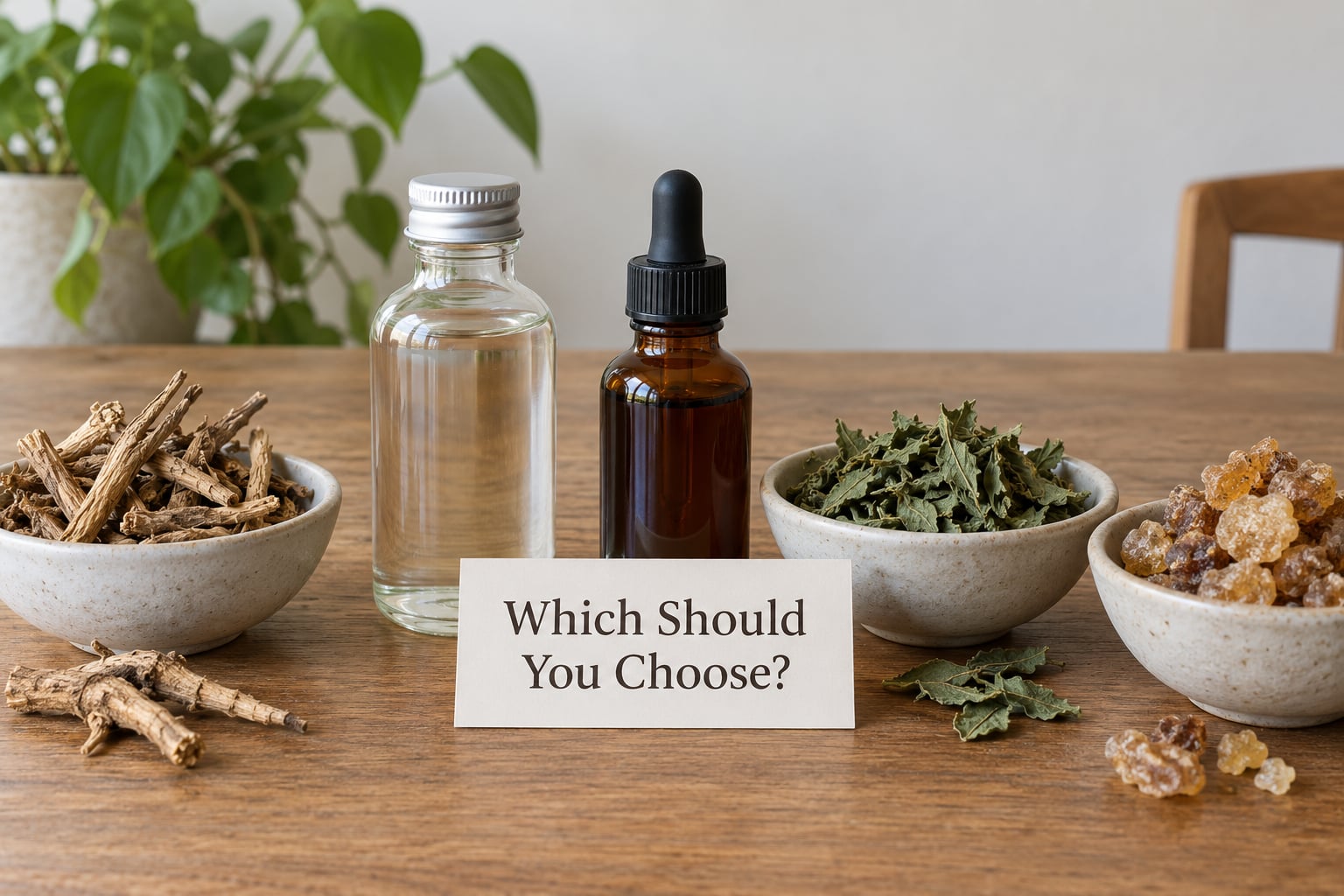
Pick the alcohol tincture when you are an adult with no alcohol contraindication, the plant is resinous, oily or woody, you want the widest compound range, or you plan to store the preparation for years.
Pick the glycerin extract when taste matters for consistency, the person taking it is a child or a pet, alcohol is off the table for pregnancy, recovery or liver reasons, or the herb is a berry, aromatic leaf or mucilage-rich root.
Pick a dual extraction when you want both, and a clinical conversation first when someone you care about has a condition or takes regular medicine. The herb and the person decide; the solvent follows.
Frequently Asked Questions
What is a glycerite?
A glycerite is a herbal extract made by macerating plant material in vegetable glycerin diluted with water, usually a 75/25 blend. It is sweet, mildly viscous and free of alcohol. Many home makers use about a 1:2 herb-to-liquid ratio by weight and steep it in the dark for four to six weeks before straining.
Are glycerin extracts as strong as alcohol tinctures?
No, not in general. Ethanol is amphiphilic, so it pulls polar and nonpolar compounds together, including resins and alkaloids that glycerin leaves behind. Industry estimates put glycerite extraction at roughly 60 to 70 percent of an alcohol baseline for well-suited herbs. For berries and mucilaginous roots the gap is small.
How long do glycerin extracts last compared with alcohol tinctures?
A tincture at 40 to 60 percent ethanol usually keeps three to five years or longer in a dark bottle in a cool cupboard. A glycerite holding at least 55 percent glycerin generally lasts one to two years. Below that glycerin threshold, or after heavy dilution with water, refrigeration becomes necessary.
Is alcohol in a tincture safe for children?
A small amount is used routinely, but the arithmetic depends on the proof and the dose. A 2 mL dropperful of a 50 percent tincture holds roughly 0.8 mL of pure ethanol. Many families prefer a glycerite for children because the sweet taste makes dosing easier. Ask your pediatrician before giving any herbal preparation.
Can you mix alcohol and glycerin in the same extract?
Yes, and herbalists do it often. A dual extraction soaks the plant in high-proof alcohol first, then does a glycerin pass on the spent plant material. You can also stir a few dropperfuls of tincture into a finished glycerite for extra potency and flavour. Either way, keep the finished preparation at or above 40 percent ethanol for reliable preservation.
Which herbs extract best in glycerin?
Berries, flowers, aromatic leaves and mucilage-rich materials do well: elderberry, lemon balm, chamomile, rose, nettle, ginger and rose hips. Mucilage-heavy roots such as marshmallow and slippery elm are trickier because they swell and thicken the menstruum, so many makers do a water pass first. Roots, barks, resins and seeds generally need alcohol.
Conclusion: Choose Based on the Herb and the Purpose
On glycerin extracts vs alcohol tinctures, the honest answer is that alcohol wins on breadth and shelf life while glycerin wins on taste and accessibility. Start by reading the label for the solvent percentage and the straining date, then pick the format that suits the herb and the person taking it, and check with a doctor or pharmacist before anyone uses it medicinally.