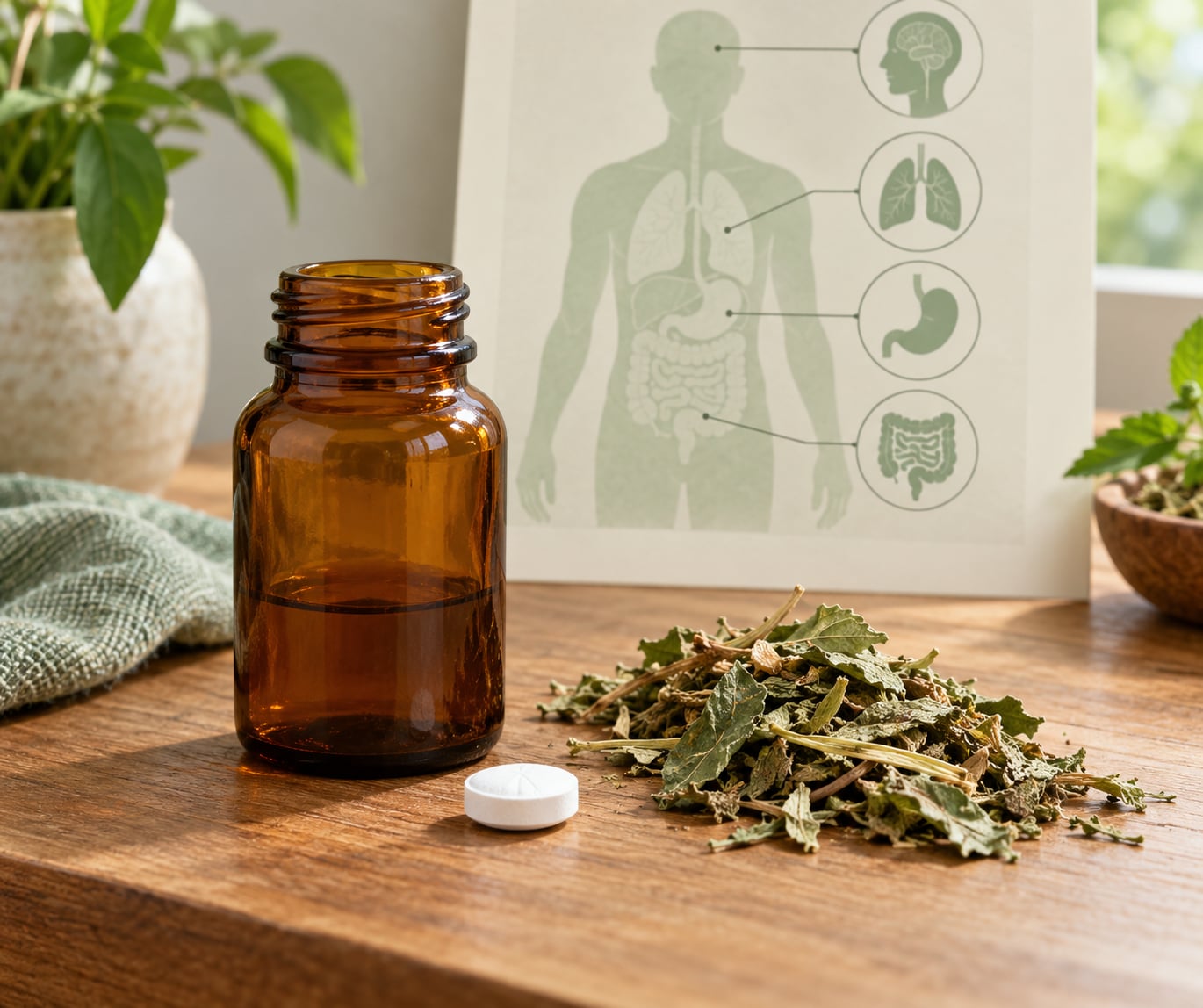
The placebo effect is when you genuinely feel better after taking a treatment that contains no active medicine, because what you expect from it changes what your body and brain actually do. It is a real, measurable change in symptoms such as pain, nausea or anxiety. It is not proof that the treatment works, and it is not a claim that your symptoms were ever imaginary.
Most people meet the placebo effect the first time they read a drug trial headline and think the whole study was fake. It was not. In a well-run trial, half the participants get the real drug and half get an inert lookalike, and the difference between the two groups is what researchers treat as the drug’s actual benefit. Everything both groups felt in common, from the attention to the relief they expected, gets subtracted out.
Below is the whole idea in plain terms: what a placebo is, how expectation works, what it can and cannot shift, why belief cuts both ways, and where traditional healing sits in all this. This is general information, not medical advice. If you are dealing with a symptom that worries you, a doctor or pharmacist is the right person to talk to.
Table of Contents
- 1In a nutshell
- 2Placebo Effect Explained in Plain Language: What Is It?
- 3How Can Expectation Change What People Experience?
- 4Placebo Effect Explained in Plain Language: The Main Mechanisms
- 5Can the Placebo Effect Change Real Symptoms?
- 6How Do Researchers Measure the Placebo Effect?
- 7Does a Placebo Prove That a Treatment Does Not Work?
- 8Can an Open-Label Placebo Work?
- 9What Is the Nocebo Effect?
- 10How Does This Relate to Traditional Healing and Ethnomedicine?
- 11What Improvements Still Need Medical Attention?
- 12Frequently Asked Questions
- 13Is the placebo effect the same as a placebo treatment?
- 14Why do some people feel better after taking a placebo?
- 15Does a placebo response mean that symptoms are not real?
- 16Can doctors prescribe a placebo without telling the patient?
- 17How can I tell whether a treatment genuinely works?
- 18Conclusion
In a nutshell
- A placebo is an inert substance with no active ingredient, often a sugar pill. A placebo effect is the improvement that follows taking it.
- The two are not the same thing, and neither is a placebo control, which is the inert comparison arm inside a clinical trial.
- Expectation, conditioning, the attention around a treatment and its meaning all appear to contribute. No single pathway is settled science.
- It moves subjective symptoms most: pain, nausea, fatigue, anxiety, some constipation and bladder urgency. It does not shrink tumours, clear infections or lower cholesterol.
- Belief can also work against you. That is the nocebo effect.
Placebo Effect Explained in Plain Language: What Is It?
The word comes from Latin. Placebo is the first person singular future of placeare, meaning “I shall please.” It entered English medical writing in the 1700s as a polite way of saying a treatment was given mainly to satisfy the patient rather than to do any work.
A placebo treatment is any inert intervention with no known active ingredient: a sugar pill, a saline injection, an inactive ointment, sometimes even a sham procedure. What makes it produce an effect is not the pill. It is everything around it, which is why researchers call the outcome a response to context rather than to chemistry.
So the placebo effect is not the pill working. It is the person getting better anyway, for reasons that are real but are not the drug. That distinction matters more than it sounds, because it is exactly the confusion behind the phrase “mind over matter,” which is both inaccurate and needlessly insulting to anyone with a genuine illness.
How Can Expectation Change What People Experience?
Several mechanisms have been proposed, and researchers still argue about how much each one contributes. What follows is the current set of main explanations, kept honest about which parts are well supported and which are contested. No single pathway has been settled.
Placebo Effect Explained in Plain Language: The Main Mechanisms
Expectation and belief. If you expect a treatment to lower your pain, your attention turns toward pain signals that would otherwise go unnoticed. Several trials have used naloxone, which blocks the brain’s natural opioids, to test this. When a placebo response is blocked by naloxone in people who had taken a real opioid drug, that tells researchers the brain’s own pain-relief system was doing the work. It does not tell us the same thing about every treatment.
Conditioning. Pair a neutral cue with a real effect often enough and the cue alone starts to trigger it. In the case of a pill, the cue is the shape, colour, taste and the ritual of swallowing it. Some trials have gone further and conditioned people with a flavoured drink before giving an inert version, finding that the drink alone could shift symptoms. This is why the packaging, the cup of water and the waiting room are not decoration.
Attention and the practitioner. A consultation itself involves focused attention, being listened to, having your experience taken seriously. Reviews of pain treatment consistently find that how warmly a clinician communicates accounts for a meaningful share of reported relief, independent of any medication.
Meaning. Researchers such as Ted Kaptchuk at Harvard’s Beth Israel Deaconess Center have argued that a treatment works partly through what it means to the person receiving it, whether that is a specific herb, a specific ritual or a specific injection. That framing explains why the effect is not confined to pills.
None of these are settled to the same degree. Expectation and conditioning have the strongest experimental support; the relative size of each contribution is still being argued over, and a researcher at McGill, Jeffrey Mogil, noted that placebo response in US trials became about 18% stronger over two decades of data without any change in the inert pills themselves, which points at changing expectations and marketing rather than a new mechanism.
Can the Placebo Effect Change Real Symptoms?
Yes, but the honest answer has two halves. The improvement is real for the person experiencing it. It is also, for most symptoms, a change in perception and brain processing rather than a change in the underlying disease. The table below separates the two.
| What placebo can measurably shift | What it will not change |
|---|---|
| Pain, including migraine and chronic low back pain | Tumour size or cancer progression |
| Nausea and vomiting, including during chemotherapy | Infections and the bacteria causing them |
| Fatigue and sleep quality | Cholesterol, blood sugar or blood pressure markers |
| Anxiety, low mood and stress | Broken bones, torn ligaments, an untreated infection |
| Itching, dry mouth, some bowel and bladder urgency | Genetic conditions and structural damage |
That table answers the most common question I get asked, which is whether placebos “cure” anything. For the first column, yes, and the relief can be worth a great deal. For the second column, no mechanism is known and none should be claimed.
How big is it? In pain trials, roughly 30% to 60% of people report meaningful relief from inert pills, which is why placebo pain relief is not the consolation prize it is often assumed to be. Those figures are not universal. Effect sizes vary by condition, by how strongly people expect relief, and by how the trial is run.
How Do Researchers Measure the Placebo Effect?
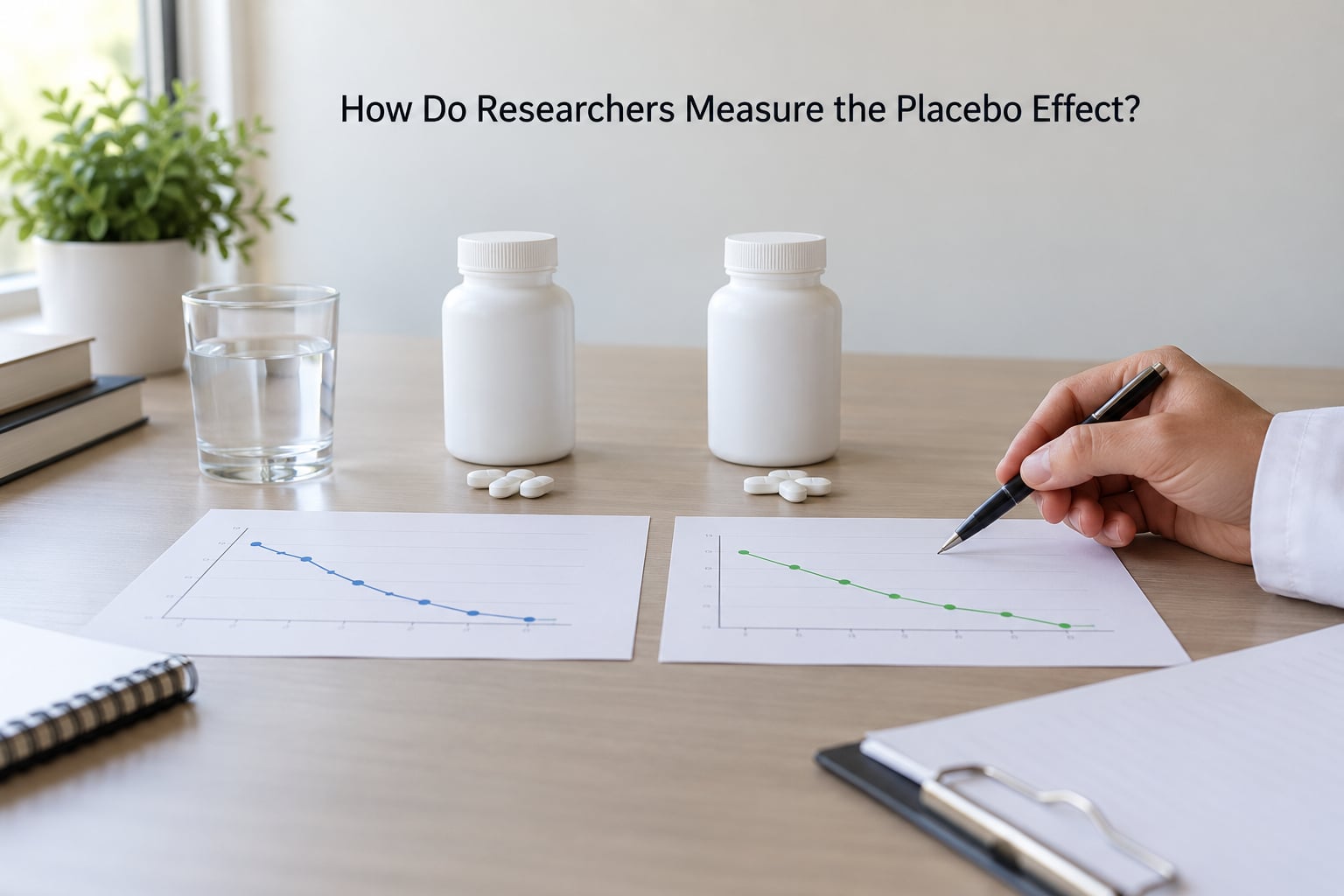
You cannot measure an effect without a comparison, so researchers build one into the trial itself. The basic design divides participants at random into two groups that look identical from the outside. One receives the real treatment, the other receives a placebo made to match it in appearance, taste and dosing schedule. Neither the participants nor the researchers assessing outcomes know who has which, which is what “double-blind” means.
The comparison then happens at the group level. Both groups get attention, both may feel better. What matters is whether the real-treatment group improves more, or whether outcomes such as blood tests, imaging or infection clearance differ. Symptom scores are recorded too, usually alongside an objective measure, precisely because self-reported relief on its own can be swayed by expectation.
Expectations are measured rather than assumed. Trials commonly ask participants how much they expect the treatment to help, and some studies deliberately vary what patients are told in order to test expectation directly. When results are written up, researchers report both the effect in the treated group and the improvement in the placebo group, and it is the second number that tells you how much any benefit has to be discounted.
Does a Placebo Prove That a Treatment Does Not Work?
No, and this is the single most common misunderstanding. If people in the placebo group improve, that tells you the placebo group improved, not that the treatment failed. A treatment is judged on the difference between the groups.
Say 60% of people on the real drug report good relief and 40% of people on the placebo do. The drug’s effect is the 20-point difference. Reading the 40% figure and concluding the drug does nothing throws away the actual result.
There is a second reason the conclusion fails. Group averages describe groups. Individual responses vary widely, and some people respond substantially to inert treatments while others respond to nothing at all. Neither of those people is unusual, and a trial average cannot tell you in advance which one you are.
Can an Open-Label Placebo Work?
Open-label placebo means the participant is told plainly that they are receiving an inert pill, and takes it anyway. Yes, it can still produce benefit, which surprised researchers for years. Trials in irritable bowel syndrome, chronic low back pain and chronic fatigue have reported improvements in cohorts who knew what they were taking, and researchers argue that honest explanation plus structured ritual can sustain expectancy better than deception does.
It also removes the deception objection, which is a serious ethical advantage in conditions where no good treatment exists. The honest version asks nothing of the patient except participation.
The evidence is contested, though, and anyone claiming certainty is overselling it. A 2025 study of open-label placebo for headache reported no reduction in headache days compared with a control, and reporting on it drew a sharp reaction from people who had been sold the idea that knowing cannot matter. The reasonable position is that open-label placebo sometimes helps, that we do not yet know how reliably, and that it is not a substitute for an effective treatment.
What Is the Nocebo Effect?
The nocebo effect is the same mechanism pointed the other way. Expecting a treatment to cause harm makes side effects more likely to be reported and, in some studies, more severe. In trials where patients are warned in detail about side effects, those warning lists have been shown to increase the rate of reported side effects without changing the treatment itself.
This is genuinely useful to know, and it is also where misinformation does real damage. “It’s probably just a placebo effect” and “it’s all in your head” are not explanations. If a symptom is new, severe, persistent or worsening, it needs assessment, not reinterpretation. Expectation shapes symptoms; it does not diagnose them.
How Does This Relate to Traditional Healing and Ethnomedicine?
Most traditional and ethnobotanical practices, across Africa and everywhere else, combine a plant preparation with a person, a setting, a dosage routine and an explanation of what is being treated. Expectancy research maps onto that combination neatly. The taste and smell of a preparation, the authority of the healer, the specificity of a diagnosis and the ritual around dosing are all cues that can carry a real contextual effect.
That does not mean traditional healing works by placebo alone, and it does not mean the chemistry is irrelevant. A plant can contain active compounds, and where evidence exists it should be weighed on its own terms. What the placebo literature contributes is an honest account of part of the total effect, rather than treating the whole outcome as either pure chemistry or pure belief.
It also explains a genuine problem in herbal research. To test whether a preparation works, researchers need an inert or “active comparator” control. When the preparation’s context, aroma and ritual cannot be matched in the control arm, a trial can end up measuring the effect of the whole encounter and calling it the effect of the plant. That is a design question, not a reason to dismiss either approach.
The safety line is simple and worth stating plainly. Belief-driven relief is a complement to care, never a replacement for it, and any preparation being taken alongside prescribed treatment should be discussed with a doctor or pharmacist, because interactions between plants and medicines are well documented.
What Improvements Still Need Medical Attention?
Feeling better is good news. It is not a diagnosis, and it does not establish that what you took is effective or safe. Some conditions improve on their own, some flare and settle, and a genuine placebo response can sit on top of an illness that is still progressing.
Book a clinical review for any symptom that is new, severe, persistent or changing, for unexplained weight loss or fatigue, for pain that keeps waking you at night, and for anything that is getting worse rather than better. Do not use a belief that a treatment must be working as the reason to keep delaying that appointment.
For anything on a prescription, or if you are using herbal preparations alongside medication, ask a pharmacist about interactions. That is exactly what they are there for.
Frequently Asked Questions
Is the placebo effect the same as a placebo treatment?
No, and the two are often confused. A placebo treatment is the inert thing itself, such as a sugar pill with no active ingredient. The placebo effect is the improvement some people experience after taking it. A third term adds more confusion: a placebo control is the inert arm of a clinical trial, used to measure what a real drug adds on top of expectations and attention.
Why do some people feel better after taking a placebo?
Expectation appears to shift how your brain processes symptoms. If you expect relief, your attention turns toward pain signals that would otherwise fade, and in pain trials blocking the brain’s natural opioids can blunt the response entirely. Conditioning plays a role too: the pill’s shape, taste, packaging and dosing routine become cues after repeated pairings. Attention from the practitioner and what the treatment means to you also count.
Does a placebo response mean that symptoms are not real?
No. The pain is real, and the relief is real for the person experiencing it. What is limited is what changed: usually perception and brain processing rather than the underlying disease. That is why placebo relief shows up strongly for pain, nausea, anxiety and fatigue, and not at all for tumours, infections or cholesterol. Feeling better and being free of disease are two different questions.
Can doctors prescribe a placebo without telling the patient?
In most settings, no. Deceiving a patient and giving them an inert treatment they believe is real breaches informed consent, and regulators restrict when it can be used at all. Trials use deception under strict ethics approval with the option to withdraw. Open-label placebo, where the patient knows they are receiving an inert pill and agrees to take it, avoids the ethical problem and is being studied for a few conditions.
How can I tell whether a treatment genuinely works?
Look for controlled evidence rather than personal experience. In a randomised trial, the drug group is compared with a placebo group that looks identical, and the gap between them is the drug’s real effect. For a treatment someone is already taking, useful signs include effects that are repeatable, appear at plausible doses, and line up with what is known about the condition. Personal improvement is genuine but cannot separate treatment from expectation.
Conclusion
Expectation, conditioning, attention and meaning can move what a person feels, and researchers can measure that effect well enough to run millions of trials on it. But a genuine placebo response proves something about the person, not about the remedy. When judging any treatment in 2026, weigh the benefit, the safety and the controlled evidence together, and treat feeling better as encouraging but never as proof.