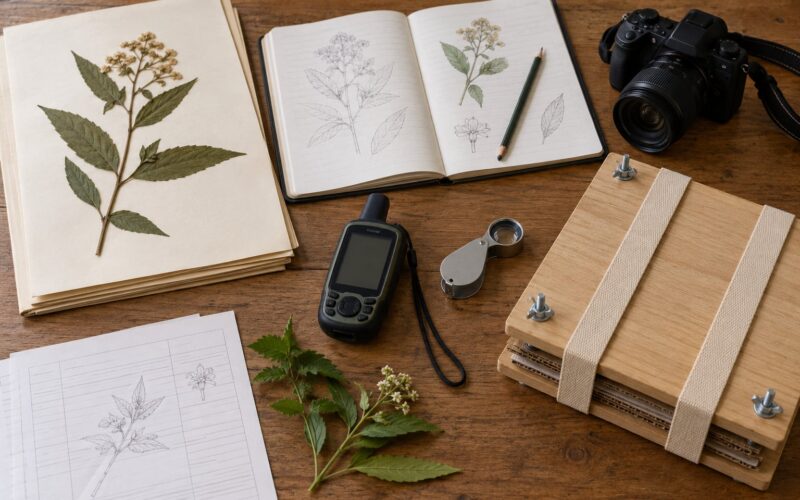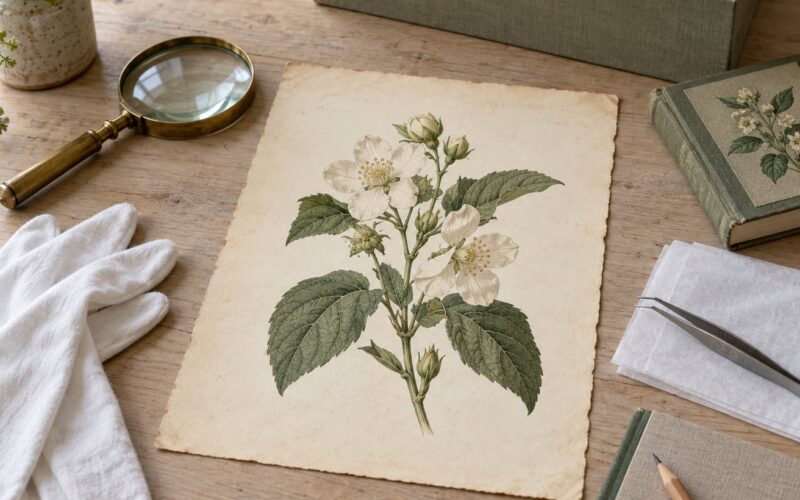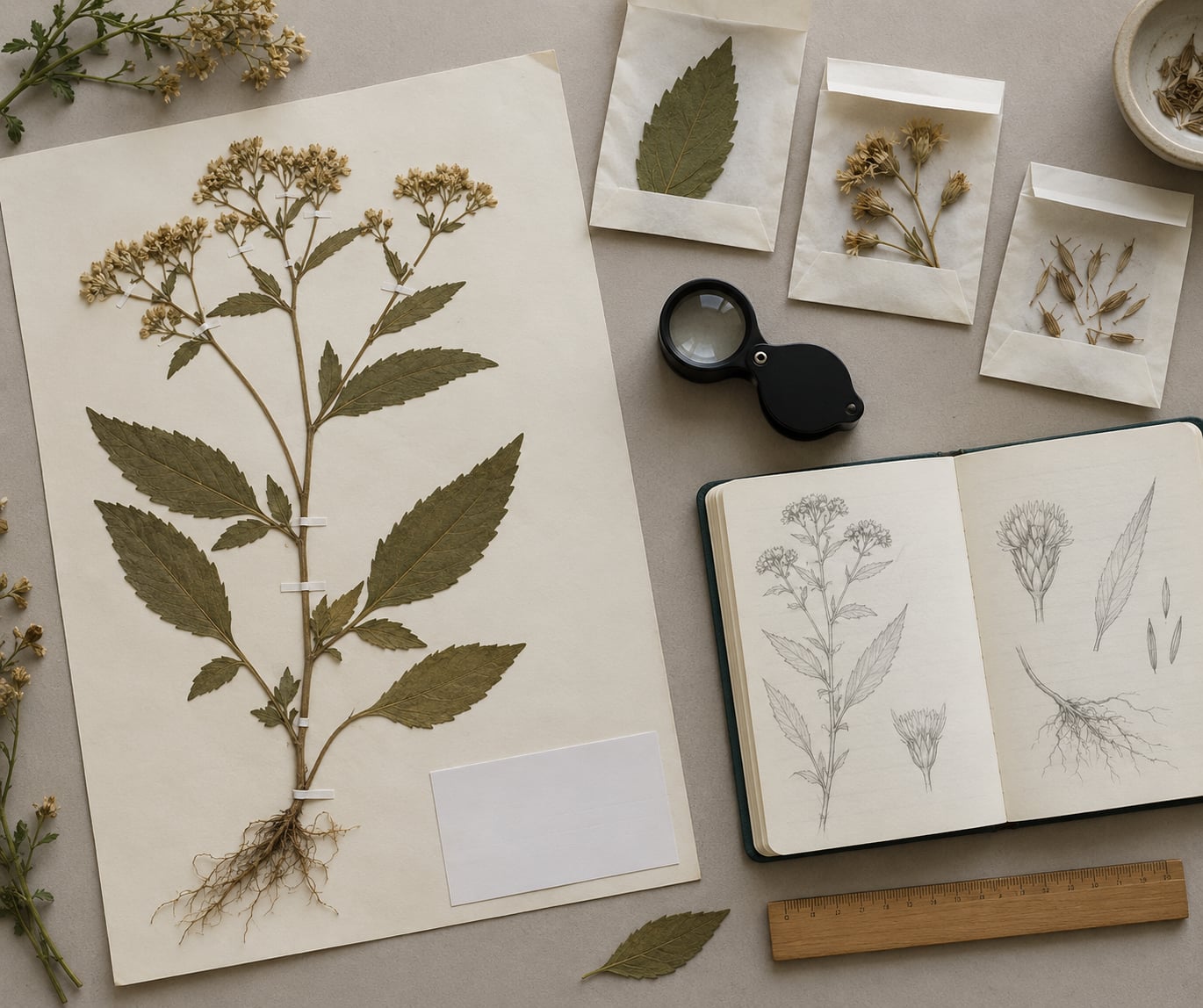
If you have ever read a paper on a medicinal plant and wondered who decided the plant was that species, this is the profession that answers it. A plant taxonomist names, describes, identifies and classifies plants, usually by collecting specimens in the field, preserving them as herbarium sheets, comparing them against reference material, and publishing formal names that everyone else then uses.
The honest version is more humdrum than most people imagine. A lot of the work is careful, repetitive and slow: checking leaf margins under a hand lens, filling in a field notebook while it still rains, remounting a faded 1920s sheet, tracking down a type specimen in another country. It is also the slowest route to a finished answer in biology. If you want to know what a plant taxonomist actually does day to day, the answer is mostly careful comparison, done slowly enough to be trustworthy.
Table of Contents
- 1What Does a Plant Taxonomist Actually Do?
- 2How Does a Plant Taxonomist Identify a Plant?
- 3What Is Plant Taxonomy Used For?
- 4How Are Plants Classified and Named?
- 5What Tools and Methods Does a Plant Taxonomist Use?
- 6What Does a Plant Taxonomist Do in a Research Project?
- 7What a plant taxonomist actually does, step by step
- 8How Does a Plant Taxonomist Work With Ethnobotany?
- 9What Are the Main Outputs of Plant Taxonomy?
- 10What Skills Does a Plant Taxonomist Need?
- 11Frequently Asked Questions
- 12Do you need a PhD to become a plant taxonomist?
- 13What is a voucher specimen and why does it matter?
- 14How do taxonomists tell two similar plant species apart?
- 15What is the difference between plant taxonomy and plant systematics?
- 16What is the average salary of a taxonomist?
- 17Is plant taxonomy a dying field?
- 18Conclusion
What Does a Plant Taxonomist Actually Do?
A plant taxonomist identifies plants, gives new species formal scientific names, places those names in a classification that reflects evolutionary relationships, and publishes the evidence. Underneath that sit seven recurring jobs: collecting material, recording field data, preserving specimens, identifying them against keys and reference collections, describing new taxa, applying the naming rules, and maintaining the records other scientists rely on.
The daily duties usually look closer to this:
- Collecting plant material with flowers and fruit, not just a convenient leafy twig
- Recording collection data in a field notebook, including a unique field number per collection
- Pressing and drying specimens and mounting them as herbarium sheets with a printed label
- Running specimens through a dichotomous key and comparing them against reference material
- Measuring and describing characters, then writing them into a formal Latin or English description
- Checking the International Code of Nomenclature before publishing any new name
- Digitizing records and making them findable through databases such as GBIF
It is worth separating this from plant ecology, which studies how plants relate to their environment and to each other, and from horticulture, which grows and manages plants for use. A taxonomist can work alongside both, but the question they are holding is always one of identity: what is this thing called, and how confident can we be?
How Does a Plant Taxonomist Identify a Plant?
Identification happens twice, and the two passes often disagree. In the field, the taxonomist looks at the living plant, which is the only time some characters exist at all: growth habit, leaf arrangement on the stem, colour, smell, whether the plant is woody or herbaceous, and how the flowers attach.
Back in the herbarium, the same specimen is re-read under better conditions, often years later, sometimes by someone who has never seen it growing.
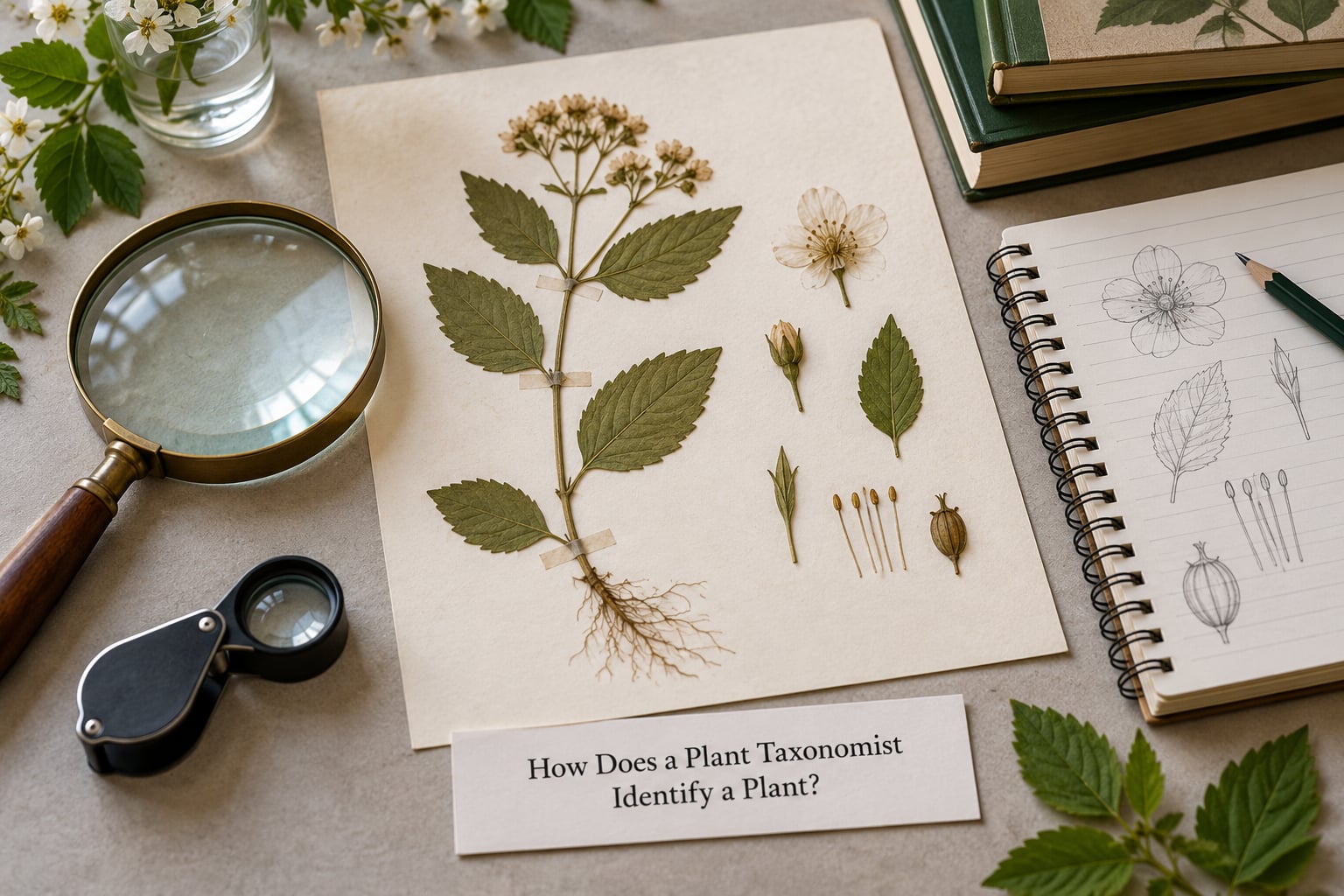
The characters that decide it are specific rather than general. Stamens and their arrangement, the shape and position of the ovary, fruit structure, seed surface, indumentum on leaves, stipules, node arrangement, and the shape of the leaf apex and margin. Two genera in the mallow family can look nearly identical in a photograph and separate cleanly once you count the staminal columns.
Keys narrow the field, they do not decide it. A dichotomous key gives paired statements where you follow the one that fits, step by step, until one taxon is left. Experienced taxonomists treat a key as a first pass and then go to the herbarium wall, where they pull the neighbouring species and lay them side by side. When the two disagree, the specimens win.
What Is Plant Taxonomy Used For?
Plant taxonomy is what makes every other plant record meaningful. Without a stable name attached to a specimen, a measurement, a chemical analysis or a conservation decision has nothing to attach itself to.
Its practical uses run wider than most people assume:
- Conservation: Red List and protected-area decisions depend on knowing which species exists in which place, and how many populations there are.
- Biodiversity inventories: National and provincial flora projects map what grows where, which is the baseline every later survey is compared against.
- Herbarium management: Collections at institutions such as Kew, the New York Botanical Garden and the Missouri Botanical Garden are reference libraries; verification of an unknown plant often means physically going to look at the sheets.
- Agriculture and forestry: Pest and weed identification, hybrid parentage, seed certification and disease host records all run through names.
- Pharmacognosy and herbal safety: Chemical and safety testing on a plant is meaningless unless the plant was correctly identified in the first place.
- Ethnobotanical documentation: Recording a traditional use credibly requires a name a botanist stands behind.
How Are Plants Classified and Named?
Plants sit in a nested hierarchy. Species sit inside genera, genera inside families, families inside orders, and orders inside larger clades. The binomial name of a species, a genus name plus a specific epithet, is followed by an author citation that credits the person who validly published it.
The rules are written down. The International Code of Nomenclature for algae, fungi, and plants, maintained through the International Association for Plant Taxonomy, defines what makes a name validly published: a Latin or English description, a designated type specimen, a stated place of publication, and the correct citation format.
Names also change. When evidence shows that two named species are really one, a taxonomist publishes a synonymy that merges them and keeps the record straight. When a regional flora is revisited after fifty years of collecting, a taxonomic revision can move dozens of species between genera at once. That is normal maintenance work, not failure.
What Tools and Methods Does a Plant Taxonomist Use?
The kit is modest and the methods behind it are not. In the field: a vasculum or a plastic bag for wet material, a plant press with newspaper and straps, a hand lens, pruning shears, a GPS unit or phone, a field notebook, and a collecting permit issued by the relevant authority. Every collection gets a field number that follows the specimen through the rest of its life, so the label, the notebook entry and the database record all point back to the same gathering event.
In the herbarium, the tools are the compound microscope, the plant press again, mounting paper, a label printer, a fume hood for chemical preservatives, and cabinets that hold dried sheets at stable humidity. Many collections are registered with Index Herbariorum, the global directory of herbaria, which gives each one a permanent code.
Desk work adds floras, regional monographs, the Biodiversity Heritage Library for scanning older literature, and databases. Global Biodiversity Information Facility (GBIF) pulls records from hundreds of institutions into one searchable place, so a distribution map can be built in an afternoon from records that took centuries to assemble.
Molecular work sits alongside all of this. DNA barcoding reads a short standard region of the plant genome and compares it against a reference library, which settles questions morphology leaves open and flags possible new species quickly. It does not replace looking at the plant; a barcode match to a misidentified reference specimen just propagates the error.
What Does a Plant Taxonomist Do in a Research Project?
Here is what a plant taxonomist actually does in a typical revision project, in the order the work really happens.
What a plant taxonomist actually does, step by step
- Set the question. A genus with conflicting names across three regional floras, or a group with an unresolved species complex.
- Assemble the evidence. Pull the herbarium sheets and existing descriptions, list what is claimed and how far each claim is supported.
- Go look at plants. New collecting, revisiting type localities, measuring character ranges across individuals and across the range rather than off one specimen.
- Compare directly. Type specimens against suspected duplicates against modern collections, all in the same room, all under the same lens.
- Analyse the characters. Record which differences are consistent and which are noise, backed by microscopy or sequence data where the question demands it.
- Write the treatment. Descriptions, a key, a synonymy, distribution notes and conservation status, published under the Code with types designated.
- Deposit and share. Voucher specimens go into a named herbarium, and the data is digitised and shared through the network.
Steps 3 and 4 are the ones that take years. The writing is the part everybody imagines.
How Does a Plant Taxonomist Work With Ethnobotany?
This is where taxonomy earns its keep in traditional medicine research. Ethnobotanical interviews produce local names, and a local name is often shared by several unrelated species, or used for one species in one district and a different one fifty kilometres away. Treating the local name as the species is the single most common reason a traditional-use claim cannot be verified later.
The fix is procedural. When a taxonomist documents a medicinal plant, they collect a voucher specimen at the moment of use, with the parts actually used, and record provenance: who collected it, where, when, under what local name, and who supplied the knowledge. That specimen becomes the permanent, checkable link between the claim and the plant.
Two habits keep this honest. First, no identification from a photograph alone; a taxonomist will usually ask for material, or for a pressed sample to be mailed in. Second, the ethnobotanist keeps the local name as reported and records the determination separately, so a future reader can see exactly where the two diverge.
Working with traditional healers and community knowledge holders also carries obligations beyond data collection. Consent has to be recorded and ongoing rather than assumed, the community’s preferred name for a plant outranks a published one in its own context, and benefits from any resulting product, publication or patent should be negotiated before the work starts, not after a result looks valuable.
For anyone reading herbal safety material, the practical test is simple. Ask whether the claim names a voucher-backed determination, and which herbarium holds it. If it does not, treat the plant identity as unconfirmed.
What Are the Main Outputs of Plant Taxonomy?
The products of the discipline are unglamorous and durable.
| Output | What it contains | Who uses it |
|---|---|---|
| Species description | Formal diagnosis, measurements, type designation | Taxonomists, taxonomically trained researchers |
| Taxonomic revision | Re-examination of a whole group, with synonymy | Herbaria, floras, ecologists |
| Identification key | Paided statements leading to a name | Field botanists, forestry officers, students |
| Flora | All plants of a region, with keys and notes | Everyone working in that region |
| Herbarium record | Mounted specimen plus label and data | Verification, loans, teaching |
| Conservation assessment | Range, population size, threat status | Red List, protected-area planners |
| Shared data record | Digitised occurrence with coordinates | GBIF users, mapping and monitoring projects |
Every one of these is citation-tracked. A name, a type and a herbarium accession number stay linked for decades, which is why the discipline keeps value long after the person who compiled it retires.
What Skills Does a Plant Taxonomist Need?
The skill list is broader than the subject suggests. Patient observation is first, then steady hands and a good hand lens. On top of that: microscopy, careful measurement and honest data recording, and the ability to write a precise description that someone else can act on years later. Geography matters because distributions are ranges, not points. So do statistics and data handling, GIS, and enough computing to work with databases and sequence output. Grant writing is a real skill for anyone without a permanent post.
Where the work happens is equally varied. Herbaria and natural history museums employ curators, collection managers and technicians. Botanical gardens run both research programmes and public horticulture. Universities carry taxonomists in botany departments, often the only one or two on staff. Government agencies run national herbaria and flora projects. NGOs and conservation organisations fund inventory work, often in the places with the least documented plant diversity and the most of it to lose.
On pay, the honest answer is that taxonomists are paid by sector rather than by discipline. Academic and museum roles track public-sector or university salary scales, and much of the taxonomic literature comes from fixed-term grant posts. Anyone weighing this path should assume the funding question as seriously as the training question, and should look at where the grants come from before choosing a supervisor.
On entry, a PhD is the standard route to independent research, since describing new species and revising genera requires original work. It is not the only route. Herbarium technician and assistant curator roles, field botany work with herbaria and botanical gardens, and biodiversity inventory projects have all launched careers, and the digitization of collections has created real demand for people who can read specimens and enter good data.
One honest note from inside the field: taxonomists themselves have been describing the discipline as underfunded and under-valued for years, and much of the strongest work still sits on short-term contracts. Practitioners on community forums make the counterpoint that the work matters regardless of who funds it. Both are true at once.
Frequently Asked Questions
Do you need a PhD to become a plant taxonomist?
A PhD is the standard route to independent taxonomic research, because describing new species or revising a genus requires original work that only a doctoral project supports. It is not the only route in. Herbarium technician roles, field botany assistant positions, botanical garden posts and biodiversity inventory projects have launched plenty of careers, and herbarium digitization work has created steady demand for people who can read specimens and enter reliable data.
What is a voucher specimen and why does it matter?
A voucher specimen is the physical, dried plant sample deposited in a named herbarium to document the identity of something studied. If a researcher tests a plant for chemistry, safety or traditional use, the voucher is the permanent link between that result and a species name. Without one, the claim cannot be verified years later, because common names and local names vary from place to place and often cover several species.
How do taxonomists tell two similar plant species apart?
They compare a fixed set of characters side by side under magnification, focusing on flower structure, fruit, seeds, indumentum and leaf arrangement, and they measure the range of variation across many individuals rather than one specimen. A dichotomous key narrows the candidates, then comparison against herbarium reference material, including type specimens, settles it. DNA barcoding is often used to confirm or flag a result.
What is the difference between plant taxonomy and plant systematics?
Taxonomy names and arranges plants into a hierarchy and produces the classification itself. Systematics is the broader study of the relationships among plants and the evidence behind that classification, drawing on morphology, anatomy, embryology, ecology and molecular data. In practice the two overlap heavily, and many working botanists use the terms interchangeably when describing a revision or a family-level classification.
What is the average salary of a taxonomist?
There is no single figure, because taxonomists are paid by sector rather than by discipline. Academic and museum roles follow public-sector or university salary scales, and a great deal of taxonomic output comes from fixed-term grant posts with shorter contracts. The figures published for botany and related occupations therefore blend field botanists, greenhouse staff and museum curators, which is why they rarely describe a taxonomist’s earnings accurately.
Is plant taxonomy a dying field?
The profession has been described that way from inside for years, usually for funding reasons rather than a lack of plants to study. Collections need curation, regions still lack a documented flora, and DNA barcoding has pulled more people into identification work rather than fewer. The real pressure is that permanent research posts are scarce and much of the work is grant-funded and short-term, which affects job security far more than it affects the demand for the science.
Conclusion
A plant taxonomist gives plants their names, proves those names with preserved specimens, and publishes the evidence so that a scientist in another country can check it a century later. The work is slow, methodical and unglamorous, and it is the foundation that conservation records, agricultural advice and medicinal-plant research all stand on.
If you want to study African medicinal plants, verify a traditional plant name, or contribute records that a region’s flora has never had, taxonomy is the place to start. Begin with a local herbarium or botanical garden, learn to read a specimen sheet properly, and ask which plants in your area are still unidentified. That question is where every useful project begins.