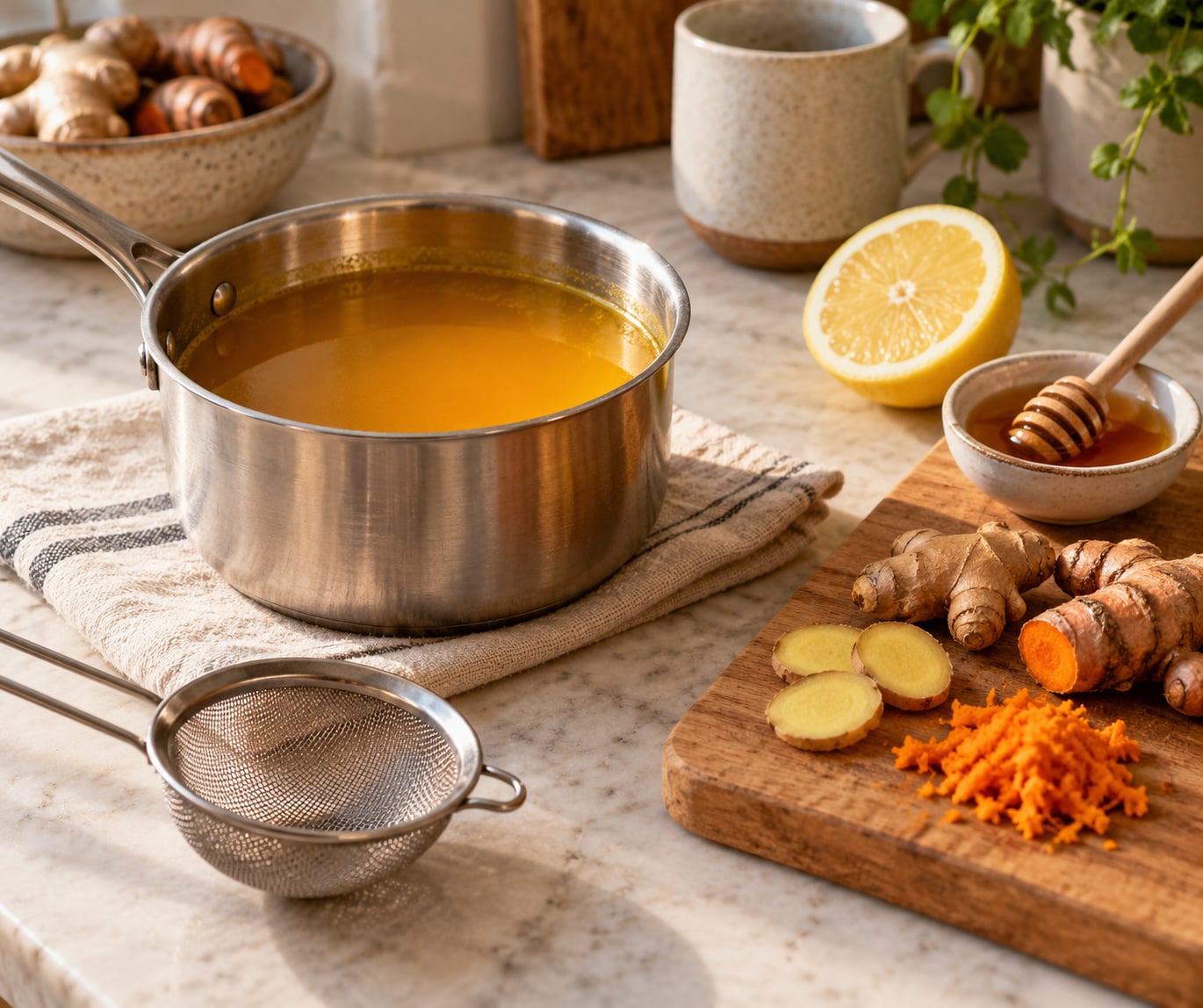
To make ginger and turmeric tea, simmer 2 cups of water with a 1-inch piece of fresh ginger and a 1-inch piece of fresh turmeric root for 10 to 15 minutes, then strain and finish it with lemon juice, honey, and a pinch of crushed black pepper. The whole thing takes about 15 minutes and needs nothing more than a saucepan and a strainer.
Ginger here is Zingiber officinale, and turmeric is Curcuma longa. The pairing is not a modern invention: Ayurvedic kitchens have made turmeric milk, haldi doodh, for centuries, Chinese practice has used fresh ginger as a warming everyday herb, and West African households have kept both roots in the kitchen for cooking and for tea long before the drink showed up in Western wellness blogs.
What follows is the plain kitchen method. The amounts below are recipe quantities for one generous serving, not therapeutic doses.
Table of Contents
- 1What You Need
- 2Step-by-Step
- 31. Prepare the Ginger and Turmeric
- 42. Warm the Water and Spices
- 53. Simmer Until Fragrant
- 64. Strain and Season
- 75. Serve and Adjust
- 8Common Mistakes
- 9Frequently Asked Questions
- 10Can I use ground turmeric instead of fresh turmeric?
- 11How strong should ginger and turmeric tea taste?
- 12Can I add honey or lemon to ginger and turmeric tea?
- 13How long should I steep ginger and turmeric?
- 14Is ginger and turmeric tea safe to drink every day?
- 15Can I make ginger and turmeric tea ahead of time?
What You Need
- 2 cups (500 ml) filtered water — filtered water tastes cleaner, though tap water works fine
- Fresh ginger root, 1-inch piece (about 6 g peeled), or 1/2 teaspoon ground ginger
- Fresh turmeric root, 1-inch piece (about 10 g), or 1/2 teaspoon ground turmeric
- Black pepper, 2 or 3 whole peppercorns — cracked or ground, which helps your body take up the turmeric
- Lemon juice, 1 to 2 teaspoons (optional), added after pouring
- Raw honey, 1 to 2 teaspoons (optional), added after the tea cools a little
- Cinnamon stick (Ceylon), 1 small stick (optional) — sweet, warm, no cassia overload
- 1/2 teaspoon coconut oil or a splash of milk (optional) — a small amount of fat helps with uptake
For equipment you need a small saucepan with a lid, a fine strainer, a grater or a sharp knife, and a mug. A small kitchen scale helps, because home brewers rarely have a scale and end up guessing at ratios.
One honest note before you start. Herbal safety rules differ from cooking rules, and ginger, turmeric, cinnamon, black pepper and honey all have their own cautions around medication, pregnancy and gallbladder problems. If you take any regular medicine or have a health condition, a doctor or pharmacist can tell you whether this drink fits your situation. Seek medical care for any warning symptoms rather than treating a cup of tea as a remedy.
Step-by-Step
1. Prepare the Ginger and Turmeric
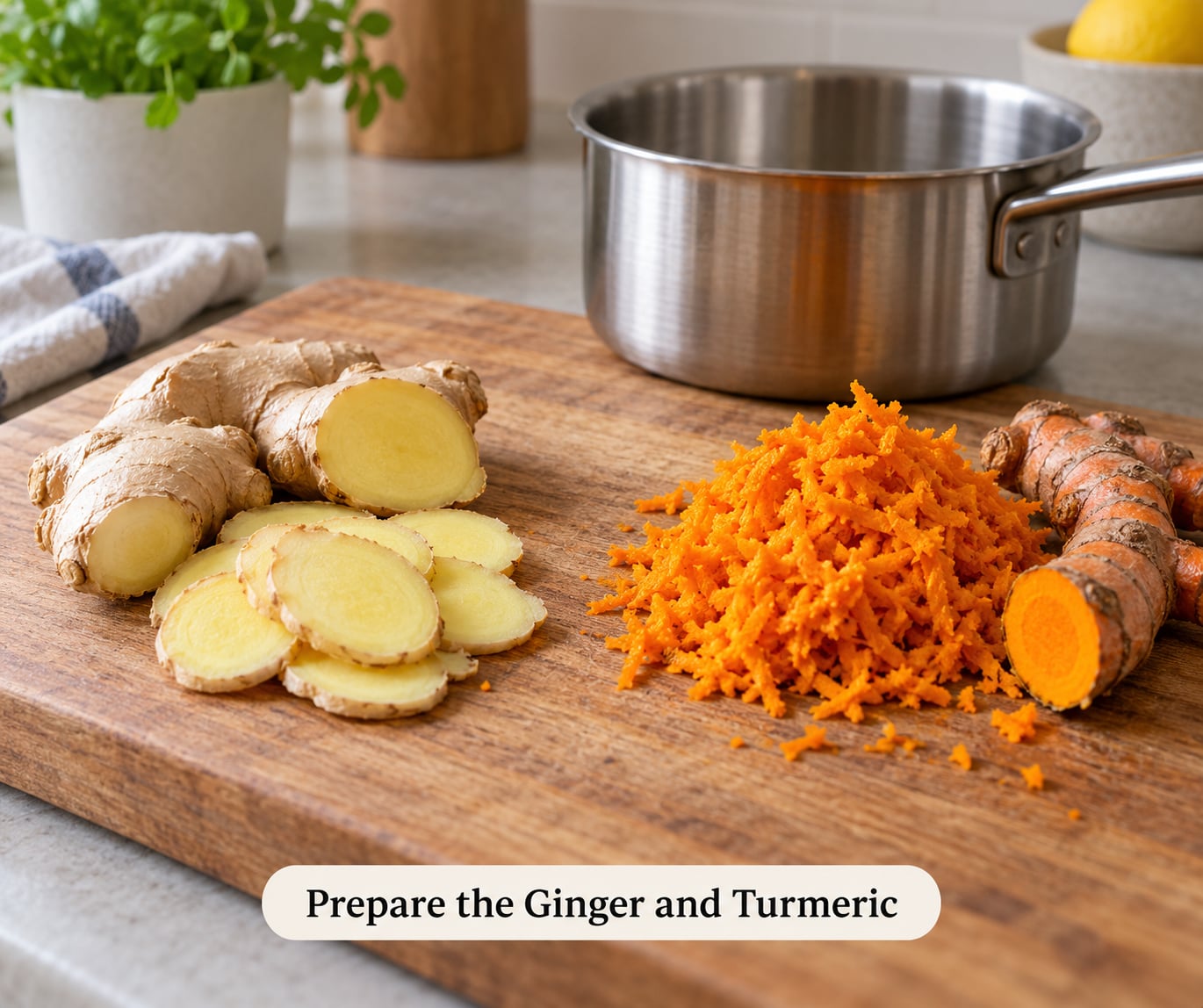
Rinse both roots under cold water, then peel the ginger with a spoon or knife and scrape the skin off the turmeric. Slice both into thin coins or grate them coarsely. Thin slices matter more than the knife you use.
When fresh rhizomes are not available, ground turmeric and ground ginger work. Use half the volume you would have used fresh, and add the powder to the cold water so it does not clump on the bottom. Grated fresh root sits somewhere between the two: more aromatic than powder, and easier to strain out.
How to tell the prep worked: the slices should be thin enough to see light through the ginger. Turmeric stains everything it touches, so wear gloves, use a cutting board you do not mind sacrificing, and wash tools right away.
2. Warm the Water and Spices
Put the water in the saucepan first, then the ginger and turmeric, then the peppercorns and cinnamon if you are using them. Water first prevents the powder from sticking to the base of the pan.
Bring it up to a boil over medium-high heat, then turn the heat down and put the lid on. It is ready for the next stage once the surface is just barely moving.
3. Simmer Until Fragrant
Hold it at a bare simmer for 10 to 15 minutes. You will know it is ready when the liquid turns a deep golden-orange and the kitchen smells warmly of ginger and pepper, not when the pot is rolling.
There is a second method that works just as well: bring the water to a boil, boil for 2 minutes, then take it off the heat, cover it, and let it steep for at least 15 minutes. The off-heat version keeps more of the volatile aromatics and tastes brighter. The simmer version pulls more flavour into the water and is easier to make stronger.
Either way, gentle infusion beats a vigorous boil. A hard boil extracts bitterness from the ginger skin and concentrates the turmeric until the cup is hard to drink.
4. Strain and Season
Strain the tea into your mug while it is still hot. Push a little on the solids with the back of a spoon to get the last of the liquid out.
Let it sit for a minute or two before adding anything sweet. Honey goes into liquid that is still close to boiling and loses some of its character, and honey is not for children under one year old. Then add lemon juice, honey, and a crack of black pepper to taste.
5. Serve and Adjust
Drink it warm, not scalding, around 60 to 70 degrees C. From there, four adjustments cover almost every preference.
- Milder: top the cup with more hot water, or cut the ginger in half for the next pot
- Stronger: reduce to 1 cup of water, or steep 5 minutes longer
- Sweeter: a second spoonful of honey, or warm milk in place of some of the water for a golden milk style drink
- More citrus-forward: a full teaspoon of lemon, plus a thin slice of lemon floated on top
Common Mistakes
- Boiling the spices hard for 20 minutes. The drink turns bitter and the ginger skin leaches. Fix: lid on, heat low, simmer only.
- Too concentrated. Home brewers often use 8 g of each root in about 7 oz of water. That is a strong double dose, and reflux or stomach upset is a common result. Fix: start lighter and dilute.
- Thick ginger coins. Long steeping plus thick slices gives an unpleasant raw ginger bite. Fix: slice thinner and pull the solids out on time.
- Honey into near-boiling liquid. Fix: wait a minute or two.
- Forgetting to strain. The sediment keeps extracting in the mug and the last sip is gritty. Fix: strain into the mug rather than spooning the liquid out.
- Stacking too many optional spices. Cinnamon, cayenne, cardamom, fennel and lemon in one cup tastes like a masala blend nobody asked for. Fix: build up one addition at a time.
Frequently Asked Questions
Can I use ground turmeric instead of fresh turmeric?
Yes, and most people do. Ground turmeric works well in tea because the compounds dissolve in hot water, though you get less of the aroma fresh root gives off. Use about 1/2 teaspoon of ground for a 1-inch piece of fresh root. Whisk the powder into the cold water before heating so it does not settle into a paste at the bottom of the pan, and keep the lid on while it simmers.
How strong should ginger and turmeric tea taste?
Strong enough that you clearly taste ginger, but still able to finish the cup. For a single serving, 1 inch of each root in 2 cups of water is a good start. Concentrate too much and the drink gets earthy and hot enough to upset a stomach. If your first cup is too strong, dilute it with hot water before you reduce the recipe next time, since it is far easier to add water than to extract it back.
Can I add honey or lemon to ginger and turmeric tea?
Both work, and most people add at least one. Lemon juice sharpens the cup and lifts the ginger, and honey rounds out the bitterness of the turmeric. Add both after the tea has poured and cooled for a minute or two, since very hot liquid changes the flavour of honey and scalded honey is unpleasantly sweet. Honey should not be given to infants under one year old.
How long should I steep ginger and turmeric?
Ten to 15 minutes at a bare simmer is the usual window, and the colour of the liquid tells you where you are: a deep golden-orange means the turmeric has come through. If you prefer a brighter cup, boil the water, boil the roots for 2 minutes, then take the pot off the heat and steep it covered for about 15 minutes. Steeping much beyond 25 minutes mostly buys bitterness.
Is ginger and turmeric tea safe to drink every day?
Many people drink it daily as a beverage rather than as a treatment, and the culinary amounts in a home recipe are modest. Still, daily use is a question worth raising with a doctor or pharmacist if you take any medication. Ginger and turmeric can both interact with blood thinners and with blood pressure or diabetes medicines, and turmeric is not a good choice for anyone with gallbladder or bile duct disease. Stop drinking it and get medical advice if you notice warning symptoms.
Can I make ginger and turmeric tea ahead of time?
Yes, and a big batch is the version most home brewers actually use. Simmer a triple recipe, strain it, and refrigerate the liquid in a glass jar for up to three or four days. Dilute a quarter cup of concentrate with about 6 oz of hot water to serve. For a faster version, chop the raw roots in a food processor, cover them with cold water in the fridge overnight, and strain in the morning. Warm gently rather than microwaving, and re-boil only once.
Start with one cup of water, one inch of ginger, one inch of turmeric, and two cracked peppercorns. Simmer it for 12 minutes, strain it, and taste before you add anything sweet. Adjust from there, and keep the amounts in this how to make ginger and turmeric tea guide as your baseline rather than someone else’s strong version.
Two things to keep in mind as you get comfortable with it. Build flavour in one addition at a time, and give the roots a real simmer rather than a boil, because that single change fixes most of the complaints people have with the drink. If you take medication or have a health condition, check with a doctor or pharmacist before making it a daily habit.