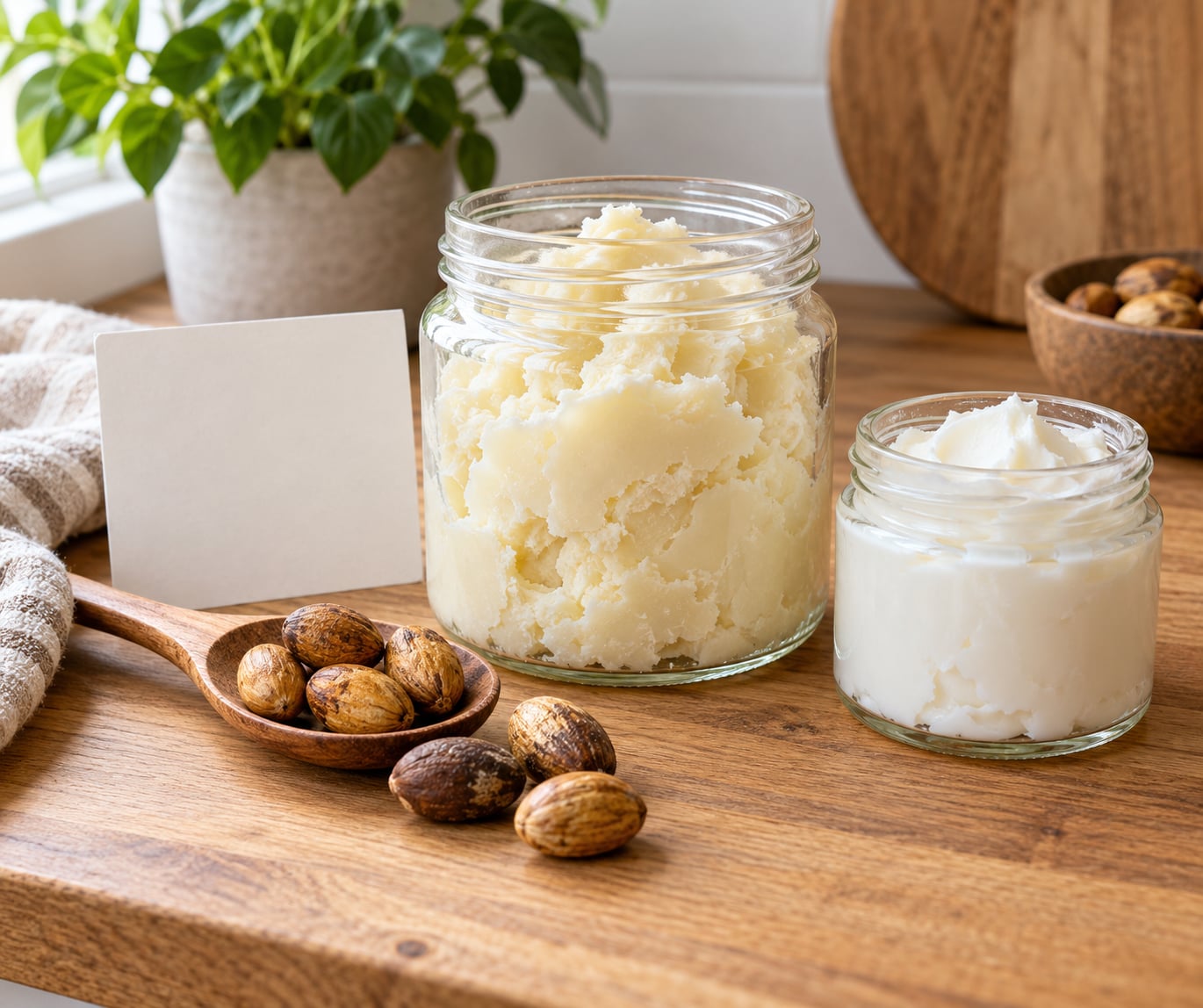
Real unrefined shea butter melts into a light oil the moment it touches warm skin, smells mildly nutty or smoky, and ranges from ivory to pale yellow. Fake shea butter feels waxy, smells of perfume or chemicals, or lists petroleum jelly or mineral oil first on the label.
There is one honest caveat before we start. Learning how to tell real shea butter from fake with kitchen tools gives you strong clues, not proof. None of the checks below can confirm geographic origin, and some will not catch a clever blend, so treat a pass on every check as permission to use the butter, never as a certificate.
The shea tree, Vitellaria paradoxa, grows across West Africa, and its kernels hold one of the most distinctive plant butters in skin care. That rarity is exactly why imitation is common.
Table of Contents
- 1What You Need
- 2Step-by-Step: How to Tell Real Shea Butter from Fake
- 3How to tell real shea butter from fake by checking the label
- 4Inspect the color and texture
- 5Compare smell and skin feel
- 6Run a small melt and transfer test
- 7Check sourcing and supporting evidence
- 8Common Mistakes
- 9Frequently Asked Questions
- 10What color is real shea butter?
- 11Does real shea butter smell like peanuts?
- 12How can I tell if shea butter is refined or unrefined?
- 13Does pure shea butter melt like coconut oil?
- 14What should the ingredient list say on pure shea butter?
- 15Can a home test prove that shea butter is authentic or unadulterated?
- 16Conclusion
What You Need
Everything below costs about the price of a cup of coffee and takes maybe ten minutes per jar.
- A small glass dish or a white plate for each sample you are comparing.
- Two identical teaspoons, so you can compare like amounts.
- A plain white cotton cloth or paper towel for the transfer test.
- A warm spot: a sunny window sill, a radiator that is not hot to the touch, or a mug of warm water to stand the spoons in.
- A magnifier or your phone camera to read small print and look at surface texture.
- The full jar, not a spooned-out sample. Batch numbers and ingredient lists live on the container.
What you cannot get at home is an identity reading. Saponification value, refractive index, iodine value and unsaponifiable matter come from a laboratory, and they are the only numbers that separate genuine shea from a blend. Keep that in mind as you read on, and you will not over-trust a scent or a colour.
Step-by-Step: How to Tell Real Shea Butter from Fake
Run the checks in this order, cheapest and most revealing first. The label settles more cases than any sensory test, and it takes five seconds.
Quick checks at a glance:
- Scent — mild, nutty or lightly smoky, never perfumed, sour or nail-polish sharp.
- Colour — ivory, cream or pale yellow; batch-to-batch variation is normal, dead-uniform white is a question.
- Texture and melt — soft at room temperature, spreading into a light oil, not a hard waxy brick.
- Ingredients — Butyrospermum parkii as the first and ideally only ingredient.
- Skin feel — absorbs and leaves a slight sheen, no greasy film that lingers.
- Paperwork — botanical name, country of origin and a batch number you can trace.
How to tell real shea butter from fake by checking the label
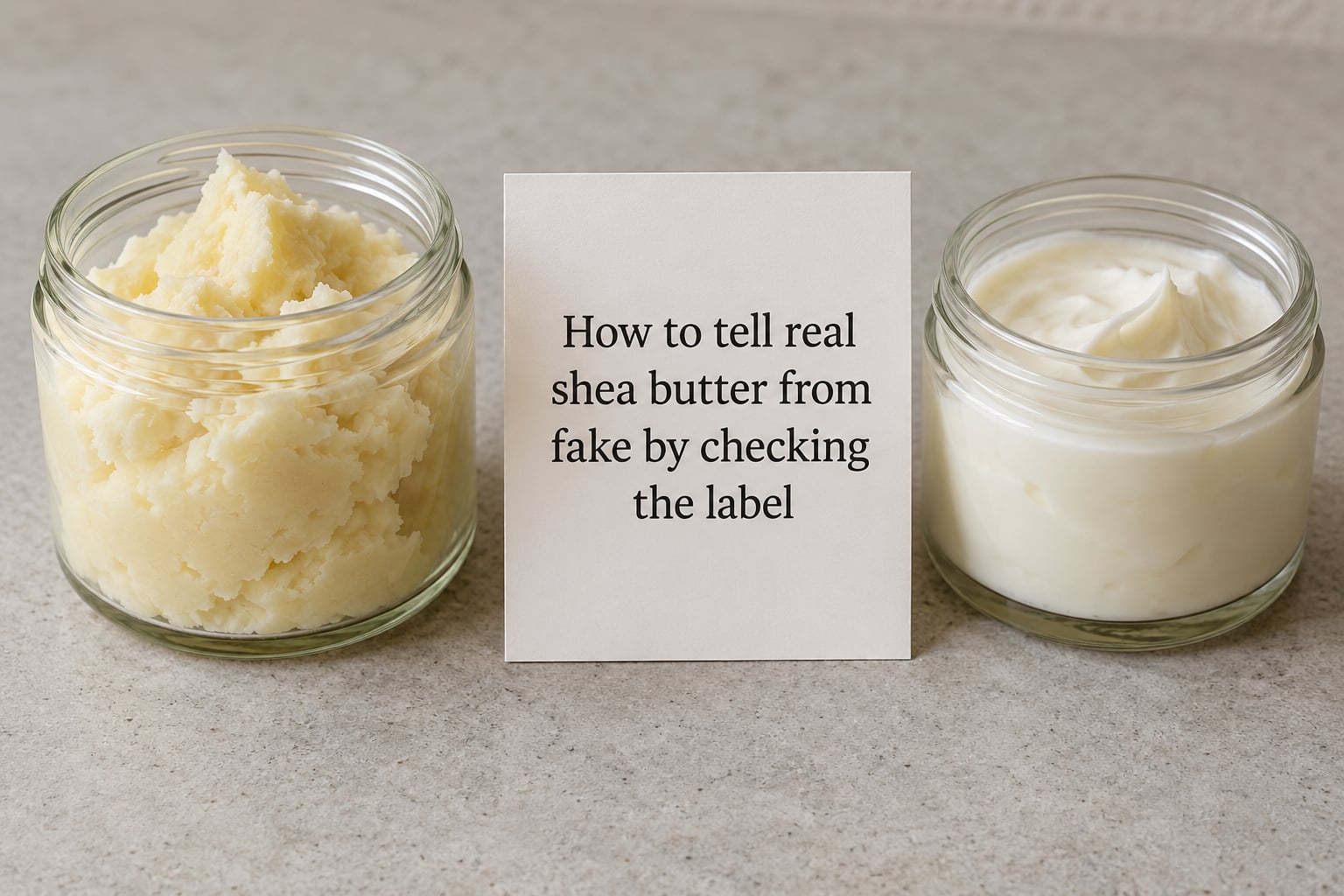
Turn the jar over before anything else. On a European cosmetic label the INCI name for shea butter is Butyrospermum parkii, the older name for the same species. Some honest labels also print Vitellaria paradoxa, which is the botanical name of the tree the fat comes from.
Ingredients are listed in descending order by weight, so the first ingredient is most of what is in the jar. If Butyrospermum parkii is first and something petrochemical is further down, you know exactly what you are buying.
| Credible signals | Warning signs |
|---|---|
| Butyrospermum parkii listed first, and often alone | Petrolatum, mineral oil or paraffin listed first |
| Unrefined, raw, Grade A or N-RBD stated plainly | Vague front-of-pack language with no grade named |
| Country of origin and a batch or lot number | No origin, no batch number, no contact details |
| A weight in grams and an ingredient list that matches the claim | Front label says pure shea butter while the back lists a blend |
Watch for the words that appear on a front label but not on the ingredient list. Words like pure, natural, 100 percent, fair trade and cold pressed cost a marketing team nothing and prove very little on their own.
One more label trick. A blend still has to declare every ingredient, so a jar claiming to be pure shea butter that lists mineral oil has told you what is in it. That contradiction is the end of the discussion.
Inspect the color and texture
Unrefined shea butter from freshly pressed kernels is ivory to pale yellow, sometimes with visible nut-like specks left from the milling. Refined shea is bleached and deodorised, so it is much whiter and almost odourless. Colour alone tells you about processing, not about honesty.
This is where most online argument happens, and it is mostly noise. Forum threads repeat the claim that white means fake and yellow means real, and just as often insist that off-white is the best of all three. All three positions are describing different processing stages badly.
Refined, bleached, deodorised shea butter is legitimately white. It is still shea butter. The genuine problem is not whiteness, it is a jar labelled unrefined or raw that arrives uniform, bright white and scentless, because that lot has been refined and then sold under the grade with the higher value.
Texture is more telling. Genuine shea is soft at room temperature, dense rather than greasy, and slightly grainy in unrefined form. A hard waxy brick, a greasy drag, or an almost liquid oil that never firms up in a cool room all point away from shea.
One myth to retire while we are here: graininess is not evidence of faking. Shea butter is polymorphic, meaning its crystal structure changes when it is heated and cooled again. Butter that has melted and been recombined goes grainy, and unrefined shea with its natural fat crystals often does too.
Compare smell and skin feel
Genuine unrefined shea has a mild, nutty, faintly earthy or smoky aroma. It is present but soft, and it never fills a room. Refined shea has very little scent at all, which is expected rather than suspicious.
The smells that do matter are the wrong ones. A sour, sharp, burnt or nail-polish-like scent means rancidity, from oxidation of the unsaturated fatty acids. Perfume, fragrance or a synthetic chemical note means the batch was deodorised with added fragrance or cut with petrochemical filler.
Do your nose a favour and test the aroma warm, not cold. Rub a dab between your fingers and smell your hand, then smell it again a minute later, which is closer to how it behaves on skin at body temperature.
Skin feel gives supporting evidence. Real shea melts first and then absorbs, leaving a slight sheen that settles over a minute or two. Mineral oil and petroleum jelly behave differently: they stay put, they slide, and the skin stays slick far longer than it should. If a butter is going on a face for the first time, patch test a small area and wait a day.
Run a small melt and transfer test
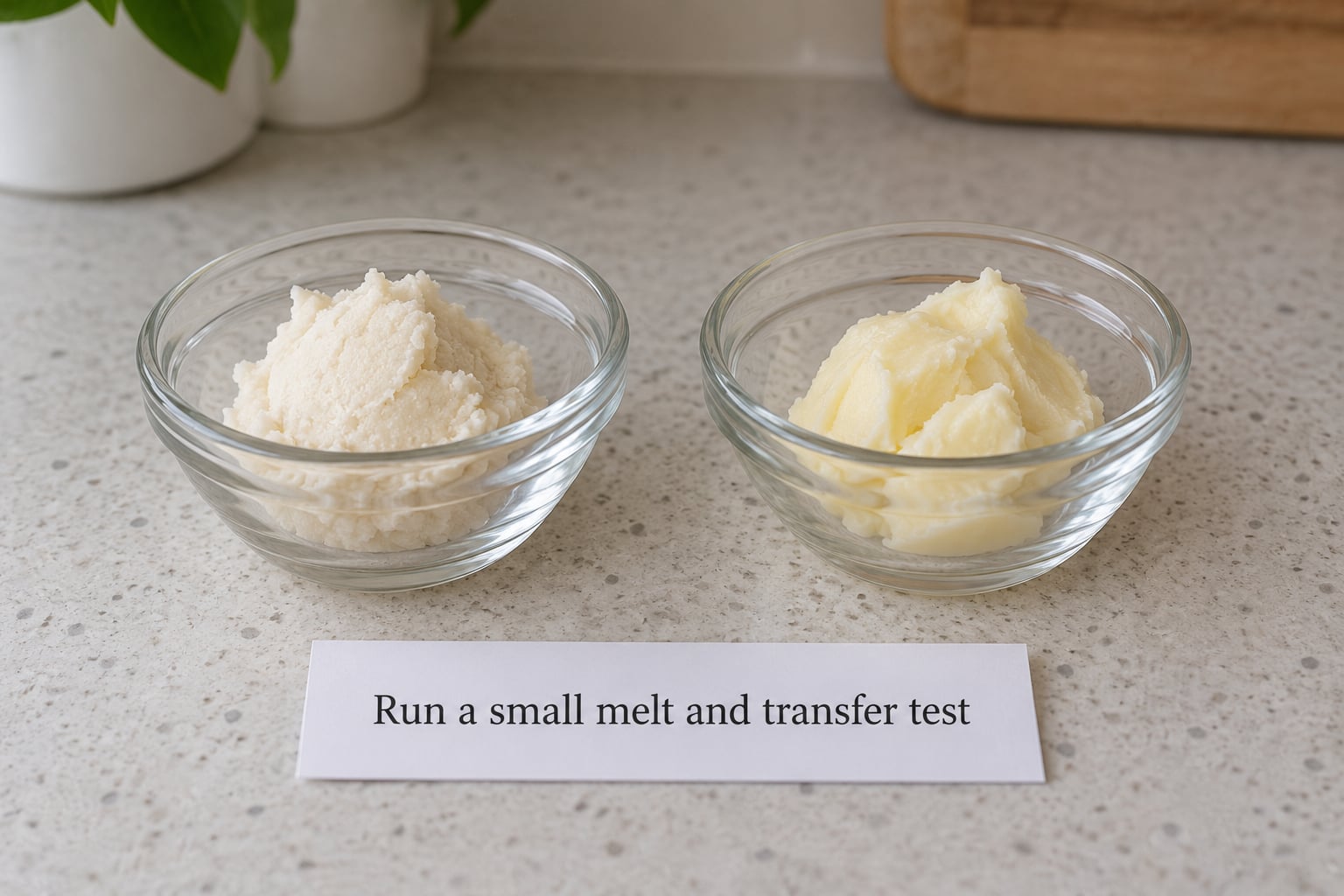
Put an equal teaspoon of each sample on two separate spoons, rest them in a mug of warm water, and wait three minutes. Note what happens rather than trying to time a melting point.
Real shea softens from the outside in, then collapses into a clear light oil that runs off the spoon and spreads readily. It softens across a temperature range rather than snapping from solid to liquid, which is a sign of a mixed fat blend with a sharper transition.
For the transfer test, smear an equal dab of each sample onto plain white cloth. Genuine shea leaves a soft, even, slightly translucent film that has soaked into the weave. Mineral oil or paraffin leaves a greasy ring that sits on the surface, and a blend with palm stearin often leaves a waxy, stiff mark that resists rubbing.
This test is genuinely useful for separating shea from petroleum products and for noticing differences between batches. It cannot prove purity, and it will not tell you whether the fat came from a cooperative in northern Ghana.
Check sourcing and supporting evidence
Sourcing is where a knowledgeable buyer gains the most. Genuine West African shea usually names a country of origin, and increasingly names the cooperative or the collection area, with names like Tamale in northern Ghana or the Kano region of Nigeria appearing on export documentation.
Ethnobotanically, this matters. Harvesting is seasonal and largely women-led, with kernels cracked, roasted, milled and pressed, traditionally in village kilns rather than industrial plants. A label that credits a producer group is describing a supply chain that exists. A label that only says natural shea butter made in a European cosmetics plant is not claiming where any of it came from.
For anything bought in bulk, ask for a certificate of analysis tied to the specific batch rather than a generic company brochure. A useful one shows saponification value, refractive index, iodine value and unsaponifiable matter sitting inside the identity band for shea butter, alongside free fatty acid and peroxide values that show how fresh the lot is.
If a seller cannot produce a batch-specific certificate, ask them to explain what fraction of the product is shea and what the rest is. Straight answers are rare, and the evasion is itself a result.
Good specialist retailers and co-operatives selling unrefined butter directly tend to publish their process and their provenance openly. That is a better signal than any front-label adjective, and it costs you nothing to check before you buy.
Common Mistakes
Treating colour as proof. Bright white butter can be honestly refined shea. What matters is whether the colour matches the grade claimed, and whether the batch varies naturally or looks machine-uniform.
Deciding on scent alone. A refined product is nearly odourless and that is not a defect. Equally, absence of a nutty smell tells you little about what is in the jar.
Expecting every shea butter to smell strongly nutty. Expectation varies widely between regions and between refined and unrefined grades. A mild aroma in a Grade A lot is normal; a perfume note never is.
Reading a melt test as laboratory authentication. Melting behaviour separates shea from waxes and petroleum fats well enough to catch bad product. It does not verify a certificate, a species, or a country of origin.
Treating fair trade or natural claims as purity proof. Fair trade concerns how people were paid and treated. Natural is a marketing category with no fixed definition. Neither addresses what proportion of the jar is shea.
Confusing rancidity with fakeness. Genuine shea goes off, especially raw shea in a warm jar. Smell it, and if the aroma turns sour, sharp or burnt after storage rather than at purchase, you are looking at oxidation, not a substitution. The reverse mistake happens too, and a blended jar gets blamed as spoiled.
Ignoring graininess. Heat cycling changes the crystal structure. Grainy is not the same as fake, and throwing away perfectly good butter over texture alone is a common and expensive habit.
A few practical habits close the loop. Buy a small jar from a supplier you could name if asked, and ask for the origin before you buy rather than after. Compare two or three samples side by side in the same dish, which is the fastest way to train your own eye. Store unrefined shea somewhere cool and dark, and buy amounts you will use within a year, since raw butter does not keep indefinitely. And if a jar fails on the ingredient list, stop there and do not try to rescue it with further testing.
Frequently Asked Questions
What color is real shea butter?
Unrefined shea butter runs from ivory through cream to pale yellow, and it varies between batches and between harvest years. Refined shea butter is much whiter because it has been bleached, so white does not mean fake. The thing to watch for is a jar claiming to be unrefined that arrives bright white and completely uniform.
Does real shea butter smell like peanuts?
Pure shea butter has a mild nutty, earthy or faintly smoky scent. It reads as nutty to some people and as closer to roasted or earthy to others, which is a cultural difference in expectation rather than a difference in the butter. A strong perfume note, a sour tang or a sharp nail-polish smell are the actual warning signs.
How can I tell if shea butter is refined or unrefined?
Colour and aroma do most of the work. Unrefined butter is ivory to pale yellow with a mild nutty smell and may show natural specks from the milling. Refined butter is bleached and deodorised, so it is whiter and nearly odourless with a smoother, more uniform texture. Check whether the label states unrefined, raw or N-RBD explicitly.
Does pure shea butter melt like coconut oil?
Not quite. Both melt at skin temperature, but shea softens gradually across a temperature range and then collapses into a light oil, while coconut oil gives a sharper, more decisive melt. That difference is useful for spotting blended butters, which often show a sudden transition from solid to liquid rather than a slow soften.
What should the ingredient list say on pure shea butter?
It should say Butyrospermum parkii, sometimes alongside the botanical name Vitellaria paradoxa, and that name should sit at the top of the list because ingredients are ordered by weight. Many genuinely pure butters list that one ingredient only. If mineral oil, petrolatum or paraffin appears anywhere on the list, it is a blend.
Can a home test prove that shea butter is authentic or unadulterated?
No. Home checks narrow things down. A label, a smell, a colour, a melt and a cloth transfer together can tell you that a jar is probably fine to use and can catch the common adulterants such as mineral oil, paraffin, palm stearin and waxes. Only a laboratory can confirm identity through saponification value, refractive index, iodine value and unsaponifiable matter.
Conclusion
Start where a technician would start: with the ingredient list and the grade the jar actually claims. If Butyrospermum parkii is first and nothing petrochemical follows, you have answered most of the question about how to tell real shea butter from fake before you ever touch the product.
From there, read the rest as supporting evidence rather than proof. Colour, aroma, texture and melt behaviour tell you whether the jar behaves like the grade it claims, and sourcing tells you whether anyone is willing to say where it came from. Weigh all of it together, and when something still bothers you, escalate to a batch-specific certificate rather than to a louder smell test.