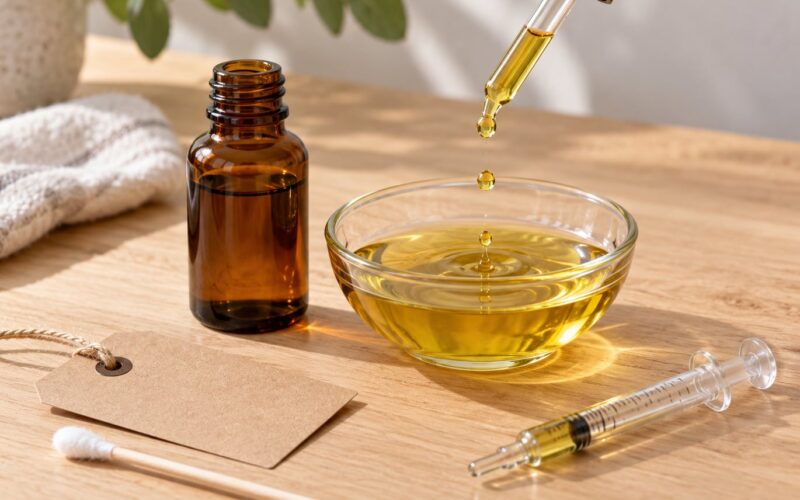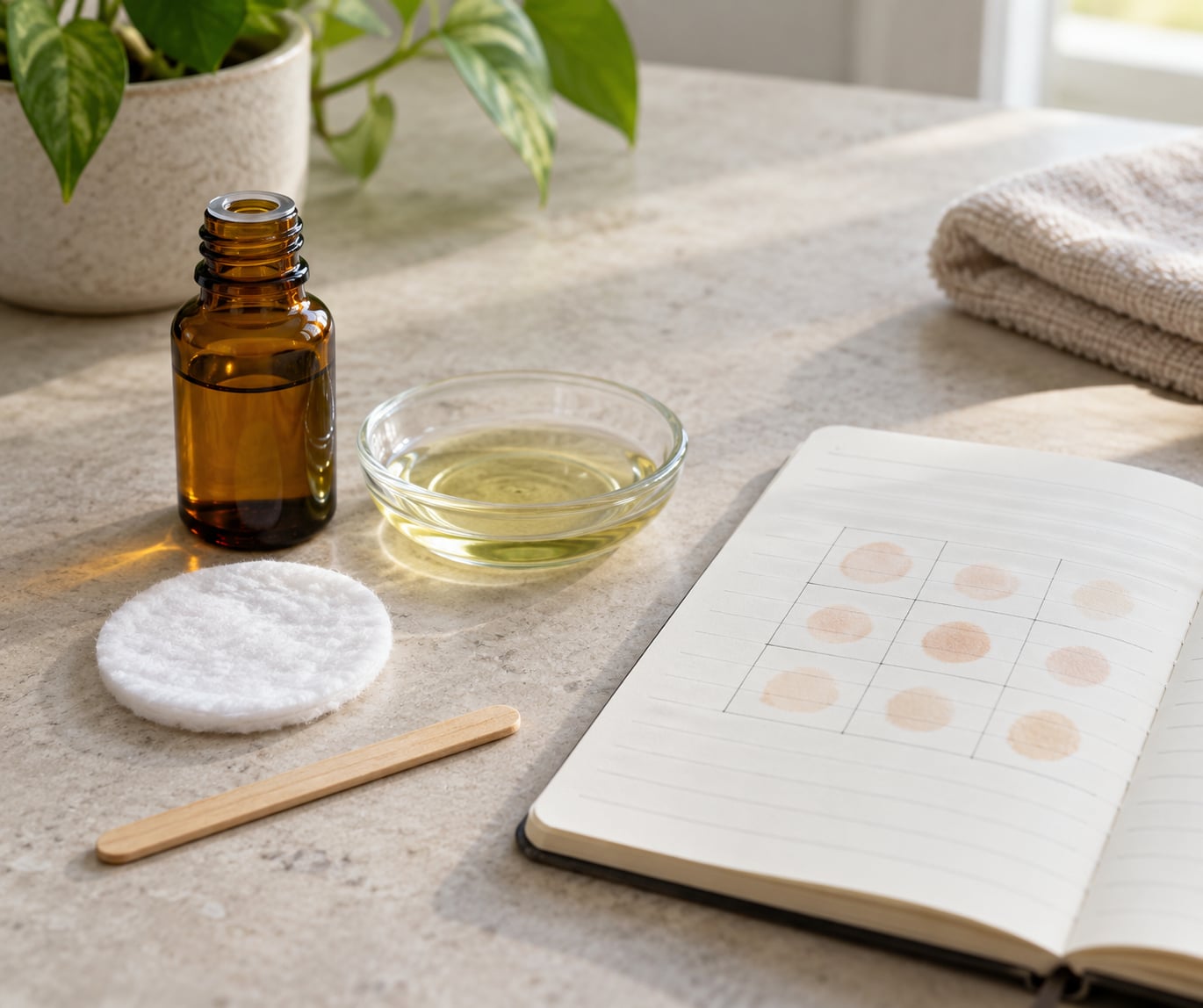
To patch test a new botanical oil, put a small amount of it on a coin-sized area of intact skin, usually the inner forearm, and watch that spot for four days. The whole job takes about five minutes of setup and a few seconds of attention at 24, 48 and 96 hours.
“Natural” is not the same as gentle, and that gap is where most surprises happen. Plant-derived molecules such as linalool and limonene are among the most frequently detected contact allergens in dermatology clinics, and an oil that has been sitting warm on a shelf for a year can be a different chemical proposition than the one you bought last month.
A patch test is a screening step, not a guarantee, and it is not the same thing as the clinical patch test a dermatologist performs. This guide covers what a home test can and cannot tell you, where to place it, how far to dilute, and the point where you should stop testing and ask a professional.
All of this is general information about skin care, not medical advice. If you already have an active rash, eczema flare, or a diagnosed skin condition, talk to a doctor or dermatologist before testing anything new.
Table of Contents
- 1What You Need
- 2Know which kind of oil you actually have
- 3A dilution guide you can eyeball
- 4Reading for the two details that change everything
- 5How to Patch Test a New Botanical Oil: Step-by-Step
- 6Prepare the Test Area and Product
- 7Where to Patch Test a New Botanical Oil on Your Body
- 8Apply a Small Amount
- 9Watch for Irritation
- 10Decide Whether to Continue
- 11Common Mistakes
- 12Frequently Asked Questions
- 13How long should I patch test a new botanical oil?
- 14Where should I patch test a botanical oil?
- 15Should I dilute a botanical oil before patch testing?
- 16What does an allergic reaction to botanical oil look like?
- 17Can I patch test myself at home?
- 18Why does my skin react to an oil I have used for years?
- 19Start With a Small Test
What You Need
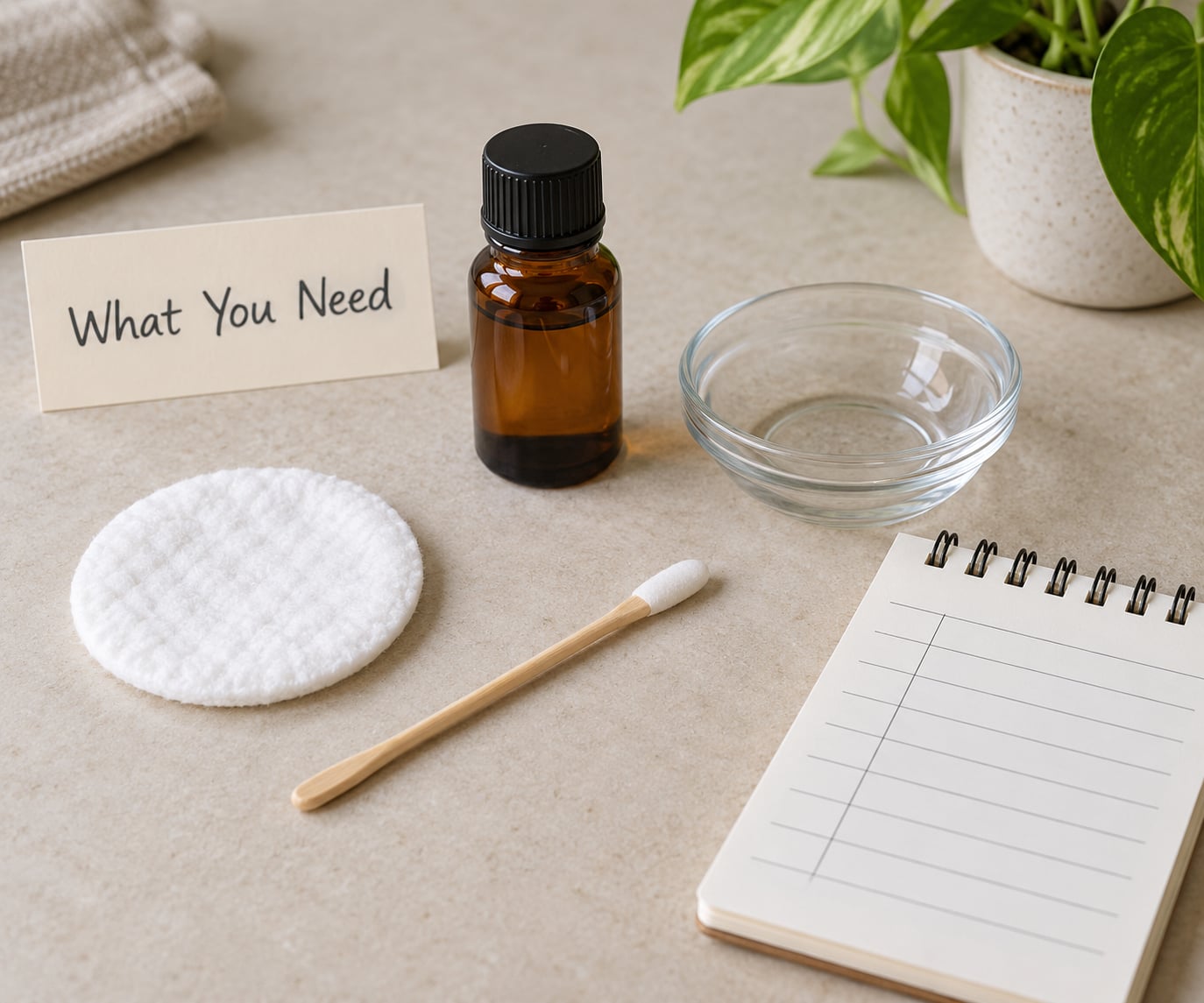
You need fewer things than most guides imply. An undiluted botanical oil, a clean cotton pad or a fingertip, a timer or a note in your phone, and a small mirror are enough. If you are testing a concentrated essential oil rather than a ready-to-use oil, you also need a carrier oil and a small measuring spoon.
Know which kind of oil you actually have
The single most useful thing to establish before you start is whether you hold a carrier oil, an essential oil, or a formulated product, because each carries a different expectation.
A carrier oil such as jojoba, sunflower, coconut or olive is pressed or extracted from the plant itself and used at full strength. These are the oils most people mean when they say a “botanical oil” for skin. An essential oil is the volatile, concentrated aromatic fraction, usually steam-distilled, and it is not meant to go on skin undiluted. A formulated product is one that already arrives blended, such as a body oil or a facial oil with a diluted essential oil in it.
Read the label for the Latin plant name, the part of the plant used, and any dilution instruction. If the bottle says pure, neat, essential, or undiluted, treat it as concentrated. If it says blend, formulated, or body oil, follow the directions as written.
A dilution guide you can eyeball
For a home test, low dilutions are the sensible default. Use a plain carrier oil that you already tolerate, and count drops rather than trying to be precise to the millilitre.
| Dilution | How to mix it | When to use it |
|---|---|---|
| 1% | 1 drop essential oil to about 5 mL carrier oil (roughly one teaspoon) | The gentle starting point for facial oils, and the right level for a second test after a first one irritated |
| 2% | 2 drops to about 5 mL carrier oil | Body oils, and repeat open application testing over several days |
| 5% | 5 drops to about 5 mL carrier oil | Closer to what clinical patch testing uses, and what some manufacturers recommend for specific oils |
Some oils should not be put on skin at all in a home test. Cinnamon bark and leaf oil, wintergreen, camphor-rich oils, and camphor or menthol-rich preparations are traditionally used in ways that do not include broad skin application, and undiluted expressed oils of citrus and cinnamon are a common cause of both burning and trouble-sensitising. If the supplier gives no dilution guidance and the oil is a known sensitiser, ask a pharmacist or a qualified aromatherapist before it touches your skin.
Reading for the two details that change everything
Look at how the oil was stored and how old it is. Essential oils autoxidise, and the oxidation products of linalool and limonene are more reactive to skin than the fresh molecules. Warm storage, a partly full bottle, and a dark or cloudy colour are all reasons to buy a new one rather than test the old one.
The second detail is the plant family. Members of the daisy family, or Compositae, share a class of molecules called sesquiterpene lactones and cross-react readily. That group includes chamomile, calendula, arnica, yarrow and echinacea, and if you have reacted to one of those as a child, testing a “different” daisy-family oil is not a fresh start.
How to Patch Test a New Botanical Oil: Step-by-Step
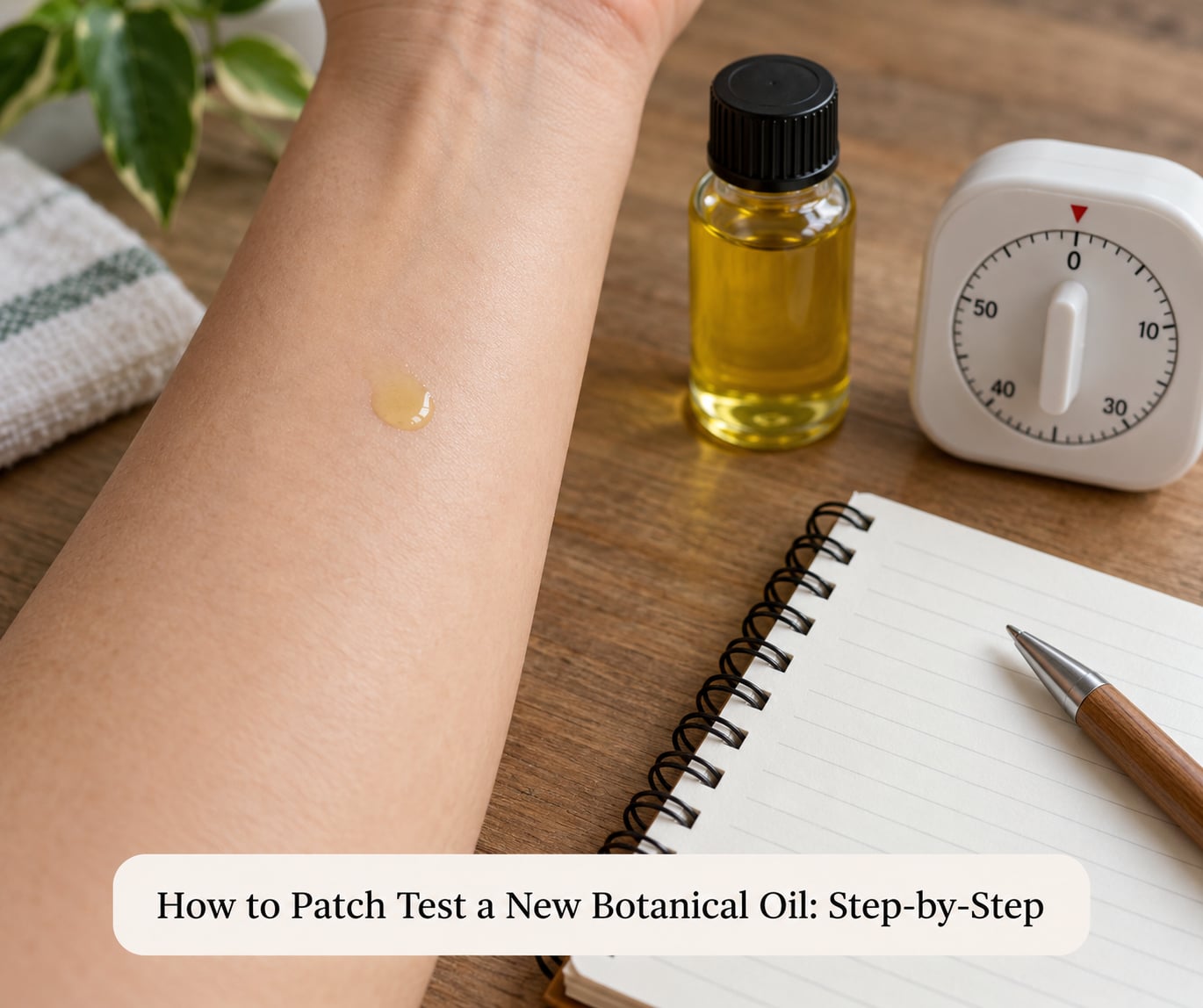
Here is the whole procedure in five steps. Check the label, dilute a concentrated oil, apply a small amount to a discreet area of intact skin, leave it uncovered, and read the site at 24, 48 and 96 hours before you use the oil anywhere else.
- Read the label and decide whether the product is ready to use or needs dilution.
- Choose a small area of unbroken skin and note the date and time of your first application.
- Apply a small amount, no more than two to four drops or a pea-sized smear.
- Leave it uncovered and undisturbed, and check the area at 24, 48 and 96 hours.
- Wash off and stop using the product if redness, itching, burning or swelling appears at any point.
Prepare the Test Area and Product
Pick a spot about 3 to 5 cm across on skin that is healthy and quiet. Inner forearm, the crease at the elbow, or the area behind the ear all work. Wash it with plain water and mild soap, pat it dry, and wait a few minutes so that water and heat do not add their own irritation.
Stay away from anything already compromised: cuts, scrapes, recent shaving, a tattoo that is still healing, an existing rash, or skin currently flaring. Testing on damaged skin gives you a result you cannot interpret, because the damage itself will look like a reaction.
Prepare the product next. Follow the manufacturer’s directions first, and dilute any concentrated essential oil in a carrier oil at the level above. Shake or stir it properly. A badly mixed sample can give you a false clean result on day one and a real burn on day three.
Where to Patch Test a New Botanical Oil on Your Body
Match the site to the intended use. If the oil is for your face, test behind the ear or along the jawline, where the skin is comparable and the spot is easy to hide. If it is for the body or scalp, the inner forearm is the sensible choice, and the elbow crease is even more reactive if you want an early signal.
Two places look tempting and are poor choices. The inner wrist is thin and often gets used for other products, and the palm of the hand is not representative because it is a different skin environment entirely. Test one product at a time, on a separate site from anything else new, or you will not know which one caused what.
Apply a Small Amount
Dab the diluted oil on with a cotton pad or a fingertip. Two to four drops, or about the size of a grain of rice, is plenty for a coin-sized area. More product does not produce a better result; it only raises the dose and makes irritation more likely to confuse your read.
Do not rub, scrub, massage or cover the area with a bandage or a watch strap. Occlusion holds the oil against the skin and increases exposure, which is useful in a clinical setting under supervision and not what you want at home. Let it dry and leave it alone.
Watch for Irritation
Set your first read for 24 hours. The two reactions you are trying to tell apart behave differently, and that difference is the reason you read more than once.
| Irritant contact dermatitis | Allergic contact dermatitis | |
|---|---|---|
| Onset | Minutes to a few hours | Usually 1 to 4 days after exposure |
| Mechanism | Direct damage to the skin barrier, no immune memory needed | Delayed Type IV hypersensitivity; the immune system had to sensitise first |
| Dose | Worse with a bigger amount, longer contact or broken skin | Can be triggered by a small amount once sensitised |
| Memory | Happens every time, with no build-up | Cumulative; can flare after months of trouble-free use |
| What it means for your test | Often means the oil or the dilution was too strong for that skin | Means you should stop using that plant oil and raise it with a doctor |
Symptoms to look for at each read: redness, itching, a burning or stinging feeling, warmth, swelling, small blisters, a dry scaly patch, or a rash spreading beyond the test spot. Burning that fades within a minute and comes back with each fresh application usually points to irritation. Itching and a persistent, spreading rash that peaks a couple of days later fits an allergic pattern more closely.
Photographs help. Take one at each read in the same light and same position, because “slightly pink” is hard to judge from memory and easy to argue away.
The moment you see redness, itching, burning or swelling, stop. Wash the area with mild soap and water, pat dry, and cool the skin with a cool damp compress for 10 to 15 minutes. Do not apply another botanical or a home remedy on top of it.
Decide Whether to Continue
Keep a short log. It takes thirty seconds per entry and it settles arguments later, especially when you are deciding which of three products in your bathroom caused a reaction.
| Read | Date and time | Appearance | Sensation | Action |
|---|---|---|---|---|
| Day 0 | Your entry | Your entry | Your entry | Applied |
| 24 hours | Your entry | Your entry | Your entry | Continue or wash off |
| 48 hours | Your entry | Your entry | Your entry | Continue or wash off |
| 96 hours | Your entry | Your entry | Your entry | Result |
| Day 7 | Your entry | Your entry | Your entry | Final call |
A clean 96-hour read is a good sign, not a certificate. The longest window most people quote is about four days, because that covers the typical delay before sensitisation shows, and delayed reactions can still appear later. For anything you plan to use regularly, a repeat open application test is the more rigorous version: apply a small amount to the same forearm area twice a day for five to ten days and keep watching.
That matters most if the oil contains lavender, rosemary, tea tree, citrus, geranium or any daisy-family plant. Those carry compounds that oxidise over time, so a bottle that sat in a warm cupboard is a more plausible trigger than a fresh one, and a year of trouble-free use is not evidence that next year will be the same.
Get medical help rather than trying again if the rash spreads, swells, blisters, weeps, or involves your face, eyelids or hands, or if it has not settled within a few days of stopping. Trouble breathing or swelling of the lips or throat is an emergency. A formal clinical patch test, with allergen chambers applied to the back and read at 48 and 96 hours, is the right next step when a product you rely on causes repeated problems.
Common Mistakes
Testing too much product. A thick layer raises exposure and turns a mild signal into a burn. Two to four drops is enough.
Testing on broken or recently shaved skin. Micro-abrasions from shaving or waxing are a classic source of false positives, so skip that area for at least a day or two.
Applying an undiluted concentrated oil. This is the mistake that sends people to urgent care. Even a few drops of neat cinnamon, wintergreen or camphor-rich oil on the forearm can blister.
Starting several new products at once. Three new oils in one week gives you three suspects and no answer. Test one at a time, on separate sites, and give each its full window.
Treating a clean 24-hour read as permission. Irritation shows fast; allergy does not. Extend the observation to 96 hours, and longer if you intend to use the oil daily.
Skipping the test because you have used the plant before. Sensitisation is cumulative, and a bottle that has oxidised is not the same product as the one that first suited you.
Frequently Asked Questions
How long should I patch test a new botanical oil?
Follow the product label first. For a general at-home check, watch the site for at least 24 hours, but treat 48 and 96 hours as the real answers, because allergic contact dermatitis usually appears one to four days after exposure. A clear test at four days is reassuring, not a guarantee. For a daily product, keep observing for a week.
Where should I patch test a botanical oil?
Choose a small area of intact skin, such as the inside of the forearm or behind the ear, depending on where you plan to use the oil. For facial products, the jawline or behind the ear matches the skin better. Avoid cuts, rashes, recently shaved skin, fresh tattoos and irritated areas, and test one product at a time on a separate site.
Should I dilute a botanical oil before patch testing?
That depends on the product. A ready-to-use formulated oil may not need dilution, while a concentrated essential oil generally should not be applied neat unless a qualified professional or the manufacturer says it can be. For a home test, mix one drop of essential oil into about a teaspoon of carrier oil and work up only if that is well tolerated.
What does an allergic reaction to botanical oil look like?
Possible signs include redness, itching, burning, warmth, swelling, small blisters, a dry scaly patch, or a rash that spreads past the test spot. Wash the oil off with mild soap and water and stop using it. Seek urgent medical help for facial or eye swelling, blistering, weeping, or anything involving difficulty breathing.
Can I patch test myself at home?
Yes, a home test is a reasonable screening step for a product you intend to buy and use on yourself. It is not the same as clinical patch testing, where allergens are applied in chambers to the back under supervision and read at 48 and 96 hours. If a product causes repeated reactions, ask a dermatologist about formal testing rather than repeating the test at home.
Why does my skin react to an oil I have used for years?
Sensitisation is cumulative, and it does not start from the first application. Plant oils can also oxidise as they age, and the oxidation products of molecules such as linalool and limonene are more reactive to skin than the fresh form. Heat and light speed that up, so an old bottle can provoke a reaction that a fresh one does not.
For anyone working with plants that matter culturally, from shea and moringa to a pressed oil prepared at home, the same caution applies. You rarely know the concentration or how long the material has been sitting, and that makes a first small test more worthwhile, not less.
Start With a Small Test
Read the label and work out whether the oil is ready to use or concentrated. If it is concentrated, dilute it in a carrier oil you already tolerate, then put two to four drops on a coin-sized area of unbroken skin.
Leave it alone, look at it at 24, 48 and 96 hours, and keep one product under test at a time. Wash it off and speak to a doctor or dermatologist if redness, itching, burning or swelling appears, or if the rash spreads after you have stopped using it.