Water soluble vs fat soluble plant compounds behave differently inside the body because of one thing: whether the molecule is polar enough to dissolve in water or nonpolar enough to dissolve in oil. Polar plant compounds travel in the watery gut and the blood. Nonpolar ones need bile, fat and micelles, and they can collect in liver and fat tissue. That single distinction explains absorption, why a root gets decocted in water while a seed gets infused in oil, and why concentrated extracts carry real interaction risks. This is general education about plant chemistry, not medical advice.
Water soluble vs fat soluble plant compounds in one paragraph: water soluble plant compounds (hydrophilic) are polar molecules — think sugars, anthocyanins, vitamin C — that dissolve directly in the watery contents of the gut and move into the bloodstream, with excess usually leaving in urine. Fat soluble plant compounds (lipophilic) are nonpolar molecules — carotenoids, tocopherols, curcuminoids, essential oil terpenes — that need dietary fat, bile salts and micelles to be absorbed, then enter the lymph, get stored in adipose tissue and the liver, and can build up over time.
Most readers arrive here from a vitamin question. That is the wrong shelf. Vitamins are a tidy, small slice of the plant-compound world, and treating them as the whole picture is what makes the pages above them so thin. What matters if you are studying ethnobotany, preparing herbs, or simply trying to understand why a label says “take with food,” is the underlying chemistry.
Table of Contents
- 1water soluble vs fat soluble plant compounds at a Glance
- 2What Does Water Soluble Mean for Plant Compounds?
- 3What Does Fat Soluble Mean for Plant Compounds?
- 4How Does Solubility Affect Absorption and Body Use?
- 5How to Tell If a Plant Compound Is Water- or Fat-Soluble
- 6How Do Cooking and Preparation Change Plant Compounds?
- 7Which Types of Plant Compounds Are More Bioavailable?
- 8What Are the Differences in Traditional Herbal Preparation?
- 9Water Soluble vs Fat Soluble Plant Compounds: Safety and Stability
- 10Which Should You Choose?
- 11Sources and Further Reading
- 12Frequently Asked Questions
- 13Do you need fat to absorb plant compounds?
- 14Do flavonoids dissolve in water?
- 15Which antioxidants are water soluble?
- 16What are the main types of phytochemicals?
- 17Is curcumin water soluble or fat soluble?
- 18Does cooking destroy plant compounds?
- 19Conclusion
water soluble vs fat soluble plant compounds at a Glance
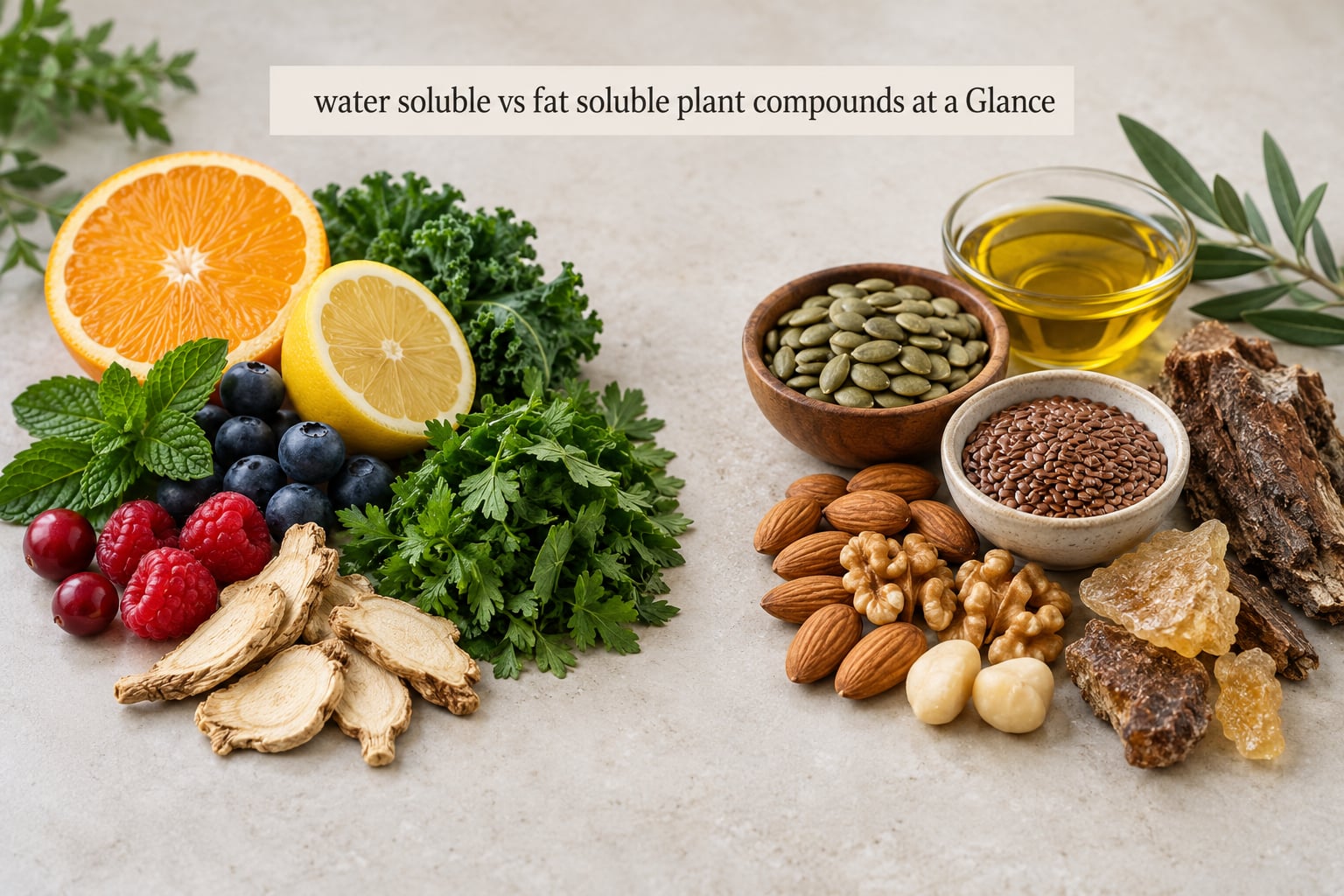
| Criterion | Water soluble plant compounds | Fat soluble plant compounds |
|---|---|---|
| Dissolves in | Water and watery liquids | Oil, fat and organic solvents |
| Chemical character | Polar: hydroxyl, amine, carboxyl groups, sugar chains | Nonpolar: long carbon skeletons, few charged groups |
| Typical examples | Anthocyanins, glucosinolates, phenolic acids, tannins, ascorbate, betalains, alkaloid salts | Carotenoids, tocopherols, phytosterols, chlorophyll, curcuminoids, stilbenes, terpenes, squalene |
| Where they sit in the plant | Cell sap of leaves, fruit, roots, bark | Oil bodies, plastids, waxes, resins, seed endosperm |
| Absorption route | Direct across the gut lining into portal blood | Must be packaged into micelles first |
| Transport after absorption | Bound to blood proteins, carried in blood | Often packaged into lipoproteins or chylomicrons, entering lymph |
| Where the body keeps it | Little long-term storage; surplus leaves in urine | Adipose tissue, liver, skin, cell membranes |
| Excess handling | Generally less accumulation risk | Accumulation is possible with repeated high intake |
| Best matching solvent | Water, or alcohol-water for stronger pulls | Fat, oil or alcohol; steam for volatiles |
| Fragility | Often heat and oxidation sensitive, poor shelf life | Oxidation sensitive, light sensitive, more stable overall |
| Main risk at high intake | Gut upset, kidney load, drug displacement | Accumulation, liver load, fat-soluble vitamin excess |
Read that table once more if you only read one thing. The rows at the bottom — solvent and fragility — are where the practical consequences sit, and they are the two nobody in the search results above mentions.
What Does Water Soluble Mean for Plant Compounds?
Water soluble means the molecule carries enough polar or charged groups to bond with water molecules. Water is polar at the molecular level, so it dissolves polar things well. A plant compound covered in hydroxyl groups (–OH), amine groups, carboxyl groups (–COOH) or attached sugar chains behaves the same way salt dissolves in water: like dissolves like.
The water soluble side of plants is large and familiar:
- Sugars and sugar derivatives — glucose, fructose, sucrose, and the oligosaccharides such as raffinose found in beans and legumes.
- Ascorbate (vitamin C) — the most familiar water soluble compound in plants, present in citrus, berries, peppers and leaf vegetables.
- Anthocyanins — the red, blue and purple pigments in berries, cherries, red cabbage and red onion. They are also pH indicators, which is why red cabbage turns blue in alkaline water.
- Flavonoid glycosides — flavonols such as rutin and quercitrin, and citrus flavanones such as naringenin glycosides. The attached sugar is what makes them water soluble.
- Phenolic acids — caffeic acid and chlorogenic acid in coffee and many herbs.
- Glucosinolates — the sulfur-containing precursors in Brassicaceae such as cabbage, broccoli, mustard and wasabi.
- Tannins — hydrolysable and condensed tannins that bind proteins and give many astringent remedies their grip.
- Betalains — betacyanins in beetroot, and betalains in amaranth and Swiss chard. Most people have never had these explained to them.
- Alkaloid salts — many plant alkaloids are weak bases and, when protonated, dissolve readily in water.
- Mucilage — water-soluble polysaccharides that swell in liquid and give psyllium, flaxseed and mallow their slippery texture.
Two qualifications keep this honest. First, solubility is not a fixed property of a class name; it depends on molecular structure, and pH shifts the answer. Alkaloids that dissolve well in acidic water can behave very differently in neutral or alkaline liquid. Second, some of these compounds carry a sugar purely for transport inside the plant. Strip that sugar off with acid or enzymes, as the gut does, and you get the aglycone — the bare flavonoid, say quercetin or apigenin — which is decidedly fat soluble instead.
That glycoside versus aglycone split is the single most useful nuance here, and it explains why two things made from the same plant can behave so differently in the body.
What Does Fat Soluble Mean for Plant Compounds?
Fat soluble means the molecule is dominated by carbon and hydrogen and carries few or no charged groups, so it sits comfortably in lipids rather than water. Lipids are nonpolar, so nonpolar compounds dissolve in them. The practical consequence is that these compounds need a fat pathway to get into the bloodstream at all.
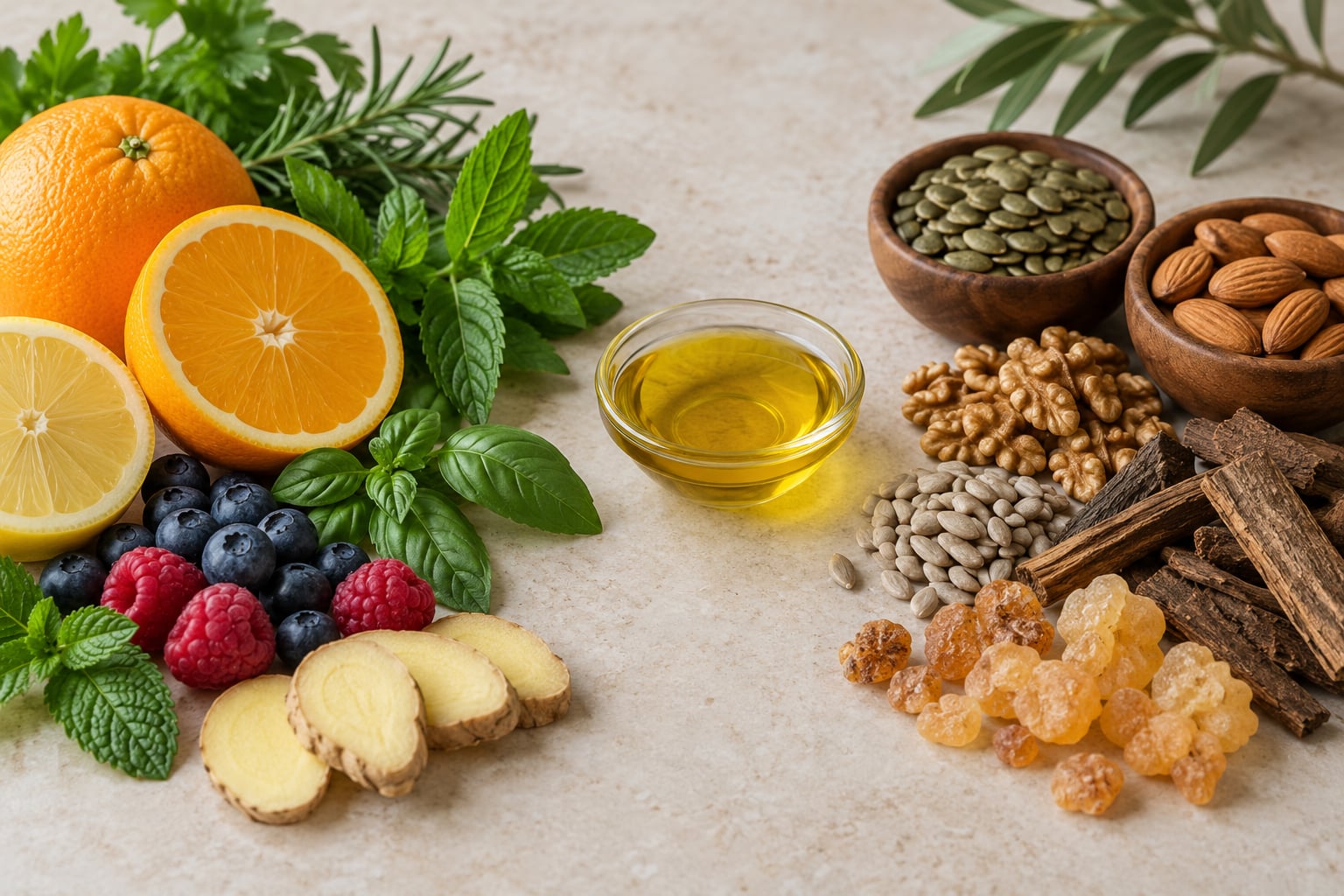
The fat soluble side includes most of the coloured, oily and aromatic material in plants:
- Carotenoids — beta-carotene, lycopene, lutein and zeaxanthin. Carrots, tomatoes, squash, citrus peel, avocado and dark leafy greens all carry them, and each brings a different molecule rather than a generic “vitamin A”.
- Tocopherols and tocotrienols — the plant form of vitamin E, concentrated in seeds, nuts and leaf oils.
- Phytosterols — beta-sitosterol and stigmasterol, the plant sterols in nuts, seeds and vegetable oils.
- Chlorophyll — the green pigment, and its derivatives such as chlorophyllin, which is more stable and more water dispersible than the parent molecule.
- Curcuminoids — the yellow-orange pigments of turmeric, famously reluctant to dissolve in water.
- Stilbenes — resveratrol in grape skin, berries and knotweed, plus its better-absorbed sugar form, glucosylresveratrol.
- Terpenes — the monoterpenes and sesquiterpenes that give essential oils their volatility and smell: linalool, limonene, pinene, thujone, eucalyptol.
- Squalene and waxes — from olive oil, shark liver historically, and plant waxes in fruit skins and leaf cuticles.
- Plant fatty acids — including the alpha-linolenic acid in flaxseed, chia and walnuts.
- Fat soluble vitamins from plants — provitamin A carotenoids, vitamin K2 in fermented and leafy plants, and vitamin D from UV-converted ergosterol in mushrooms and lichen. Vitamin D is fat soluble, not water soluble, and plant versions depend on light exposure during growth.
Notice where these sit in the plant. Carotenoids are stored in plastids in fruit, roots and leaves; oils concentrate in seeds; waxes coat fruit skins and leaves; resins ooze from bark. The chemistry of a plant part and its chemistry are the same thing. That is why preparation follows plant part so consistently across traditions.
How Does Solubility Affect Absorption and Body Use?
Water soluble compounds have the shorter route. They dissolve in the digestive fluids, cross the intestinal lining, and enter the portal vein straight to the liver. Some need transport systems rather than simple diffusion, but there is no mandatory fat step. What is not absorbed tends to reach the large intestine, get fermented by gut bacteria, or leave in urine.
Fat soluble compounds cannot cross that way. They have to be emulsified by bile salts and pancreatic lipase, captured inside micelles, and then taken up. From there they often enter the lymph as chylomicrons before reaching the blood, which routes them around first-pass liver metabolism and lets them be stored in adipose tissue and membranes. This is also why fat soluble compounds circulate bound to lipoproteins instead of floating free.
Here is the part most write-ups flatten. Forum questions on this topic keep circling the same confusion: “take with food” gets read as a rule about the whole product, when it usually refers only to the fat soluble fraction. And the belief that a compound is “wasted” without fat sends people to force large amounts of oil at every meal, while long-time users on the other side point out that an ordinary mixed diet already supplies enough. Both are partly right. A genuinely low-fat meal lowers the absorption of carotenoids and curcuminoids; a normal mixed meal usually does not require anything special.
Solubility is also not the same thing as absorption. Poor dissolution in the gut is one of several limiting factors, alongside crystal structure, molecular size, food matrix, and what the liver does to a compound once it arrives. That is worth saying plainly, because it stops people from treating a fat soluble compound as automatically “better absorbed” than a water soluble one.
How to Tell If a Plant Compound Is Water- or Fat-Soluble
You can predict solubility without a laboratory, using five clues in this order.
- Count the polar groups. More hydroxyl, amine or carboxyl groups relative to carbon count means more water soluble. Resveratrol has three hydroxyls and stilbenoid structure, and it sits awkwardly in the middle. A long isoprenoid chain like squalene has almost none, so it is firmly fat soluble.
- Look for a sugar moiety. If the molecule carries a glycoside, treat it as water soluble until proven otherwise. Rutin is far more water soluble than its aglycone quercetin.
- Check the logP, the octanol-water partition coefficient. Low logP means the compound prefers water; high logP means it prefers octanol, a stand-in for fat. As a rule of thumb, logP above about 3 signals fat solubility, and below about 1 signals water solubility. Intermediate values mark the awkward middle ground.
- Use the plant part as a heuristic. Juicy fruit, leaf and root chemistry tends toward water soluble. Seed oils, waxy fruit skins, resins and bark exudates tend toward fat soluble. It is a rough guide, but it is right far more often than not.
- Watch the colours and smells for confirmation. Water-soluble pigments wash out into cooking water (beet juice, red cabbage, purple sweet potato). Fat-soluble ones leave oily streaks on paper and stain a shirt permanently (avocado, turmeric, carrot). Volatile terpenes smell; they escape into steam.
How Do Cooking and Preparation Change Plant Compounds?
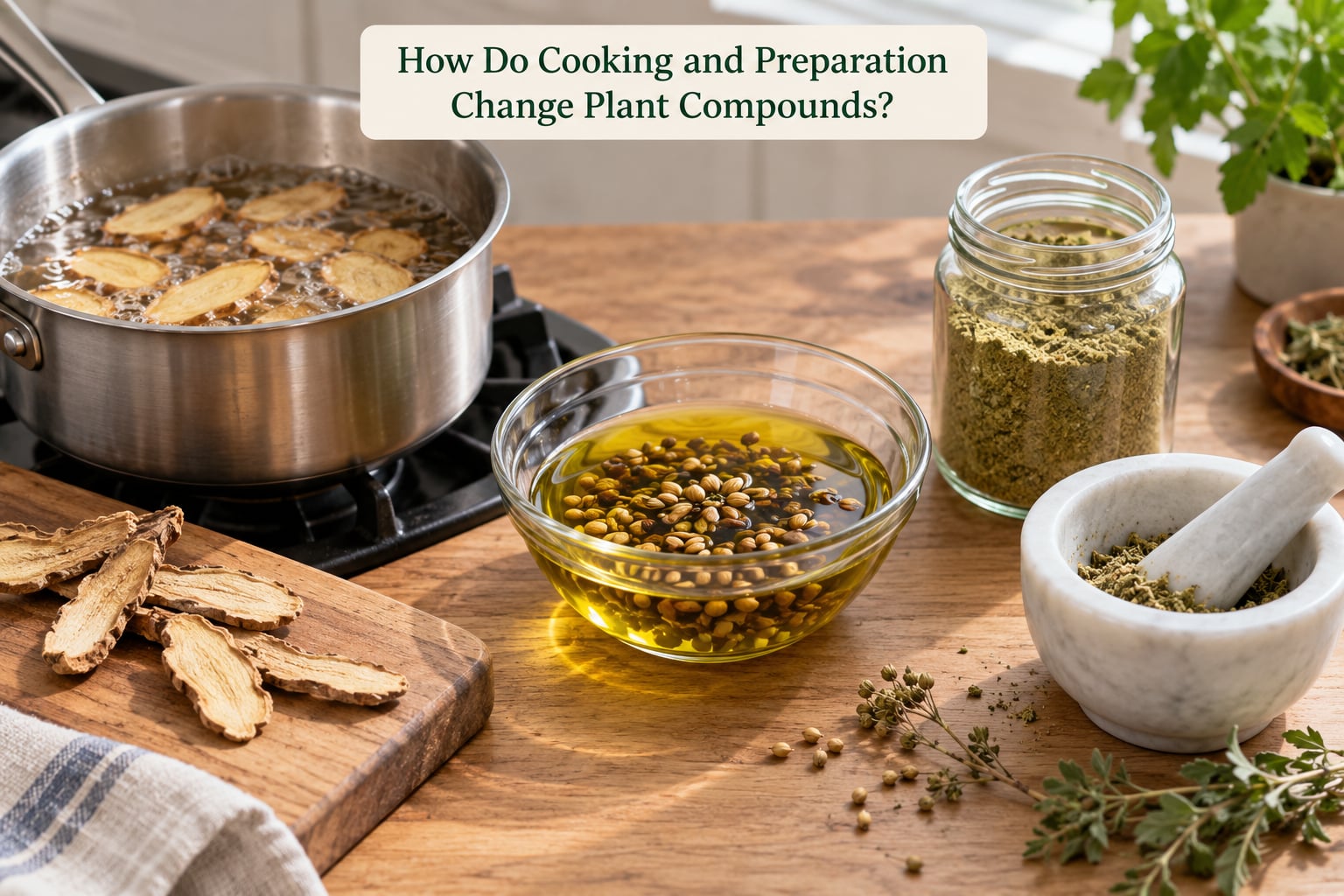
Heat breaks cell walls, which helps both classes out, but it also destroys some compounds and changes others into new ones. Boiling is the roughest treatment: water soluble vitamins and anthocyanins leach into the pot, and the liquid you throw away carries a measurable share of them with it. Steaming and stir-frying retain more of the same fraction because the water never leaves the food.
Fat soluble compounds behave differently under heat. They are more stable in a matrix that already contains fat, which is one reason cooking tomatoes in oil changes the lycopene picture: heat breaks the tissue matrix that traps the carotenoid, and fat carries it. Drying and storage shift the trade-off the other way. Water soluble fractions oxidise and degrade faster once the tissue is dried, while oils are comparatively stable if kept cool, dark and sealed.
The most instructive case is glucosinolates in Brassicaceae. Chopping or crushing brassica releases myrosinase, an enzyme stored separately from its glucosinolate substrate. Water and mild heat inactivate the enzyme. What that means is not that the compound dissolves better, it is that chopping and lightly steaming can preserve myrosinase and change the reaction pathway, while boiling removes the enzyme and changes which compounds form. Preparation altered the chemistry, not just the concentration.
Fermentation works on the same principle from another angle. Bacterial or fungal enzymes hydrolyse glycosides and convert precursors into more active or more absorbable forms, which is part of why fermented soy, fermented cabbage and fermented tea are treated as different remedies from their raw sources.
Which Types of Plant Compounds Are More Bioavailable?
Bioavailability is the fraction of an ingested compound that reaches the bloodstream intact and at the site it acts. Bioaccessibility is the looser, earlier step: how much of it is released from the food and dissolved at all. Neither is high for most plant compounds, and a table of honest figures would be more useful than a marketing claim.
Fat soluble compounds can have higher total absorption when fat is present, and they benefit from a matrix that releases them, but they oxidise, get metabolised heavily and are eliminated. Water soluble compounds get out of the gut efficiently, are rapidly metabolised, and leave quickly, so a small share of the ingested dose reaches tissues. Neither class wins by default.
The grey areas matter more than the clean rules. Curcuminoids are fat soluble and poorly absorbed even in fat; adding piperine changes the pharmacokinetics by affecting metabolism, which is a drug interaction mechanism, not a food trick. Resveratrol has a sugar form that is absorbed better than the bare aglycone, the same glycoside story as flavonoids. Quercitrin and rutin are water soluble and absorbed, while the aglycone quercetin is not. Beta-carotene from plants needs fat and enzymatic conversion in the body, and conversion is variable between individuals.
So when someone says a fat soluble compound is “better absorbed”, the useful question is: better than what, in which preparation, in which person? Usually the honest answer involves meal context and the compound’s own structure, not its solubility label.
What Are the Differences in Traditional Herbal Preparation?
Solubility is the quiet reason behind most traditional preparation rules. A decoction puts water-soluble alkaloids, glycosides and tannins out of roots and barks. An infusion steeps leaves and flowers, which are poorer in heavies but richer in delicate water soluble volatiles that heat would drive off. A tincture uses alcohol or an alcohol-water mix to reach the middle of the spectrum, pulling in compounds water alone cannot dissolve. A fat infusion carries the lipophilic fraction, which is why resinous barks and seeds go into oil and watery leaves usually do not.
This also answers the longest-running debate in the forums I read while preparing this: whether a tincture is simply stronger than tea. It is not a potency ladder, it is a different selection. A tincture and a decoction made from the same root are chemically different mixtures, because each solvent pulled a different fraction. “Soluble in the extraction liquid” and “soluble in your body” are two separate properties that people constantly merge, and merging them is what makes the comparison go wrong.
| Preparation | Solvent and heat | Best-matched constituents |
|---|---|---|
| Infusion (tea) | Hot water, no simmer | Water soluble glycosides, mucilage, delicate volatiles, ascorbate |
| Decoction | Simmered water | Water soluble alkaloid salts, tannins, hard root and bark material |
| Alcohol tincture | 40–90% ethanol, no heat | Intermediate-solubility resins, terpenes, aglycones, some alkaloids |
| Fat infusion (oil) | Warm carrier oil | Carotenoids, tocopherols, curcuminoids, lipophilic terpenes, chlorophyll derivatives |
| Steam distillation | Vapour | Volatile monoterpenes and sesquiterpenes (essential oils) |
| Dried powder | None, whole dried material | Everything present, released only after swallowing — concentration by removal of water |
| Fermented preparation | Microbial, mild acid or alkali | Hydrolysed glycosides, altered precursors, altered microbial metabolites |
A word on evidence, because traditions and clinical findings are not the same thing. The chemistry above — which solvent pulls which class — is established food and pharmacognosy science. Traditional use is documented and meaningful in its own right, but a remedy being prepared this way for centuries is not evidence of a particular clinical effect at a particular dose. When those two claims get blurred, it is usually the second one that has never been tested. Documented traditional practice and demonstrated clinical effect are two different claims, and this article keeps them apart throughout.
Water Soluble vs Fat Soluble Plant Compounds: Safety and Stability
Stability differs by class. Water soluble fractions oxidise quickly once the plant tissue is cut, dried or powdered, so light, heat and air all shorten their shelf life. Fat soluble oils are more stable in the bottle but degrade through oxidation and rancidity, and any light-sensitive pigment fades. Drying, sealing, cool storage and darkness help both, for different reasons.
Concentration changes the risk profile more than solubility does. A culinary amount of turmeric and a standardised curcumin extract are not comparable exposures, and neither is a cup of decoction and a 1:5 tincture. Extract labels matter here: check whether the label names the solvent and the extract ratio, because “standardised to 5% something” tells you very little about the rest of the plant material. Labels that say “take with food” without explaining which fraction needs the fat were one of the most repeated complaints in the forum threads I read.
Accumulation is the fat soluble risk people mis-hear. It is not automatic, and it is not a reason to avoid these compounds, but repeated high intake of fat soluble material can build up. Water soluble is not automatically harmless either; alkaloids and some phenolic compounds can irritate the gut or the kidneys at high intake, and both classes can displace or interact with medicines. Herb-drug interactions are the concern I would raise first with anyone considering a concentrated plant extract, particularly alongside anticoagulants, blood pressure medicines, diabetes medicines and any drug with a narrow therapeutic window. A pharmacist or physician can screen that in a few minutes; guessing cannot.
Seek prompt medical care for severe abdominal pain, persistent vomiting, unusual bruising or bleeding, jaundice, confusion, or any acute reaction after taking a plant preparation. If a preparation is meant to treat a medical condition, work with a qualified health professional rather than a label on a jar.
Which Should You Choose?
Choose by compound and plant part, not by solubility label.
- Root or bark, hard material — decoct in water. These tissues are built with water soluble alkaloid salts, tannins and lignans, and water at a simmer extracts them.
- Leaf, flower, soft fruit — infuse rather than simmer, and keep the water just off a boil so you do not drive off the volatiles and destroy ascorbate.
- Seeds, resinous bark, aromatic material — infuse in oil or use a tincture. Alcohol reaches a wider band than water without needing fat in the gut later.
- A plant with both classes, like mint or nettle — do both. A water extract and an alcohol or oil extract of the same plant are different remedies, and taking one does not cover the other.
- Lipophilic compounds from food, like carotenoids — eat them with some fat and eat the whole plant rather than isolating the molecule. The matrix is part of the dose.
- An extract whose class you cannot determine — look for the solvent and the extract ratio on the label, then ask a pharmacist. An unlabelled fat infusion is a guessing game.
Nobody needs a whole shelf. Most people get a better result by understanding the eight or nine plants they actually use than by collecting preparation styles for compounds they never take.
Sources and Further Reading
For general information on the fat soluble and water soluble vitamins specifically, the NIH Office of Dietary Supplements fact sheets are the most-cited starting point, alongside the National Academies dietary reference intake reports. Mechanistic and formulation detail sits in pharmacopeial monographs such as the USP–NF herbal monographs, and European Medicines Agency HMPC community herbal monographs. Current absorption and bioavailability reviews are indexed in PubMed and PubMed Central, which is also where to look for compound-specific work on anthocyanins, carotenoids, glucosinolates and curcuminoids. Conventional nutrition textbooks cover the food matrix and digestion basics more clearly than any search result will.
Frequently Asked Questions
Do you need fat to absorb plant compounds?
Only the fat soluble ones need it. Carotenoids, curcuminoids and tocopherols require dietary fat, bile salts and micelles to be absorbed, so a low-fat meal lowers how much reaches your bloodstream. Water soluble compounds travel in the gut fluid directly and do not need fat. Most people eating a normal mixed diet already supply enough fat at a main meal for good absorption; forcing extra oil at every meal is rarely necessary.
Do flavonoids dissolve in water?
Sometimes, and the difference matters. Flavonoid glycosides such as rutin and quercitrin carry an attached sugar, which makes them water soluble. The aglycones, the same flavonoid with the sugar removed, are fat soluble and dissolve poorly in water. Since gut enzymes routinely strip the sugar off, some of what you absorb is the fat soluble form arriving after a water soluble one. Solubility can also shift with the pH of the liquid.
Which antioxidants are water soluble?
The main water soluble antioxidant groups are ascorbate (vitamin C), anthocyanins, flavonol glycosides, flavanone glycosides, phenolic acids such as caffeic and chlorogenic acid, and glutathione. The fat soluble set is carotenoids, tocopherols and tocotrienols, phytosterols and chlorophyll derivatives. Calling one group better than the other is a mistake; they do different jobs in different parts of the cell.
What are the main types of phytochemicals?
The broad families are polyphenols (flavonoids, anthocyanins, phenolic acids, tannins), carotenoids, terpenoids (including essential oil components and phytosterols), glucosinolates and other organosulfur compounds, alkaloids, saponins, and phytolipids. Each family splits further by solubility: the same class can contain both water soluble glycosides and fat soluble aglycones, so classifying a compound rather than a family is the accurate approach.
Is curcumin water soluble or fat soluble?
Fat soluble, and stubbornly so. The curcuminoids in turmeric do not dissolve appreciably in plain water, which is why turmeric decoctions look pale and why preparations pair it with fat. Combining it with black pepper and an oil carrier improves dispersal and changes how much reaches circulation, though the piperine part works through drug metabolism pathways and needs care with medication.
Does cooking destroy plant compounds?
It changes them. Heat breaks cell walls, which can release more compound, but boiling also leaches water soluble vitamins and pigments into the cooking liquid that often gets discarded. Fat soluble compounds often become more available from cooked food, because heat frees them from the tissue matrix and fat carries them. Boiling also deactivates enzymes such as myrosinase, which changes which compounds form in brassicas rather than simply reducing the amount.
Conclusion
The whole topic turns on one property: whether a plant molecule is polar enough to live in water or nonpolar enough to live in fat. Everything downstream — absorption route, whether you eat it with a meal, which solvent your preparation should use, whether repeated use can build up — follows from that.
So here is the first step, and it is a small one. Name the specific compound rather than the plant, find out what is actually documented about it, then pick the preparation whose solvent matches that compound instead of the preparation you happen to like. Traditional practice deserves respect on its own terms, but it is not a substitute for evidence about effects and doses. And when a health decision is on the table, a doctor or pharmacist can tell you in a few minutes whether the extract in your hand is worth the risk of taking alongside your medication.