Mold cannot grow without available water, and a water-based herbal preparation supplies it in generous measure. Add plant tissue as food, spores that are already sitting on dried herbs or floating in the air, a warm room, and a few days of storage, and a decoction, syrup, infused vinegar or water-based cream becomes a mold bed.
So why water-based herbal products mold comes down to one thing: the water. Alcohol tinctures and properly dried oil infusions resist mold without any added preservative, while anything held at ordinary water levels does not. This guide covers what triggers the growth, how to tell mold from harmless sediment, and what to do the moment you spot something fuzzy.
Table of Contents
- 1Why Water-Based Herbal Products Mold
- 2What Conditions Allow Mold to Grow?
- 3Which Water-Based Herbal Products Are Most Vulnerable?
- 4How Can You Tell If a Herbal Product Has Molded?
- 5What Causes Mold During Preparation and Storage?
- 6How to Prevent Mold in Water-Based Herbal Products
- 7Ingredients and raw material
- 8Process and equipment
- 9Preservation
- 10Packaging and storage
- 11What Should You Do If You Find Mold?
- 12How Are Commercial Water-Based Herbal Products Evaluated?
- 13Frequently Asked Questions
- 14Does refrigeration stop mold in water-based herbal products?
- 15Is boiling homemade herbal preparations enough to prevent mold?
- 16Can a water-based herbal product look normal and still contain mold?
- 17Do alcohol-based herbal tinctures have the same mold risk?
- 18What should I do if I accidentally used a herbal product with suspected mold?
- 19Conclusion
Why Water-Based Herbal Products Mold
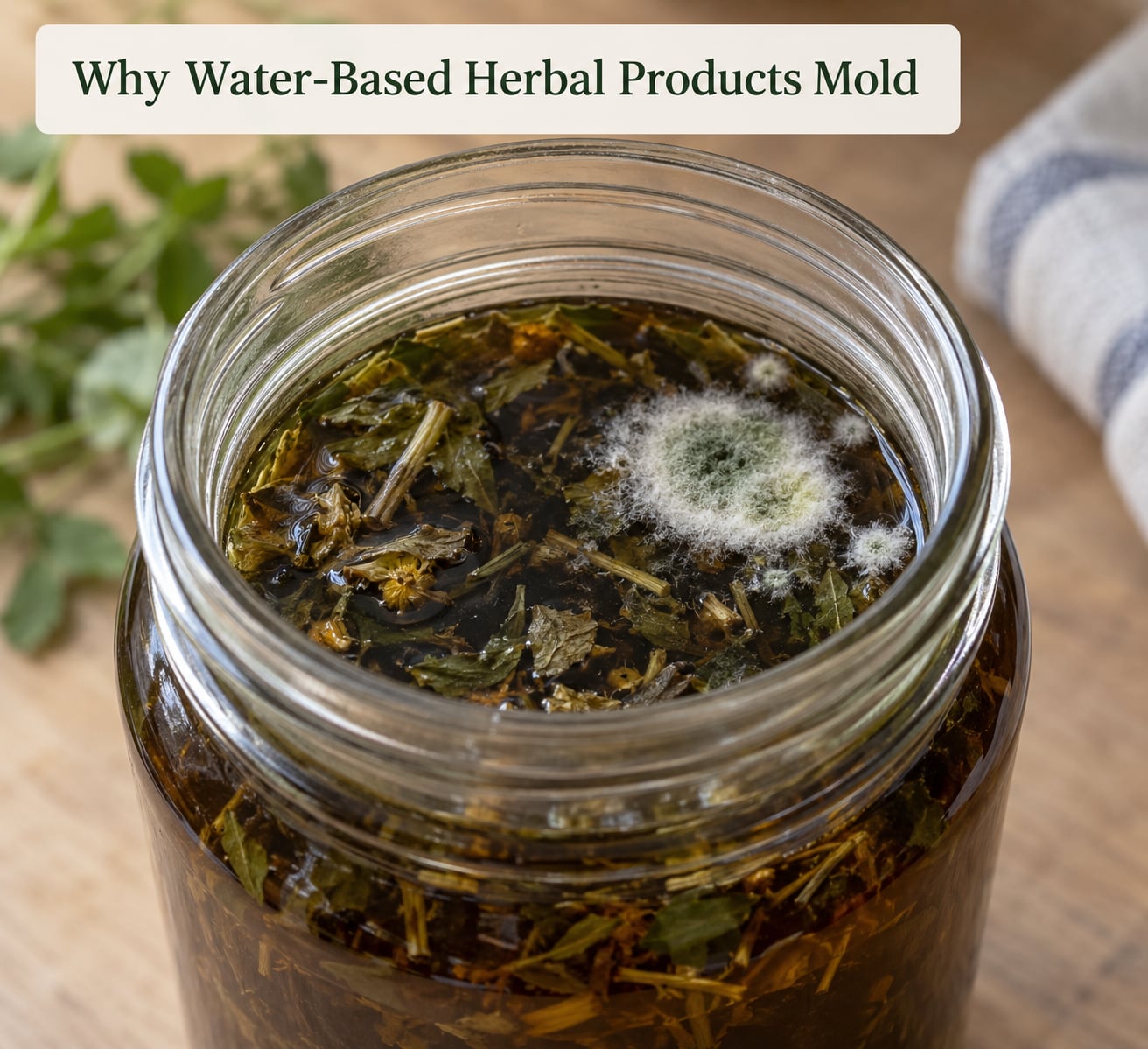
Why water-based herbal products mold is not complicated to explain. The water keeps the preparation at a moisture level fungi can use, and the botanical matter in it acts as food. Mold spores are already present on plant material and in ordinary room air, so nothing needs to be introduced later. Give it warmth and time, and growth stops being a question of whether and becomes a question of when.
Molds are fungi, not bacteria. They spread as spores, land on a wet surface, germinate when conditions suit them, and grow into the material. The mycelium you see as fuzz on the surface is only the visible part; the organism is also producing metabolites and changing the chemistry of the liquid underneath.
Botanical material makes this worse than a plain liquid would. Plant tissue is rich in sugars, amino acids and minerals, so a decoction is closer to a weak growth medium than to water. Acidic plants such as lemon balm or pine needle do pull the pH down somewhat, but plant material also buffers pH, so an infusion rarely stays low enough to be protective on its own.
What Conditions Allow Mold to Grow?
Mold needs five things at the same time. Remove any one of them and growth stops, which is why the prevention advice later in this guide always comes back to the same list.
- Available water. Fungi need free water they can draw from the material, not just total moisture bound inside it. The measurement is water activity (aw), which runs from 1.00 for pure water to 0.00 for a bone-dry solid. Most common molds cannot grow below about 0.60 aw, which is roughly why dried herbs, honey and dried powders are shelf stable while anything near 1.00 aw is not.
- Spores. There is no sterile botanical material. Fresh herbs, market bunches, and even dried herbs carry fungal spores and bacteria picked up in the field, on handling equipment, and in storage.
- Nutrients. Leaf, bark, root and seed tissue provides carbon, nitrogen and minerals. Plant material is exactly what mold feeds on.
- Suitable temperature. Room temperature sits inside the range most storage molds prefer. Warm kitchens, closed cupboards and summer heat all speed things up.
- Time. A jar left untouched on a shelf does not fail overnight, but many home preparations show visible growth within a week or two, and faster in warm conditions.
Oxygen matters as well. Most storage molds are aerobic, so sealed jars with some headspace are more exposed than completely filled containers, though low-oxygen conditions still allow some yeasts and molds to persist.
| Condition | What it looks like in a water-based preparation | Effect on mold risk |
|---|---|---|
| Available water | Water, decoction, syrup, vinegar, hydrosol, water in a cream | The enabling factor. Nothing grows below roughly 0.60 aw; almost all water-based preparations sit far above it |
| Spore load | Fresh-picked herbs, partially dried material, dusty market bunches | Higher load means shorter time to visible growth |
| Nutrients | Leaf, root, bark or seed material left in the liquid | Turns the liquid into a growth medium |
| Temperature | Kitchen counter, warm cupboard, car, direct sun | Faster germination and faster visible growth |
| Time | Batches made larger than you can use | Slowest-varying factor, and the one people forget |
| Headspace and oxygen | Half-full jar with loose lid | More air space, more surface exposed to airborne spores |
Which Water-Based Herbal Products Are Most Vulnerable?
Risk is a function of formulation, preservation, packaging and handling, not of the word natural on the label. Two products with the same herb in them can behave completely differently if one is alcohol based and the other is water based.
| Preparation | Water present | Mold risk | What keeps it stable |
|---|---|---|---|
| Fresh or dried herb tea | Yes, high | High; made for immediate drinking | Nothing. Drink it fresh |
| Decoction or cold infusion stored in the fridge | Yes, high | High | Cold slows growth; it does not stop it |
| Hydrosol or steam distillate | Yes, high | Very high; little to no preservative system | Usually a preservative, or very short storage |
| Water-based cream, lotion or gel | Yes, high | High; emulsions are well known for this problem | A broad-spectrum preservative used at its stated rate |
| Infused vinegar | Yes, with acid | Moderate to high | Acidity helps but rarely finishes the job alone |
| Syrup or oxymel with honey | Yes, with sugar | Mold moderate, botulism a separate concern | Sugar concentration, plus refrigeration for honey syrups |
| Alcohol tincture | Minimal | Low | The alcohol itself |
| Oil infusion and salve | None, if fully dried | Low if dry; high if any water came in with the plant | Complete dryness before the oil goes in |
The vinegar and syrup rows deserve a note. Acid and sugar slow some organisms down, which is why oxymels and herbal vinegars last longer than plain water, but neither is a reliable stand-alone preservative in a homemade batch.
How Can You Tell If a Herbal Product Has Molded?
Fuzzy growth, a film, or a smell that is not from the herb is a clear signal. Most confusion comes from the opposite problem: harmless cloudiness and sediment that get mistaken for growth.
| What you see | Most likely cause | What to do |
|---|---|---|
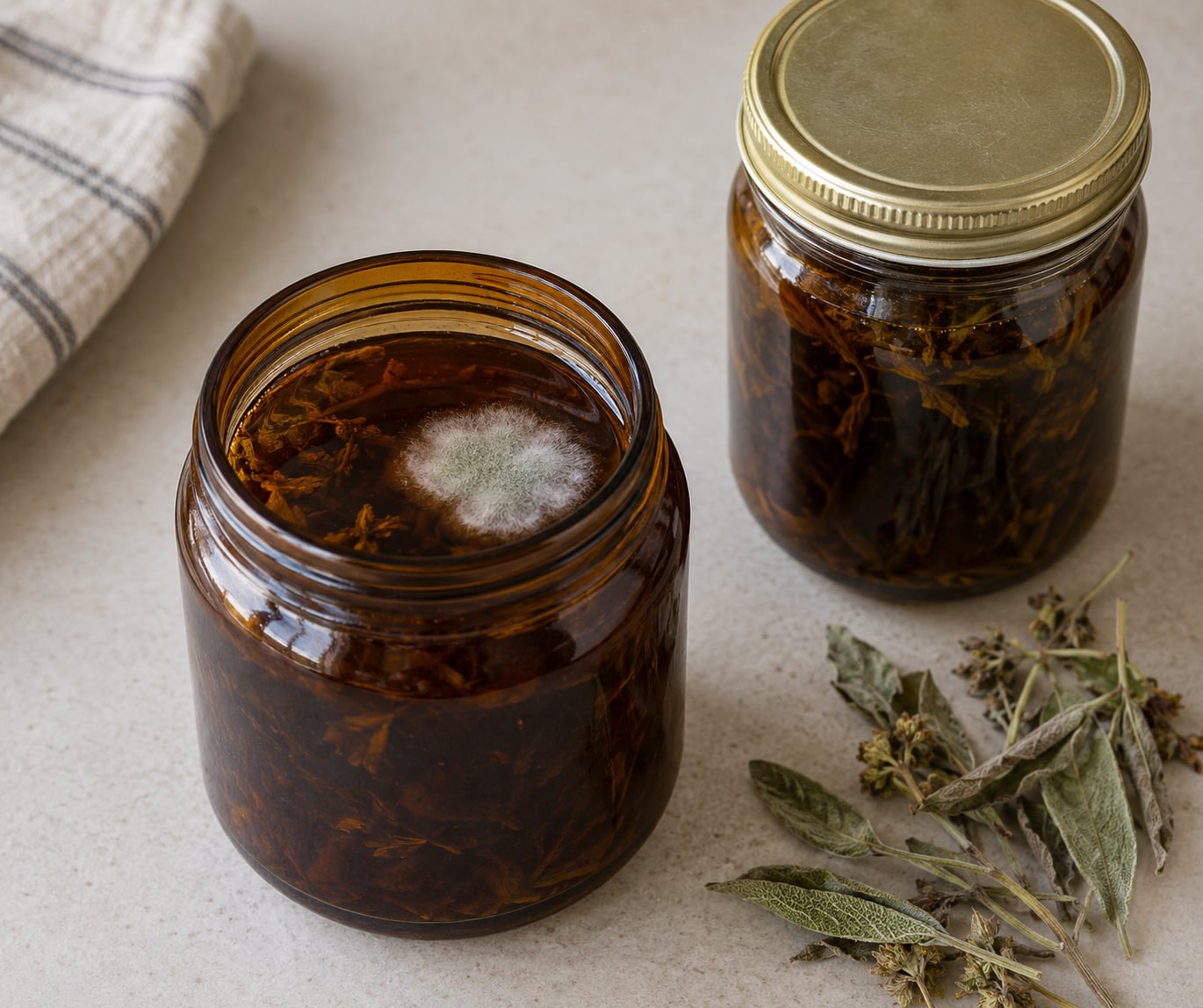
| Fuzzy strands, white or green specks sitting on the surface, or a web-like film | Actual fungal growth | Discard the whole batch. Do not skim or strain it |
| Uniform cloudiness that swirls back in when you shake the jar | Suspended fine particles | Not mold, but do not drink it if it has been sitting for weeks |
| Layer of sediment that settles flat on the bottom | Tannins and plant debris, often from tannin-rich leaves or barks | Common and usually harmless; filter it before use |
| Two clear layers, oil above water or vice versa | Emulsion breaking | A sign the formula has separated, not that mold is present |
| Sour, fermented or musty smell that was not there before | Bacterial activity, often with mold | Discard; never taste it to check |
| Swollen or leaking container, or a lid sealed by pressure | Gas production from microbes | Discard, and handle the container away from your face |
Two things a photograph cannot settle. Mycelium from a water-based preparation spreads through the liquid and into the plant material, so a clean-looking surface does not mean a clean batch. And mold metabolites are not tied to visible growth, so a jar with no fuzz at all is not proof of anything. Appearance tells you what it tells you, and that is not safety.
What Causes Mold During Preparation and Storage?
Contamination usually enters during making, then grows during storage. In DIY circles the single most self-reported cause is plant material that was not completely dry before it went into liquid or oil. Half-dried leaves hold water in the leaf, and that water shows up later as a film, condensation or a cloudy layer.
Other common entry points:
- The raw material. Herbs straight from a garden, farm stand or market shelf carry a spore load picked up in the field. Drying reduces it but does not sterilise anything.
- Water and equipment. Tap water, pots, jars and utensils that were rinsed but not cleaned properly, and cloths reused across batches.
- Air and hands. Spores arrive on every opening of the lid. Handling the jar with wet or unwashed hands adds more.
- Reused containers. A jar that held a previous infusion can harbour spores in its seams and threads.
- Storage surfaces. Cupboards, pantry shelves and fridges all collect spores, and a leak or condensation puts liquid exactly where those spores are waiting.
Then storage decides how much it grows. Warmth, poor sealing, condensation from moving a cold jar to a warm one, and repeated opening all shorten the window. A large batch made in a humid season is the classic failure. Many herbalists in r/herbalism describe the same pattern: a successful infusion turning cloudy weeks later, with the batch forgotten in the back of a cupboard.
How to Prevent Mold in Water-Based Herbal Products
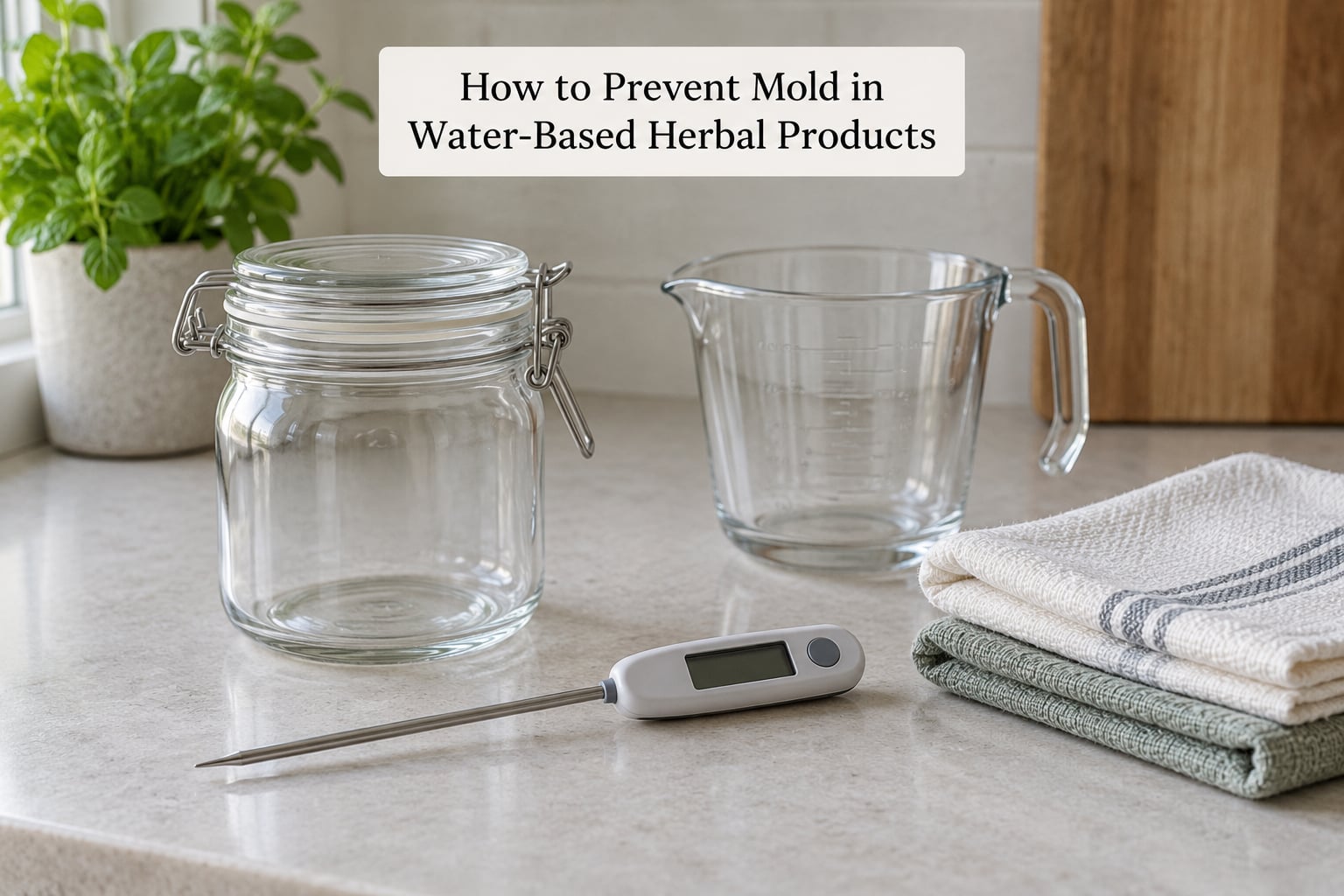
Prevention is not about one magic step. It is about removing conditions from a list, and every control below removes at least one of the five.
Ingredients and raw material
- Use plant material that is completely dry and brittle before it goes anywhere near liquid. If leaves bend instead of snapping, it is not dry.
- Source from suppliers who store material dry and ventilated, and keep it off a damp floor or a concrete surface.
- Do not mix a warm batch with a cool room. Let the liquid cool before it goes into a closed jar.
Process and equipment
- Wash hands and clean and dry all utensils and containers before the batch starts. Clean, then dry, since moisture harbours growth on surfaces.
- Fill the container as close to the top as you can. Every centimetre of headspace is air that spores can reach.
- Make only what you will use inside the shelf-life window. Small batches are the single most effective control a home maker has.
Preservation
Water-based formulas need a broad-spectrum preservative. One mild preservative aimed at bacteria does not cover molds and yeasts, and no single ingredient covers everything; that is why commercial systems are blends. Ask the manufacturer or your supplier for the stated use rate and the in-use period the rate is valid for, then follow it. Widely used cosmetic preservative blends are commonly offered around 0.5 to 1.0 percent of the total formula, and some ingredients such as sorbates or phenoxyethanol carry regulatory limits on their own concentration, so use the supplier’s figure rather than a number found online. If you are not sure which system suits a formula, ask a qualified formulator.
Refrigeration slows growth. It does not make a water-based preparation shelf stable, and it is not a substitute for a preservative or for a short intended life.
Packaging and storage
| Storage factor | Practice | Why it matters |
|---|---|---|
| Container | Clean, dark or amber glass, or opaque plastic; new or thoroughly washed | Blocks light and avoids carrying spores in old seams |
| Headspace | Fill to the top, then seal | Less air means fewer spores reaching the surface |
| Seal | Tight lid, applied while contents are cool | Limits air exchange and leaking |
| Temperature | Cool, dark cupboard or refrigerator as directed | Slows spore germination |
| Label | Ingredients, batch number, date made, and a use-within date you actually expect to honour | Without a date you cannot judge an old jar |
| Batch size | Small, and only as much as you will use | Old liquid is where growth gets found |
Boiling is worth clarifying. Heating kills organisms that are present at that moment, but spores survive the pan, land again the next time you open the jar, and find the same warm liquid waiting. The same goes for refrigeration.
What Should You Do If You Find Mold?
The rule is short: do not strain it out, do not heat it and keep using it, and do not taste it to check. Discard the batch. That answer is the one home herbalists ask for most often and the one most often answered with guesswork on forums. Growth means hyphae have run through the liquid and the plant material, and their metabolites are dispersed through the whole batch, so there is no clean layer left to save.
What to do in practice:
- Stop using it. Set it aside rather than returning it to the shelf.
- Keep other people from opening or sampling it, especially children and pets.
- Isolate the container. A leaking or swollen jar belongs outside, not in the kitchen bin, and not near your face when it goes.
- Photograph it and note the batch number, date and storage history before you discard it. If a whole batch from one purchase is affected, the manufacturer needs those details.
- Contact the manufacturer if it is a commercial product, and ask about the batch. If it is homemade, throw it away and rework the process next time.
After ingestion or skin exposure, contact a pharmacist, a clinician or your local poison-control service. Get help straight away if someone has swallowed a large amount, has used a preparation on broken skin or eyes, or develops vomiting, cramping, diarrhoea or a rash. Do not wait for symptoms to decide whether it matters.
How Are Commercial Water-Based Herbal Products Evaluated?
A manufacturer that makes water-based products has to control the same five conditions you do at home, and there are documented ways to show it. Formulation work sets the preservative system, water activity and pH. Microbial testing checks the finished batch, and for many markets the applicable pharmacopoeial limits such as USP set the counts a product is expected to meet.
Packaging matters as much as the liquid: seal integrity, headspace, light protection, and whether the container keeps out the air the formulation assumes. Batch coding and a printed expiry date let you trace a problem to a production run. Storage instructions on the label are part of the safety case, not decoration.
Natural or traditional status proves none of this. A preparation can be entirely plant-derived and still need a preservative, and a long history of use in one culture says nothing about shelf life in a sealed jar on a shelf in a different climate. What matters is whether the maker can show the testing and the controls behind the label.
If you need more than a label can tell you, a commercial herbal preparation with a suspected contamination problem can be sent for professional microbial analysis. For advice about a product you plan to use regularly, a pharmacist or clinician is the right first stop.
Frequently Asked Questions
Does refrigeration stop mold in water-based herbal products?
Refrigeration slows mold growth but does not stop it. Cold temperatures make spore germination slower, which is why a refrigerated syrup outlasts one on a counter, but the water is still there at a level fungi can use. Refrigeration works as a supplement to a preservative and to short storage times, not as a substitute for either. If a batch depends on refrigeration to stay usable, that is a short-life product and it should be labelled and dated as one.
Is boiling homemade herbal preparations enough to prevent mold?
No. Heating kills the organisms present at that moment, but fungal spores survive ordinary boiling and land again the moment the jar is opened. Since the liquid is still water-based and still full of plant nutrients, they germinate and grow exactly as before. Boiling also changes finished preparations, so many aromatic and heat-sensitive constituents are lost. Use heat during processing as part of a controlled method, and use a preservative and short storage times for the shelf-life question.
Can a water-based herbal product look normal and still contain mold?
Yes, and this is one of the most important things to understand. Mold filaments spread through the liquid and into the plant material, well beyond anything visible on the surface, and microbial metabolites are present before any growth can be seen. Clear liquid, an undented container and a normal smell are not proof that a water-based preparation is sound. Appearance can raise or lower suspicion, but it cannot certify a batch as safe to use.
Do alcohol-based herbal tinctures have the same mold risk?
Much less, and that is the practical difference people care about. A properly made tincture uses enough ethanol to hold the preparation at a water level below what molds need, so the alcohol preserves the extract without an added preservative. That protection disappears if the tincture is diluted with water or stored in a way that allows dilution. Anhydrous oil infusions work on the same principle: with the plant material completely dry, there is no free water for fungi to use.
What should I do if I accidentally used a herbal product with suspected mold?
Stop using it, and do not try to remedy the container yourself. Note the product name, batch number, date made and how much was used or swallowed or applied, and keep the container so a pharmacist, clinician or poison-control service can look at it. Get advice promptly, and get it urgently if a large amount was swallowed, if it went on broken skin or into the eyes, or if vomiting, cramping, diarrhoea or a rash appear. Nobody needs a spoiled batch, but nobody needs to guess about exposure either.
Conclusion
The first action is simple: do not use a product with suspected mold. Discard it, and do not strain it, skim it or boil it and carry on, because what you cannot see is spread through the whole batch.
After that, look at what actually drives it. A water-based preparation needs a broad-spectrum preservative at a stated use rate, completely dry plant material, clean equipment, minimal headspace, cool dark storage, and a date on the jar so you know how old it is. If you take a product regularly, a pharmacist or clinician can help you judge its formulation and storage history, and after any ingestion or skin contact your local poison-control service is the right call.