Shea butter is a genuinely useful occlusive for dry, flaking or over-exfoliated skin, but the same dense texture that seals moisture also causes most of the trouble people report. The shea butter mistakes to avoid on your face are almost always one of four things: using far too much, using it on the wrong zones, applying it over skin that is dry rather than hydrated, or pushing through burning and stinging instead of stopping. Get those right and the ingredient behaves like the rich night cream it is.
I have watched the same three complaints cycle through skincare communities for years, and they always trace back to one misunderstanding. Shea butter does not add water to your skin. It seals whatever is already there, so it works as the last step of a routine and fails badly as the only step.
Table of Contents
- 1Shea Butter Mistakes to Avoid on Your Face at a Glance
- 21. Using shea butter that has spoiled or smells rancid
- 3How to tell the batch is no longer fit for your face
- 4What to do instead of trying to rescue it
- 52. Assuming every skin type needs the same amount
- 6Dry and dehydrated skin
- 7Oily, combination and acne-prone skin
- 8Sensitive skin
- 93. Applying a thick, undiluted layer
- 10How much shea butter to use on each face zone
- 11Why sealing is not the same as hydrating
- 124. Skipping a patch test
- 13A five step patch test that uses a teaspoon of butter
- 14When to stop and wash it off
- 155. Choosing an unverified product with a long ingredient list
- 16Reading the INCI line
- 17Why natural does not mean gentle
- 186. Believing raw or unrefined is automatically better
- 19What these labels actually describe
- 20The nut allergy question nobody warns you about
- 217. Storing shea butter in heat, sunlight, or an open container
- 22Storage rules that cost nothing
- 238. Mixing it into several active skincare products at once
- 24One new product at a time
- 25Where shea butter sits in the routine order
- 269. Using it as a substitute for sunscreen or prescribed skincare
- 27What shea butter cannot do
- 2810. Ignoring where and when it is applied
- 29Zones to leave alone
- 30Timing: night versus morning
- 3111. Reusing contaminated fingers or tools
- 32Keeping water out of the jar
- 3312. Expecting one ingredient to treat acne, eczema, or another condition
- 34What a realistic timeline looks like
- 35Alternatives worth comparing
- 36Frequently Asked Questions
- 37Is shea butter bad for your face?
- 38Can shea butter cause acne or breakouts?
- 39Is raw shea butter better for facial use?
- 40How should shea butter be stored so it does not spoil?
- 41Can you use shea butter with retinol or other active skincare ingredients?
- 42How do you know when to stop using shea butter on your face?
- 43What to Do First
Shea Butter Mistakes to Avoid on Your Face at a Glance
| Mistake | Why it matters | Safer approach | Take extra care if |
|---|---|---|---|
| Using a spoiled or rancid batch | Oxidised oils can irritate and lose any useful property | Smell and inspect each new jar, discard on doubt | You bought it second-hand or in bulk |
| Same amount on every skin type | Oily faces congest where dry faces benefit | Pea-sized for the whole face, less on the T-zone | You already get breakouts along the jaw |
| Thick undiluted layers | Occlusion plus excess sebum traps congestion | Warm a pea-sized amount between fingertips first | You are applying it as an overnight mask |
| No patch test | Allergy and irritation take days to show | 24 to 48 hours on the inner forearm | You have eczema or a known nut allergy |
| Long, unverifiable ingredient lists | Added fragrance and botanicals are common irritants | Check the INCI line and the order of ingredients | The label leans on buzzwords rather than names |
| Assuming raw is better | Raw describes processing, not facial suitability | Look for cosmetic-grade sourcing and allergen info | You have a tree nut or latex sensitivity |
| Heat, sunlight or open storage | Air and warmth accelerate rancidity | Airtight jar, cool dark cupboard, clean spatula | Your bathroom gets hot and steamy |
| Changing several actives at once | You cannot tell which change caused the reaction | Introduce one product, wait two weeks | You just started retinoids or exfoliating acids |
| Using it as sunscreen or treatment | No SPF, no evidence it treats a condition | Keep sunscreen and prescribed care separate | You have a diagnosed skin condition |
| Ignoring zone and timing | Eyes and active lesions react badly | Cheeks and jaw at night, eyes untouched | You use strong actives during the day |
| Dipping wet fingers into the jar | Water introduces microbes and speeds spoilage | Decant a daily scoop into a small dish | The jar lives in a humid bathroom |
| Expecting it to treat a condition | A cosmetic moisturiser is not a therapy | Ask a clinician about ongoing symptoms | Breakouts or itching are spreading or persistent |
1. Using shea butter that has spoiled or smells rancid
The clearest sign that a jar has turned is smell. Fresh shea butter has a faint nutty, slightly smoky scent; once the oils oxidise it moves toward a stale, crayon-like or paint-like smell that most people describe as “chemical”.
Oxidation changes the texture and colour too, and those changes are easier to miss because they happen slowly.
How to tell the batch is no longer fit for your face
- A greyish or dull film on the surface where there was a clean pale or ivory colour before
- Visible separation, where water or oil has pooled at the edge of the jar
- Fuzzy green, white or black specks anywhere in the butter
- A scooped surface that has gone grainy or waxy rather than smooth and pliable
- A scent that is sharper, sweeter or more chemical than when it was new
Mould is the one you never negotiate with. Scooping the top layer off does not help, because what you cannot see is already through the whole jar.
What to do instead of trying to rescue it
Throw it out. Fragrance and melting it over a bain-marie do not undo oxidation, and you have no way to measure how far the batch has progressed. An unrefined butter kept in a warm cupboard can go off in a season; a refined one in a cool cupboard can last a year or more.
The same batch is often also the source of a “shea butter gave me a reaction” story. In one corner of r/Blackskincare, a user described raw shea butter from a beauty supply store as burning their face badly, and the reaction was later traced to an allergy rather than the age of the butter. Rancidity and allergy produce different symptoms, and both get filed under the wrong label.
2. Assuming every skin type needs the same amount
There is no single correct dose, and the reason most people over-apply is that they judge by how dry their skin feels rather than by how much the skin can absorb. Skin that feels tight after cleansing usually needs water and a humectant, not more oil on top.
Dry and dehydrated skin
Dry faces handle shea butter well. A pea-sized amount warmed between the fingertips and pressed into the cheeks and jaw is usually plenty, and dry patches such as the corners of the nose and the area beside the mouth take a second light pass.
Oily, combination and acne-prone skin
Here the mistake is easiest to make. People on r/IndianSkincareAddicts generally advise acne-prone users to skip it or keep it strictly to dry zones, mostly because the texture is heavy and heavily marketed as a miracle ingredient.
The practical version: overnight only, on cheeks and jaw, and less than you want. Skip the forehead and nose entirely unless your T-zone is genuinely flaking.
Sensitive skin
Sensitised skin tolerates the plain, single-ingredient version far better than a fragranced formulation. Start at a fraction of your normal amount, wait a full day, and only then increase.
3. Applying a thick, undiluted layer
This is the single most common error, and it is a quantity error dressed up as a technique error. A thick layer creates an occlusive film that keeps moisture in and keeps sebum in, and clogged pores follow.
It is worth being honest about the limits of the evidence here. There is no large-scale clinical trial showing that pure shea butter is comedogenic for most people, and comedogenicity ratings vary between sources. Individual response beats any index, which is why the amount guidance below matters more than the number.
How much shea butter to use on each face zone
| Zone | Amount | When |
|---|---|---|
| Whole face | Pea-sized, warmed between fingertips | Nightly, last step |
| Cheeks and jaw | Most of the pea-sized amount | Nightly |
| Flaky patches beside the nose | Half a fingertip, pressed in | Nightly, or twice daily when very dry |
| Forehead and nose | Half a pea-sized amount or none | Nightly only, if at all |
| Eye contour | None | Not an area for shea butter |
| Active, open or inflamed spots | None | Not a spot treatment |
Why sealing is not the same as hydrating
Shea butter is an occlusive, not a humectant. It reduces water escaping through the stratum corneum, which is genuinely useful, but it does not pull water into the skin the way glycerin or hyaluronic acid does.
That is why using pure shea butter as your only moisturiser is such a common mistake. You seal existing dryness instead of correcting it, and in r/SkincareAddiction the most common version of this story is someone switching from a proper lotion to a jar of butter and finding the tightness still there. Put a water-based layer underneath and the same amount of butter suddenly does twice the work.
4. Skipping a patch test
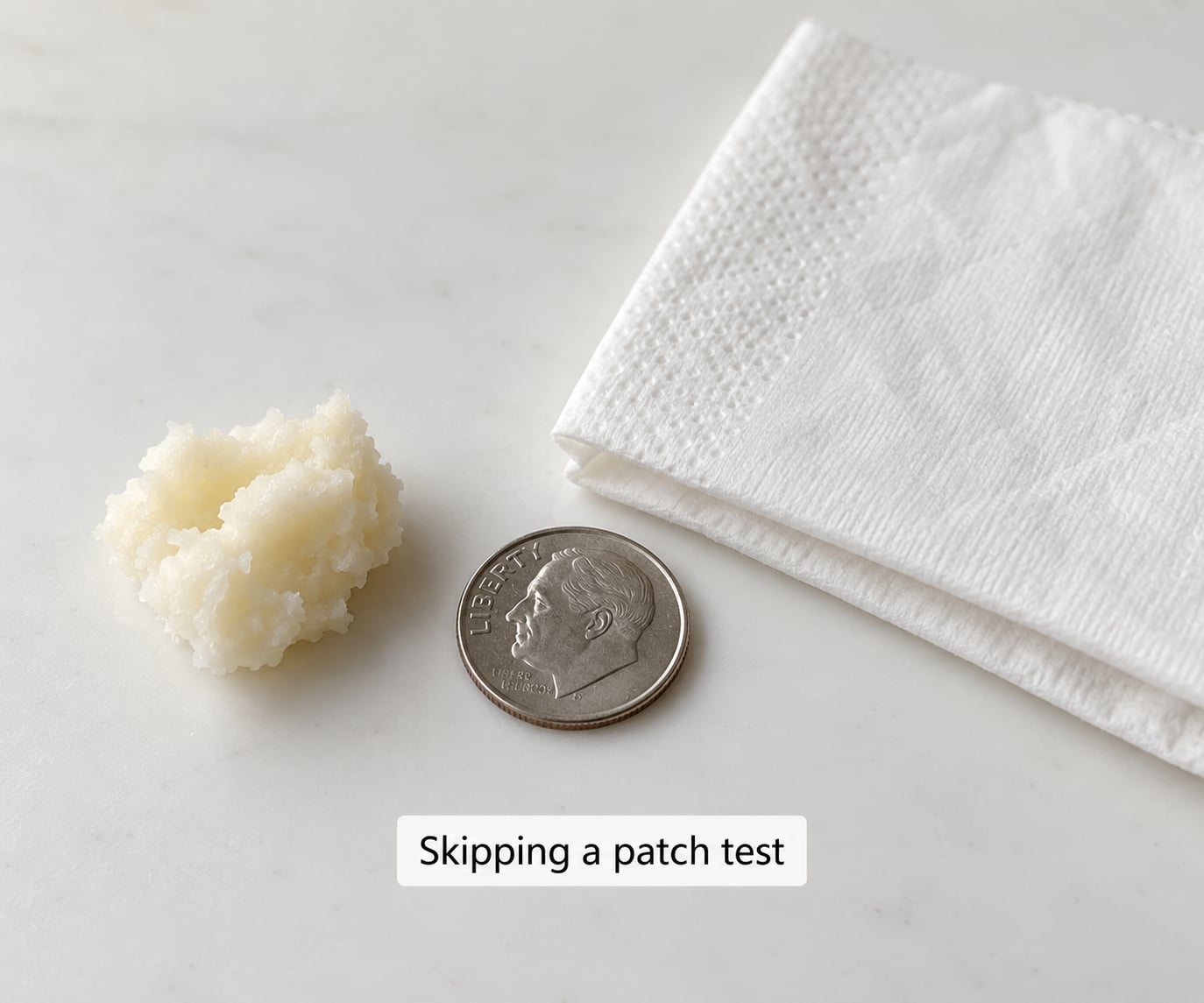
Skipping the patch test is the mistake people regret most, because the reaction shows up on the whole face and takes weeks to settle. It takes five minutes and a teaspoon of butter to avoid that.
A five step patch test that uses a teaspoon of butter
- Scoop about a quarter teaspoon onto the inside of one forearm, near the elbow.
- Leave it uncovered for 24 to 48 hours rather than washing it away.
- Watch for burning, itching, redness, swelling, hives or a rough patch.
- Wash it off with a gentle cleanser, pat dry and stop using the product.
- Only move to the face if the test area stayed calm for the full wait.
When to stop and wash it off
Stinging that fades in a few minutes is one thing, and people debate whether it means anything at all. Burning that climbs, swelling around the eyes, or itching that lasts into the next morning is a different thing entirely. Wash it off and give your skin a few days of nothing new.
5. Choosing an unverified product with a long ingredient list
Reading the label takes about twenty seconds and tells you more than any front-of-pack claim.
Reading the INCI line
On a cosmetic label, shea butter is listed as Butyrospermum Parkii Butter, using the older name for the tree that botanists now call Vitellaria paradoxa. The further down the list it sits, the smaller the amount in the jar.
A formula whose top ingredient is shea butter behaves like a rich cream. A formula where it appears fifth behaves like a moisturiser with a shea note. That difference matters more to your skin than any rating scale, because it tells you what is actually sitting on your face.
Why natural does not mean gentle
Plant-derived botanicals are perfectly capable of irritating skin, and fragrance oils appear in formulas marketed as pure and natural. People on r/NaturalBeauty and r/SkincareAddiction often point out that the horror stories involve refined or heavily fragranced products far more often than plain shea itself.
Check whether the label states a country of origin, a batch number and a use-by date. Suppliers that cannot name where their nuts came from rarely test them properly.
6. Believing raw or unrefined is automatically better
Raw, unrefined and cosmetic grade describe processing and intended use, not a guaranteed result on your face.
What these labels actually describe
Unrefined butter keeps more of the unsaponifiable fraction, the triterpenes, phytosterols and tocopherols that are often credited with the soothing and conditioning effects. Refined butter has most of that fraction removed and is lighter, less odorous and more uniform, which is why many people with reactive skin find it more comfortable.
Either way, the deciding factor on your face is how your skin behaves, not which label sounds purer.
The nut allergy question nobody warns you about
Shea comes from a tree, and tree nut allergies are not rare. The dramatic reactions described in skincare communities tend to be allergy rather than congestion, and the two look nothing alike.
| What happened | Typical timing | What it usually points to |
|---|---|---|
| Closed comedones or small bumps | Several days to weeks | Occlusion and quantity |
| Congestion in the T-zone | A week or two | Heavy layer on an oily zone |
| Immediate burning or itching | Minutes to hours | Sensitivity or intolerance |
| Redness, swelling, hives or a rash spreading beyond where you applied it | Hours, sometimes overnight | Allergic reaction, not breakout |
Shea is also linked to latex in some dermatology references, which matters if latex sensitivity runs in your family.
7. Storing shea butter in heat, sunlight, or an open container
Storage is unglamorous and it decides how long you can use a jar. Heat is the one that matters most, because a jar left on a sunny windowsill or near a radiator can go from solid to liquid and start breaking down far faster than the label suggests.
Storage rules that cost nothing
- Keep it in a cool, dark cupboard rather than a steamy bathroom
- Use a clean spatula or spoon instead of your fingers
- Decant a few days’ worth into a small dish so the main jar is not opened daily
- Close the lid properly; air is what drives oxidation
- Write the opening date on the jar with a marker
A wholesale block you bought in bulk is the one to think hardest about. Those are often unrefined and unstabilised, and they do not keep the way a formulated cosmetic does.
8. Mixing it into several active skincare products at once
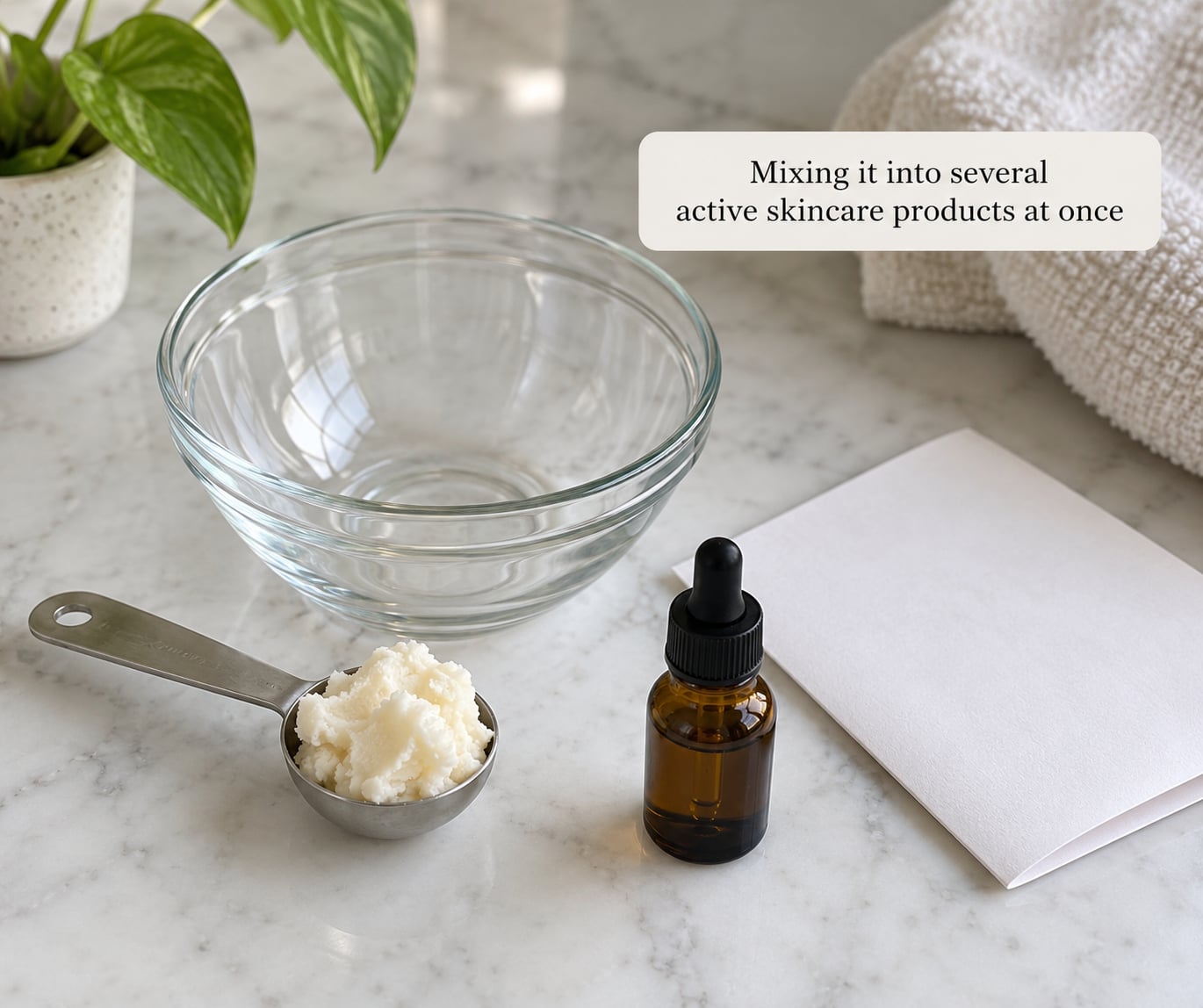
Changing four things in the same week means that if your skin reacts, you have no idea which change did it. That confusion turns a small irritation into a month of guessing.
One new product at a time
Add shea butter, then leave everything else alone for two weeks. If your skin is fine, add the next thing. This is slower and it is the only approach that gives you usable information.
Where shea butter sits in the routine order
| Product | Shea butter before or after | Note |
|---|---|---|
| Water-based cleanser | After | Skin should be slightly damp, not soaking |
| Hyaluronic acid or glycerin serum | After, as a sealer | The occlusive only works over damp skin |
| Niacinamide | Either order | Generally well tolerated together |
| Vitamin C | After | Keep the acid formula on thinner skin |
| Retinoids or AHAs and BHAs | After, at night only | Buffering with a rich layer can reduce stinging and dryness |
| Sunscreen | Shea butter always under, never over | A thick occlusive film can interfere with even film formation |
Nothing here is a hard contraindication. The real risk is layering heaviness on skin that is already being stressed by actives, and mistaking that irritation for a bad reaction to the butter.
9. Using it as a substitute for sunscreen or prescribed skincare
Shea butter offers no meaningful ultraviolet protection, whatever else it does. It belongs at the end of a nighttime routine, not in the morning slot where sunscreen goes.
What shea butter cannot do
- It is not a broad-spectrum sunscreen and should never replace one
- It does not treat acne, and applying it to active lesions is not a shortcut
- It does not fade melasma or other pigment changes
- It does not replace a prescribed retinoid, steroid or antimicrobial treatment
- There is no strong clinical evidence base for it as a treatment for eczema or any other condition
Anyone with a diagnosed condition, or with symptoms that keep returning or spreading, should talk to a dermatologist rather than experimenting with jars.
10. Ignoring where and when it is applied
The same amount of butter is a good idea on one part of your face and a bad idea two centimetres away. Thin skin around the eyes reacts faster than the cheek, and the skin over an active blemish is already inflamed.
Zones to leave alone
Keep it off the eye contour, the crease of the nose, the lip border, any broken or weeping skin, and anything freshly shaved or peeled. Lips and cuticles are fine; those are body skin and they are much more forgiving.
Timing: night versus morning
Night is the easiest slot, especially if you use retinoids or acids, because a rich occlusive reduces the dryness those ingredients cause. If you prefer to use it in the morning, keep it to a very small amount and let it settle fully before sunscreen goes on top.
11. Reusing contaminated fingers or tools
A jar of butter that you dip into with damp fingers every night is a jar with water and microbes in it. That is a straightforward route to the kind of change people then blame on the ingredient.
Keeping water out of the jar
Use a small clean spatula, or twist back a subsection of the butter with a clean scoop so you never touch the surface. Decanting a few days’ worth into a small dish is the simplest habit, and it means the main jar stays sealed for weeks instead of days.
Wash the spatula between uses, keep water off the rim, and store the jar away from the sink where splashes happen.
12. Expecting one ingredient to treat acne, eczema, or another condition
Realistic expectations are the difference between a product you keep and one you abandon after a week. Shea butter is a cosmetic moisturiser with a good reputation, and that is a modest claim on purpose.
What a realistic timeline looks like
- Minutes to an hour: a soft, less tight feeling on the surface
- One to two weeks: flaking and roughness visibly reduced
- Four to eight weeks: barrier comfort improves if you were also fixing hydration underneath
None of that requires it to be the only product on your face. If you have used a plain butter consistently for eight weeks and nothing has changed, the honest read is that it was not the missing piece.
Alternatives worth comparing
Squalane is lighter and closer to the skin’s own lipids. Jojoba oil is a wax ester rather than a butter, so it spreads further. If your barrier is the problem rather than dryness, a ceramide formula addresses the lipid matrix directly. For congested skin, a niacinamide-based lotion gives you hydration without the heavy film.
That is not a verdict against shea butter. It is just a faster route than testing jars one at a time for a year.
Frequently Asked Questions
Is shea butter bad for your face?
For most people it is not. Shea butter is an occlusive that seals moisture onto the skin, which suits dry, flaking or over-exfoliated faces. Problems come from quantity and placement rather than the ingredient itself. Use a pea-sized amount at night on cheeks and jaw, keep it away from the eye contour and active spots, and stop if you notice burning or a rash that spreads beyond where you applied it.
Can shea butter cause acne or breakouts?
It can contribute to congestion, particularly on oily and acne-prone faces. A thick layer traps sebum under an occlusive film, and closed comedones tend to appear over days or weeks rather than hours. If you are prone to breakouts, use a much smaller amount, keep it to dry zones at night, and place a water-based layer underneath so you are sealing hydration instead of dryness.
Is raw shea butter better for facial use?
Raw and unrefined describe processing rather than a guarantee. Unrefined butter retains more of the unsaponifiable fraction, including triterpenes and tocopherols, and refined butter is lighter and less odorous, which some reactive skin prefers. Because shea is tree-derived, anyone with a tree nut allergy should avoid raw butter and speak to a clinician first.
How should shea butter be stored so it does not spoil?
Keep it in a cool, dark cupboard away from sunlight, radiators and steamy bathrooms, with the lid properly closed. Use a clean spatula rather than your fingers, and decant a few days’ worth into a small dish so the main jar is not opened constantly. Mark the opening date on the jar, and discard it if you notice a greyish tint, separation, specks or a sharper chemical smell.
Can you use shea butter with retinol or other active skincare ingredients?
There is no hard contraindication, and pairing a rich occlusive with retinoids or exfoliating acids at night often reduces the dryness and stinging those ingredients cause. Apply the actives first, on drier skin, and shea butter last as a sealer. Never layer it over sunscreen, since a heavy film can interfere with an even layer in the morning.
How do you know when to stop using shea butter on your face?
Stop if you notice burning that builds rather than fading, itching that lasts into the next morning, swelling, hives, or redness spreading beyond the area you applied it. Those patterns point to sensitivity or an allergic reaction rather than congestion, and congestion takes days or weeks to appear instead. Wash the product off, leave your routine alone for a few days, and see a clinician if the reaction does not settle.
What to Do First
If you do nothing else on this list, work through it in order over the next five minutes. Check the label and the ingredient list, then smell the jar and look at the colour and texture.
Next, put a quarter teaspoon on the inside of your forearm and leave it for 24 to 48 hours. If that area stays calm, start on your face with a pea-sized amount at night, on cheeks and jaw only, over a water-based layer.
Then pay attention for a week. Burning, itching or redness that spreads means stop and wash it off. Small bumps that take a week or two to appear mean less product and drier zones. If nothing changes after eight weeks of consistent use, you have your answer, and it is time to try squalane, jojoba or a ceramide formula instead.