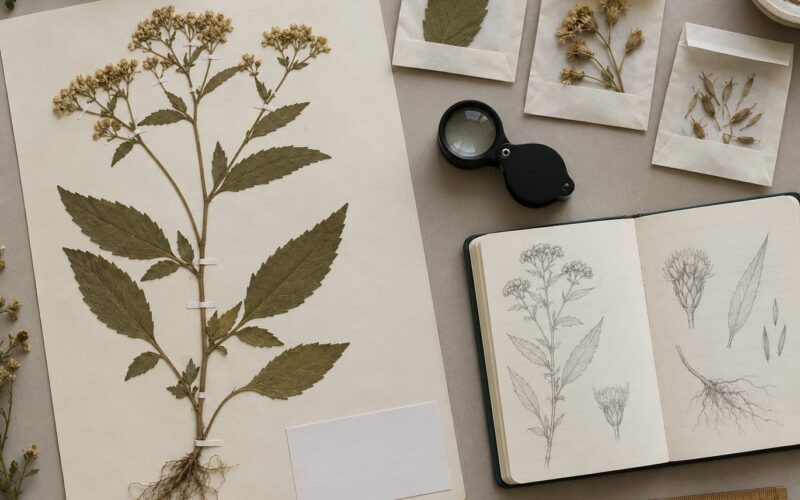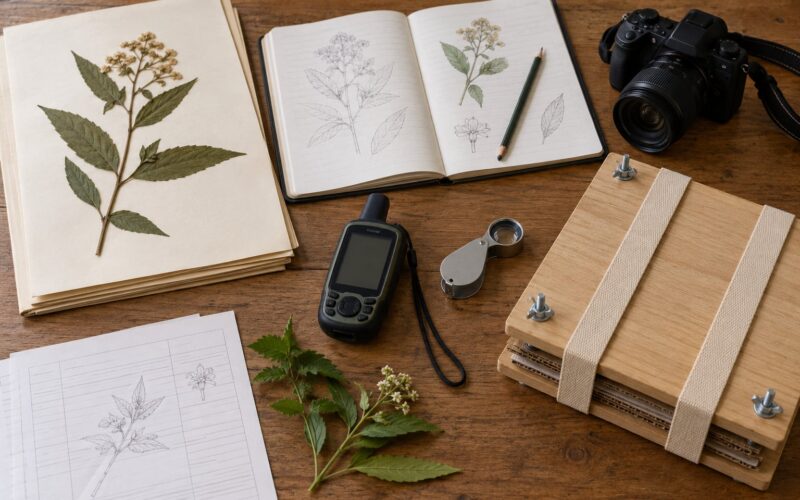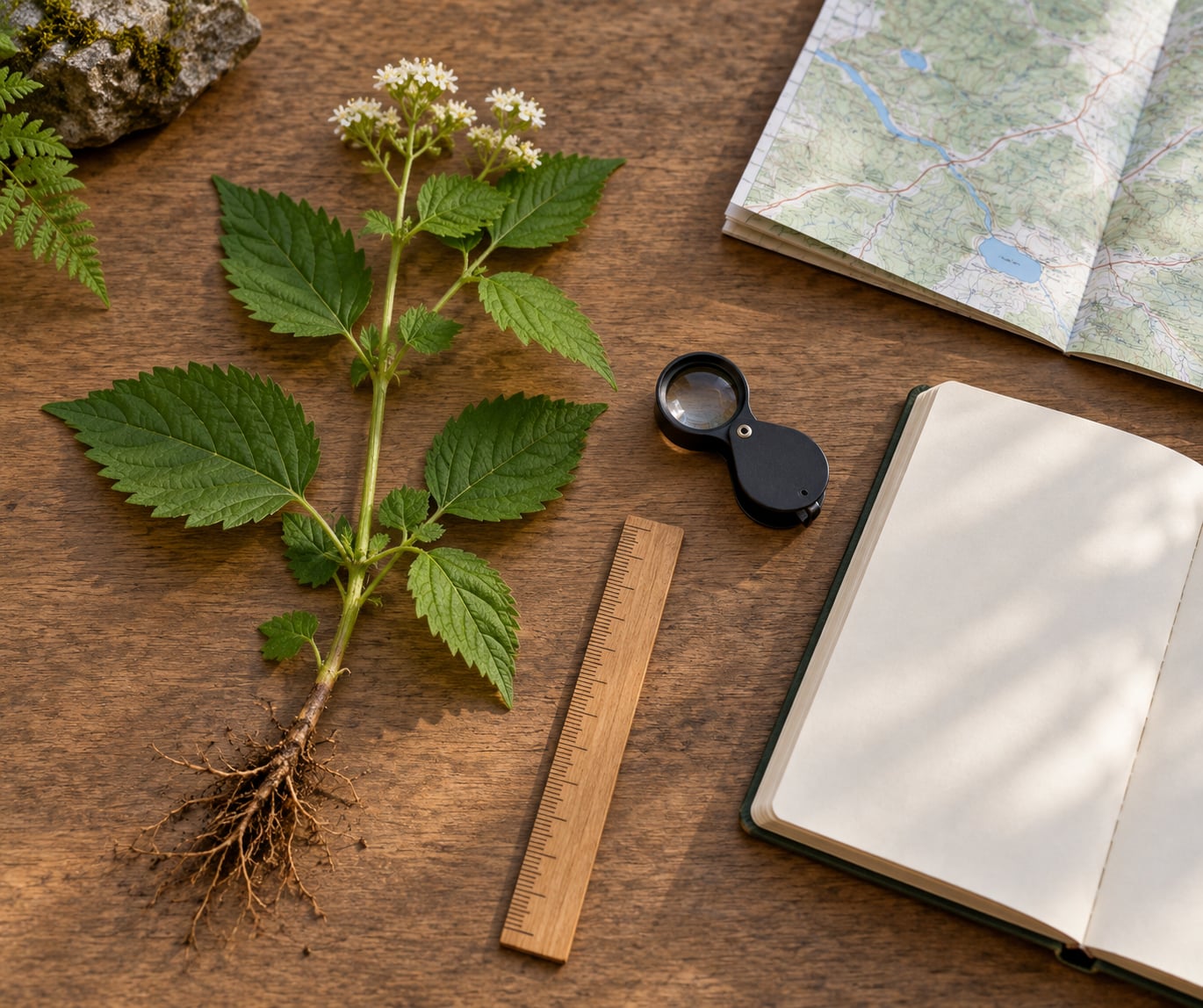
To identify a plant from a photo, work in a fixed order: fix the plant’s growth form, read its diagnostic features (leaf outline and margin, venation, leaf arrangement), add location, habitat and season, then compare a short list of candidate species against a regional flora. One image can start the process. It cannot finish it.
This guide is written for anyone standing in a garden, on a path or in a field with a phone and no name for what is growing in front of them. That includes houseplant owners who inherited an unnamed plant, new landowners surveying an unfamiliar holding, hikers recording wildflowers, and herbalists or foragers who need certainty before anything else happens.
One caution first, and it matters more than any technique in this article. No photograph can establish that a plant is safe to eat, safe to touch, or safe to use medicinally. Several species that look nearly identical carry entirely different compounds, and no image can distinguish them reliably. Every result below is a candidate list that needs a qualified human to confirm.
Table of Contents
- 1What You Need
- 2How to Identify a Plant From a Photo in 7 Steps
- 31. Begin with the clearest image available
- 42. Fix the order you use to identify a plant from a photo
- 53. Classify the plant’s basic growth form
- 64. Examine diagnostic botanical features
- 75. Add location, habitat and season
- 86. Compare a few plausible candidates
- 97. Confirm the identification and record uncertainty
- 10Common Mistakes
- 11Frequently Asked Questions
- 12Can I identify a plant using only a photo of its leaf?
- 13What is the best plant-identification app for a photo?
- 14Can a photo show whether a plant is safe to eat or use medicinally?
- 15How many photos should I take to identify an unknown plant?
- 16Why does an app give me several plant names instead of one?
- 17Can an app tell me the exact variety or cultivar of my plant?
- 18Conclusion
What You Need
Most failed identifications fail because a piece of evidence was missing before the photo was taken. Gathering these seven items first turns a guess into a repeatable process.
1. The original image, not a screenshot of a screenshot. Send the file straight from the camera roll at full resolution. Re-encoded images lose the fine detail in leaf margins and vein patterns, which are exactly the features the match depends on.
2. Location as precisely as you can give it. Country, then the nearest town or village, then coordinates if your phone records them. Add elevation if you know it. Between Nigeria and the Drakensberg, or between coastal thicket and montane forest, the same genus can look completely different.
3. Habitat notes. Is it growing in full sun or shade, in standing water, on a rock face, along a roadside, in a crack between paving slabs, or in a pot? Habitat narrows a candidate list faster than leaf shape does.
4. Close photographs of individual features. At minimum: the whole plant in its setting, one mature leaf face, the underside of that leaf, and the point where the leaf joins the stem. Add flowers, fruit, bark or buds if they exist.
5. Dates and stage. When you photographed it, and whether it was flowering, fruiting or purely vegetative. In the 2026 growing season, a plant photographed during flowering can be matched far more precisely than the same plant photographed in a dry week.
6. A field notebook. A few lines is enough: date, location, habitat, height, colour, texture, smell, and anything that surprised you. Smell in particular is diagnostic for some groups and cannot be photographed at all.
7. A route to a qualified person. Keep the contact details of a botanist, a herbarium, a university botany department, a local native plant society or a recognised practitioner in your area. Verification is not optional in this workflow, so decide now who will do it.
If you have inherited a property with an acre of unknown plants rather than one troublesome specimen, the same kit becomes a survey routine: photograph, note location and date, identify later in batches, and repeat through a flowering period. Batching beats one-at-a-time guessing, and repeated visits catch plants in different stages.
How to Identify a Plant From a Photo in 7 Steps
This is the repeatable version. Run it in order, because each step removes options from the list rather than adding guesses to it.
1. Begin with the clearest image available
Start with the image where the plant is in focus, evenly lit and filling the frame. If two images exist, use the one where the whole plant’s shape is readable, even if the close-up is technically sharper.
Why shape beats sharpness here: a blurred leaf photograph usually contains almost no usable detail, while a slightly soft but complete plant shows the growth habit, branching pattern and leaf arrangement that narrow a family before species-level detail even matters. A canopy tree shot from six metres away that reads as a single-trunked, upright-crowned tree has already eliminated a large number of candidates.
Take the additional angles before you leave the plant, not afterwards. Fill the frame, keep the background plain, put the light behind you rather than behind the leaf, and clean dust or water off the surface with a thumb or cloth. Shooting on an overcast day or in open shade gives softer, more even colour than midday sun, which blows out pale leaves.
Useful habits that cost nothing: tap the subject to lock focus and pull exposure down slightly if highlights blow out; keep steady; and capture three to four complementary views rather than eight near-identical ones. Multiple views of different features beat repeated shots of the same angle every time.
2. Fix the order you use to identify a plant from a photo
Record features in this sequence, and resist jumping straight to colour: leaves, stems, bark, roots where visible, flowers, fruit and seeds, then arrangement and overall habit. Only after that do you note colour.
Colour is the least reliable character in botany and the one most likely to mislead. The same species varies with light, soil, season, water stress and the camera’s white balance. A purple cast on a green leaf is a processing artefact, not a species trait.
Write down what you can actually see, then mark what you cannot. An unseen flower is unknown, not absent. A feature hidden behind a leaf is unknown too. This distinction matters more than it sounds, because a confident identification built on an assumed feature is exactly how look-alike species get mixed up.
A short field record keeps you honest. Six lines is enough: growth form, leaf shape and margin, venation, arrangement, flowering state, and one distinguishing memory such as a milky sap or a strong scent.
3. Classify the plant’s basic growth form
Before naming anything, decide what kind of plant you are looking at. Growth form is visible at a glance and splits the plant kingdom into manageable groups.
Trees have a single woody trunk and a crown above a clear break in the canopy. Shrubs branch from or near the base with several woody stems. Climbers and lianas twine, hook or cling to support and have no self-supporting trunk. Herbs are soft, non-woody and often seasonal. Grasses and sedges have narrow leaves with parallel venation and nodes along a hollow or solid stem, often with sheathing leaf bases.
Succulents store water in thick leaves or stems, with a waxy surface and translucent margins or windows. Aquatic plants show floating, emergent or submerged leaves, and their underwater leaves look nothing like their surface leaves.
In African landscapes this sorting pays off immediately. A plant on a miombo woodland margin that you assumed was a shrub may be a liana threading through the canopy. A rosette on a granite outcrop in the highveld is a different problem entirely from a plant in a shaded courtyard garden.
Watch the joint. Where a leaf meets the stem you can often see a swollen node, a stipule, a sheath or an unusual attachment. That junction is one of the most diagnostic spots in the whole plant, and it is the first thing most people fail to photograph.
4. Examine diagnostic botanical features
Five groups of characters carry most of the identification weight. Learn to name them and you can read a plant description properly instead of guessing from prose.
Leaf outline and margin. Overall shape (oval, lanceolate, oblong, heart-shaped, needle-like) and the edge of the leaf (entire, toothed, lobed, spiny, scalloped, fringed). Margins are where many families separate cleanly.
Venation. Reticulate (netted) in most broadleaf plants; parallel in grasses, sedges, bananas and gingers. Within netted leaves, note whether veins arc toward the margin in pairs or branch at angles. Vein relief on the underside is often clearer than on the upper surface.
Leaf arrangement (phyllotaxy). Alternate leaves sit one per node and alternate sides. Opposite leaves sit in pairs at the same node, and a plant with opposite leaves and square stems is a strong lead toward a particular family. Whorled leaves ring a node three or more at a time.
Flowers and inflorescences. Count petals, look at how many stamens are visible, note the arrangement (a single flower, a cluster, a spike, an umbel, a head) and whether flower parts come in fours or fives. Flower structure is where botanical keys actually end, so a plant in flower is the easiest case in the whole workflow.
Fruit, bark and sap. Fruit shape and how the capsule splits, if it splits, separates whole families. Bark texture, lenticels and vertical fissures help with trees. Milky or sticky latex, resin or a strong smell is a clue with real safety weight, because it often marks a group with irritant or toxic members.
Three safety rules while you work. Do not taste anything. Do not crush an unknown leaf to smell it, because several irritant plants release a fine sap or an allergen on contact. Do not handle a plant with milky sap bare-handed and then rub your eyes. Gloves and a wash afterwards are cheap.
5. Add location, habitat and season
Geography is a filter, never a proof. It can remove ninety percent of your candidates and it cannot confirm the last one on its own.
Record rainfall regime and soil (wet rainforest, miombo woodland, arid scrub, coastal thicket, riverine, highland grassland, disturbed ground or garden soil), the plants growing beside it, elevation, and whether it is in sun or shade. Field guides and national floras are organised by region for good reason: a species list for one catchment is often largely wrong two hundred kilometres away.
Worked example. A shrub with opposite leaves, glossy oval leaves and small white flowers appears on a garden boundary in a wet, high-rainfall part of southern Africa. Add “wet, highland, garden soil” and the candidate list collapses sharply, because many superficially similar species in that group are confined to drier woodland or lower elevations. Habitat has done the narrowing; it has not identified the plant, and the flowers, leaf margin and bark still have to agree.
Season is the other half. Many plants are identifiable only during flowering or fruiting, and a vegetative plant in the dry season may be genuinely unidentifiable from a photo. If a first pass fails, mark it unresolved and return in a better month rather than forcing a name.
6. Compare a few plausible candidates
Build a short list, usually three to six candidates, and use sources that carry authority in your region. Start with a national or regional flora and a reputable field guide for your area, then use a plant database and its herbarium records for the difficult comparisons. Peer-reviewed observational platforms with location-tagged records are useful because you can see what genuinely grows near where you are standing.
Now eliminate by conflict, not by resemblance. For each candidate, check whether the visible features you recorded are actually present. A candidate that needs a margin you photographed as entire, or a fruit type that has not formed yet, goes down that list. Resist keeping a favourite because it is the plant you hoped to find.
Published tests give a realistic expectation of what a photo can carry. Multi-angle research summarised by Leaf Scan reports roughly 77% accuracy from a whole-plant view, around 81% from a leaf surface and about 87-88% from a front or side view of a flower, rising to roughly 96% when several complementary views are combined. The same reporting puts top-1 accuracy near 69% against about 85% for the top five suggestions. In other words, the first answer is wrong often enough to matter, and the fifth suggestion matters too.
A peer-reviewed comparison of identification apps (Otter, 2020) found the best-performing app got 10 of 17 species correct on every image tested, and the next best 8 of 17. That is the honest scale of the technology: useful, frequently right on common plants, and wrong often enough that treating the answer as final is a mistake.
7. Confirm the identification and record uncertainty
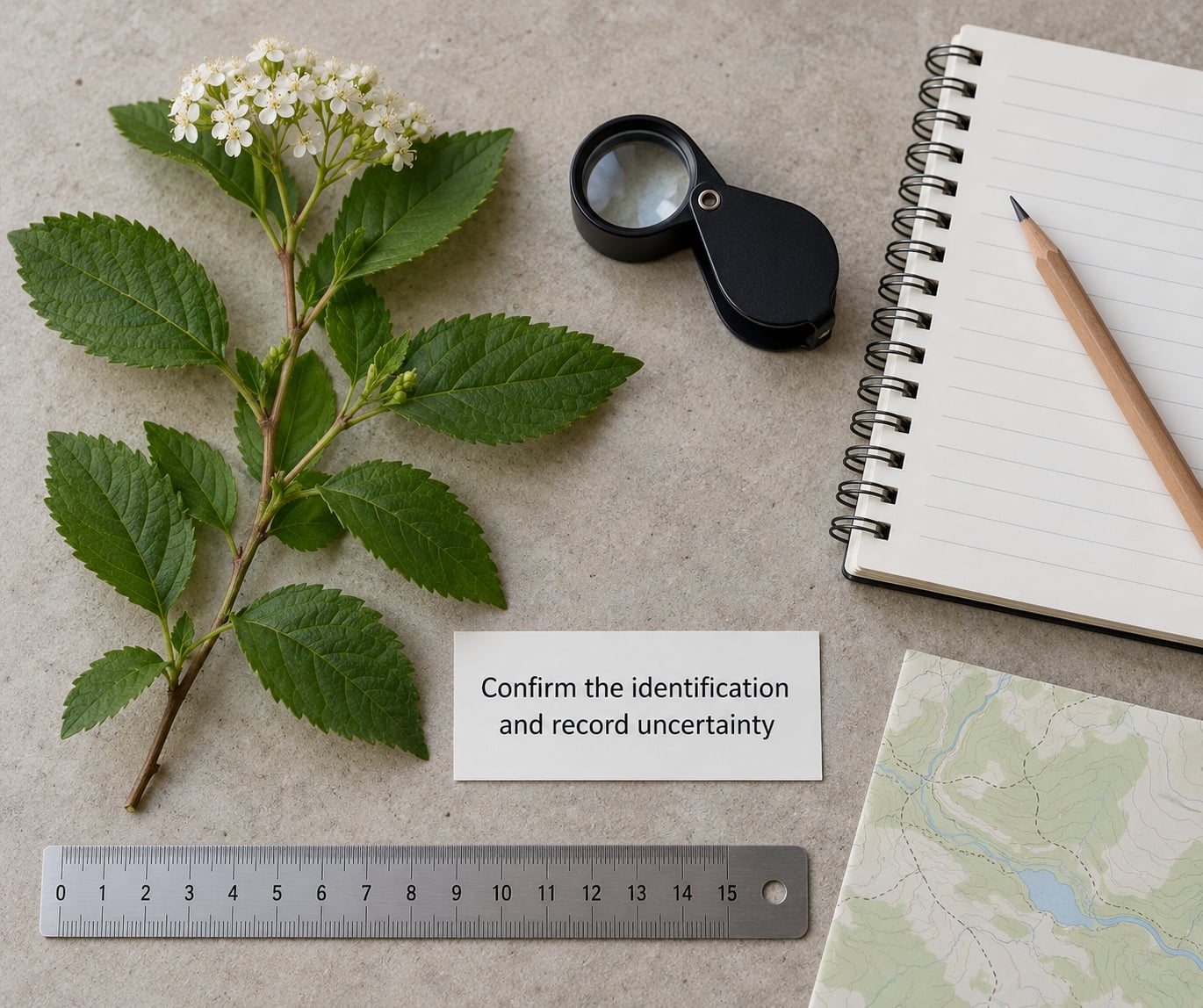
An identification is confirmed when the visible features, the habitat and the written description agree across at least two independent sources, and a qualified person with local knowledge has looked at your evidence. Where no such person is available, say so in your notes rather than promoting a guess.
Two habits make this practical. First, ask a second tool or a second community for an independent read before you compare notes, because copying the first answer’s reasoning defeats the purpose. Second, use community identification threads where several identifiers respond; consensus among people who can see your photographs and your location is worth a lot more than one confident name with a high-looking confidence score.
Record the evidence, not just the name: the sources you used, the features you checked, who confirmed it, the date, and what would change your mind. Then log the observation to a citizen-science platform if the identification is solid, which improves the record for the next person standing where you stood.
Where the plant is edible, toxic, medicinal or an irritant, confirmation is not the end of the process. Take the documented identification to a pharmacist, clinician, botanist or recognised local practitioner before any use, and ask about interactions, pregnancy, breastfeeding, children and pets. General information about traditional use belongs in a reference work, not in a guess from a photograph.
Common Mistakes
Identifying from one leaf. A single detached leaf removes the arrangement, the joint, the branching and the habit, which is most of your evidence. Fix: photograph the whole plant first, then the leaf in place.
Trusting flower colour. Many unrelated species share a colour, and colour shifts with camera processing. Fix: count petals and stamens and photograph the inflorescence as well as the colour.
Letting the location make the decision. Knowing you are in one region and seeing one expected species is how an invasive is mistaken for a native and a look-alike for the real thing. Fix: use location to remove candidates, then require the features to agree.
Trusting an unnamed online image. Images recirculate with the wrong caption, and a photograph lifted from a forum can be labelled with the very species you are trying to rule out. Fix: work only from your own photographs.
Photographing new growth. Juvenile leaves are smaller, simpler and often differently shaped, which is precisely why they get misidentified. A young aroid can read as a philodendron rather than the mature plant it will become. Fix: photograph mature, fully expanded leaves wherever the plant has them.
Leaving the background cluttered. Other plants, pots, gravel and shadows confuse both the model and the human checking it. Fix: place a plain card or your hand behind the leaf, and shoot on an overcast day or in open shade.
Expecting a cultivar name. Named varieties are propagated and sold with labels, and a photograph of foliage generally cannot resolve which one you have. Fix: accept the species or genus, and check a nursery label, a previous owner, or a horticultural record if the variety matters.
Asking about handling too late. The moment to ask is before you touch, taste, prune, burn or give the plant to a child. Fix: treat milky sap, fine hairs, spines and any unknown fruit as a reason to stop and get advice.
Two cases fall outside photo identification properly. Fungi should never be identified from a photograph for eating purposes, because the dangerous and the edible can look alike in a single image, and no image shows the spore print or substrate detail that matters. For stinging plants such as nettles, treat any unidentified plant with stinging hairs as an irritant hazard rather than a naming question.
Frequently Asked Questions
Can I identify a plant using only a photo of its leaf?
A leaf photograph gives useful clues but rarely supports a confident species identification. Leaf outline, margin, venation, texture and arrangement narrow the field, yet closely related species often differ only in features you cannot see in one image. Photograph the whole plant, the leaf in place, the underside and the leaf-to-stem joint, then add location and habitat before comparing candidates.
What is the best plant-identification app for a photo?
The best tool is one backed by plant records from the country or continent where you photographed the plant, with expert-reviewed images. Built-in options such as Google Lens and iPhone Visual Look Up work for common plants, while citizen-science platforms give you location-tagged records and community verification. Accuracy varies by region and no tool is reliable enough on its own to decide edibility, toxicity or medicinal use.
Can a photo show whether a plant is safe to eat or use medicinally?
No. A photograph cannot establish safety for ingestion, skin application or medicinal use. Visually similar species can differ in toxic compounds, dosage and preparation, and plant databases record these differences rather than hiding them. Treat any unknown plant as unsafe to consume, and take a documented identification to a pharmacist, clinician, botanist or recognised practitioner before any use.
How many photos should I take to identify an unknown plant?
Take at least three complementary images: the whole plant in its setting, a mature leaf showing its full outline, and one close detail such as the leaf underside, the stem joint, bark, flower or fruit. Research combining several views reports markedly higher accuracy than a single shot. Note location, date and stage in text too, because metadata often does more for an identification than another near-identical photo.
Why does an app give me several plant names instead of one?
Several suggestions usually means the image did not contain enough distinctive detail to separate the candidates. That happens with juvenile leaves, missing flowers, cluttered backgrounds and plants outside the model’s training range. Add a clearer image of a mature leaf or the flower, then compare each candidate against a regional flora and eliminate any whose visible features conflict with what you photographed.
Can an app tell me the exact variety or cultivar of my plant?
Rarely from a photograph. Cultivars are selected and named variants, often distinguished by colour patterns and growth habit that overlap heavily in the wild and in gardens. Most tools return the species or a close relative. When the variety matters, check a nursery label, the plant’s previous owner, or a horticultural record, and accept the species level when nothing confirms more.
Conclusion
Identifying a plant from a photo is a process of elimination, not a guess. Fix the growth form, read the diagnostic features in a fixed order, add location, habitat and season, compare a short candidate list, and confirm with a qualified person before you touch, eat or use anything.
Start with one thing: take a clear whole-plant photograph, record the location and date in text, and add close views of a mature leaf and the stem joint. Those four pieces of evidence decide more identifications than any app choice will.