To become an ethnobotanist you need three things in this order: a relevant undergraduate degree, specialist graduate training, and real field and research experience with communities. Most people spend six or more years getting there, and most of them build the degree out of a botany or biology major plus anthropology electives, because undergraduate programmes literally named ethnobotany are rare.
The shortcut people ask about online does not exist in the form they hope for. There is no licence, no registration and no single degree that confers the title. What there is, is a body of skills that herbariums, universities, conservation organisations and natural-products companies can check: can you identify a plant in the field, document it properly, interview a knowledge holder without taking their knowledge, and analyse what you collected.
Here is the short version of the route, in three parts.
- Earn a relevant undergraduate degree — botany or plant biology, general biology, ecology, environmental science, anthropology, or a named ethnobotany programme where one exists.
- Pursue specialist graduate training — an M.Sc. or Ph.D. in ethnobotany, ethnobiology, ethnopharmacology, or environmental anthropology, with a supervisor who actually works with communities.
- Build field and research experience — plant identification, herbarium technique, ethnographic interviewing, quantitative analysis, and published or presented work.
That third pillar is the one that decides most job applications, and the one that career changers consistently underestimate.
Table of Contents
- 1What You Need to Become an Ethnobotanist
- 2Academic background
- 3Practical abilities you will be tested on
- 4Research tools
- 5Ethical preparation
- 6Field conditions to prepare for
- 7Step-by-Step: How to Become an Ethnobotanist
- 8Choose an Ethnobotany Path
- 9Build the Core Academic Skills to Become an Ethnobotanist
- 10Learn Plant Identification and Field Methods
- 11Gain Experience Through Community-Based Research
- 12Develop Research and Communication Skills
- 13Create a Portfolio and Find Opportunities
- 14Common Mistakes That Derail New Ethnobotanists
- 15Treating traditional knowledge as a list of plants
- 16Collecting or photographing without permission
- 17Confusing traditional use with proven treatment
- 18Ignoring language
- 19Relying on unpaid fieldwork with no plan
- 20Skipping statistics and GIS
- 21Over-investing in a narrow degree without a fallback
- 22Frequently Asked Questions
- 23What degree do I need to become an ethnobotanist?
- 24Can I become an ethnobotanist without studying biology?
- 25Which subjects should I study for a career in ethnobotany?
- 26How do I find fieldwork experience in African medicinal-plant research?
- 27Is ethnobotany the same as traditional medicine research?
- 28What skills do ethnobotanists need besides plant identification?
- 29Conclusion: What to Do First
What You Need to Become an Ethnobotanist
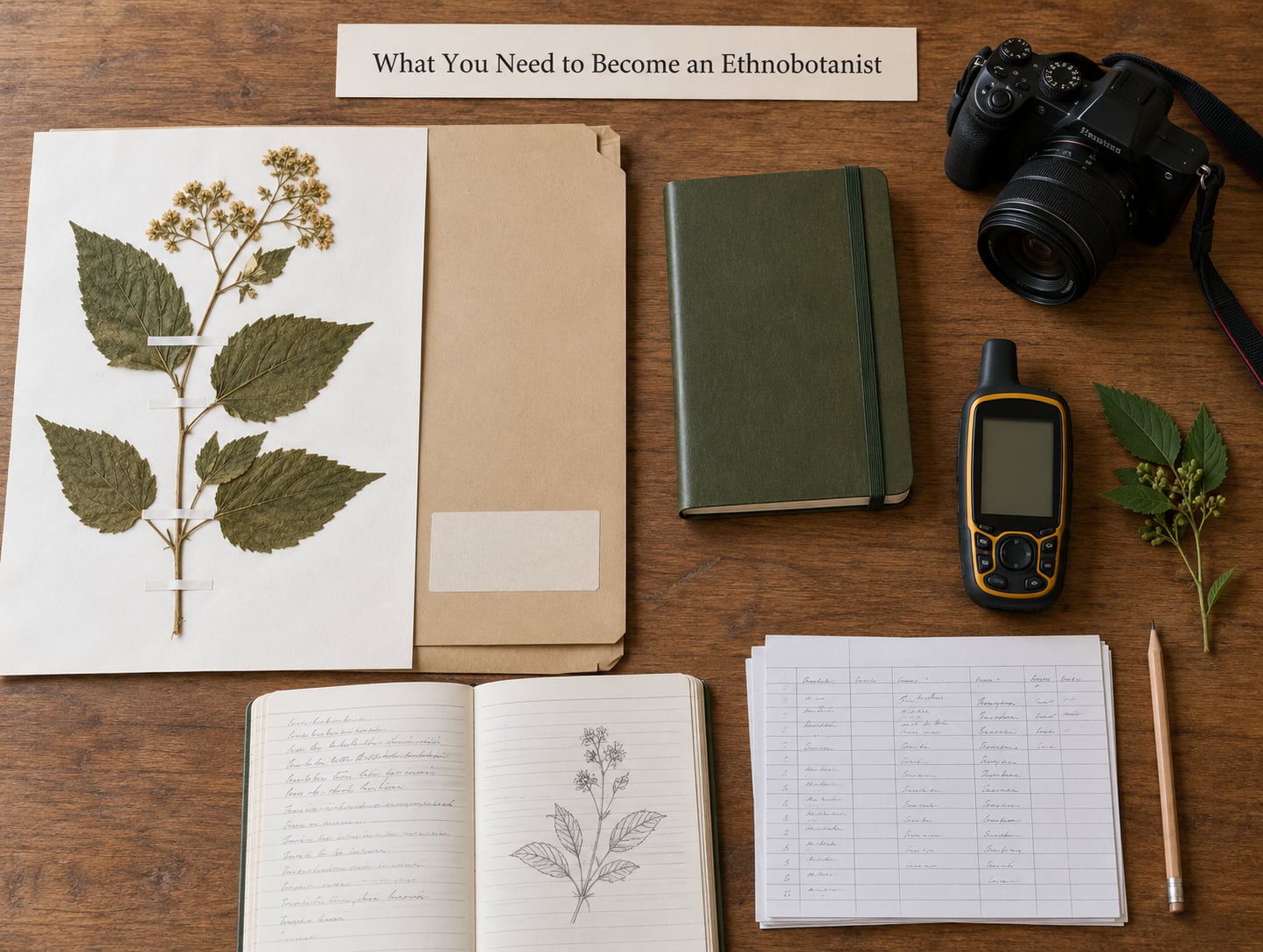
Before you apply to any programme, you need four things lined up: an academic base, a set of practical abilities, the right tools, and enough ethical preparation that a community will talk to you at all.
Academic background
Biological grounding matters most in the field: plant structure, taxonomy, ecology, genetics and chemistry. Anthropological grounding matters most in the interview: qualitative methods, research ethics, language and social context. Serious programmes expect both, and the balance you build now determines which kind of work you will be hired for later.
Practical abilities you will be tested on
- Identifying a plant to species from a key, a herbarium sheet and a habitat description
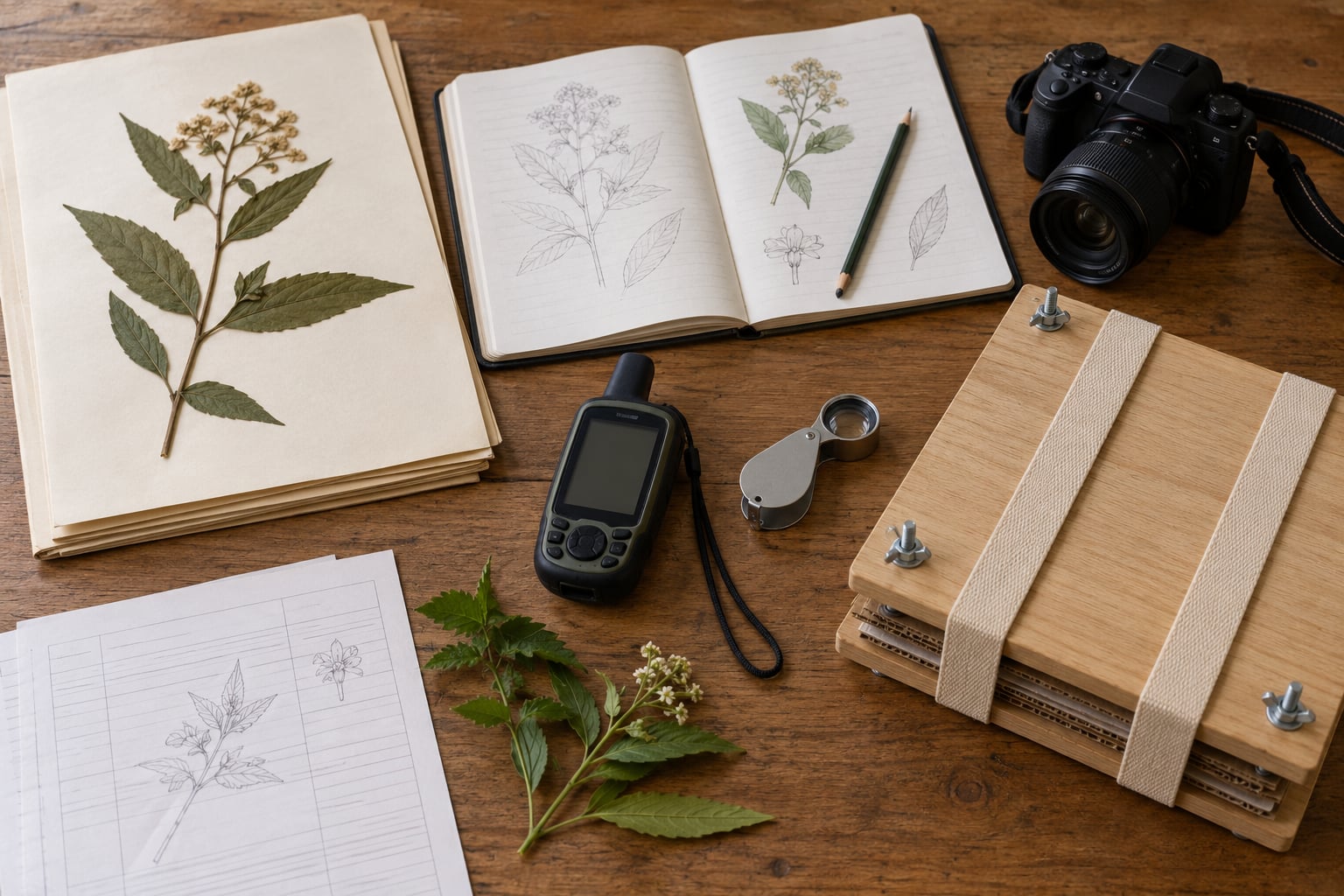
- Collecting, pressing and properly labelling voucher specimens
- Recording field notes another researcher could follow and repeat
- Running a semi-structured interview and taking notes without leading the answers
- Cleaning and analysing a dataset, then writing it up clearly
Research tools
A GPS unit or phone with offline maps, a hand lens, a camera with a scale reference, a sturdy field notebook, and species identification software. Add a decent taxonomic key for your region, a specimen database account, and statistical software you have used properly rather than installed once. GIS is worth learning, particularly for anything touching land rights, harvest pressure or habitat change.
Ethical preparation
You need to understand free prior informed consent before your first interview, not after your first disagreement. That means explaining the project in plain language, agreeing to record and destroy at the community’s wish, and being willing to hear no. The Nagoya Protocol on access and benefit-sharing, the CARE Principles for Indigenous data governance, CITES and the IUCN Red List are the frameworks practitioners actually cite. Read at least the summaries.
Field conditions to prepare for
Most ethnobotanical field seasons are physically demanding, seasonal and underpaid, and many are unpaid. Heat, long travel days on bad roads, mosquitoes, limited connectivity and unpredictable clinic access are normal in much of Africa. Learn first aid, carry a written field safety plan, and never work alone in remote habitat. Confirm collecting permits and protected-species rules before you enter a site, because collecting without them can end a project and a career in local conservation.
Step-by-Step: How to Become an Ethnobotanist
Choose an Ethnobotany Path
There is no single route, so choose the one that matches where you want to end up. The table below compares the realistic options on duration, entry requirement and what each one actually leads to.
| Route | Typical length | Entry requirement | Realistic outcome |
|---|---|---|---|
| BSc in ethnobotany (named programme) | 4 years | Secondary school certificate | Direct entry into field assistant, herbarium and conservation roles |
| BSc botany or plant biology, plus anthropology electives | 4 years | Secondary school certificate | Strongest all-round base; most common entry to a graduate programme |
| BSc environmental science or ecology | 3-4 years | Secondary school certificate | Good for conservation and sustainable harvest careers |
| BA or BSc anthropology, plus botany modules | 3-4 years | Secondary school certificate | Strong interviewing skills; needs taxonomy training elsewhere |
| M.Sc. in ethnobotany, ethnobiology or ethnopharmacology | 1-2 years | Relevant bachelor degree | Research assistant, project officer, NGO and industry roles |
| Ph.D. in ethnobotany or ethnobiology | 3-5 years | Masters usually required | Lecturer, research scientist, independent researcher |
| Short online certificate or diploma | Under 1 year | None | Supplementary knowledge; rarely sufficient for a research post |
Named undergraduate programmes do exist. Kenya’s KUCCPS framework includes a Bachelor of Science in Ethnobotany, a four-year, eight-semester course that blends biological and social science subjects and is built around conservation of biological and cultural diversity. That is a useful model: it treats the cultural side as examinable, not optional.
When you compare graduate programmes, ignore the programme name and read the supervisor list. A supervisor working with rural communities, herbaria and local universities will give you fieldwork. One working on molecular systematics will not. Ask former students what the fieldwork actually looked like and who paid for it.
Build the Core Academic Skills to Become an Ethnobotanist
Take the courses that make you employable rather than the ones that sound impressive. Students consistently ask which classes matter, and the answer is fairly consistent across the field.
- Plant taxonomy and field botany — the core skill; keys, nomenclature, family-level recognition
- Ecology and plant geography — needed to read habitat, disturbance and harvest pressure
- Ethnobiological research methods — interviewing, participant observation, focus groups, ethics review
- Statistics and quantitative methods — for use-value rankings, abundance data, and any claim of prevalence
- GIS and spatial analysis — mapping distributions, land use and collection sites
- Pharmacognosy or natural products chemistry — essential for medicinal plant work with laboratories
- Conservation biology and policy — where the jobs and funding are
- Scientific writing and a second language — often an African language plus English, which is a genuine advantage
Add anthropology if the programme lets you. Half the interviews you will ever run are qualitative, and social science training is what keeps them from becoming data collection with a clipboard.
Learn Plant Identification and Field Methods
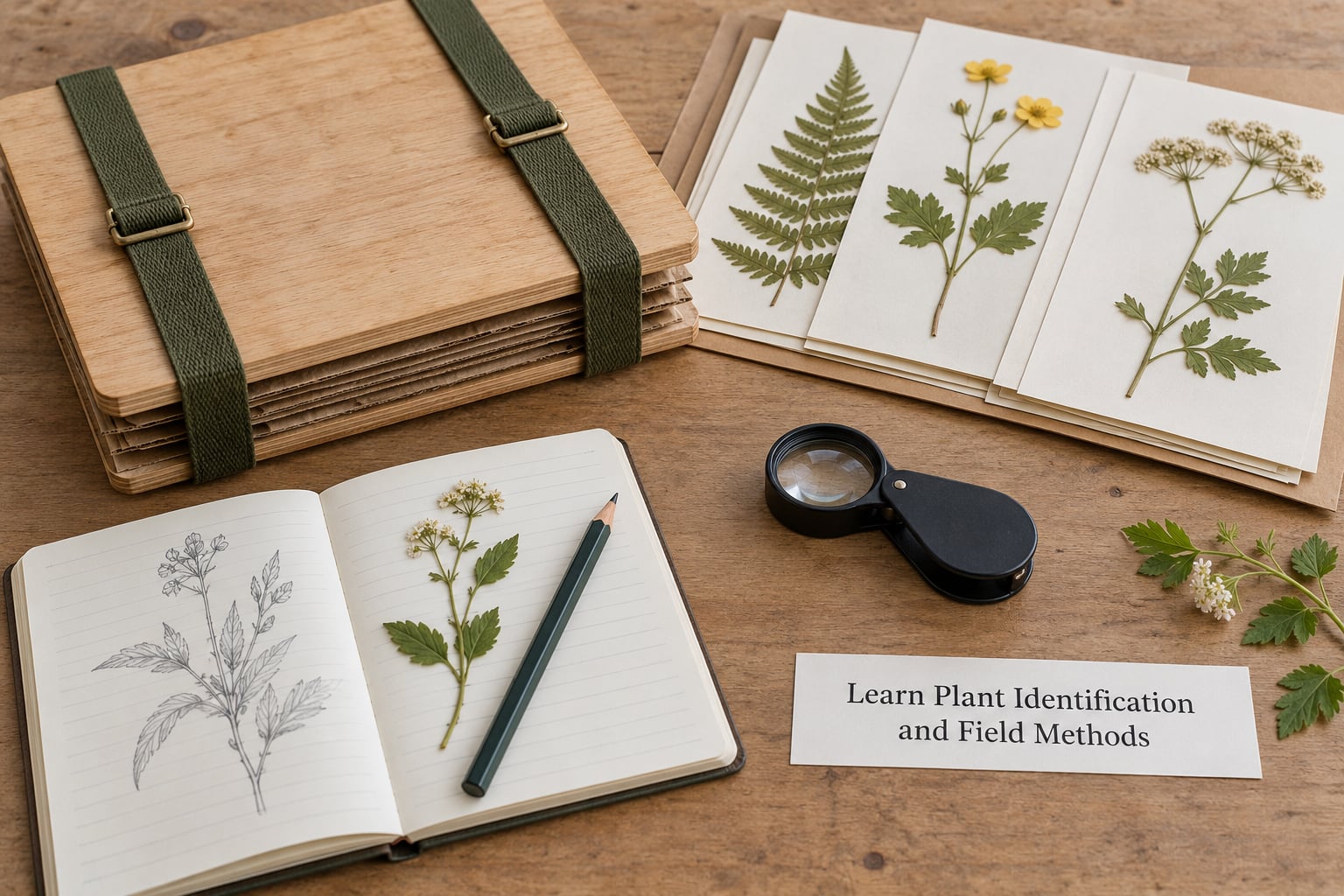
The gap between knowing a plant in a textbook and knowing it in a forest closes through repetition, not reading. The standard route is: join a herbarium, learn to mount and file sheets, then go into habitat with an experienced identifier until your errors drop.
Learn to work from voucher specimens. A plant is only useful as evidence if someone can find the same taxon again, so every collection needs a duplicate sheet, a locality with coordinates, a date, a collector name, a habitat note and a determination recorded by someone qualified. Write notes on location, habit, soil, associated species and local names in the community’s own language, with the recording spelled as it sounds and marked as uncertain where it is uncertain.
Handle poisonous and irritant species with gloves and eye protection, and treat unknown plants as toxic until proven otherwise. Check national protected species lists and the IUCN Red List before collecting, obtain the collecting permit your national system requires, and agree in advance in writing what happens to the specimens and the data afterward.
The people who get hired in this field are usually the people who can do all of this without being reminded, and the way to get there is volume: more seasons, more sheets, more reliable identifications.
Gain Experience Through Community-Based Research
This is where a career is made or stalled, and where the ethics matter most. You are asking busy people to give you knowledge that their community has held for generations, and you owe them a real say in whether and how it is used.
Before fieldwork, prepare in the local language. Your ethics consent form should be translated, read aloud and explained in person, not signed and filed. Build the interview around open questions: what is this plant called, when is it gathered, who taught you, what has changed about how it is gathered. Do not lead with “is this used for malaria” because you will get a yes you cannot use.
Decide benefit sharing before you start, not after results are published. Options include a copy of the work in the local language, equipment provided to the community, training for local researchers, herbarium material deposited locally, or a percentage of any downstream value returning to the community. Agree who owns the data, how long you may store it, and how the community can withdraw their contributions.
Work through local researchers and community organisations rather than around them. It is slower at the start and considerably faster at the end, and it is the difference between a project and an extraction.
Develop Research and Communication Skills
A good study starts with a question that a community actually wants answered. Write the question, the design, the consent process and the intended outputs in plain language before you book a field season, and put it past your supervisor and an ethics committee if your institution has one.
Keep records that make your work reproducible: consistent field forms, a data dictionary, dated and versioned files, and specimens whose determinations can be revisited. Analyse your data honestly. A use-value ranking tells you what people value, not what is medically effective, and saying so is part of your competence, not a weakness.
On writing, the discipline is to report traditional knowledge precisely without magnifying it. Record a use as a reported use, cite the community and the informant’s consent terms, and never translate a household remedy into a treatment claim. If your work touches health outcomes, hand any clinical questions to a qualified clinician or pharmacist and let them speak for what the evidence supports.
Create a Portfolio and Find Opportunities
Nobody hires on a transcript. Build evidence of what you can do, in this order of return.
- Volunteer in a herbarium or a professor’s lab. It is unglamorous and it is the fastest route into the network, because most supervisors say the same thing: they hire people they have already watched work.
- Get a fieldwork placement. Write to regional herbaria, botanical gardens, conservation organisations and university departments in the countries you want to work in. Offer a specific contribution, such as a plant name database or a translated consent process.
- Present your work. Student conferences and the Society for Ethnobotany and International Society of Ethnobiology meetings are where assistants get noticed by hiring supervisors. The ISE congress in Bhutan was the professional touchpoint one practitioner named as the moment the field opened up for her.
- Publish something small. A short note, a methods paper or a data paper counts. Practising taxonomists and field researchers publish continually, and that record is the proof of ability.
- Line up funding early. Fieldwork bursaries, national scholarship schemes and research grants are the real bottleneck for students in the Global South, and applications open well before the field season.
- Ask for references you can rely on. A supervisor who never needs to tell you anything twice, and who wants to see you succeed, is the reference that gets you hired. A r/botany hiring manager described seasonal botany hiring as roughly ten roles filled from more than a hundred applicants, and said references can make or break the hire.
If you are changing careers, the non-linear version works too. One ethnobotanist came to the field from mental-health practice at 37, taught herself taxonomy alongside an eight-month field journey across England, Wales and Scotland, then took a master’s in ethnobotany and a Ph.D. on the international orchid trade at the Naturalis Biodiversity Center. It took longer and involved a campervan. It was still a route.
Expect to start with titles that do not say ethnobotanist: field assistant, research assistant, herbarium technician, conservation officer, natural-products analyst, botanical consultant. The specialism arrives through the work.
Common Mistakes That Derail New Ethnobotanists
Treating traditional knowledge as a list of plants
Correction: knowledge is a practice with a context, a season, a language and a person attached. Practical tip: record habitat, harvest timing, preparation and who knows the use, not just the species and the ailment.
Collecting or photographing without permission
Correction: consent comes before the camera, the knife and the specimen. Practical tip: use a translated consent form, and offer a way for a participant to withdraw their contribution after publication.
Confusing traditional use with proven treatment
Correction: a long history of use is evidence of cultural value, not clinical efficacy. Practical tip: write “reported use” in every draft, and refer safety or efficacy questions to a clinician or pharmacist rather than answering them.
Ignoring language
Correction: an interpreter is a research tool, not an afterthought. Practical tip: work in the community’s language, learn the names of the plants you work with, and budget for a translator instead of relying on a community member to interpret for free.
Relying on unpaid fieldwork with no plan
Correction: unpaid seasons are normal but they cannot be the only thing on your CV. Practical tip: set a fixed number of seasons, apply for bursaries early, and treat every field season as a chance to produce a deliverable such as a dataset or a conference talk.
Skipping statistics and GIS
Correction: the shortage is people who can turn field observation into analysis others can trust. Practical tip: take one serious statistics course and one GIS course, and learn at least one programming environment, because these skills travel between sectors.
Over-investing in a narrow degree without a fallback
Correction: an ethnobotany Ph.D. opens research roles, not guaranteed ones. Practical tip: keep the skills portable, since plant identification, survey design, ethnography and data work all transfer into conservation, public health, supply chain and natural-products roles.
Frequently Asked Questions
What degree do I need to become an ethnobotanist?
Most people combine an undergraduate degree in botany, plant biology, general biology, ecology or environmental science with anthropology electives, then add an M.Sc. in ethnobotany, ethnobiology or ethnopharmacology. A few countries offer a named BSc in ethnobotany, including a four-year programme in Kenya’s KUCCPS framework. Research and lecturing roles usually need a Ph.D. No licence or registration is required to use the title, but the skills are what employers check.
Can I become an ethnobotanist without studying biology?
It is harder, not impossible. A strong anthropology or social science degree can be the base, particularly for qualitative, policy and conservation work, but you then need real training in plant identification, taxonomy and ecology, usually through herbarium volunteering, short courses or a masters programme. Career changers commonly start with a biology module or two and build the botanical side alongside their existing expertise.
Which subjects should I study for a career in ethnobotany?
Prioritise plant taxonomy and field botany, ecology, ethnobiological research methods, statistics, GIS, conservation biology, and natural products chemistry if you want medicinal plant work. Add anthropology, because most of the work is interviewing and observation, and pick up an African language if your research will be in the field. Scientific writing matters more than students expect; it is the constant output of the job.
How do I find fieldwork experience in African medicinal-plant research?
Write directly to national and regional herbaria, botanical gardens, universities and conservation organisations, and offer a specific contribution such as a plant name database, specimen preparation or a translated consent process. Student placements, research assistant posts and volunteer field seasons are the usual entry. Build a relationship with one supervisor rather than applying widely, and ask former students what the fieldwork looked like before you commit.
Is ethnobotany the same as traditional medicine research?
Not quite. Ethnobotany documents the relationship between people and plants, including how medicinal plants are named, gathered and used, but recording a use is not testing it. Traditional medicine research, often called ethnomedicine or ethnopharmacology, adds the study of preparation, safety and efficacy. Ethnobotanists document carefully and refer clinical questions to qualified clinicians and pharmacists.
What skills do ethnobotanists need besides plant identification?
You need interviewing and participant observation, written consent practice in the local language, statistics, GIS, database and specimen curation skills, report and grant writing, and the judgement to handle other people’s knowledge respectfully. Language ability often decides who gets hired for community-based projects. Budgeting, logistics and field safety are practical skills that decide whether a season succeeds.
Conclusion: What to Do First
Start by naming the specialisation you want, because it decides which subjects to take next. Then get into a herbarium or a lab this month, where you will learn identification and handling faster than any course.
Next, apply to one reputable programme with a supervisor who does community-based fieldwork, and read the Society for Ethnobotany and International Society of Ethnobiology material to see the standard the field expects.
Finally, treat consent, reciprocity and clear agreements about data ownership as part of your training rather than paperwork for later. That is what separates researchers who get trusted and invited back from those who work through a single season.